How to Get Free Treatment Through Zakat at Sindh Government Hospitals: Rs 5,000 Indoor Ceiling
Sindh zakat pays a government hospital up to Rs 5,000 for an admitted poor patient and Rs 3,000 for OPD, never cash. See how to get an istehqaq certificate.
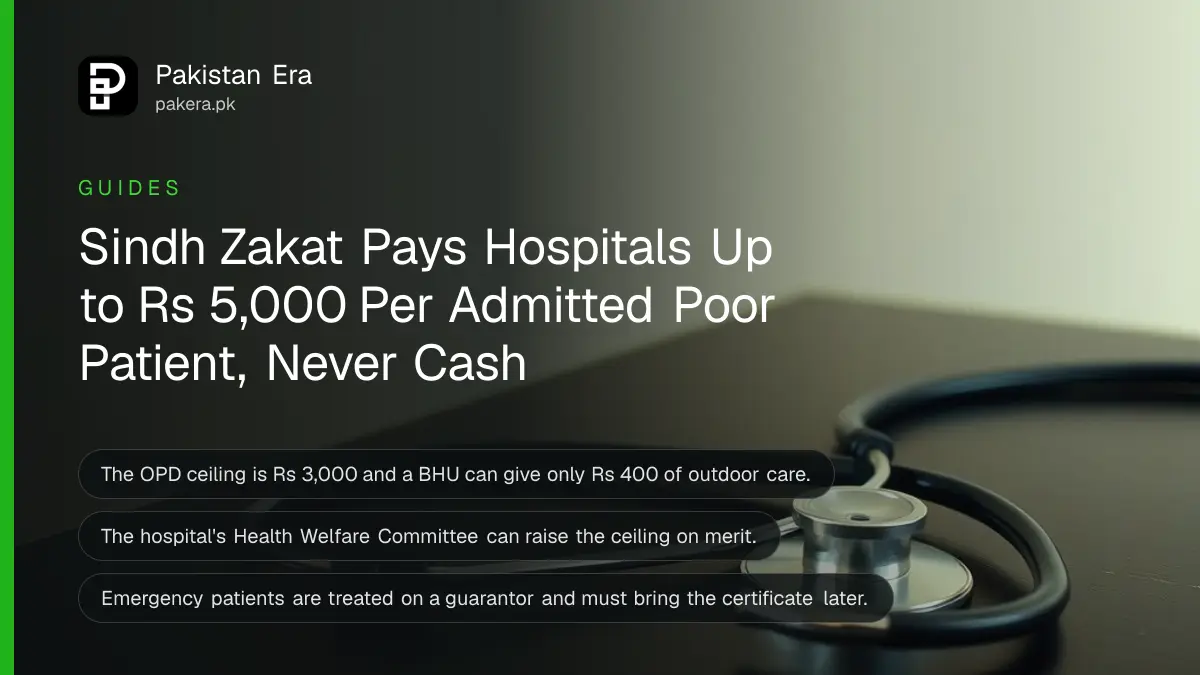
A poor patient in Sindh can get free treatment at a government hospital through zakat up to Rs 5,000 as an indoor patient and Rs 3,000 as an outdoor patient, with the hospital's Health Welfare Committee able to raise the ceiling on merit. You need an istehqaq certificate from your Local Zakat and Ushr Committee, and in an emergency the hospital can treat you first on a guarantor's signature. The money is never paid to you in cash.
Zakat health care is the oldest free treatment route in Pakistan and the least explained. We read the two health care sections of the Sindh Zakat Disbursement Procedure on the Auqaf, Religious Affairs, Zakat and Ushr Department's site on 19 October 2026. The rules below are Sindh's; Punjab and KP run their own.
The ceilings are Rs 5,000 indoor, Rs 3,000 outdoor and Rs 400 at a BHU
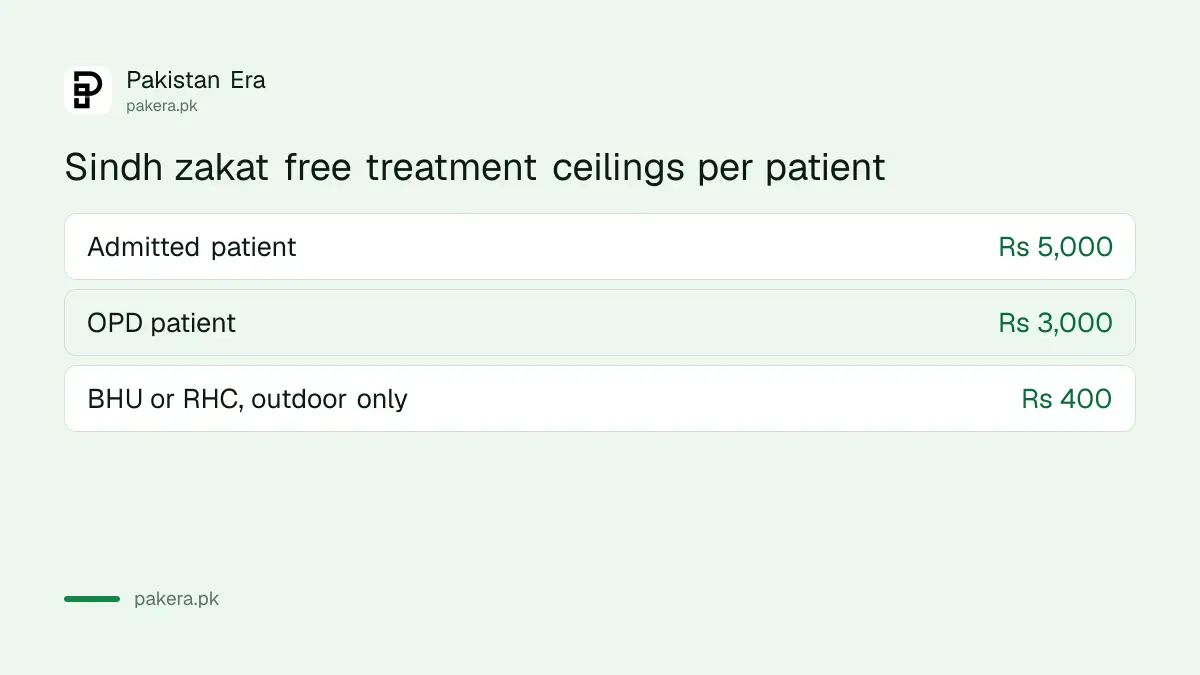
Clause 5 of the national level section and clause 6 of the provincial section set the same two ceilings for a mustahiq patient: Rs 5,000 for an indoor patient and Rs 3,000 for an outdoor patient. At a Basic Health Unit or Rural Health Centre, free treatment is outdoor only and capped at Rs 400 per patient.
| Where you are treated | Ceiling per mustahiq patient | Who can raise it |
|---|---|---|
| National level hospital, admitted | Rs 5,000 | Hospital Health Welfare Committee |
| National level hospital, OPD | Rs 3,000 | Hospital Health Welfare Committee |
| DHQ or THQ hospital, admitted | Rs 5,000 | Health Welfare Committee at DHQ or THQ level |
| DHQ or THQ hospital, OPD | Rs 3,000 | Health Welfare Committee at DHQ or THQ level |
| BHU or RHC | Rs 400, outdoor only | No relaxation stated |
The committee can relax the ceiling "up to the requisite limit, on merit". The procedure warns it to be careful, so that one expensive case does not use up the funds meant for many patients. In plain terms, a Rs 5,000 limit is the starting point, not a hard wall, but the hospital decides.
Zakat pays the hospital for medicine, tests, a bed and limbs, never cash to you
Clause 4 says zakat funds for medical treatment shall not be provided to beneficiaries in cash. You get free treatment to the extent of the zakat money the hospital holds, shared fairly among all its zakat patients. Every benefit is in kind or in service.
The committee may spend the funds only where the hospital does not already provide the item free. The list is medicines including blood, treatment including operations, laboratory tests, a bed in the general ward, artificial limbs, transport of the patient from one institution to another, and any other item the committee approves, excluding a cash grant.
There is one exclusion that matters for working families. Zakat money cannot pay for anyone, or their dependants, who is entitled to treatment at the employer's cost or under any other arrangement. A registered worker should use SESSI benefits in Sindh instead, and a family with a working Sehat card should use that first.
You need an istehqaq certificate from your home area committee
Istehqaq means entitlement. The chairman of the District Zakat Committee, the Taluka or Town committee or the Local Zakat and Ushr Committee of your permanent residence decides it on a set proforma. At a DHQ, THQ or BHU, a medical officer can also certify it.
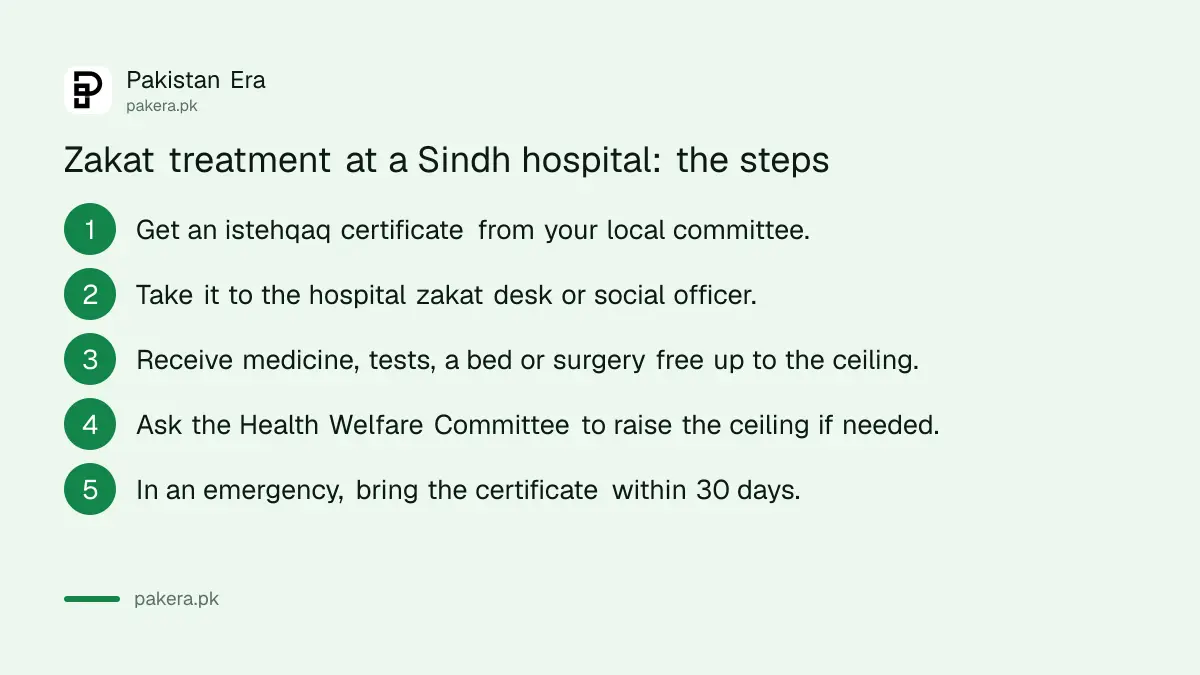
- Go to the Local Zakat and Ushr Committee for your permanent address with your CNIC.
- Ask for an istehqaq certificate for medical treatment. The committee uses the proforma in Annexure A of the procedure.
- Take the certificate to the hospital's zakat desk or medical social officer.
- The hospital treats you free up to the ceiling. Keep every slip in case the committee needs to relax the limit.
- If the cost will exceed the ceiling, ask the medical social officer to put your case before the Health Welfare Committee.
The committee sits in the hospital. At a DHQ it has the medical superintendent as convener, a senior doctor, the district zakat chairman or nominee, the district zakat officer and the medical social officer as secretary. At a BHU the medical officer, the union council nazim or administrator, the dispenser and a taluka committee nominee sit on it.
In an emergency the hospital treats first, and you have 30 days to bring the certificate
Clause 2 covers the patient who arrives with nothing. Any member of the hospital's Health Welfare Committee can decide istehqaq on the spot, on the guarantee of a relative, friend or other reliable person known to both the patient and the hospital. The hospital takes that guarantee on the proforma in Annexure B.
The patient then has to produce the istehqaq certificate afterwards. Clause 3 gives 30 days where a Sindh Zakat Council member certified the emergency. If the certificate never comes, the whole cost of the emergency treatment falls on the patient, and the person is blacklisted for any future zakat assistance. The guarantor should understand that before signing.
So the practical order is: get the emergency care, then send a family member to the local committee the same week. Leaving it to the end of the month is how people end up blacklisted.
Funds reach hospitals by bed count, which is why small units run out first
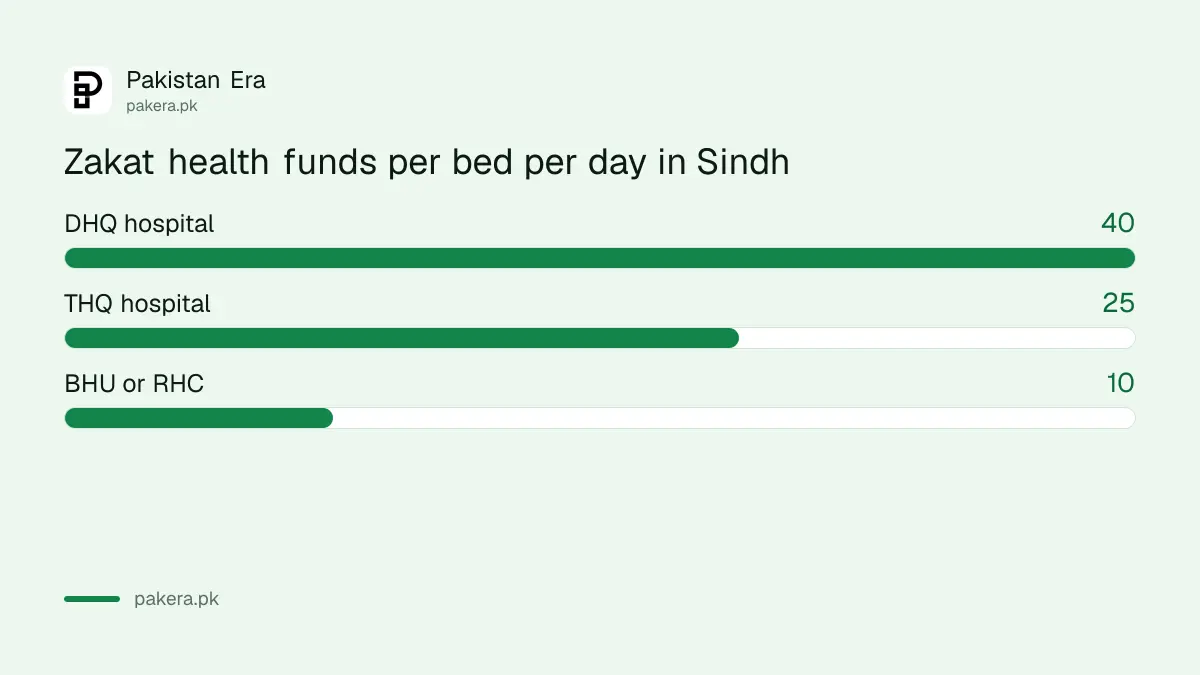
The provincial head is released to District Zakat Committees by population, and the districts pass it to hospitals by a formula: Rs 40 per bed per day at a DHQ, Rs 25 at a THQ and Rs 10 at a BHU or RHC. BHU and RHC funds come in two half-yearly instalments, and a unit that skips its monthly utilisation report loses the next one.
Charitable health institutions get funds on need, as the council decides. The procedure also tells district committees to release BHU and RHC money at once, so free care reaches the village level, but only after checking that the unit is actually functioning.
If the zakat money at your hospital is finished, the ceiling is academic. For bigger bills, the Bait-ul-Mal medical assistance route pays hospitals directly for major treatment, and free dialysis has its own programmes across the provinces.
Common questions
How much free treatment does zakat cover in Sindh?
Rs 5,000 for an admitted patient and Rs 3,000 for an outdoor patient, which the hospital's Health Welfare Committee can raise on merit. At a BHU it is Rs 400, outdoor only.
Will I get the money in my hand?
No. Zakat health funds are never paid in cash. The hospital provides medicine, tests, a bed, an operation or limbs free.
What if I arrive in an emergency without a certificate?
A Health Welfare Committee member can certify you on a guarantor's signature. You must then bring the istehqaq certificate, within 30 days where a council member certified you, or pay the full cost and lose future zakat help.
Who issues the istehqaq certificate?
The chairman of your Local Zakat and Ushr Committee, the taluka or town committee or the district committee for your permanent residence. A medical officer can also certify at DHQ, THQ and BHU level.
Can a government employee's family use zakat treatment?
No. Anyone entitled to treatment at an employer's cost, including dependants, is excluded.
Does this cover private hospitals?
The procedure names government hospitals, DHQs, THQs, BHUs and RHCs, plus charitable institutions funded by the council. It does not cover private clinics.
How we verified this
What we checked, where we read it, and what we could not confirm.
Last checked 19 October 2026. The ceilings, the cash bar, the list of items, the emergency guarantee, the 30 day rule, the blacklisting, the committee composition, the per bed per day rates, the BHU Rs 400 limit and the employer exclusion all come from the Health Care National Level and Health Care Provincial Level sections of the Sindh Zakat Disbursement Procedure PDF, approved on 16 July 2011 and amended on 17 April 2018, on the Auqaf, Religious Affairs, Zakat and Ushr Department's site, read on 19 October 2026. We did not visit a hospital zakat desk or test the process. The department's page on grants to health institutions is for 2024-25 and we could not find a later one, so current fund balances at any hospital are unverified.
About the author

Global Affairs & Political Economy Writer
Muhammad Hatim is a book lover who started writing because he enjoys it. At Pakistan Era he writes about international relations, geopolitics and the global economy, with a particular interest in South Asia and the forces behind current events.