Gram, Lentil and Canola Care in Punjab: When to Weed and Water After Sowing
Punjab crop care for gram, lentil and canola: weed at 30 to 40 days, water gram only if dry, give canola its first water at 25 to 30 days. Full schedule inside.
Weed gram and lentil in Punjab 30 to 40 days after they come up, then again later: a month after the first weeding for gram, and at 70 to 80 days for lentil, says the Punjab Agriculture Department. Canola gets a dry hoeing after it comes up and its first irrigation at 25 to 30 days. Gram and lentil need little water. Water them only if rain fails, at flowering and when pods form.
These are the care steps in the department's advice for 1 to 15 and 16 to 30 November 2026, once the rabi pulses and oilseeds are in the ground. Here is each crop, with the timings as given.
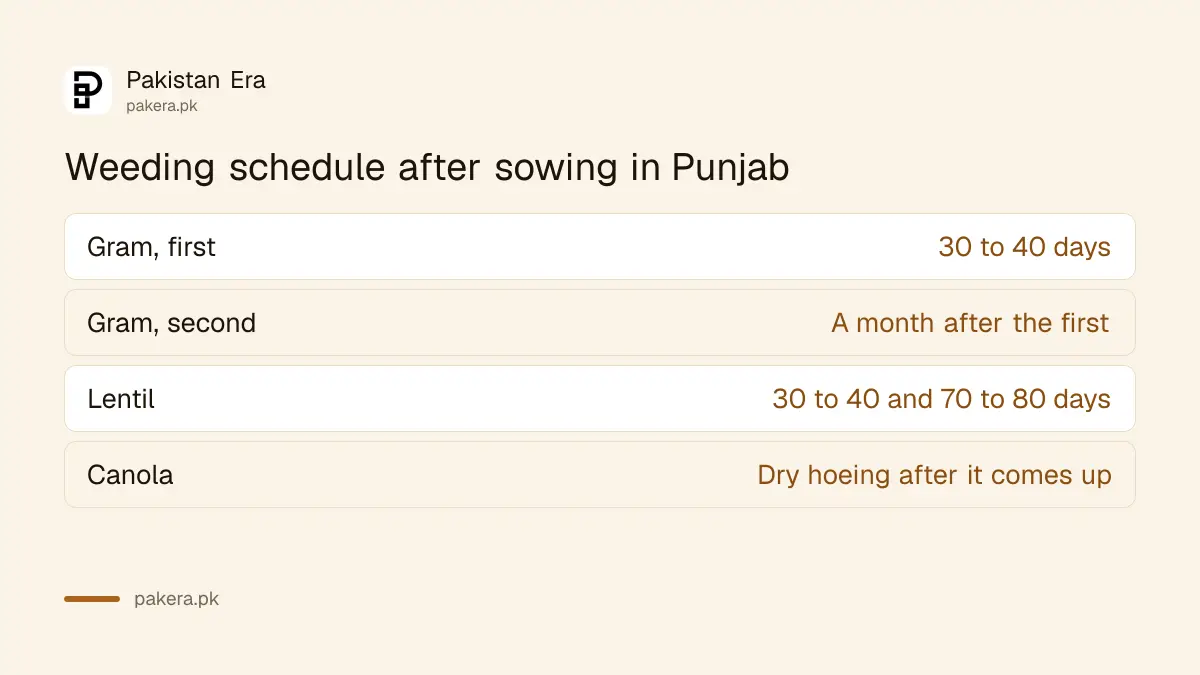
Gram: weed at 30 to 40 days and again a month later
The department advises the first weeding of gram 30 to 40 days after the crop comes up, and the second a month after the first. In sandy areas a rotary hoe does it easily. On barani land use a rotary weeder or hand weeding; on irrigated land, a recommended weedicide can be used.
- First weeding: 30 to 40 days after germination.
- Second weeding: about a month after the first.
- Sandy (thal) areas: rotary hoeing is the easiest method.
- Barani land: weeding machine or a hand rotary weeder.
- Irrigated land: a weedicide recommended by the department.
Keep checking the crop for pod borer and cutworm. If either attacks, the department says to use a recommended insecticide. Ask the local Agriculture Extension office which product and dose, and buy it only from a licensed dealer.
Gram needs little water, and none after rice
Gram needs less water than wheat. On irrigated land, if there is no rain and the crop looks dry, the department says to water it, especially at flowering. Early sown gram gets its first water 60 to 70 days after sowing and its second at flowering.
Gram sown after rice does not need irrigation, the department says. So do not water gram on a fixed schedule like wheat.
| Crop | Weeding | Water |
|---|---|---|
| Gram | 30 to 40 days, then a month later | Only if dry; at 60 to 70 days and at flowering for early sowing; none after rice |
| Lentil | 30 to 40 days and 70 to 80 days | Only if rain is short; before flowering and at pod formation |
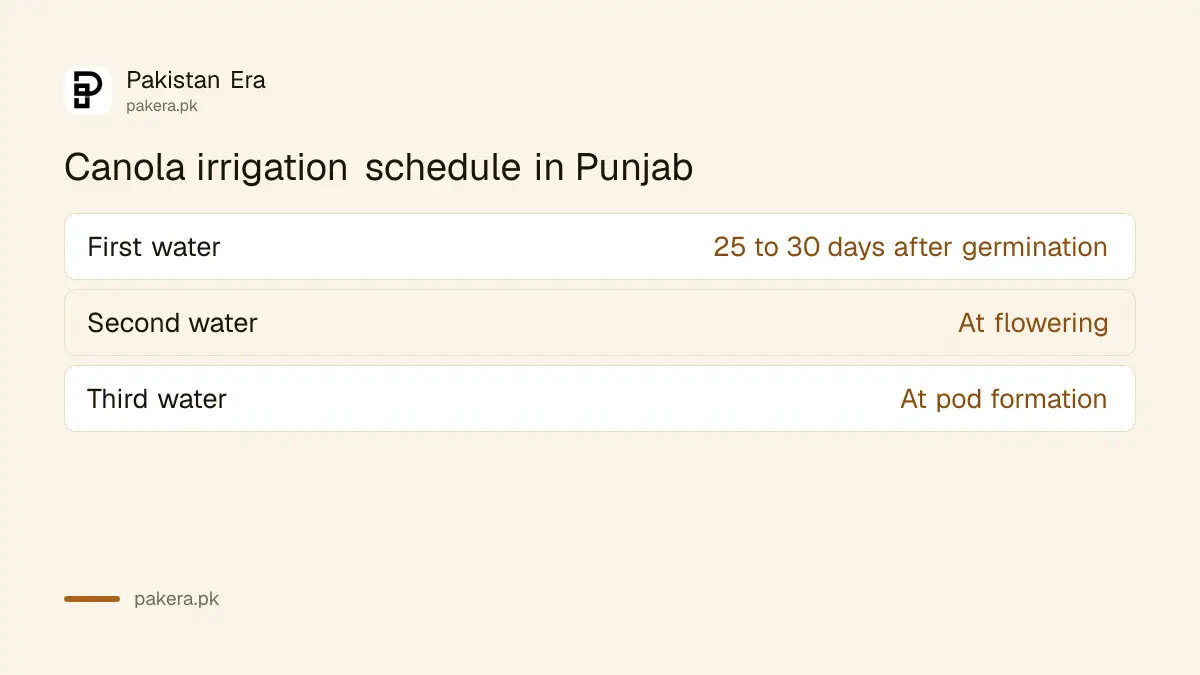
| Canola | Dry hoeing after it comes up | 25 to 30 days, then at flowering and at pod formation |
Lentil: weed at 30 to 40 and 70 to 80 days
For lentil (masoor), the department advises weeding by hoeing 30 to 40 days and 70 to 80 days after the crop comes up. On barani land it prefers a rotary machine to weedicide. On irrigated land, a recommended weedicide can be used.
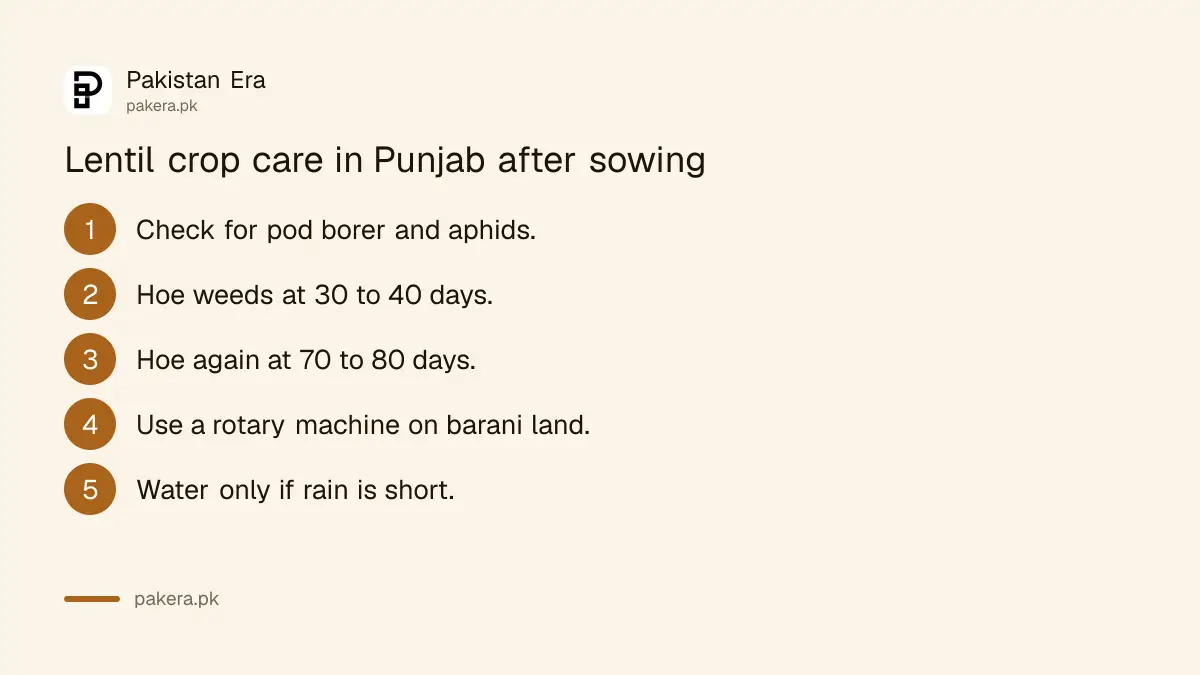
- Inspect the crop for pod borer and aphids; spray a recommended insecticide only if they attack.
- Hoe out weeds 30 to 40 days after germination.
- Hoe again 70 to 80 days after germination.
- On barani land, use a rotary machine rather than weedicide.
- Water only if rain is short: before flowering and when pods start to form.
Lentil can also be grown with September sugarcane. The department says 5 to 6 kg of lentil seed an acre in a sugarcane field can give 10 to 12 maunds an acre of lentil, and the department says it also helps the cane yield. For seed rates and varieties for a normal crop, see lentil sowing in Punjab.
Canola: hoe dry, then water at 25 to 30 days
For canola, the department advises a dry hoeing (khushk godi) after the crop comes up, to kill the weeds already in the field. The first irrigation goes at 25 to 30 days after germination, the second at flowering and the third when pods form.
Dry hoeing breaks the soil crust and kills small weeds before the first water. Canola is sown in October, so most fields are now at or past the 25 to 30 day mark. Varieties and sowing windows are covered in canola and mustard sowing in Punjab.
Weedicide on pulses needs care and the right product
Weedicides are made for particular crops. Use only a product the department recommends for that crop, at the dose on the label, and only on irrigated land as the department advises. On barani land, machines and hand weeding are its advice.
- Read the label for the crop name before you buy.
- Check the company is not on the department's list of cancelled pesticide companies.
- Spray on a calm day, so the drift does not reach a neighbour's crop.
- Wash the sprayer well after use, before using it on another crop.
Gram sowing dates and seed rates by district are in gram sowing in Punjab. For any doubt, the agriculture helpline 0800-17000 is open from 8 am to 8 pm.
Common questions
When should gram be weeded in Punjab?
First 30 to 40 days after germination, and again a month after the first weeding, according to the Punjab Agriculture Department.
Does gram need irrigation?
Only if rain fails and the crop looks dry, especially at flowering. Early sown gram gets water at 60 to 70 days and at flowering. Gram after rice needs none.
When should lentil be weeded?
By hoeing 30 to 40 days and 70 to 80 days after germination.
When is canola's first irrigation?
25 to 30 days after germination, then at flowering and at pod formation.
Can I use weedicide on lentil and gram?
On irrigated land, a weedicide the department recommends for that crop. On barani land, it advises a rotary weeder or hand weeding instead.
Can lentil be grown with sugarcane?
Yes. In September sugarcane, 5 to 6 kg of lentil seed an acre can give 10 to 12 maunds, the department says.
How we verified this
What we checked and where we read it.
We checked these Punjab Agriculture Department documents on 15 November 2026:
- The Crop Advisory page: "Zarai Sifarishat" for 1 to 15 November 2026 (gram, oilseeds, lentil) and 16 to 30 November 2026 (gram, lentil), issued by the Director General Agriculture (Extension), Punjab (Urdu PDFs).
- The department's home page, for the 0800-17000 helpline and its list of cancelled pesticide companies.
Neither note names a specific weedicide or insecticide product; both say to use the recommended one, so we give none here.
About the author

Tax, Bills and Technology Writer
Ali Akhtar is a young and curious voice here at Pakistan Era. He is currently pursuing his A-Levels and has a growing interest in Pakistan’s changing industrial landscape and educational trends. Ali likes to write in a way that helps him explain and explore the world around him. His writing reflects the perspective of the new generation navigating the evolving trends of Pakistan where technology, youth innovation, and shifting opportunities are reshaping the country’s future.