How to Get Exemption From Personal Attendance in a Criminal Court in Pakistan
Exemption from personal attendance in a Pakistani criminal court: Section 205 and 540A CrPC, how to apply, proof to attach and what happens if you miss a date.
An accused person in a Pakistani criminal case can ask the court to excuse his personal attendance and let his lawyer appear for him. Section 205 of the Code of Criminal Procedure (CrPC) lets a Magistrate who issues a summons do this. Section 540A lets a Judge or Magistrate excuse one of two or more accused who cannot remain in court, if a lawyer represents him. The court can call you back in person at any stage, and missing a date without leave can lead to a warrant.
Court dates in a criminal case can run for years. People working abroad, patients in hospital, students in exams and day labourers who lose a day's pay each hearing all ask the same thing: do I have to be there every time? The answer depends on what the court allows, and on what you ask for in writing.
Two sections let the court excuse your attendance
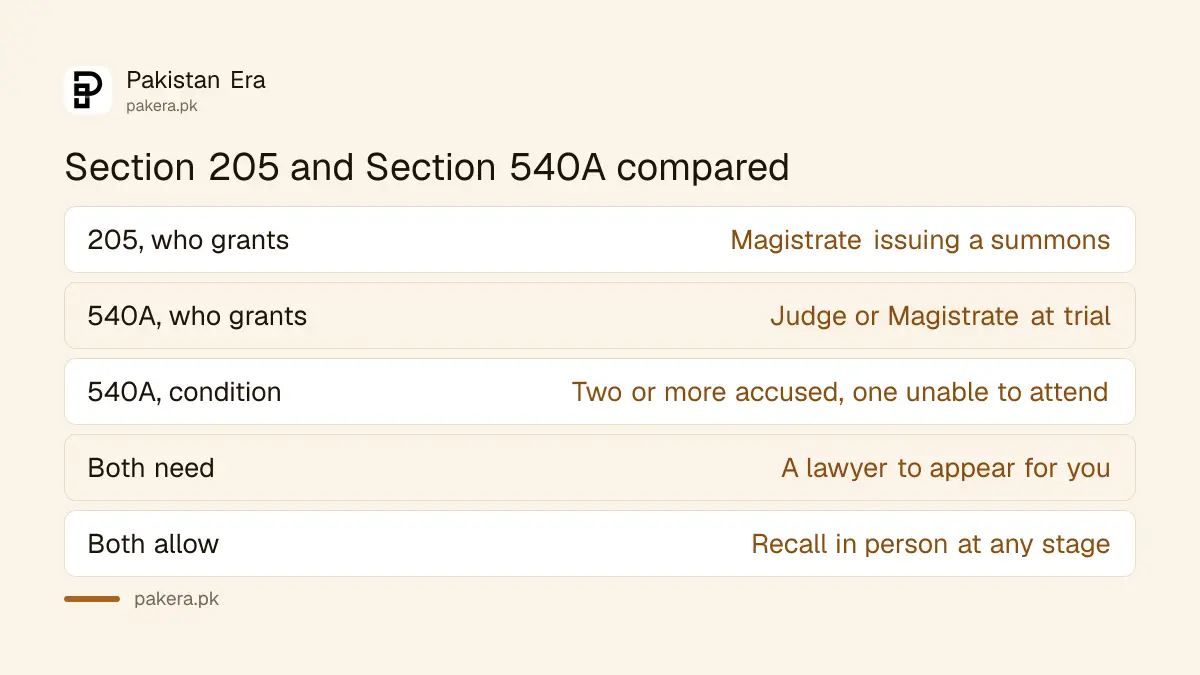
Section 205 CrPC covers summons cases before a Magistrate: he may dispense with the accused's personal attendance and permit him to appear by his pleader. Section 540A covers trials with two or more accused, where one cannot remain before the court.
| Point | Section 205 CrPC | Section 540A CrPC |
|---|---|---|
| Who can grant it | A Magistrate who issues a summons | A Judge or Magistrate in an inquiry or trial |
| When | When the summons is issued, if he sees reason | At any stage, where two or more accused are before the court |
| Condition | The accused appears through his pleader | The accused is incapable of remaining before the court and is represented by a pleader |
| Reasons | "If he sees reason so to do" | Reasons to be recorded by the court |
| Can the court call you back? | Yes, at any stage of the proceedings | Yes, at any subsequent stage |
A pleader is the Code's word for a lawyer entitled to appear in that court. Both sections depend on having one. Without a lawyer, Section 540A(2) lets the court adjourn the trial, or take up the case of the absent accused separately, rather than proceed without him.
How to apply for exemption from personal attendance
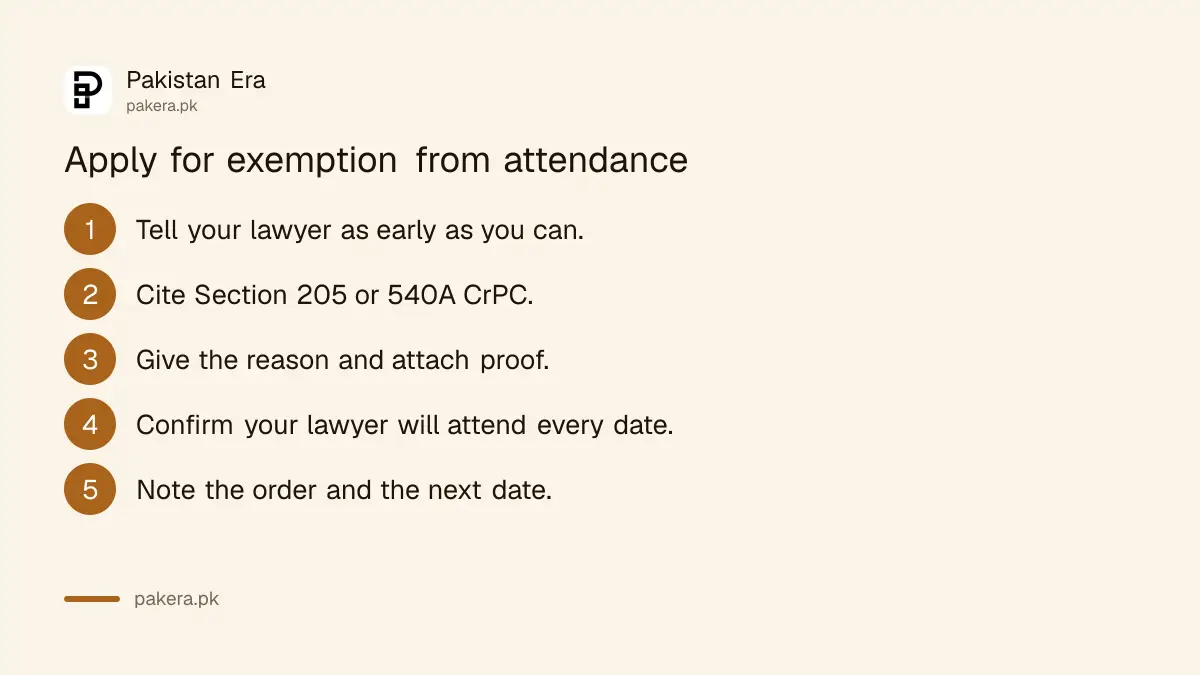
Your lawyer files a written application in the court hearing the case, usually on or before the date, explaining why you cannot attend and attaching proof. The court decides it and records the order on the case file.
- Tell your lawyer early. As soon as you know you cannot attend, not on the morning of the hearing.
- Name the section. The application cites Section 205 or Section 540A CrPC, whichever fits the case.
- Give the reason. Illness, hospital admission, travel abroad for work, an exam, or the needs of a disabled family member.
- Attach proof. A medical certificate from the treating doctor, an admission slip, a visa or ticket, or an exam roll number slip.
- Offer a lawyer for every date. Say that your pleader will attend each hearing and that you will appear whenever the court directs.
- Get the order copied. Ask your lawyer to note the order and the next date, so you know whether you must attend then.
If you cannot pay a lawyer, free legal aid can provide one. In Islamabad, the Legal Aid and Justice Authority takes criminal cases, and the provinces have district committees.
When the court will want you in person
Section 353 CrPC says evidence in a trial is taken in the accused's presence, or in his pleader's presence when attendance is dispensed with. Even so, the court can direct your personal attendance at any stage under both Section 205(2) and Section 540A(1).
Some stages commonly need the accused in person: when the charge is framed and read out, when the court records the accused's own statement, and when judgment is announced. Ask your lawyer which dates fall at those stages, so you plan travel around them.
- Charge: the court frames the charge and asks the accused whether he pleads guilty.
- Accused's statement: under Section 342, the court questions the accused on the case after the prosecution witnesses are examined.
- Judgment: Section 366(2) says the accused shall be required to attend to hear the judgment, except where attendance was dispensed with and he is acquitted or fined only.
Missing a date without leave has consequences
If you are on bail and miss a date without the court's permission, the court can issue a warrant for your arrest under Section 92 CrPC, and the bail bond can be forfeited. Your sureties can then be asked to pay the bond amount.
Section 92 says that when a person bound by a bond to appear does not appear, the court may issue a warrant for his arrest. Section 514 sets out how a forfeited bond is recovered, including from sureties. That is why anyone who stands surety for a bail bond has a direct interest in the accused attending.
Repeated absence can go further. The court can issue a proclamation and attach property, explained in responding to a court warrant or proclamation. If a warrant has already been issued, your lawyer can apply for it to be cancelled, usually when you appear in person with the reason for the absence.
Common questions
What is Section 205 CrPC?
It lets a Magistrate who issues a summons dispense with the accused's personal attendance and let him appear through his lawyer. The Magistrate can still order personal attendance later.
What is Section 540A CrPC?
It lets a Judge or Magistrate, where two or more accused are before the court, excuse one who cannot remain present, if he has a lawyer, and continue the trial in his absence.
Can I be exempted from every hearing?
The court decides. It can grant exemption for one date or longer, and can call you back in person at any stage.
Do I need a lawyer to get exemption?
Yes, in practice. Both sections let the accused appear by his pleader, so a lawyer must attend in your place.
What happens if I miss a hearing while on bail?
The court may issue a warrant under Section 92 CrPC, and the bail bond can be forfeited under Section 514.
Can an overseas Pakistani be exempted?
He can apply with proof of employment and travel, but the court decides on the facts. It can still order attendance at key stages.
How we verified this
What we checked and where we read it.
Sections 92, 205, 353, 514 and 540A are from the Code of Criminal Procedure 1898 PDF on the Ministry of Law's Pakistan Code website. Section 540A was inserted by the Code of Criminal Procedure (Amendment) Act 1923. The list of stages that commonly need the accused in person describes ordinary trial practice, and the court's order on your case is what governs. This page explains the procedure and is not legal advice.
Last checked 15 November 2026.
About the author

Global Affairs & Political Economy Writer
Muhammad Hatim is a book lover who started writing because he enjoys it. At Pakistan Era he writes about international relations, geopolitics and the global economy, with a particular interest in South Asia and the forces behind current events.