What to Do If a Pakistani Court Issues a Warrant or Proclamation Against You
Know what a court warrant and proclamation mean in Pakistan: the 30 day minimum to appear, property attachment, the 6 month sale bar and the 2 year claim back.
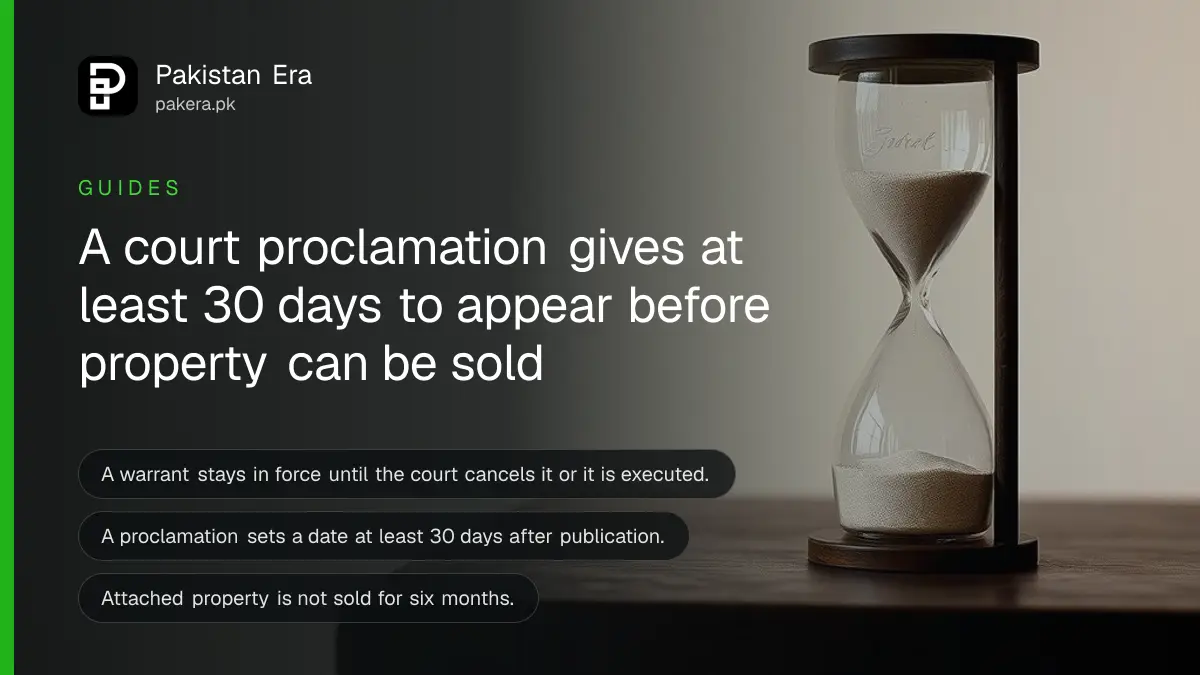
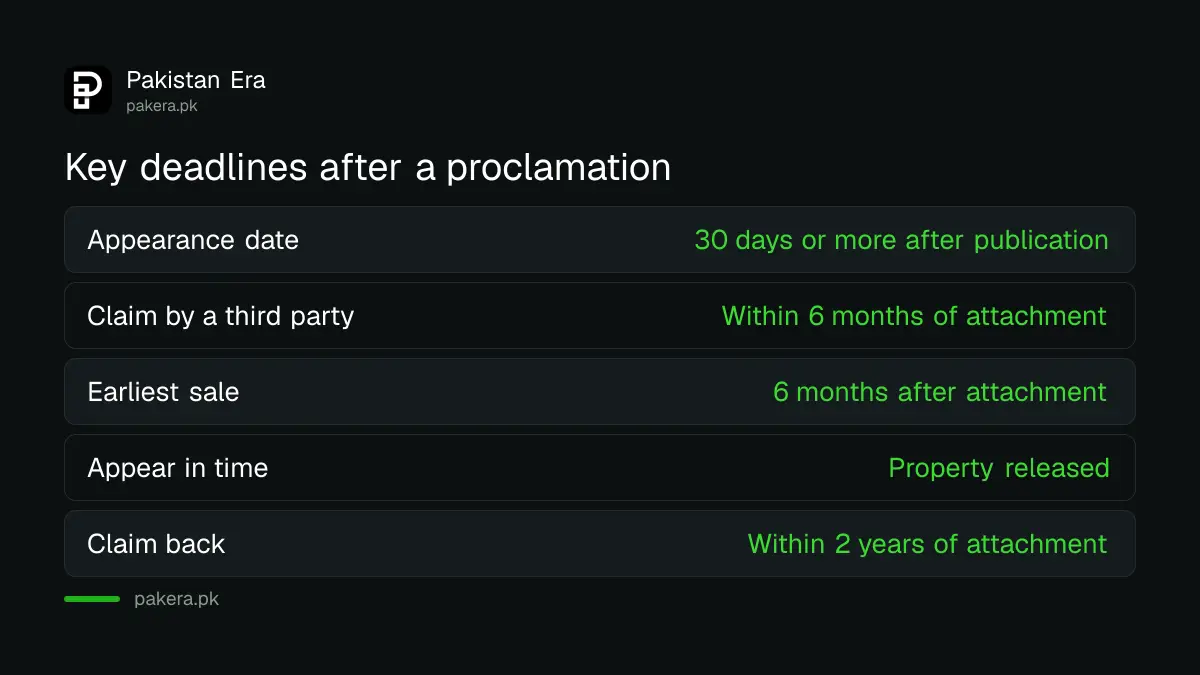
Short answer: If a court proclaims you an absconder under section 87 of the Code of Criminal Procedure, you get at least 30 days from publication to appear. If you appear in time, any attached property is released. If you do not, it is not sold for six months, and you can still claim it back within two years.
A summons is a call to attend court. A warrant is an order to arrest. A proclamation is the next step when a person with a warrant cannot be found. Each step has rules and time limits. Knowing them lets you act before property is touched.
We read sections 75, 76, 87, 88, 89 and 90 of the Code of Criminal Procedure, 1898 on the Pakistan Code portal (pakistancode.gov.pk) on 14 October 2026. This guide follows that text. It is general information, not legal advice for your case.
A warrant stays in force until it is cancelled or executed
Section 75 says a warrant of arrest issued by a court must be in writing, signed by the presiding officer and carry the seal of the court. It remains in force until the court cancels it or until it is executed. Time passing does not cancel it.
That is why an old warrant can still be used years later. If you learn there is a warrant against you, do not wait for it to expire. Find the court and the case number, and ask a lawyer to apply for its cancellation or for bail.
A court may also issue a warrant in place of a summons. Section 90 allows this, after recording reasons, if the court believes you have absconded or will not obey the summons, or if you failed to appear after the summons was served in time and you gave no reasonable excuse.
A bailable warrant lets you give a bond instead of going to jail
Under section 76 the court may endorse a warrant so that, if you sign a bond with sufficient sureties for your attendance at a stated time, the officer shall take that security and release you. The endorsement states the number of sureties, the bond amounts and the time you must attend.
So when a warrant carries this endorsement, you can end the arrest by giving the bond. The officer forwards the bond to the court. For offences with no such endorsement, see our guide on getting bail in Pakistan.

A proclamation gives you at least 30 days to appear
Section 87 says that if a court, satisfied after taking evidence, finds that a person against whom it issued a warrant has absconded or is hiding so the warrant cannot be executed, it may publish a written proclamation. The proclamation requires him to appear at a stated place and time, not less than thirty days from publication.
The proclamation is published in three ways. It is read publicly in a conspicuous place in the town or village where the person lives. It is affixed to a conspicuous part of his house or to a conspicuous place in the town or village. And a copy is affixed to the courthouse.
The court's written statement that the proclamation was published on a stated day is conclusive evidence that the steps were followed. Count your 30 days from that day.
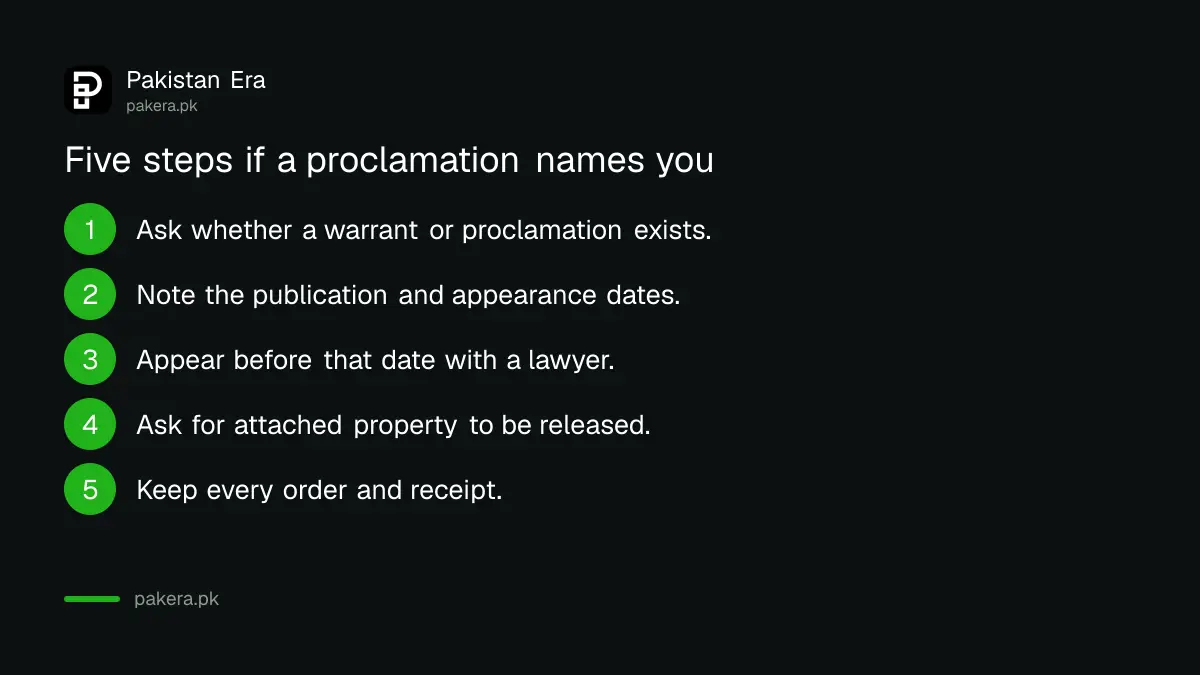
- Ask the court office or your lawyer whether a warrant or proclamation exists in your name.
- Note the date of publication and the date set for your appearance.
- Appear before that date, with a lawyer and a bail application where the offence needs one.
- Ask the court to release any property it attached.
- Keep every order and receipt.
Attached property is released if you appear in time
Section 88 lets the court that issued the proclamation order the attachment of movable or immovable property of the proclaimed person. Section 88(6E) says that if he appears within the time stated, the court shall release the property from attachment.
Attachment is done by seizure, by a receiver, by an order not to deliver property to him, or by a combination. For land, it goes through the District Officer (Revenue). Livestock and perishable goods may be sold at once, and the proceeds wait for the court's order.
Other people with an interest in the property can object. Section 88(6A) allows a claim within six months of the attachment. If a claim is disallowed, section 88(6D) lets the claimant file a suit within one year from the order.
Sale waits six months and a claim stays open for two years
If the person does not appear, section 88(7) says the attached property goes at the disposal of the Provincial Government. It cannot be sold until six months from the attachment have passed, and until claims are decided. Perishable goods and cases where sale benefits the owner are exceptions.
Section 89 gives a second chance. Within two years from the date of attachment, a person who appears voluntarily or is brought before the court can prove that he did not abscond to avoid the warrant and had no notice of the proclamation in time. Then the property, or the net sale proceeds, is delivered to him after costs are met.
| Step | Time or rule |
|---|---|
| Proclamation published | Appearance date at least 30 days later (s.87) |
| Appear in time | Court releases attached property (s.88(6E)) |
| Third party claim | Within 6 months of attachment (s.88(6A)) |
| Earliest sale | Not before 6 months from attachment (s.88(7)) |
| Claim back after sale | Within 2 years of attachment (s.89) |
If a family member has been arrested, read your rights when you are arrested in Pakistan. To follow the case itself, use our guide to checking a court case status, and a lawyer can be found through free legal aid in Punjab.
Common questions
How long is a warrant valid?
Section 75(2) says it remains in force until the court cancels it or it is executed. The text sets no expiry date.
What is the minimum time in a proclamation?
Section 87(1) says the appearance date must be not less than thirty days from the date the proclamation is published.
Can my property be sold right away?
Not in general. Section 88(7) bars sale until six months from attachment, and until claims are decided. Perishable items and livestock are the exceptions the text names.
Can a relative object to the attachment of a shared house?
Yes. Section 88(6A) allows a claim by any person other than the proclaimed person within six months, if their interest is not liable to attachment.
What if I never knew about the proclamation?
Section 89 lets you ask for the property back within two years of attachment if you prove you did not abscond to avoid the warrant and lacked notice in time.
How we verified this
What we checked, where we read it, and what we could not confirm.
We read sections 75, 76, 87, 88, 89 and 90 of the Code of Criminal Procedure, 1898 in the PDF on the Pakistan Code portal (pakistancode.gov.pk) on 14 October 2026. The file says it was last amended on 16 February 2017. We did not read court rulings or provincial rules on how these sections are applied in practice. A lawyer should confirm the current position on your case file.
About the author

Tax, Bills and Technology Writer
Ali Akhtar is a young and curious voice here at Pakistan Era. He is currently pursuing his A-Levels and has a growing interest in Pakistan’s changing industrial landscape and educational trends. Ali likes to write in a way that helps him explain and explore the world around him. His writing reflects the perspective of the new generation navigating the evolving trends of Pakistan where technology, youth innovation, and shifting opportunities are reshaping the country’s future.