Home Loan Default in Pakistan: Your Bank Can Auction the House Without Court After 3 Notices
Under section 15A, a bank in Pakistan can auction a home without court after three 30 day notices. See the steps, the rescheduling right and 7 day fraud rule.
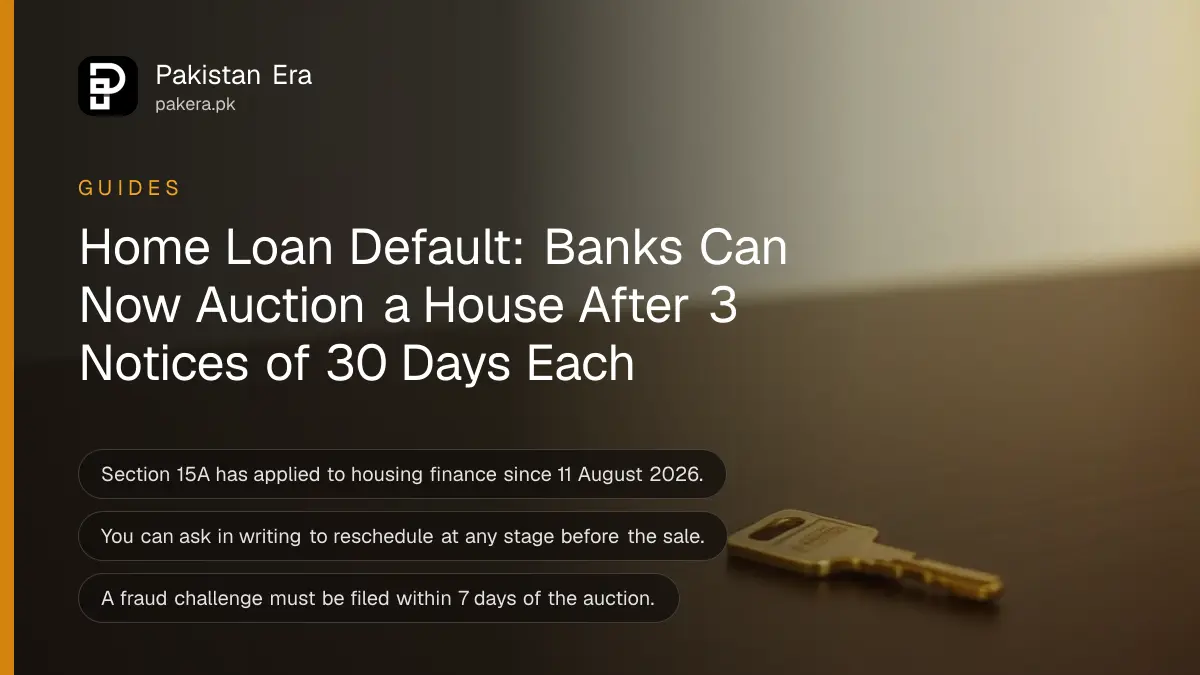
Short answer: If you stop paying a home loan in Pakistan, your bank can now sell the house at a public auction without going to court. It must first send you three written notices, each giving you at least 30 days to pay. That is at least 90 days before any sale. This is section 15A of the Financial Institutions (Recovery of Finances) Ordinance, 2001, added by Act No. XLVI of 2026, in force since 11 August 2026.
Before this change, a bank usually had to file a recovery suit in a Banking Court, which could take years. The new section applies only to housing finance. A loan to buy, build, renovate or improve a home counts, and so does a loan for a plot on which you plan to build a home. Loans for shops, factories or investment property are not covered.
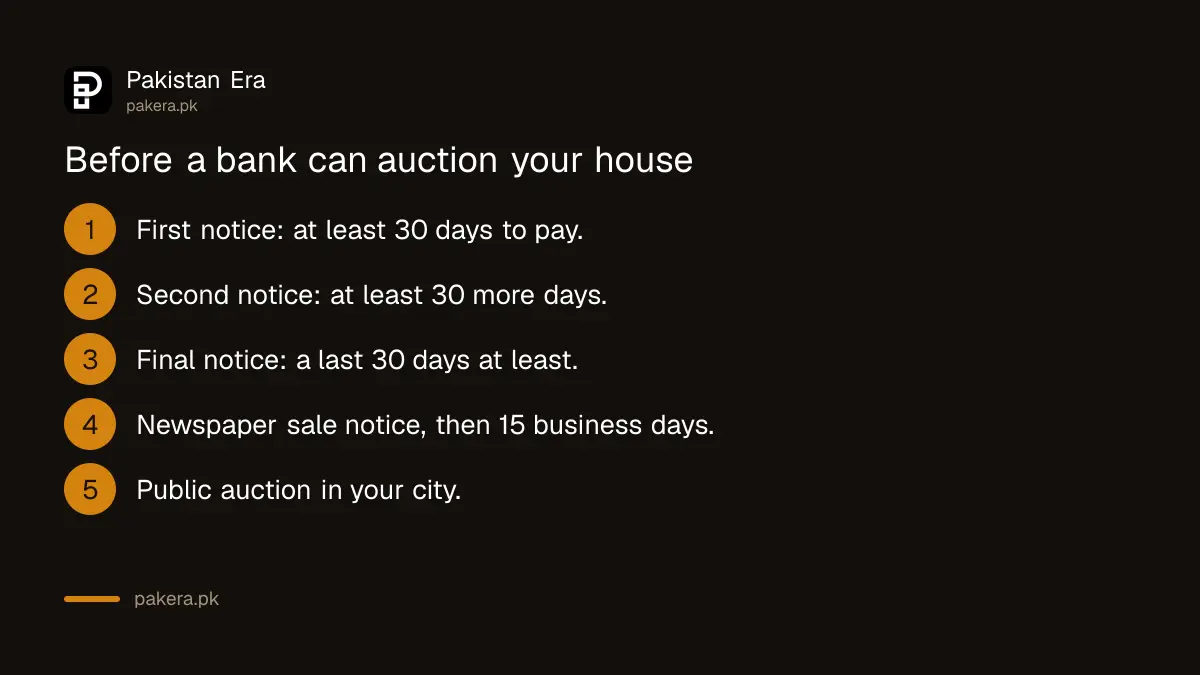
The bank must send three notices of at least 30 days each
A bank cannot auction your house the day after you miss an instalment. Section 15A(2) sets a chain of three written notices. Each one demands the unpaid mortgage money and gives you at least 30 days from the day it is served.
- First notice. Sent after you default. You get at least 30 days to pay.
- Second notice. Sent only if you did not pay within the first period. Another 30 days at least.
- Final notice. Sent if you are still in default. A last 30 days at least.
- Auction. Only after the final notice period ends can the bank start the sale steps below.
Keep every notice and the envelope it came in. The date of service matters, because each 30 day period runs from that date. If a notice reaches you late, your clock starts late too.
You can ask for rescheduling at any stage before the sale
The law gives you a way out until the property is actually sold. You can send the bank a written request to reschedule, restructure or settle the loan. The bank must consider it and decide within 30 days. If you both agree, the bank must suspend or withdraw its notice.
This is the most useful line in the whole section for a family in trouble. Put the request in writing, keep a copy with the bank's receiving stamp, and propose real numbers: a longer tenure, a lower instalment for six months, or a lump sum settlement. A phone call to the branch is not a written request.
The protection lasts only while you keep to the new terms. If you break the agreed plan, the bank can bring the notices back. Before signing, check what a longer loan costs you in total, using the same method banks use when they decide how much home loan you can afford.
After the final notice, the bank collects your rent
Once the final notice is served, your right to collect rent from the mortgaged property passes to the bank. This lasts until the notice is withdrawn. If a tenant lives in the house, the bank can write to the tenant, and the tenant must then pay the rent to the bank instead of you.
This matters for owners who financed a second home or a portion they rent out. The rent the bank receives goes towards the debt, but you lose that income while the notice stands.
How the auction works under section 15A
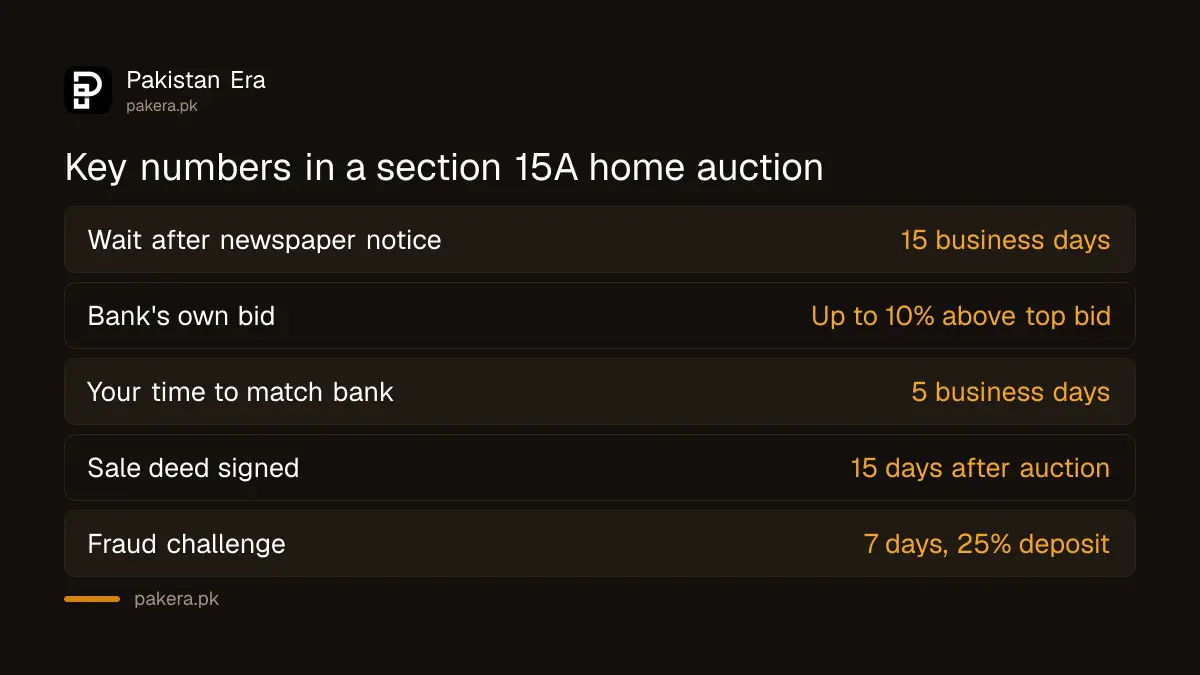
The sale follows fixed steps set out in section 15A(4). The bank must get a valuation, publish the sale in two newspapers, tell you and other lenders, and wait 15 business days before the auction. The auction must take place in the city where the house is.
| Step | What the law requires |
|---|---|
| Valuation | A valuation company on the Pakistan Banks Association panel values the house as on the date of the final notice |
| Public notice | One English and one Urdu daily newspaper with wide circulation in your province |
| What the notice must show | Property details, your name and address, amount owed, known charges on the property, reserve price, time and place of auction |
| Notice to you | The same details sent to you and to any other lender with a mortgage on the house |
| Waiting period | No auction before 15 business days after the newspaper notice |
| Place | The city where the house is located |
| Reserve price | The house cannot be sold below the price stated in the notice |
The bank may bid too. It can buy the house for up to 10% more than the highest bid. If it chooses to do that, it must tell you, and you then get five business days to match the bank's bid. Check the reserve price against the valuation. A reserve price far below what similar homes sell for is a point to raise with the bank in writing.
The Deputy Commissioner can hand possession to the bank
If you or anyone living there will not leave, the bank can ask the Deputy Commissioner of the district, or an officer he names, for help. That officer can take possession and hand it to the bank, using force if needed. The law says these acts cannot be challenged in any court.
A tenant whose genuine lease was signed before the mortgage is protected. The officer cannot hand over that house until the lease ends, unless compensation is agreed or fixed by the Banking Court. A lease made after the mortgage, which lowers the house's value or hurts the bank's rights, is presumed not genuine unless proved otherwise. The Deputy Commissioner decides that dispute, with written reasons.
The sale deed is signed by the bank as your attorney, and the Registrar must accept it. No deed can be signed until 15 days after the auction. Once it is registered, the buyer owns the house free of all charges and you lose every right in it.
Where the sale money goes
The bank first deducts the costs of the sale. The rest is shared among all lenders who hold a mortgage on the house, in order of their rights. If anything is left after every lender is paid in full, it must be paid to you.
Within 14 days of the sale, the bank must file proper accounts of the sale money in the Banking Court. Ask the bank for a copy. It shows the price, the costs taken out and whether you are owed any surplus. If the sale did not cover the whole debt, the bank keeps its other recovery rights under the Ordinance.
How to stop or challenge a sale in the Banking Court
Only the Banking Court can hear disputes about a section 15A sale. It cannot stop a sale without first hearing the bank. It can grant an injunction only on one of four grounds listed in section 15A(15).
- No mortgage was ever created on the property.
- There is a prima facie case of fraud in how the sale is being carried out.
- All the money secured by the mortgage has already been paid.
- You deposit the full amount owed in cash in the court, or a lower amount the bank agrees to.
After a sale, you can apply to set it aside, but only for fraud. The application must be made within seven days of the auction. You must also deposit 25% of the amount owed, or give security for it. The court will set the sale aside only if the fraud caused you substantial injury that money damages cannot fix. Seven days is very short, so speak to a lawyer the moment you see the newspaper notice, not after the auction.
A complaint about rude calls or visits from recovery staff is a separate matter. SBP rules on bank recovery agent harassment still apply, and service complaints against a bank go to the Banking Mohtasib.
Common questions
Can a bank sell my house without a court order in Pakistan?
Yes, for a housing finance loan. Section 15A lets the bank auction the house after three written notices of at least 30 days each, without going to court first.
How long do I get before the bank can auction my home?
At least 90 days from the first notice, plus at least 15 business days after the newspaper sale notice.
Does this apply to a plot bought with a bank loan?
Yes, if the loan was to buy a plot on which you intend to build a home. It does not apply to commercial, industrial or investment finance.
Can I still save the house after the final notice?
Yes. Until the sale, you can make a written request to reschedule, restructure or settle. The bank must decide within 30 days.
What happens to the extra money if the house sells for more than the loan?
After sale costs and all lenders are paid in full, the surplus must be paid to you.
How long do I have to challenge an auction for fraud?
Seven days from the auction, with a deposit or security of 25% of the amount owed.
Does this apply to Apna Ghar loans?
Apna Ghar loans are housing finance from banks, so the section covers them as it covers any home loan. Keep up instalments on Apna Ghar housing loans or ask for rescheduling early.
How we verified this
What we checked and where we read it.
We checked the full text of the Financial Institutions (Recovery of Finances) (Amendment) Act, 2026 (Act No. XLVI of 2026) on 15 November 2026, from the National Assembly's list of Acts. The Gazette of Pakistan copy is dated 17 August 2026 and records the President's assent on 11 August 2026. The Act says it came into force at once. It adds definitions of "Deputy Commissioner" and "housing finance" to section 2, inserts section 15A, and amends section 22. The Act lets the federal government make rules on the conduct of these sales. Any such rules can add conditions to the steps above.
About the author

Global Affairs & Political Economy Writer
Muhammad Hatim is a book lover who started writing because he enjoys it. At Pakistan Era he writes about international relations, geopolitics and the global economy, with a particular interest in South Asia and the forces behind current events.