Hong Kong Sixes Rules: Six Players, Six Overs, Cup, Plate and Bowl (Every Rule Explained for Pakistan Fans)
Hong Kong Sixes rules explained: six players, six overs, one over per bowler, retired batters, the sixes tie-break and how Cup, Plate and Bowl work. Read on.
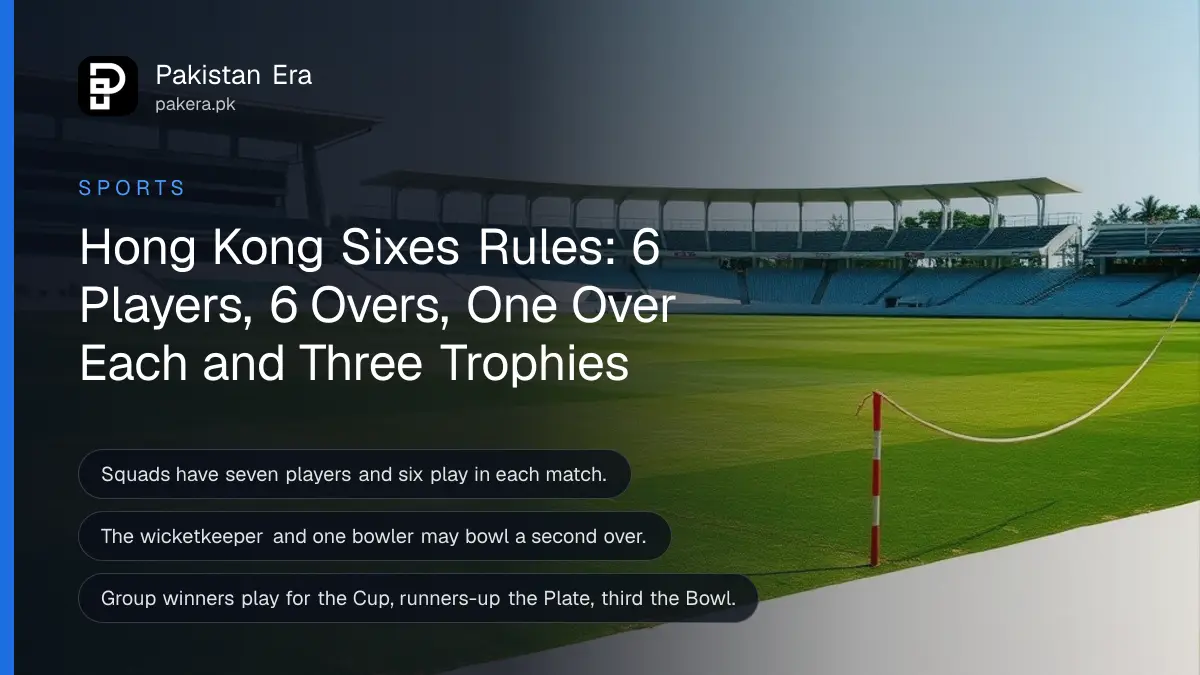
Hong Kong Sixes rules in one line: six players a side, six overs an innings, most bowlers limited to one over, and three trophies, the Cup, Plate and Bowl, decided by where a team finishes in its group of three. Ties on points in a group can come down to who hit the most sixes.
Pakistan are the most successful side in the event's history, with six titles, so the format matters to a lot of fans here. We read the organisers' format notes, the fixtures page and their 2026 match report on 31 October 2026. Below is every rule we could confirm, plus the ones the organisers do not publish.
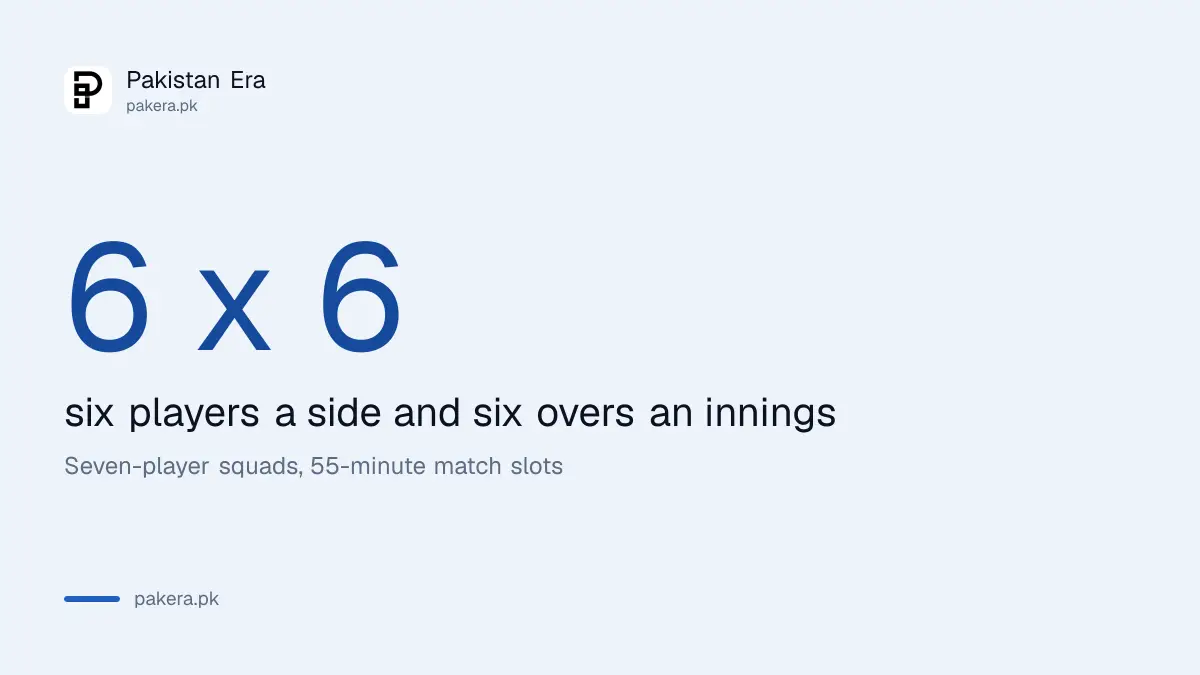
Each team plays six players for six overs
Every side fields six players and bats for six overs, unless it is all out sooner. Squads have seven players, so one sits out each match. A full match fits in a 55-minute slot on the official fixtures page.
Six overs is 36 legal balls. That is why scores look so high for so little time. India made 88 in six overs against Pakistan on 30 October 2026, and Pakistan chased it in 3.5 overs. In a T20 those would be modest totals. Here they are ordinary.
The event is in its 22nd edition and has a 34-year history, the organisers say. It is played at the Tin Kwong Road Recreation Ground in Kowloon.
Most bowlers can bowl only one over
Bowlers generally deliver one over each, the organisers say. The wicketkeeper and one designated bowler are exempt from that limit, which lets one player bowl two overs. So a captain must use almost every player in the side as a bowler.
That rule changes how teams pick sides. A team cannot hide a weak bowler, because nearly everyone bowls. All-rounders are worth far more here than in normal cricket. In Pakistan's win over India, Muhammad Shahzad, captain Abbas Afridi, Abdul Samad and Ahmed Daniyal all bowled an over.
For comparison, a T20 bowler may bowl four overs out of 20. The T20I rules for Pakistan matches set that four-over limit.
Batters can be retired, and the last batter can bat alone
A team can retire a batter during an innings. India retired Nitish Rana against Pakistan when he was stuck on 19 off 14 balls. The organisers' report also shows India's last batter facing balls on his own after the fifth wicket fell.
That second point explains the result line. Pakistan finished on 91 for 2 and won "by four wickets", which only adds up if a side has six wickets to lose, not five. So a team is not all out until every one of its six batters is out.
We could not read the full playing conditions. The "Match Playing Conditions" link on the official site does not lead to a document. Older rules people quote online, such as a batter retiring at a set score or extra runs for wides, may still apply, but we have not seen them in an official text for 2026.
Group places decide the Cup, Plate and Bowl
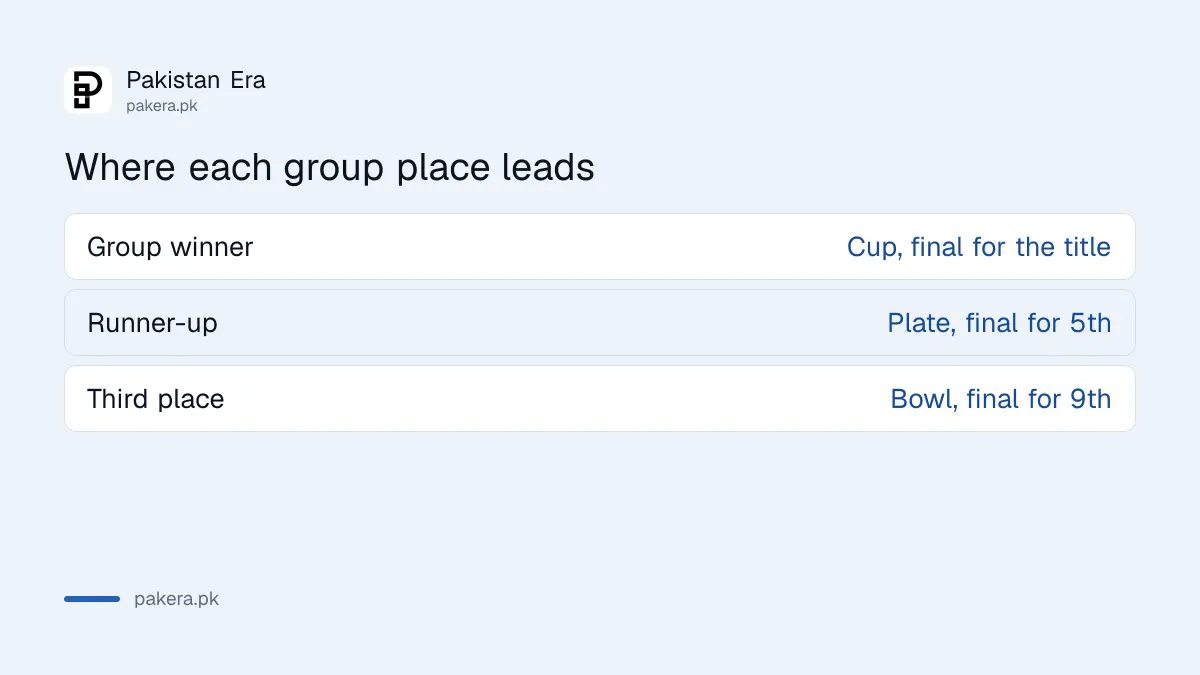
The 12 teams play in four groups of three, and each team plays twice. Group winners go to the Cup, runners-up to the Plate and third-placed sides to the Bowl. Each competition has semi-finals on Saturday and a final on Sunday.
| Group finish | Competition | Semi-finals | Sunday matches |
|---|---|---|---|
| Winner | Cup | A1 v C1, B1 v D1 | Final for the title, play-off for 3rd |
| Runner-up | Plate | B2 v D2, A2 v C2 | Final for 5th, play-off for 7th |
| Third | Bowl | B3 v D3, A3 v C3 | Final for 9th, play-off for 11th |
Every team plays four matches in all: two in the group, a semi-final and a final or play-off. No team goes home after the group stage. Every slot in the Hong Kong Sixes 2026 schedule falls between 5:45 am and 1:05 pm in Pakistan.
The most sixes can break a tie on points
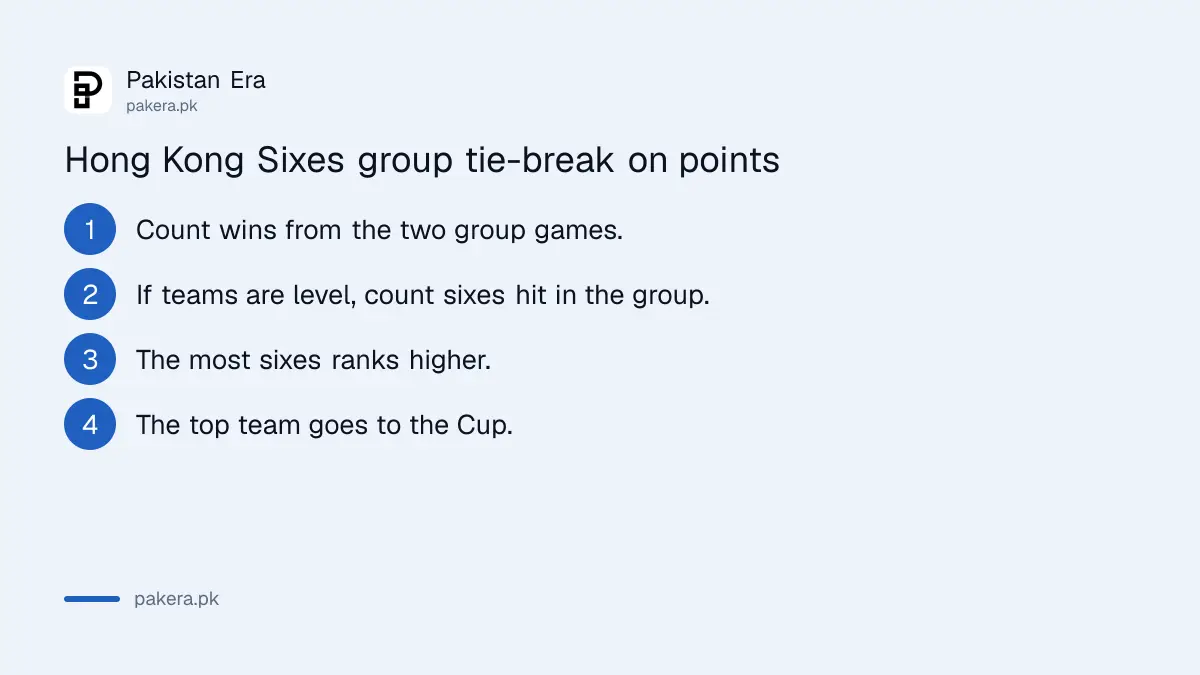
When three teams in a group finish level on points, the team that has hit the most sixes in the group goes through to the Cup, the organisers said on 30 October 2026. That made Pakistan's 23 sixes on day one a real advantage over India and the UAE.
- Count wins: a group of three gives each team two matches.
- If teams are level on points, compare total sixes hit in the group.
- The team with the most sixes ranks higher and takes the Cup place.
- The next team goes to the Plate, the last to the Bowl.
The organisers stated this for Group C in 2026. We did not find a published rule for what happens if the sixes count is also level, so we cannot tell you that.
Pakistan hold the record with six titles
Pakistan are six-time winners and the defending champions, having beaten Kuwait by 43 runs in the 2025 final. England have five titles. Australia won in 2010, Sri Lanka in 2024 and India in 2005, the organisers say.
Pakistan's 2026 side is led by Abbas Afridi, who scored 52 off 11 balls in last year's final. The other 11 Hong Kong Sixes 2026 squads have seven players each too. Fans going in person will need a Hong Kong visa from Pakistan first.
Common questions
How many players are in a Hong Kong Sixes team?
Six play in each match, from a squad of seven.
How many overs does each bowler get?
Usually one. The wicketkeeper and one designated bowler are exempt, so one player can bowl two overs.
What happens if teams tie on points in a group?
The team that hit the most sixes in the group ranks higher, according to the organisers' 2026 statement.
What are the Cup, Plate and Bowl?
Three competitions on the last two days. Group winners play for the Cup, which is the title. Runners-up play for the Plate, and third-placed teams for the Bowl.
Can a team retire a batter?
Yes. India retired Nitish Rana against Pakistan in 2026. We did not find the written rule on when this is allowed.
How we verified this
What we checked, where we read it, and what we could not confirm.
We read the organisers' format release Hong Kong Sixes Turns It Up to Six (3 October 2026), the official fixtures page with its "How the finals work" box, and the 30 October Pakistan vs India report, on 31 October 2026. The full playing conditions were not available, so rules on wides, no-balls and retirement scores are not confirmed here.
About the author

Senior Writer, Public Services and Technology
Shahid joined us in 2024 as an author. He is a senior contributor to Pakistan's leading technology websites. He writes detailed articles, mostly covering his expertise in the latest tech, mobiles, apps, gadgets, and step-by-step guides. His ideology is to help people understand the latest trends and explain complex methods through very easy-to-understand guides.