How to Read an ODI Scorecard: Pakistan vs England at Rawalpindi Worked Example
Read an ODI scorecard in minutes. We work out strike rate, economy and run rate using Pakistan's 87 run win over England at Rawalpindi on 20 October 2026.
Short answer: To read an ODI scorecard, divide runs by balls for a batter's strike rate, and runs by overs for a bowler's economy. In Pakistan's 87 run win over England on 20 October 2026, Hasan Nawaz scored at 106.8 and Arafat Minhas bowled at an economy of 4.62. Those two numbers explain the result better than the totals do.
A scorecard looks like a wall of figures. It is a short list of questions answered in a fixed order. We use the Pakistan and England match at Rawalpindi as the worked example, with the scores as reported in published match reports, and do the arithmetic ourselves so you can repeat it on any match.
Strike rate is runs divided by balls, times 100
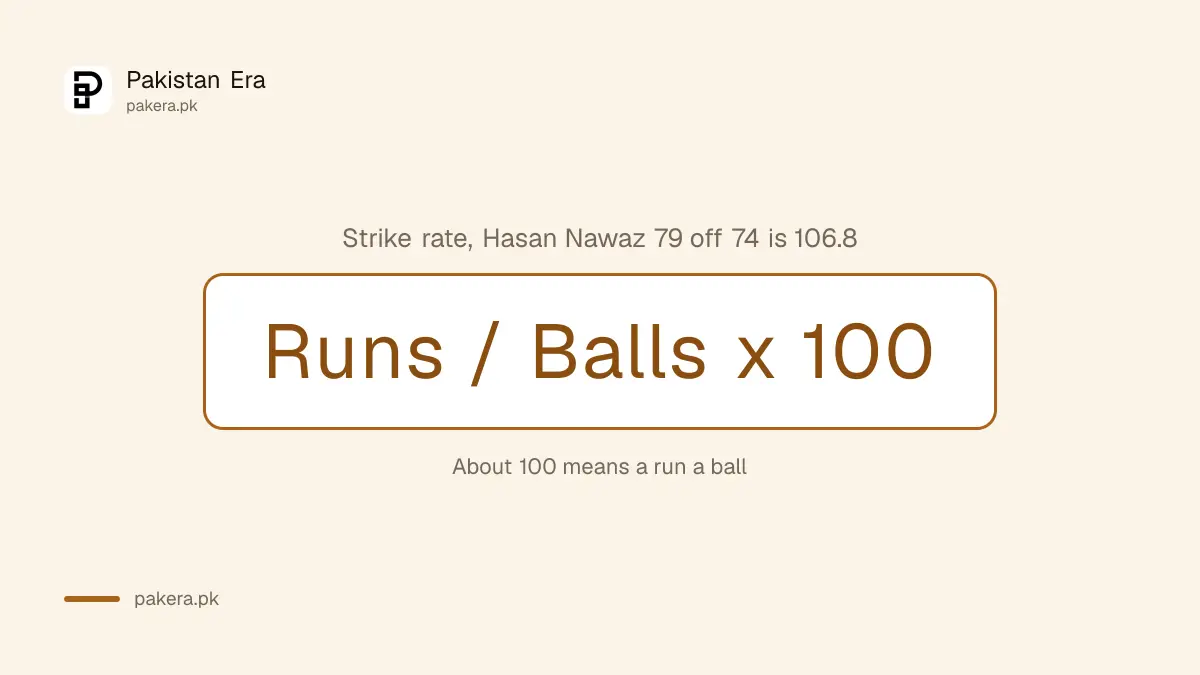
A batter's strike rate is runs divided by balls faced, multiplied by 100. It tells you how many runs the batter scores per 100 balls. In a 50 over match, a rate near 100 means a run a ball.
| Batter | Runs off balls | Strike rate |
|---|---|---|
| Faheem Ashraf (Pakistan) | 39 off 26 | 150.0 |
| Tom Banton (England) | 57 off 53 | 107.5 |
| Hasan Nawaz (Pakistan) | 79 off 74 | 106.8 |
| Arafat Minhas (Pakistan) | 59 off 58 | 101.7 |
| Ben Duckett (England) | 45 off 46 | 97.8 |
| Babar Azam (Pakistan) | 34 off 52 | 65.4 |
| Saad Baig (Pakistan) | 35 off 54 | 64.8 |
Babar and Saad Baig scored 34 and 35 at about 65. Faheem scored 39 at 150. A strike rate shows who was holding the innings back and who was speeding it up, even when the runs look similar.
Economy is runs conceded per over
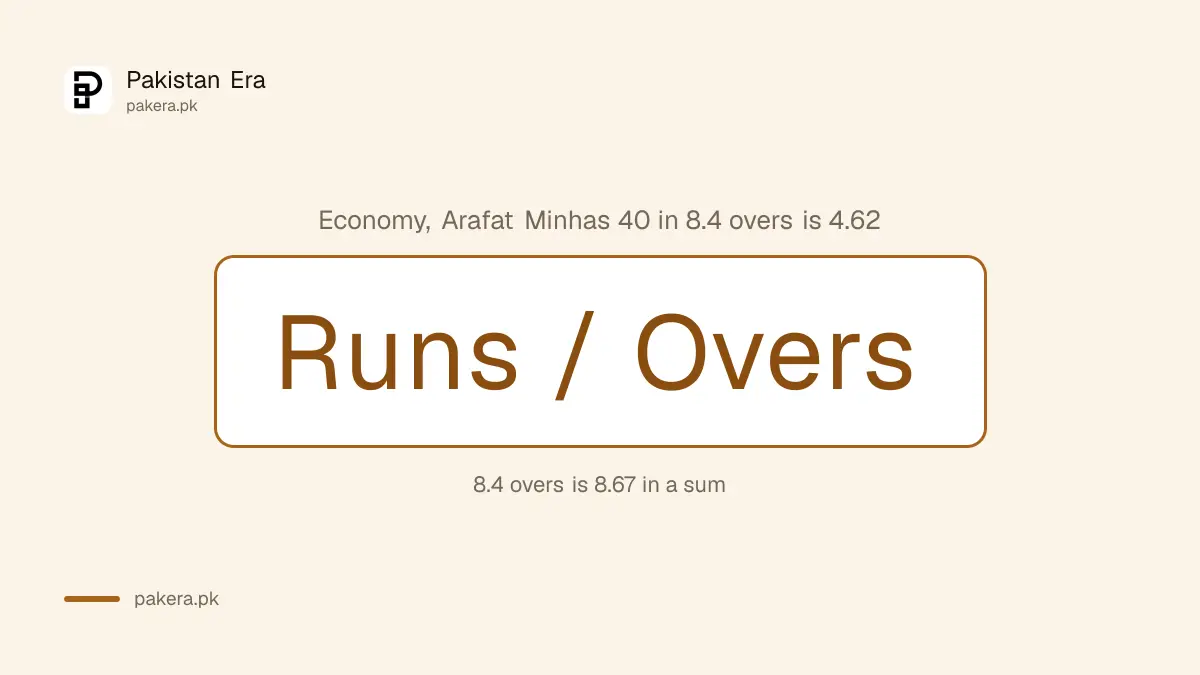
A bowler's economy is runs conceded divided by overs bowled. A lower number is better. Minhas's reported 6 for 40 in 8.4 overs is 40 divided by 8.67, which is 4.62. The figure 8.4 means 8 overs and 4 balls, not eight and four tenths.
For comparison, both teams batted at about six runs an over in the match as a whole: Pakistan's 302 over 50 is 6.04, and England's chase of 303 needed 6.06. England's actual rate was 215 over 38.67 overs, which is 5.56. Minhas, at 4.62, was well under the rate England needed.
- Convert the overs: a figure like 8.4 is 8 and 4/6 overs, so use 8.67.
- Divide runs conceded by that number: 40 / 8.67 = 4.62.
- Compare with the match run rate of about 6 an over.
- Look at wickets too, because a cheap bowler who takes none helps less.
Partnerships show where the match turned
A partnership is the runs two batters add together. Pakistan were 133 for 5 in the 28th over, and Hasan Nawaz and Minhas then added 78 for the sixth wicket. That stand took Pakistan from a weak position to a total they could defend.
On the other side, England were reported at 91 without loss after 14.3 overs, and then lost ten wickets for 124. The scorecard has a section called fall of wickets that lists the score each time a wicket fell. Read it first if you want to know where a match was won.
Run rates tell you if a chase was on track
The required run rate is the target divided by the overs. For 303 in 50 overs it is 6.06 an over. England's start of 91 in 14.3 overs, which is 87 balls, was 6.28 an over, so they were ahead of the rate before the collapse.
| Measure | Working | Result |
|---|---|---|
| Pakistan run rate | 302 / 50 | 6.04 |
| Required rate for England | 303 / 50 | 6.06 |
| England's start | 91 off 87 balls | 6.28 |
| England's final rate | 215 / 38.67 | 5.56 |
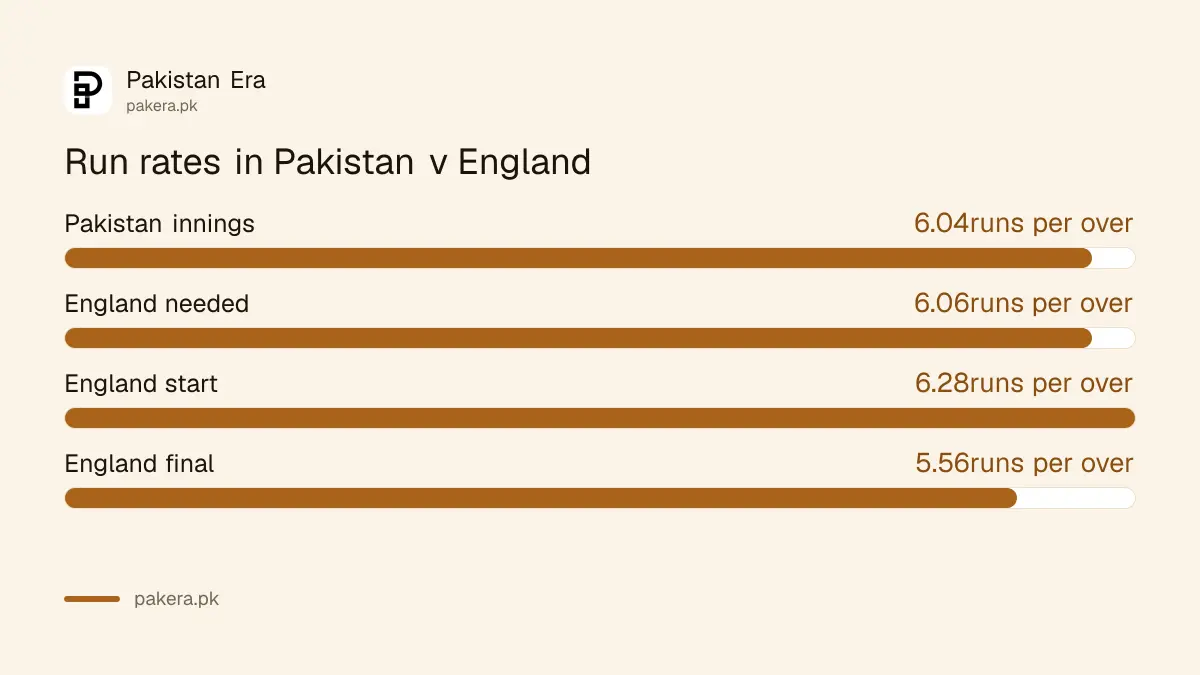
That is why a scorecard can fool you. England's final rate was not far from Pakistan's, but a rate in 38 overs is worth less than a rate over 50 when you are bowled out.
Check the result against the points table
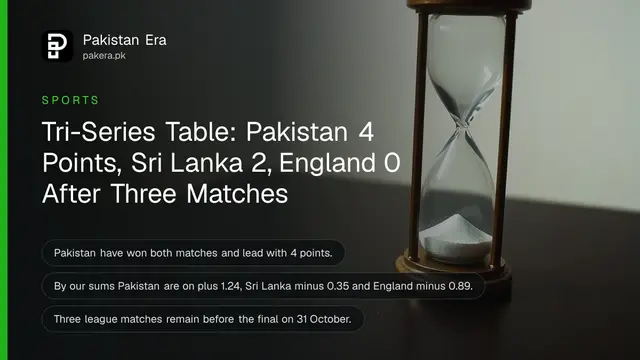
After you read the card, check what the result did to the series. Pakistan's win gave them 4 points from two matches, as shown in the tri-series points table. The full match story is in the report on how Pakistan beat England by 87 runs.
The playing rules behind the numbers, such as the two new balls and the bowling limits, are in the ICC's ODI rules for October 2026.
Common questions
What is a good strike rate in an ODI?
Around 100 is a run a ball. In this match, scores near 100 to 107 were the top innings, and 150 was exceptional.
What does 8.4 overs mean?
It means 8 overs and 4 balls. To use it in a sum, write it as 8.67.
What is a good economy rate?
Lower than the match run rate. Minhas conceded 4.62 an over when the match rate was about 6.
What is the required run rate?
The target divided by the overs. For 303 in 50 overs it is 6.06.
Where do I find the fall of wickets?
On the full scorecard, usually under the batting list. It shows the team score at each wicket.
Are these figures official?
They are as reported in match reports. The cricket board's own scorecard page did not load for us.
How we verified this
What we checked, where we read it, and what we could not confirm.
Last checked 21 October 2026. The scores, balls faced and overs come from two published match reports and the series match list for Pakistan against England on 20 October 2026. We also opened the ICC playing conditions page. The Pakistan Cricket Board scorecard did not load, so the figures are reported, not confirmed on the board's page. Every strike rate, economy and run rate here is our own arithmetic.
About the author

Tax, Bills and Technology Writer
Ali Akhtar is a young and curious voice here at Pakistan Era. He is currently pursuing his A-Levels and has a growing interest in Pakistan’s changing industrial landscape and educational trends. Ali likes to write in a way that helps him explain and explore the world around him. His writing reflects the perspective of the new generation navigating the evolving trends of Pakistan where technology, youth innovation, and shifting opportunities are reshaping the country’s future.