Pakistan's $210 Million IMF Climate Loan: What the RSF Asks on Water Charges, Appliance Standards and Flood Insurance
Pakistan's IMF climate loan, the RSF, releases about $210 million after board approval. See the five climate reforms it asks for and who in Pakistan feels them.
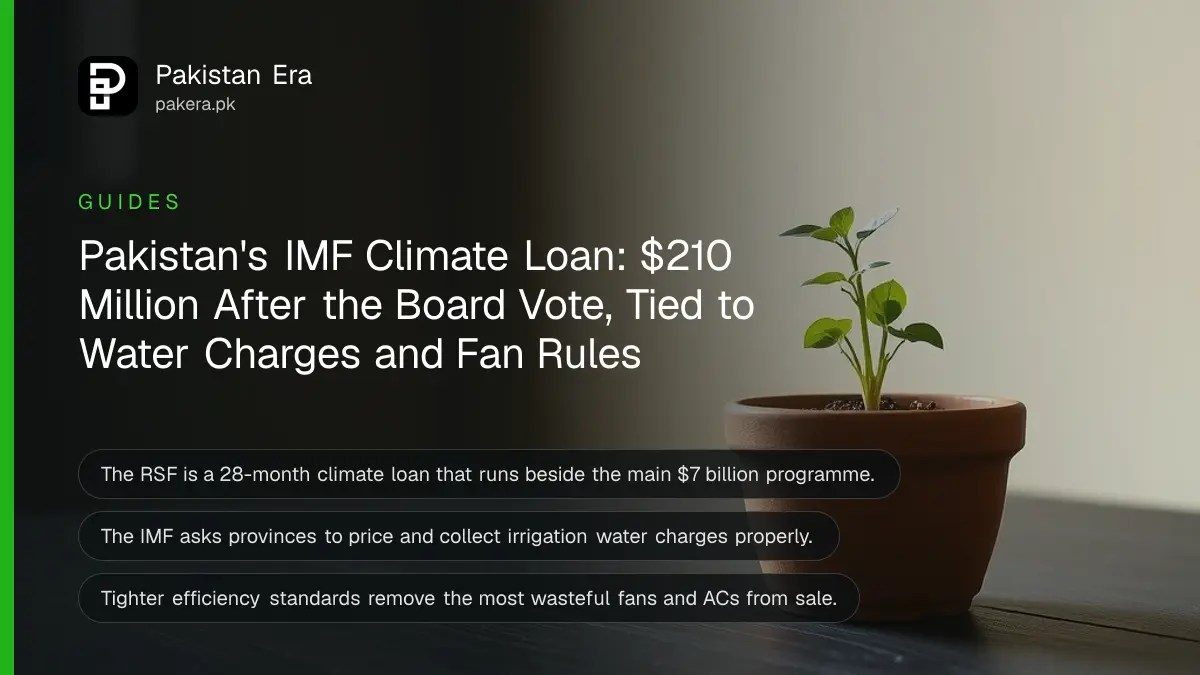
Pakistan's IMF climate loan, the Resilience and Sustainability Facility, releases about $210 million once the IMF board approves the third review, and the IMF's conditions for it reach ordinary households: pricing and collecting irrigation water charges, energy-efficiency standards for what you buy, and insurance against floods paid for in advance. None of these is a new tax today. Each is a reform the IMF expects to see move during FY27.
We read the IMF's 7 October 2026 statement on 19 October. It covers two arrangements at once: the 37-month Extended Fund Facility, which is the main $7 billion loan, and the 28-month RSF, which is the climate loan. The statement's last section lists what the RSF money is attached to. This page takes that list item by item, and says who in Pakistan feels each one.
The RSF is a separate 28-month climate loan, and this review unlocks about $210 million
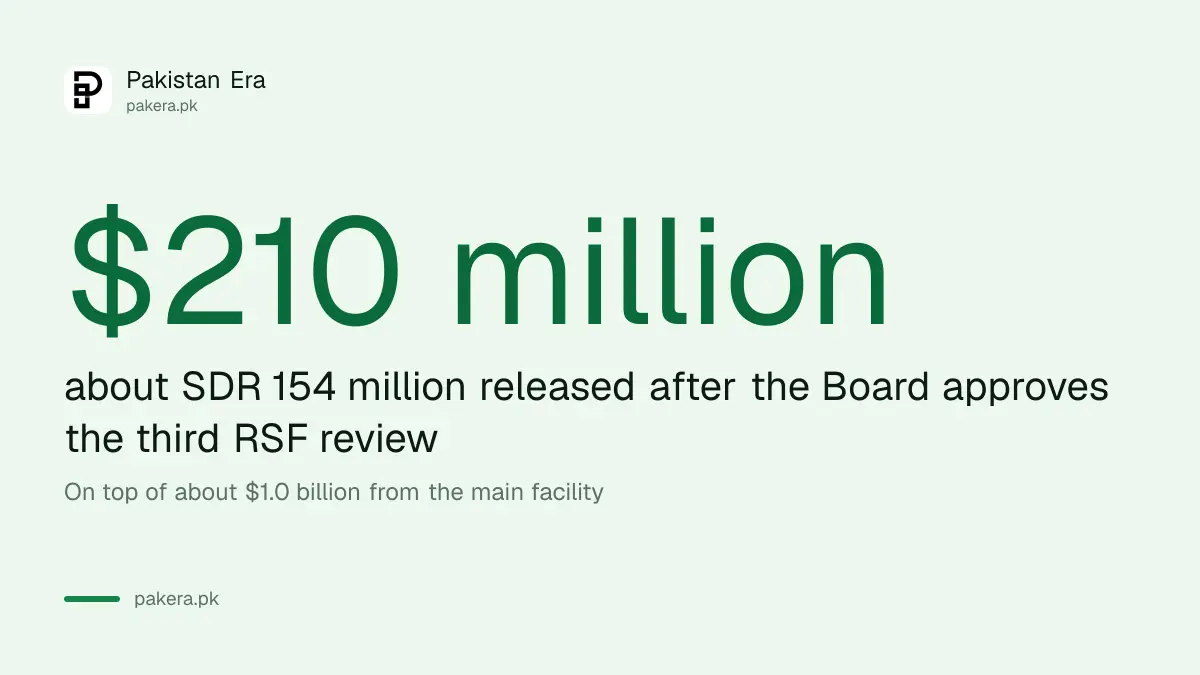
The RSF is an IMF facility for countries facing climate risk. Pakistan's runs for 28 months alongside the main programme. The 7 October agreement covers the RSF's third review and, once the Executive Board approves it, Pakistan receives about $210 million, which the IMF gives as SDR 154 million, on top of about $1.0 billion from the main facility.
The IMF's own financial data, which we set out in our report on how much IMF money Pakistan has received, showed the RSF agreed at SDR 1 billion with SDR 307.6 million drawn when we last checked it on 10 October. The RSF money carries a longer repayment period and a lower rate than the main loan, which is why the conditions are reforms rather than budget targets.
Irrigation water pricing and collection means higher, better collected abiana for farmers
The IMF asks Pakistan to "advance irrigation water pricing and collection". Irrigation water in Pakistan is charged through abiana, a per-acre water rate set and collected by each province, and the rates have for years been far below the cost of running the canals. The IMF wants two things: rates that reflect cost, and collection that actually happens.
Who feels it: canal-irrigated farmers in Punjab and Sindh first, since they use most of the system. The province sets the rate, not Islamabad, so the change arrives as a provincial notification. No new abiana rate was announced with this review, and the IMF statement gives no figure. If a notification comes, it will come from the provincial irrigation department, and we will report it when it does.
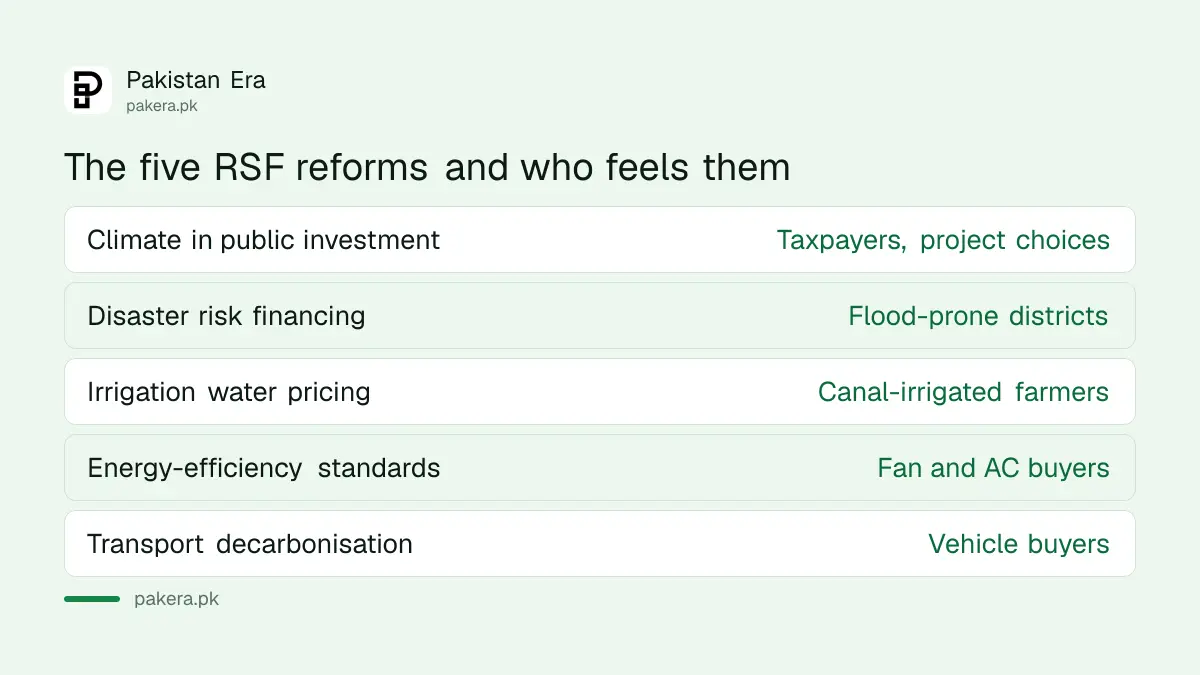
| RSF reform in the IMF statement | Who in Pakistan feels it | Which authority acts |
|---|---|---|
| Climate considerations in public investment planning | Taxpayers, through which projects are funded | Planning Commission, provincial P&Ds |
| Disaster risk financing and coordination | Flood-prone districts, insurance buyers | Finance Division, NDMA, provinces |
| Irrigation water pricing and collection | Canal-irrigated farmers | Provincial irrigation departments |
| Energy-efficiency standards | Buyers of fans, motors, ACs and appliances | NEECA, PSQCA |
| Transport decarbonisation | Vehicle buyers, fuel users | Federal ministries, provinces |
Energy-efficiency standards change what appliances can be sold
The statement asks for "energy-efficiency standards". In Pakistan that is the job of the National Energy Efficiency and Conservation Authority, NEECA, which sets minimum performance standards and star labels for products such as fans, motors and air conditioners, with the Pakistan Standards and Quality Control Authority enforcing the standard. A tighter standard removes the cheapest, most wasteful models from the shelf.
Who feels it: anyone buying a fan or an air conditioner, in both directions. The purchase price of a compliant model is usually higher, and the electricity bill is lower for years afterwards. For a household paying the tariffs the IMF also wants adjusted on time, as our report on what the IMF asked on 7 October explains, the efficiency standard is the one condition that cuts a bill rather than raising it.
Disaster risk financing means paying for the next flood before it happens
The IMF asks Pakistan to "strengthen disaster risk financing and coordination". Disaster risk financing is money arranged in advance, through insurance, contingent credit lines or a reserve fund, so a flood does not have to be paid for by cutting other spending or borrowing in a hurry. The 2022 floods were paid for the hard way, and the IMF wants a standing arrangement instead.
Who feels it: districts that flood, and the federal budget that pays. The practical sign of progress would be a disaster insurance or contingent financing arrangement announced by the Finance Division, or a provincial crop insurance scheme with a public backstop. None was announced with this review. The IMF statement names the goal, not the instrument.
Transport decarbonisation is the policy behind the electric bike and car concessions
The last item is "transport decarbonisation", which means shifting vehicles and fuel use away from petrol and diesel. In Pakistan that is the electric vehicle policy, the electric bike schemes and the tax concessions on electric cars. The IMF has questioned one of those concessions already, as our report on the IMF and the 1 per cent sales tax on electric cars noted, so decarbonisation and tax discipline can pull in opposite directions inside the same programme.
Who feels it: anyone deciding between a petrol bike and an electric one. The direction of policy is towards electric, and the RSF condition keeps it there. The price of that policy, in subsidies and lost tax, is the part the main programme watches.
How to tell whether an RSF condition has been met
The IMF publishes a staff report after each review with a table of reform measures and their status. Until then, the signs are provincial and federal notifications. Here is how to track them.
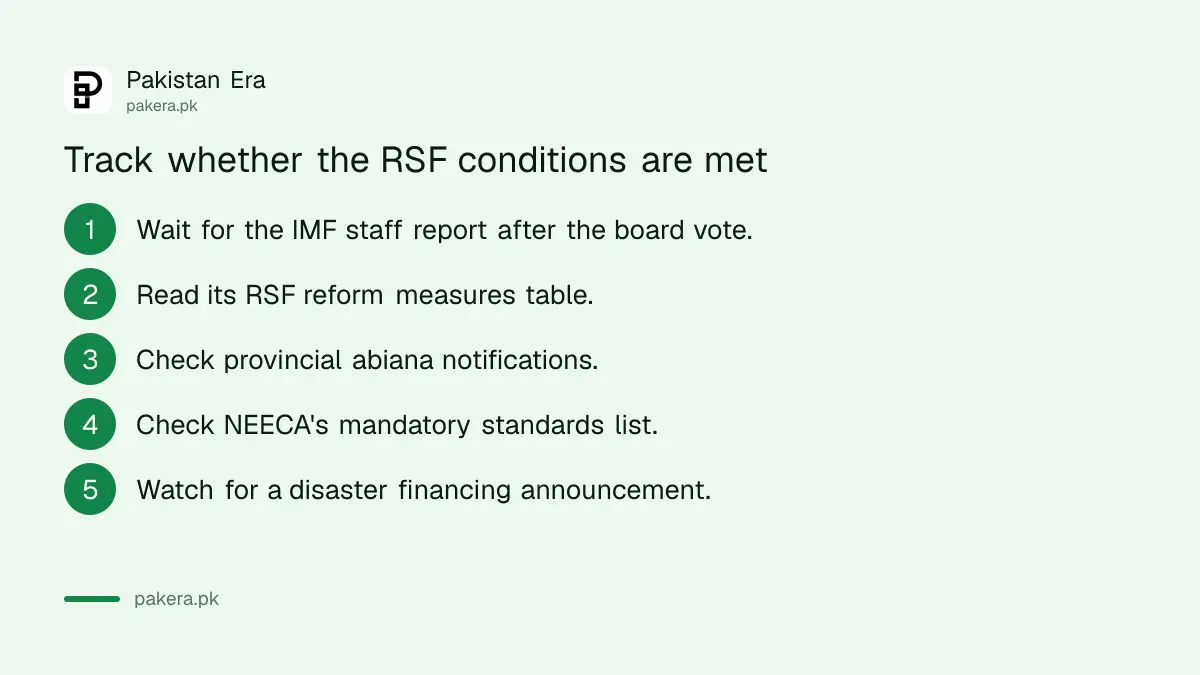
- Watch the IMF's Pakistan country page for the staff report on the fourth EFF and third RSF reviews, after the board vote.
- In the report, find the table of RSF reform measures. Each has a due date and a status of met, not met or in progress.
- For abiana, check your provincial irrigation department's notifications for a revised water rate.
- For appliances, check NEECA's list of mandatory standards before buying a fan or an air conditioner.
- For disaster financing, watch Finance Division press releases for an insurance or contingent credit announcement.
Common questions
What is the IMF's RSF loan for Pakistan?
The Resilience and Sustainability Facility is a 28-month IMF climate loan that runs alongside the main $7 billion programme. Its third review was agreed with IMF staff on 7 October 2026 and releases about $210 million after board approval.
What conditions are attached to the climate loan?
The IMF statement lists five: climate in public investment planning, disaster risk financing, irrigation water pricing and collection, energy-efficiency standards, and transport decarbonisation.
Will abiana go up because of the IMF?
The IMF asks for irrigation water pricing and collection to advance. Rates are set by provinces, and no new rate was announced with this review.
Do energy-efficiency standards raise prices?
A compliant fan or air conditioner usually costs more to buy and less to run. The standard removes the most wasteful models from sale.
When does Pakistan get the $210 million?
After the IMF Executive Board approves the third RSF review. No board date was given in the 7 October statement.
How we verified this
What we checked, where we read it, and what we could not confirm.
Last checked 19 October 2026. The RSF review, the $210 million (SDR 154 million) and the five reform areas are from the IMF's 7 October 2026 statement, read on 19 October. The SDR 1 billion arrangement and SDR 307.6 million drawn are from the IMF's financial data as we reported them on 10 October. The descriptions of abiana, NEECA's role and disaster risk financing are our explanation of how each reform works in Pakistan, and the statement itself names no rates, products or instruments. We could not read the staff report, which had not been published when we checked.
About the author

Global Affairs & Political Economy Writer
Muhammad Hatim is a book lover who started writing because he enjoys it. At Pakistan Era he writes about international relations, geopolitics and the global economy, with a particular interest in South Asia and the forces behind current events.