JS Bank Profit Rates 2026: Savings at 10.00%, Term Deposits Up to 11.29% (Full List)
JS Bank profit rates 2026: savings 10.00% up to Rs 10 million, 1 year deposits 10.94% to 11.29% from 27 October. Every tenor, monthly payout and break rule.
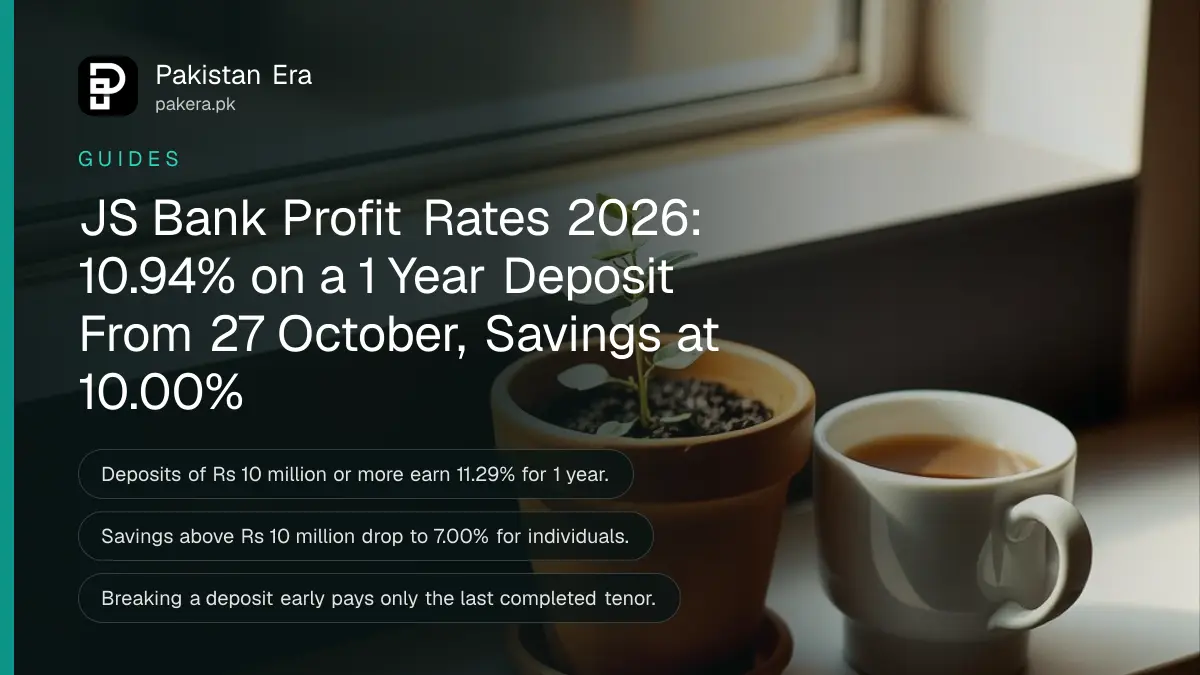
JS Bank's new term deposit rates, effective 27 October 2026, pay up to 11.29% a year: 10.94% on a 1 year deposit of Rs 100,000 to Rs 4,999,999 held to maturity, rising to 11.29% from Rs 10 million. Its savings accounts pay individuals 10.00% on balances up to Rs 10 million. The term deposit sheet took effect the day after the State Bank of Pakistan raised its policy rate to 12%.
We read JS Bank's rupee rate sheet, "LCY Rack Rates 27 Oct 26", on 28 October 2026. Below is every savings tier, the full term deposit table for each payout option, what Rs 1 million earns, and the early withdrawal rule that can cut your profit.
JS Bank savings accounts pay 10.00% to individuals up to Rs 10 million
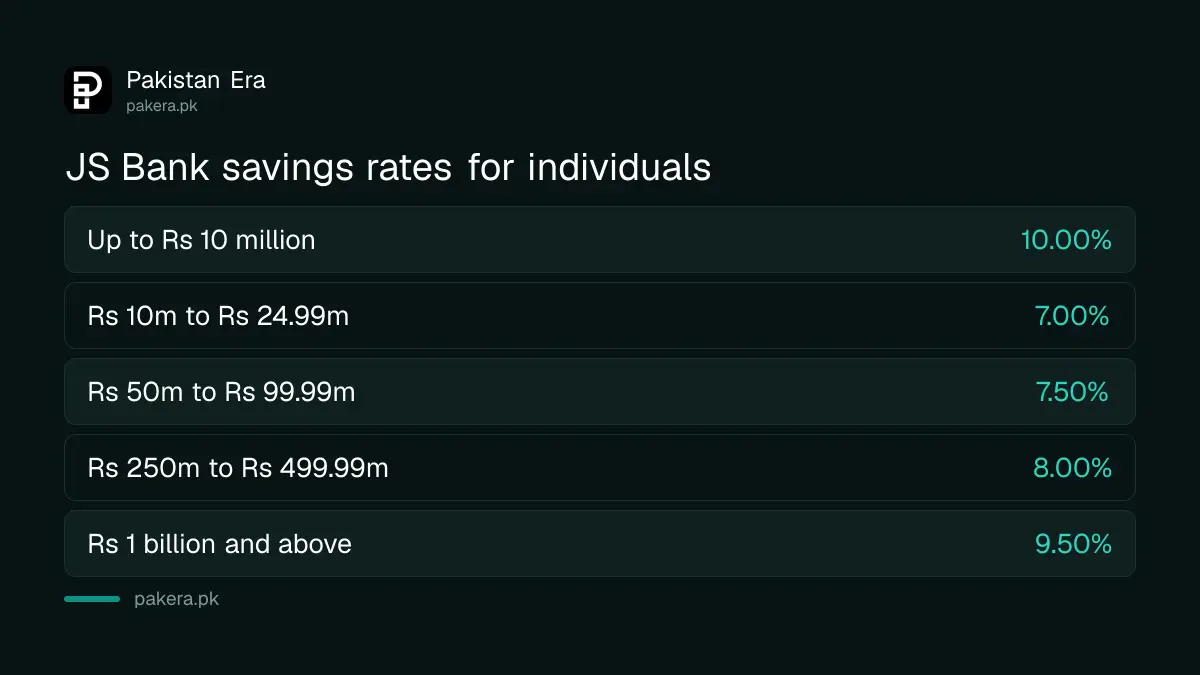
JS Bank pays 10.00% a year on rupee savings for individuals with balances up to Rs 10 million, from 1 October 2026. Above that, balances move into tiers that pay 7.00% to 9.50%. Companies and institutions start at 7.00%.
The 10.00% is the minimum rate that SBP requires for eligible individuals. JS Bank's sheet says so itself: eligible accounts under SBP's BPRD Circular No. 15 of 2026 "will receive the mandated minimum profit rate". The same rates apply to all of these accounts: PLS Saving, Rupee Plus Saving, Muhib-e-Watan, Payroll Saver, JS Asaan Savings, Asaan Digital Account Savings, Asaan Digital Remittance Savings, Freelance Digital Account Savings, JS Her Saving, JS RDA Saving and Digital Savings Account.
| Balance (individuals) | Rate a year |
|---|---|
| Up to Rs 10,000,000 | 10.00% |
| Above Rs 10 million to Rs 24,999,999 | 7.00% |
| Rs 25 million to Rs 49,999,999 | 7.25% |
| Rs 50 million to Rs 99,999,999 | 7.50% |
| Rs 100 million to Rs 249,999,999 | 7.75% |
| Rs 250 million to Rs 499,999,999 | 8.00% |
| Rs 500 million to Rs 749,999,999 | 8.25% |
| Rs 750 million to Rs 999,999,999 | 8.50% |
| Rs 1 billion and above | 9.50% |
Notice the drop just above Rs 10 million. An individual with Rs 12 million earns 7.00% on the sheet, not 10.00%. If your balance sits just over the line, splitting it may be worth asking your branch about, since the 10.00% depends on eligibility under SBP's rule.
JS Bank term deposits pay 8.95% to 11.29% from 27 October
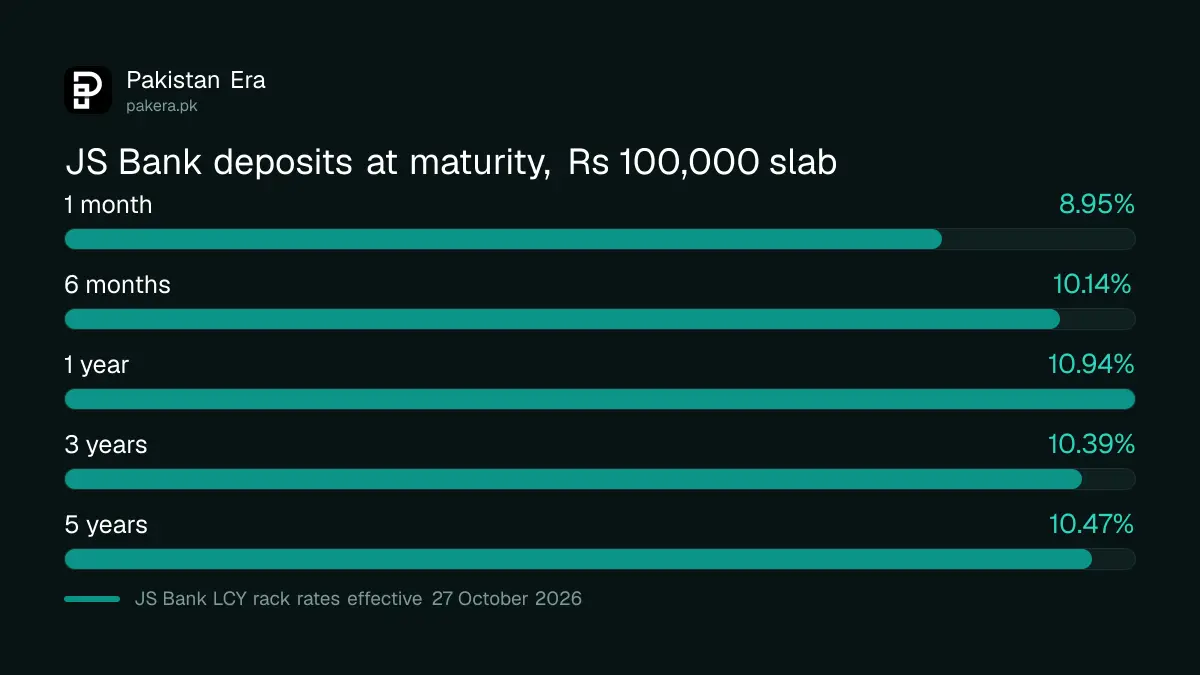
JS Bank's term deposits pay most on a 1 year deposit held to maturity: 10.94% for Rs 100,000 to Rs 4,999,999, 11.19% for Rs 5 million to Rs 9,999,999, and 11.29% from Rs 10 million. Rates are lower if you take profit monthly or quarterly.
Here is the "at maturity" row for every tenor and amount, from the sheet effective 27 October 2026.
| Tenor | Rs 100,000 to Rs 4.99m | Rs 5m to Rs 9.99m | Rs 10m and above |
|---|---|---|---|
| Up to 1 month | 8.95% | 9.20% | 9.30% |
| 3 months | 9.95% | 10.20% | 10.30% |
| 6 months | 10.14% | 10.39% | 10.49% |
| 1 year | 10.94% | 11.19% | 11.29% |
| 2 years | 10.36% | 10.61% | 10.71% |
| 3 years | 10.39% | 10.64% | 10.74% |
| 5 years | 10.47% | 10.72% | 10.82% |
The 1 year deposit beats the 2, 3 and 5 year ones. That is unusual and worth noticing. A longer deposit locks your money for longer at a lower rate, and the bank can change its sheet at any time. The sheet itself says the rates "are indicative and are subject to changes".
Monthly profit pays less than profit at maturity
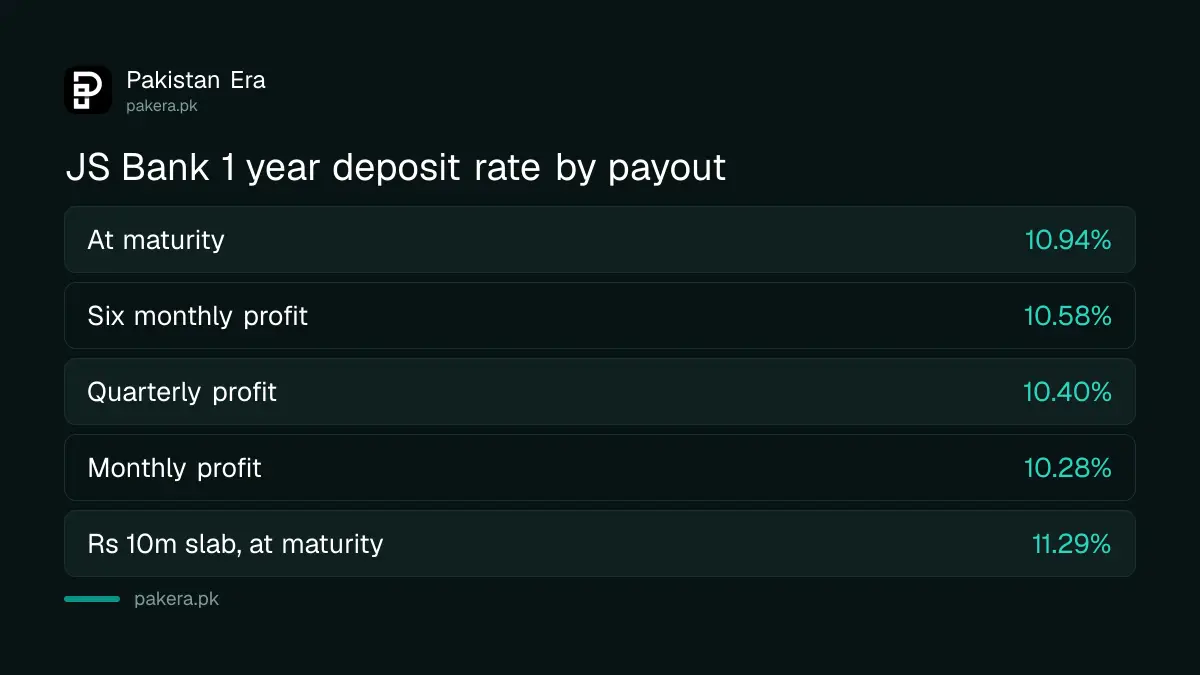
If you want profit every month, JS Bank pays 10.28% on a 1 year deposit of Rs 100,000 to Rs 4.99 million, against 10.94% at maturity. Quarterly profit pays 10.40% and six monthly profit 10.58% on the same deposit.
| Payout, Rs 100,000 to Rs 4.99m | 3 months | 6 months | 1 year | 3 years | 5 years |
|---|---|---|---|---|---|
| Monthly profit | 9.52% | 9.58% | 10.28% | 9.75% | 9.82% |
| Quarterly profit | Not offered | 9.80% | 10.40% | 9.79% | 9.84% |
| Six monthly profit | Not offered | Not offered | 10.58% | 9.84% | 9.87% |
| At maturity | 9.95% | 10.14% | 10.94% | 10.39% | 10.47% |
Each larger slab adds a fixed step. The Rs 5 million slab pays 0.25 points more than the table above, and the Rs 10 million slab pays 0.35 points more. For example, monthly profit on a 1 year deposit is 10.53% and 10.63% in those slabs.
Rs 1 million for a year at JS Bank earns about Rs 109,400 before tax
A Rs 1 million JS Bank deposit for 1 year at 10.94% earns about Rs 109,400 at maturity, before tax. With monthly profit at 10.28%, the same deposit pays about Rs 8,567 a month. In a savings account at 10.00%, it earns about Rs 8,333 a month.
These are our own sums from the published rates. Withholding tax comes off the profit, and the rate depends on whether you are on the active taxpayer list. Check the tax on bank profit before you plan around the number.
- Decide whether you need the money within a year. If you might, a savings account at 10.00% keeps it free.
- If you can wait a year, compare 10.94% at maturity with 10.28% paid monthly, and choose by whether you need the income.
- Ask the branch for the rate on the day you book. The sheet can change, and your deposit locks the rate at booking.
- Keep the deposit receipt and check the profit on your statement when it is paid.
The savings figure may also change soon. After the SBP policy rate rise to 12%, SBP's rule points to a minimum savings rate of 10.5% from 1 November 2026. JS Bank's savings table was still dated 1 October when we read it.
Breaking a JS Bank deposit early cuts your profit
If you cash a JS Bank term deposit before maturity, profit is paid only for the last completed tenor, at the rate that applied when you booked. Deposits of 1 year or more broken within the first year also carry a charge for CRR.
CRR is the cash reserve requirement, the share of deposits a bank must keep with SBP. JS Bank's sheet does not give the amount of that charge, so ask before you book. Here is how the rule works: if you book a 1 year deposit and break it after 7 months, the last completed tenor is 6 months, so you would get the 6 month rate instead of 10.94%.
That is our reading of the bank's wording. Your branch confirms the actual figure. The same problem exists at other banks, and breaking a fixed deposit early at HBL and Allied Bank follows a similar pattern. For how JS Bank compares with other banks on savings, see the savings account rates at big banks.

Common questions
What is the JS Bank savings account profit rate in 2026?
JS Bank pays individuals 10.00% a year on savings balances up to Rs 10 million, from 1 October 2026. Above Rs 10 million the rate falls to 7.00% and rises in tiers to 9.50% from Rs 1 billion.
What is the JS Bank 1 year term deposit rate?
From 27 October 2026, it is 10.94% at maturity for Rs 100,000 to Rs 4,999,999, 11.19% for Rs 5 million to Rs 9,999,999, and 11.29% from Rs 10 million. Monthly profit pays less.
What is the minimum amount for a JS Bank term deposit?
The rate sheet starts its term deposit table at Rs 100,000. Smaller amounts are not listed on the sheet, so ask a branch.
Does the JS Bank Freelance Digital Account earn profit?
Yes. Freelance Digital Account Savings is one of the accounts on JS Bank's savings sheet, so it earns the same 10.00% up to Rs 10 million.
Are JS Bank's rates fixed?
No. The sheet calls them indicative and subject to change. A term deposit keeps the rate from the day you book it.
How we verified this
What we checked, where we read it, and what we could not confirm.
We read JS Bank's LCY rack rates sheet on 28 October 2026. It is linked from the documents list on JS Bank's website. The savings rates are effective from 1 October 2026 and the term deposit rates from 27 October 2026. All sums are our arithmetic. We could not verify the size of the CRR charge on early encashment, or whether JS Bank will revise its savings sheet on 1 November.
About the author

Senior Writer, Public Services and Technology
Shahid joined us in 2024 as an author. He is a senior contributor to Pakistan's leading technology websites. He writes detailed articles, mostly covering his expertise in the latest tech, mobiles, apps, gadgets, and step-by-step guides. His ideology is to help people understand the latest trends and explain complex methods through very easy-to-understand guides.