Under 18 and Sitting an HEC Test? Get a NADRA Juvenile Card Before the Test Date
HEC says candidates under 18 must show a NADRA Juvenile Card to enter a test centre. See which tests are next, the 5 steps to get one and how to plan the days.
HEC will not let a candidate under 18 into a test centre without a NADRA Juvenile Card. The notice sits at the top of the Education Testing Council announcements page. It says candidates below 18 who do not have the card should get it from NADRA before the test date, and must show it to enter the centre. The next HEC sittings are close: the USAT undergraduate test is on 25 October 2026, with roll number slips due around 16 October.
We read the Education Testing Council announcements page on hec.gov.pk on 11 October 2026. We also reused what we had already confirmed from NADRA about the card. Where a point is our reading rather than HEC's words, we say so.
HEC asks every candidate under 18 for a Juvenile Card
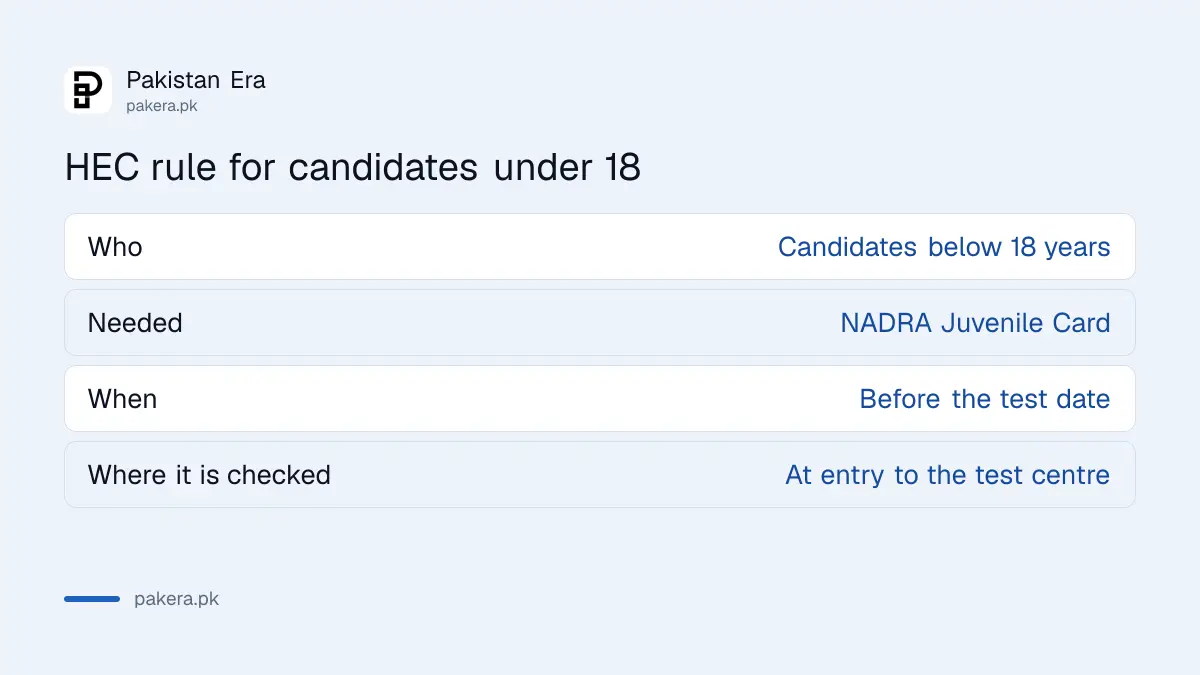
The notice reads, in plain terms: candidates below 18 years of age who do not have a Juvenile Card are advised to obtain the card from NADRA before the test date, and the card must be presented for entry to the test centre.
That makes the card a gate. A candidate with a perfect roll number slip but no card risks being turned away at the door. HEC's wording is an advice with a firm condition attached, and it is the safest course to treat it as a rule.
The notice does not say whether a B-Form is accepted instead. It names the Juvenile Card only. If you hold only a B-Form, call HEC's helpline before the test: 051-111-119-432, or use its online help desk at onlinehelp.hec.gov.pk.
Which HEC tests are coming up
Three HEC sittings fall in the next five weeks. Only some of them take candidates under 18. The undergraduate test, the USAT, is the one where students of 17 or younger are most likely to appear.
| Test | Date | Who sits it |
|---|---|---|
| USAT, undergraduate admission test | Sunday 25 October 2026 | Students finishing 12 years of education |
| HAT, MS, MPhil and PhD | Sunday 25 October 2026 | Graduate applicants, normally adults |
| LAT, law admission test | Sunday 15 November 2026 | Students applying to a five year LLB |
Our guide to the HEC USAT on 25 October shows the paper pattern and the slip date. Registration for the USAT closed on 2 October, so the card only matters to you if you already registered.
The LAT registration is still open until 20 October, and its guide is in our note on how to register for the HEC LAT. A student who finished intermediate at 17 may well sit it.
Get a Juvenile Card in five steps
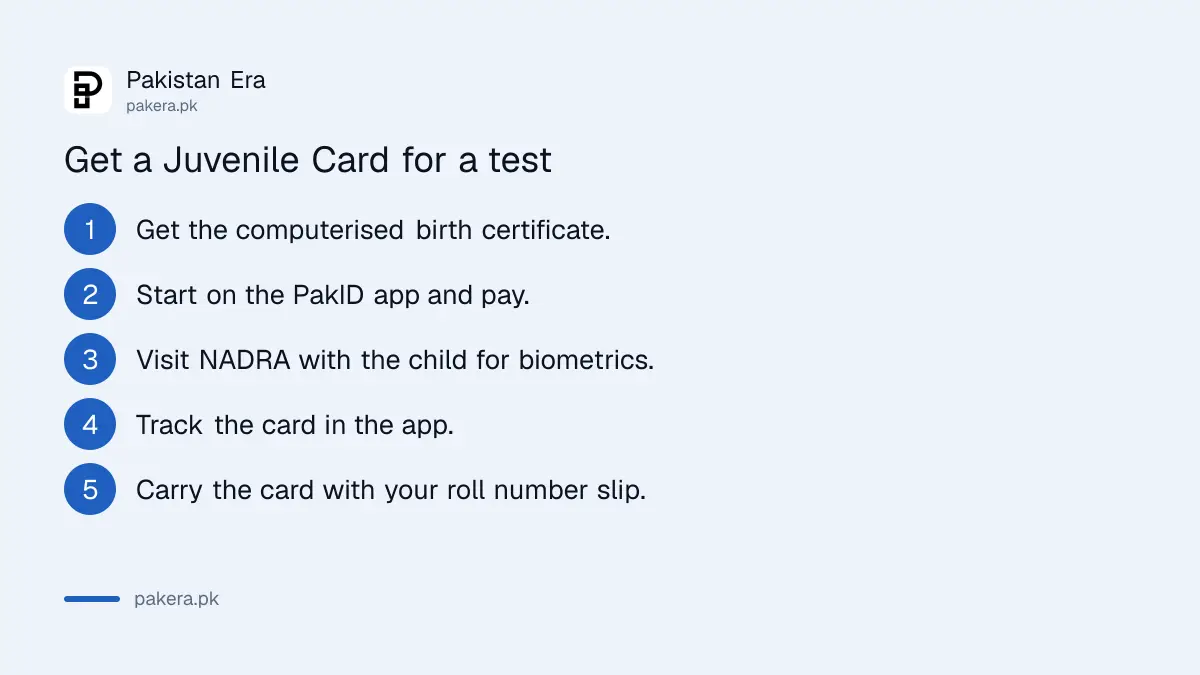
A Juvenile Card is NADRA's photo identity card for a child under 18. The child must attend in person, and NADRA asks for the child's computerised birth certificate. You can start on the PakID app or go to a NADRA Registration Centre.
- Get the child's computerised birth registration certificate from the union council, if you do not have it.
- Download the PakID app, sign in, and choose the new Juvenile Card option.
- Enter the details, upload the birth certificate and pay the fee. NADRA says processing starts only after payment.
- Take the candidate to a NADRA Registration Centre for the photo and biometrics, if the app asks.
- Track the application in the app and collect the card, then keep it with the roll number slip.
The full walk through is in our guide to applying for a NADRA Juvenile Card. Read it before you go, because a spelling mismatch between the birth certificate and the parents' CNICs can stop the form at the counter.
Count the days before you start
NADRA does not publish a Juvenile Card processing time or a separate fee on the pages we read. That is the risk. A card needed by 25 October should be applied for this week, not on 20 October.
We could not find a stated turnaround for the card, so we cannot promise it will arrive in time. Check the time and the charge in the PakID app before you pay. NADRA's fee page lists only the Child Registration Certificate at Rs 50 normal or Rs 500 executive, and no urgent tier for child documents.
| Step | Target date for a USAT candidate |
|---|---|
| Apply for the card | This week, by 14 October |
| Roll number slip issued, tentative | Friday 16 October |
| Check the card and the slip match | By 20 October |
| Test day | Sunday 25 October |
The 14 October line is our own planning advice, not an HEC or NADRA date. Names on the card and the slip must match exactly, so check them before test day.
Turning 18 changes what you need
By HEC's wording, the card is for candidates below 18. A candidate who turns 18 before the test date would hold a CNIC instead. NADRA issues the first adult card free of charge at 18, as our guide to the first CNIC at 18 explains.
That is our reading of HEC's age wording. If you turn 18 close to the test, ask HEC which document it will accept. Do not turn up with an expired juvenile card either, because the card lapses at 10 and 18, as the NADRA validity table shows.
Common questions
Do I need a Juvenile Card for the HEC USAT?
If you are under 18 on the test date, yes. HEC says candidates below 18 must present the card to enter the test centre.
Is a B-Form accepted instead of a Juvenile Card?
HEC's notice does not say so. Ask HEC on 051-111-119-432 before the test.
How do I get a Juvenile Card?
Apply on NADRA's PakID app or at a NADRA Registration Centre with the child's computerised birth certificate. The child must attend.
How much does the Juvenile Card cost?
NADRA's fee page has no separate line for it. Check the amount in the PakID app before you pay.
What if I turn 18 before the test?
By HEC's wording the card is for candidates below 18, so an 18 year old would use a CNIC. Confirm with HEC if you are close to the date.
How we verified this
What we checked, where we read it, and what we could not confirm.
Last checked on 11 October 2026. We read HEC's Education Testing Council announcements page, and NADRA's Juvenile Card and fee pages as recorded in our earlier guides. The notice carries no date of its own. We did not verify NADRA's processing time for the card, because NADRA does not state one.
About the author

Public Services and Education Journalist
Fajr Riaz is a journalist and content writer at Pakistan Era, based in Lahore. She covers the questions people meet in everyday life in Pakistan: how a public service works, what a change in the rules means, and where to find a reliable answer.