NAFSA Act in Pakistan: Up to 3 Years Jail for Fake Pesticides and Animal Imports Without Health Papers
Pakistan's NAFSA Act 2026 sets jail up to 3 years and fines up to Rs 3 million for fake pesticides, false export reports and imports without health papers.
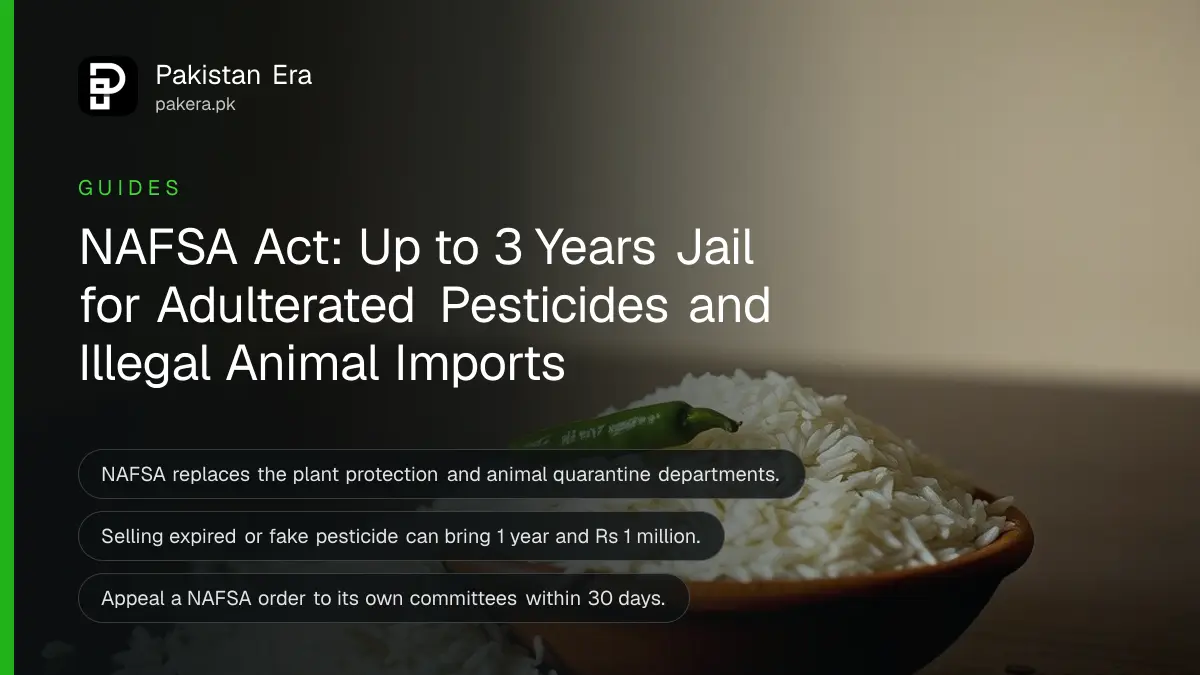
Short answer: The National Agri-trade and Food Safety Authority Act, 2026 set up NAFSA, a federal body that checks the safety and quality of food, plants, animals and pesticides that Pakistan exports and imports. Selling an adulterated pesticide, or importing an animal without a valid health certificate, can now bring up to three years in jail or a fine up to Rs 3 million, or both. The Act applies to the whole of Pakistan and came into force at once.
NAFSA replaces two federal departments, the Department of Plant Protection and the Animal Quarantine Department. If you export rice, mangoes, meat or seafood, import animals or seed, or sell pesticides, this law now sets your penalties. Here is what changed, who it covers and how to challenge a NAFSA decision.
NAFSA is the new federal food and plant safety regulator for trade
The Act received the President's assent on 19 December 2025 and was published in the Gazette on 12 January 2026. Its stated purpose is to regulate the quality of agrochemicals, farm produce, plants and animals used as food or feed that are exported or imported, using international sanitary and phytosanitary (SPS) standards. SPS simply means rules that keep pests and diseases out of food and farm trade.
Among its listed functions, NAFSA issues and cancels registrations, certificates and licences, supervises business operators on food safety, names accredited testing laboratories, runs veterinary tests for export certificates and negotiates market access abroad. It can also charge fees and impose fines. It coordinates with the provinces, which still run most farm and food matters inside their borders.
Four old laws end on a date the government notifies
Section 34 lists four laws that stand repealed once the federal government notifies a date in the Gazette. Until then, actions, licences and permits issued under them continue. They are treated as if taken under the new Act.
| Old law | What it covered |
|---|---|
| Pakistan Plant Quarantine Act, 1976 | Pests and diseases in imported and exported plants |
| Pakistan Animal Quarantine (Import and Export of Animals and Animal Products) Ordinance, 1979 | Health checks on animals and animal products crossing the border |
| Agricultural Pesticides Ordinance, 1971 | Registration and sale of pesticides |
| Agricultural Produce (Grading and Marking) Act, 1937 | Grade marks on farm produce |
On the same notified date, the Department of Plant Protection and the Animal Quarantine Department are abolished. Their trade work continues for up to six months while NAFSA makes its regulations and hires staff. A licence you already hold stays valid through this change.
Fake pesticides and illegal animal imports carry up to 3 years in jail
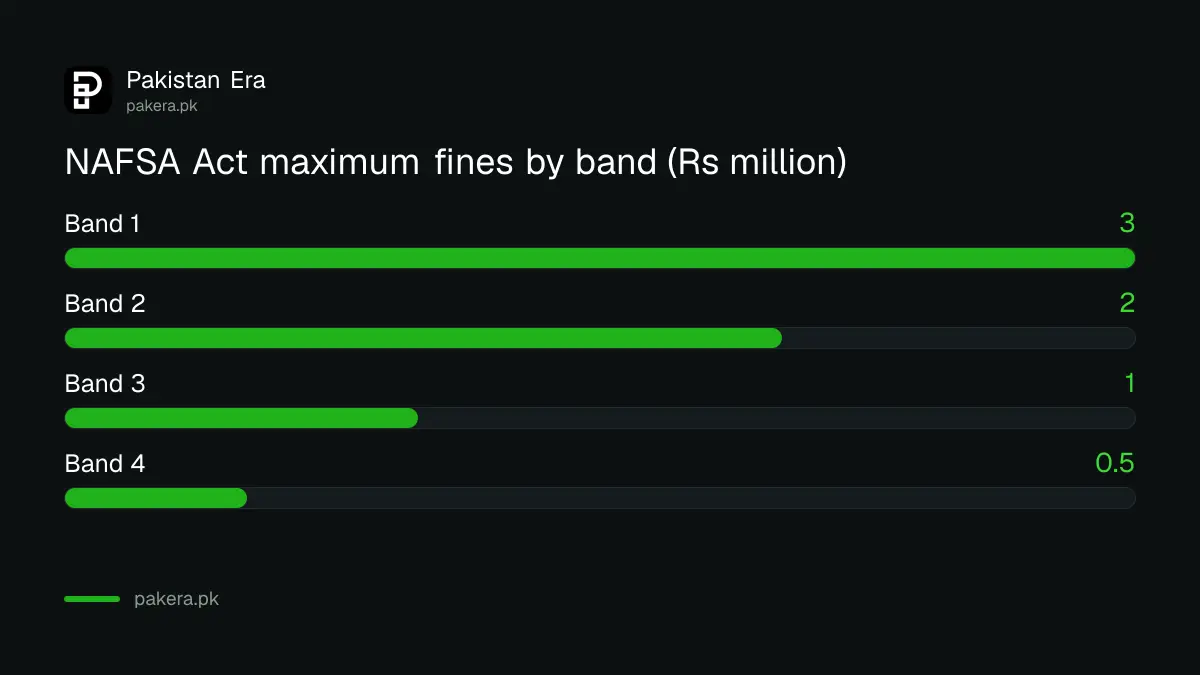
Section 20 lists 27 offences and section 21 sorts them into four penalty bands. The Court of Sessions hears these cases, but only on a written complaint from NAFSA's Director General or an authorised officer. If an officer orders you to stop and you carry on, the court can add a fine for every day the offence continues.
| Band | Examples of the offence | Maximum punishment | Extra fine per day |
|---|---|---|---|
| 1 | Importing animals from a banned country; importing or exporting an animal without a valid or genuine health certificate; dealing in adulterated pesticide; refusing inspection of a formulation plant | 3 years, Rs 3 million, or both | Up to Rs 50,000 |
| 2 | Supplying export animal products from an unregistered plant; refusing quarantine; removing animals from quarantine; storing substandard pesticides | 2 years, Rs 2 million, or both | Up to Rs 25,000 |
| 3 | Exporting without meeting the buyer country's rules; fake lab or pre-shipment reports; banned pesticides; selling unregistered, fake or expired pesticides; obstructing an officer | 1 year, Rs 1 million, or both | Up to Rs 10,000 |
| 4 | Trading without documents or with undeclared goods; incomplete pesticide labels or seals; misleading an officer; refusing to show registers | Fine up to Rs 500,000 | Up to Rs 1,000 |
Adulterated pesticide appears twice in the list. Clause (iii) puts making or selling it in band 1. Clause (xx) puts importing, selling or advertising adulterated or banned pesticide in band 3. The complaint and the court decide which clause applies to a case.
When a company commits an offence, the person in charge of its business and any director or partner can be punished too. They escape only if they prove the offence happened without their knowledge or that they took due care to prevent it. Goods forfeited on conviction are disposed of at the offender's cost.
What pesticide dealers and farmers should check
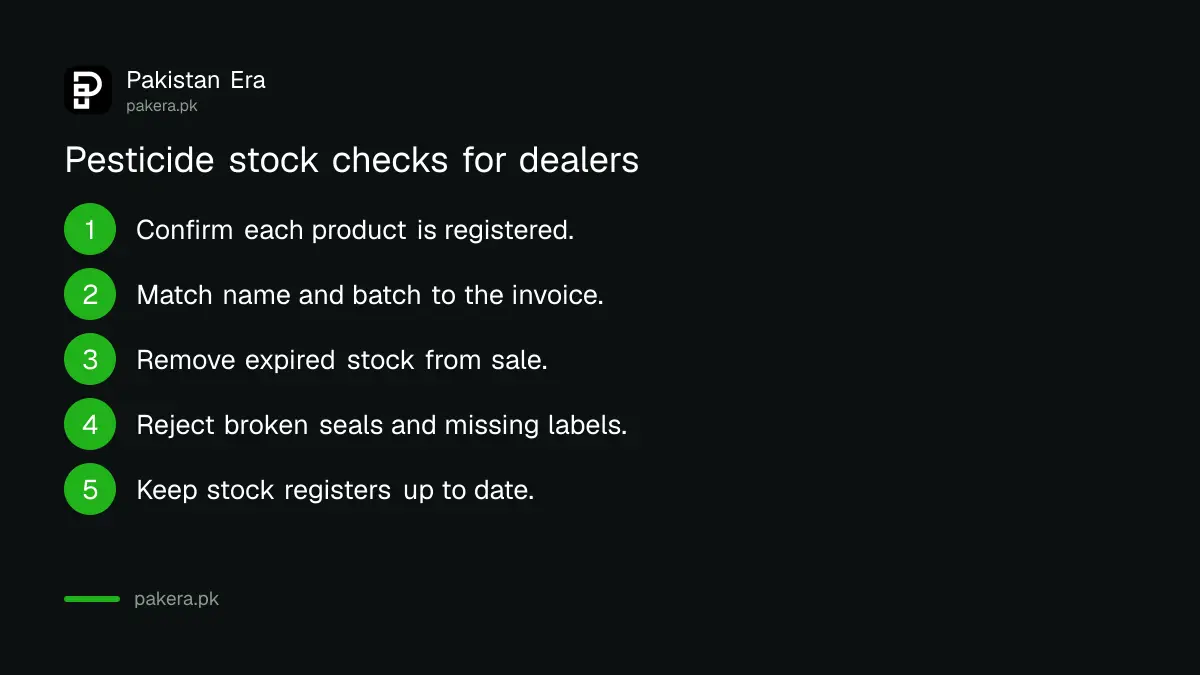
Several offences hit the ordinary pesticide shop, not just big importers. Selling or storing unregistered, fake, adulterated or expired pesticides, or bags and bottles with incomplete labels and seals, are all offences. A dealer should run a simple check on every stock delivery.
- Check each product is registered and match the name and batch to the supplier's invoice.
- Look at the expiry date and move old stock out of the sale area.
- Reject any bottle or bag with a broken seal or a missing label.
- Keep stock registers up to date, because refusing to show them is itself an offence.
- Keep your provincial dealer licence current, for example through the Punjab pesticide dealer licence process.
Farmers buying pesticide can protect themselves too. Ask for a receipt with the product's name and batch. In Balochistan, you can check an agricultural dealer's licence before you buy. In Punjab, report a suspect product on the Punjab agriculture helpline 0800-17000.
Exporters must meet the importing country's rules
For exporters, the key offences are about paperwork and the buyer's rules. Exporting animals or animal products without meeting the importing country's sanitary requirements is an offence. So is refusing special conditions set by the importing country, or submitting a fake lab report, pre-shipment inspection or certificate of origin.
Rice, fruit and meat are among Pakistan's growing exports, as the exports by product for July to September 2026 show. A single rejected container can cost a buyer. Under NAFSA, a forged report can now also cost the exporter a criminal case.
How to challenge a NAFSA decision in 30 days
The Act sets two internal steps. If NAFSA or one of its officers refuses your registration, licence or certificate, or makes another order against you, apply to its complaint resolution committee within 30 days. If you lose there, appeal to its appellate committee within 30 days of that order.
Use these steps. Section 26 says that, except as the Act provides, no NAFSA decision can be challenged in any court or tribunal, and no injunction can be granted against it. The committees are your main route.
Common questions
What is NAFSA in Pakistan?
The National Agri-trade and Food Safety Authority, a federal regulator for the safety and quality of food, plants, animals and pesticides in trade, set up by Act No. IV of 2026.
What is the punishment for selling adulterated pesticide?
Up to three years in jail, a fine up to Rs 3 million, or both, under clause (iii). A case brought under clause (xx) carries up to one year or Rs 1 million.
What is the penalty for selling expired pesticide?
Up to one year in jail, a fine up to Rs 1 million, or both.
Has the Agricultural Pesticides Ordinance 1971 been repealed?
It stands repealed on a date the federal government notifies in the Gazette. Until then, licences and actions under it continue.
Who can file a case under the NAFSA Act?
Only NAFSA's Director General or an authorised officer, by written complaint to the Court of Sessions.
How long do I have to appeal a NAFSA decision?
Thirty days to the complaint resolution committee, then thirty days from its order to the appellate committee.
How we verified this
What we checked and where we read it.
We checked the full text of the National Agri-trade and Food Safety Authority Act, 2026 (Act No. IV of 2026) on 15 November 2026, from the National Assembly's list of Acts. The Gazette of Pakistan copy is dated 12 January 2026 and records the President's assent on 19 December 2025. Offences are in section 20, penalties in section 21, cognizance in section 22, the committees in sections 24 and 25, the bar on courts in section 26, and the repeals and transition in sections 34, 38 and 39. The band labels in our penalty table are ours; the Act groups offences by clause number.
About the author

Global Affairs & Political Economy Writer
Muhammad Hatim is a book lover who started writing because he enjoys it. At Pakistan Era he writes about international relations, geopolitics and the global economy, with a particular interest in South Asia and the forces behind current events.