K-Electric Asks NEPRA to Keep Bin Qasim Unit 5 Until 2030 at Rs 225 Million a Year, Comments Open in Karachi
K-Electric wants NEPRA to keep Bin Qasim Unit 5 as a reserve until 2030 at Rs 225 million a year, about Rs 0.01 a unit. See the figures and how to comment.
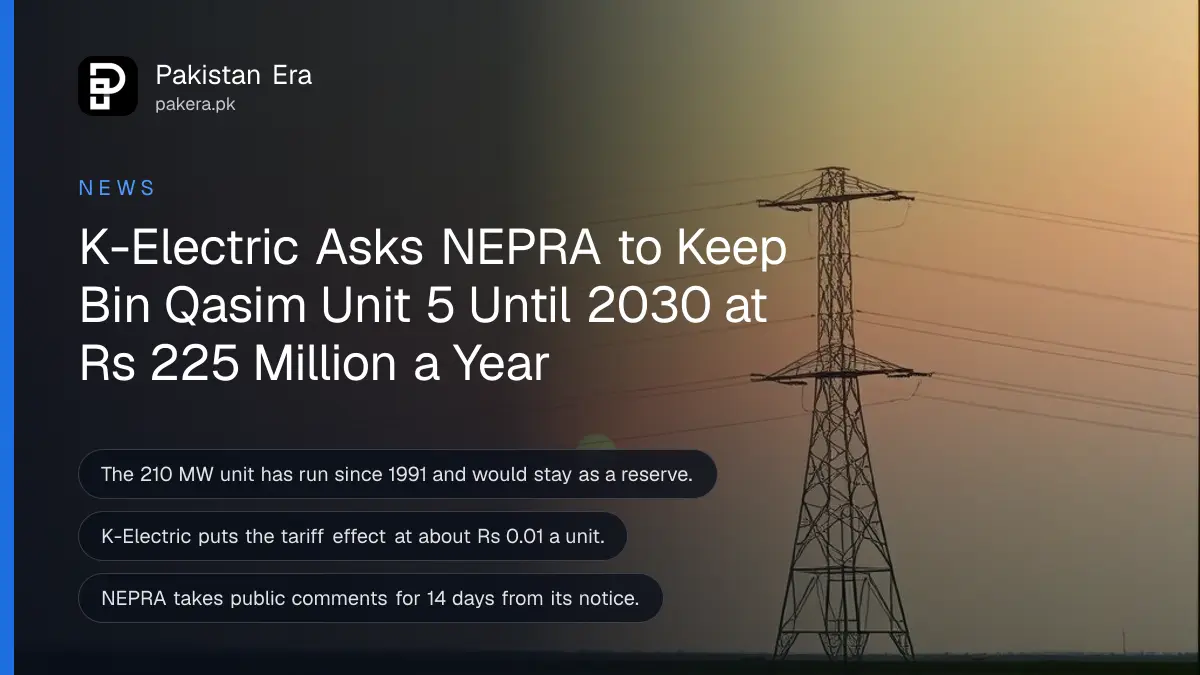
K-Electric has asked NEPRA to keep Unit 5 of its Bin Qasim Power Station I running as a reserve until June 2030, at a cost of about Rs 225 million a year that it wants passed into the tariff. NEPRA posted the request as a public notice on 30 October 2026 and gives the public 14 days from publication to send comments. K-Electric puts the tariff effect at about Rs 0.01 a unit.
Unit 5 is a 210 MW steam unit built by Hitachi and running since 1991. K-Electric, the company that supplies Karachi, says it needs the unit because gas supply is uncertain and its own forecast shows a shortfall at the night peak from 2028. We read NEPRA's notice and K-Electric's full application on NEPRA's website on 31 October 2026.
K-Electric wants Unit 5 kept as a secondary reserve until 2030
K-Electric's request is a "licensee proposed modification" to its generation licence, number GL/04/2002. It asks NEPRA to let it keep BQPS-I Unit 5 as secondary reserve until financial year 2030, dispatched only when it is cheaper than the alternatives.
The application letter is dated 4 August 2026 and signed for the chief executive. It says the licence was first issued on 18 November 2002 and was last modified on 15 September 2021. NEPRA's notice was posted on its website on 30 October 2026, almost three months after the letter.
| Item | What the application says |
|---|---|
| Plant | Unit 5, Bin Qasim Power Station I |
| Installed capacity | 210 MW, de-rated to 188.28 MW |
| Capacity kept available | 176 MW |
| Make and first operation | Hitachi, 1991 |
| Fuels | Natural gas, furnace oil (RFO) and RLNG |
| Requested life | Until 30 June 2030 |
| Yearly cost asked | Rs 152 million O&M plus Rs 73 million working capital |
| Tariff effect claimed | About Rs 0.01 per unit |
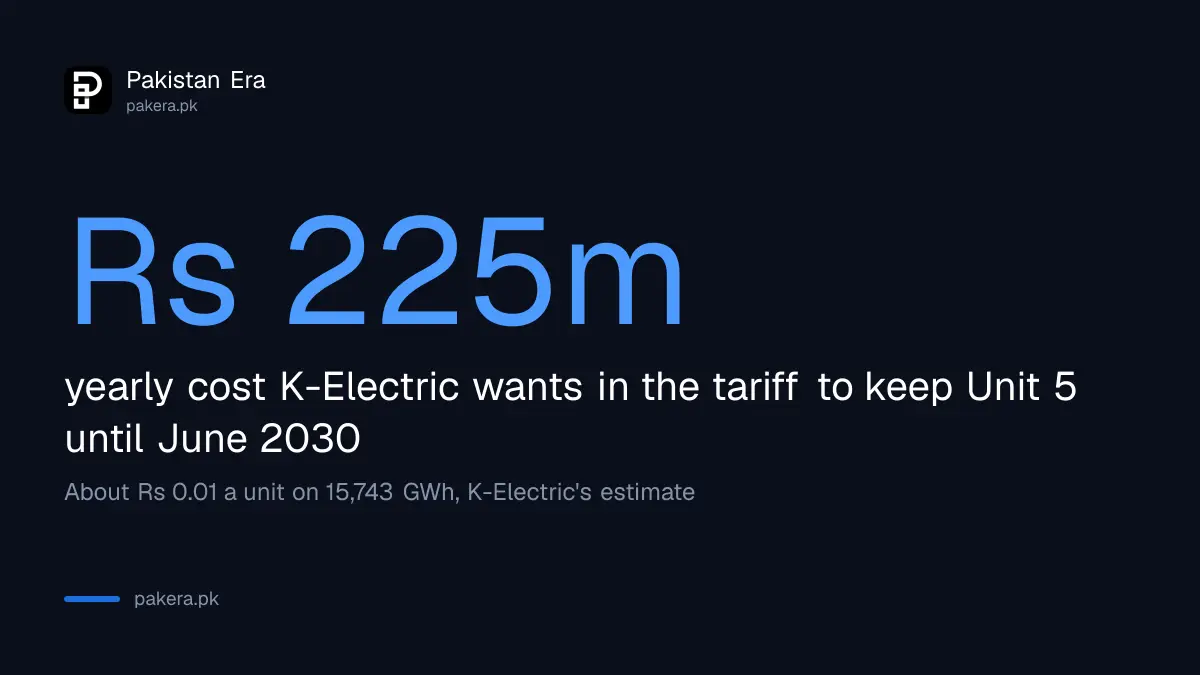
The yearly cost is Rs 225 million, or about Rs 0.01 a unit
K-Electric estimates operation and maintenance at Rs 152 million a year, of which Rs 142 million is fixed. It adds Rs 73 million of working capital. It divides the Rs 225 million total by 15,743 GWh of units it expects to bill in 2026-27.
That works out at about 1.4 paisa a unit by our arithmetic, which K-Electric rounds to Rs 0.01. On a 300 unit home bill, it would be about Rs 4 a month if passed on in full. How much actually reaches bills depends on NEPRA's decision and on the uniform tariff that sets the same rate for Karachi and the rest of Pakistan.
The application says the O&M figure assumes the unit runs about 10 per cent of the time. It excludes any overhaul. Fuel would be charged only on units the plant actually produces.
Working capital would have been Rs 392 million if K-Electric kept 15 days of furnace oil for the unit. It says it will not hold that stock for Unit 5 and will rely on the oil kept for Unit 6.
K-Electric's reasons are gas supply and a night peak shortfall
The application cites the "current geopolitical environment" and the force majeure declared on Pakistan's two RLNG terminals. It says fuel supply security is now a concern, and a dual fuel unit that can switch between gas and furnace oil protects supply.
Its own demand table shows night peak demand of 3,988 MW in 2026-27, rising to 4,202 MW by 2029-30. Total supply in the table stays at 3,998 MW, including 2,050 MW from the national grid. The resulting margin is 10 MW in 2026-27, then shortfalls of 43, 196 and 204 MW. Solar plants are left out because the peak comes at night.
| Year | Night peak demand | Supply available | Surplus or shortfall |
|---|---|---|---|
| 2026-27 | 3,988 MW | 3,998 MW | +10 MW |
| 2027-28 | 4,041 MW | 3,998 MW | -43 MW |
| 2028-29 | 4,194 MW | 3,998 MW | -196 MW |
| 2029-30 | 4,202 MW | 3,998 MW | -204 MW |
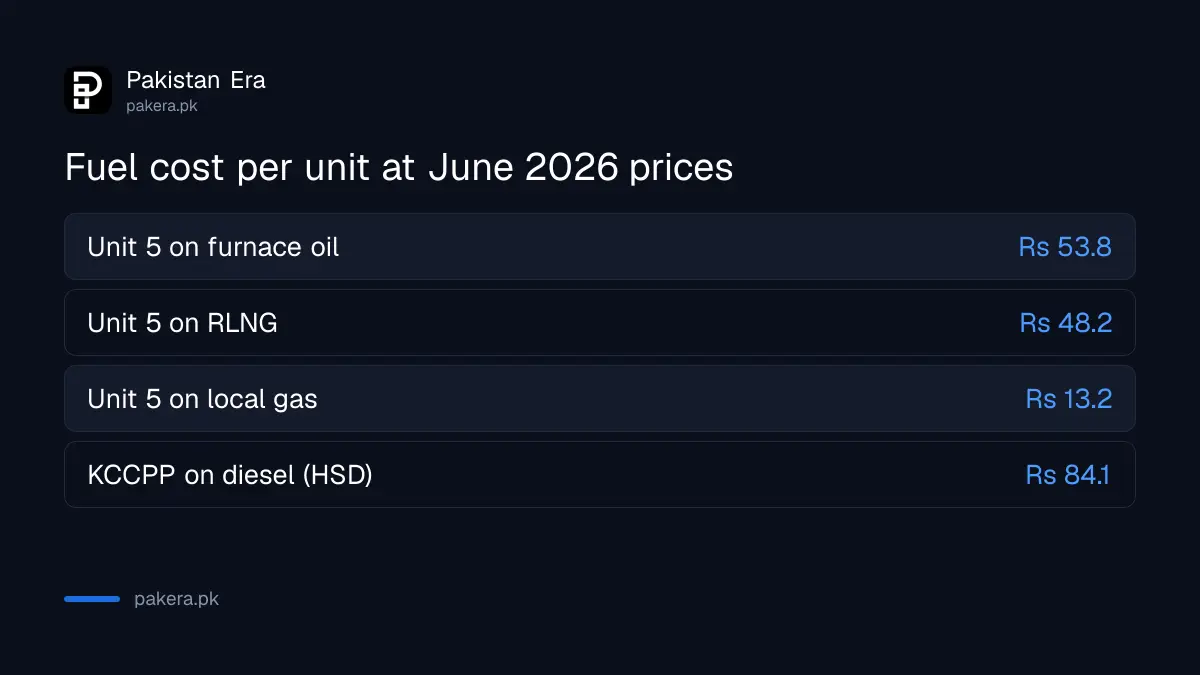
K-Electric also compares fuel cost per unit. It puts Unit 5 at Rs 53.8 on furnace oil, Rs 48.2 on RLNG and Rs 13.2 on local gas, against Rs 84.1 for its diesel (HSD) plant, KCCPP, all at June 2026 fuel prices. Its argument is that a reserve unit avoids burning costly diesel during a crisis.
Anyone can comment to NEPRA within 14 days
NEPRA's notice invites stakeholders, affected persons and the general public to send comments for or against the request to its Registrar within 14 days of publication. Sending a request to NEPRA is not approval, the notice says.
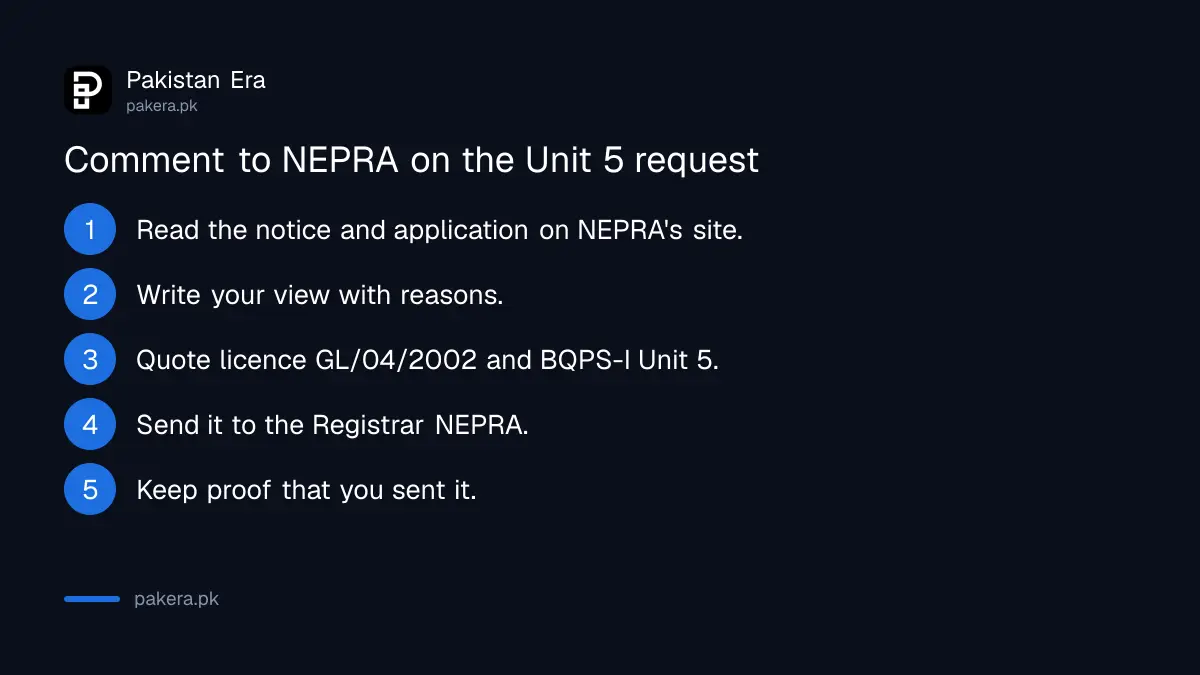
- Read the notice and the application on NEPRA's website under news.
- Write your comment, for or against, with reasons. Mention licence GL/04/2002 and BQPS-I Unit 5.
- Send it to the Registrar, NEPRA Tower, Ataturk Avenue (East), G-5/1, Islamabad, or by email to registrar@nepra.org.pk.
- Keep proof of sending. NEPRA's phone numbers on the notice are 051-9206500 and 051-2013200.
The notice does not give a calendar date for the deadline. If it is counted from 30 October, when NEPRA posted it, the 14 days end around 13 November 2026. That is our count. The newspaper date of the notice, which may differ, was not available to us.
The wider steps for joining NEPRA's process are set out in how to take part in a NEPRA public hearing. K-Electric made a separate request about another plant in October, to let BQPS-III burn local gas.
What it means for Karachi consumers
For a Karachi household, the direct cost claimed is small. The bigger question is reliability. K-Electric argues the unit lowers the risk of extra load management in summer if gas runs short or the grid link fails.
Load shedding in Karachi is still set feeder by feeder. Readers can check their own area in the K-Electric load shedding schedule. National costs of each fuel are listed in electricity cost per unit by fuel, which shows why diesel is the most expensive source.
Common questions
What has K-Electric asked NEPRA for?
It wants to keep Unit 5 of Bin Qasim Power Station I as a secondary reserve until June 2030 and pass about Rs 225 million a year of costs into the tariff.
How much will it add to my bill?
K-Electric says about Rs 0.01 a unit. By our arithmetic that is about Rs 4 a month on 300 units, if NEPRA allows it and it is passed on in full.
When can I send comments to NEPRA?
Within 14 days of the notice's publication. Counted from its posting on 30 October 2026, that is about 13 November 2026.
How big is BQPS-I Unit 5?
It is 210 MW installed, de-rated to 188.28 MW. K-Electric says 176 MW would stay available.
Has NEPRA approved the request?
No. The notice says submission and acceptance for consideration are not approval.
Why does K-Electric want an old plant?
It cites gas supply risks, force majeure on the two RLNG terminals and a forecast night peak shortfall from 2027-28.
How we verified this
What we checked, where we read it, and what we could not confirm.
We read NEPRA's notice image and the application PDF, "LPM filed by KE - Retention of Unit-5 BQPS-I", linked from the NEPRA website home page, on 31 October 2026. The server dates both files to 30 October 2026. The figures for capacity, cost, demand and fuel come from K-Electric's application, not from NEPRA, and NEPRA has not ruled on them. The per unit and household estimates, and the 13 November date, are our arithmetic. We could not see the newspaper publication date that the 14 days run from. The application's text extraction was partly garbled, so we checked each figure against the notice where both carry it.
About the author

Global Affairs & Political Economy Writer
Muhammad Hatim is a book lover who started writing because he enjoys it. At Pakistan Era he writes about international relations, geopolitics and the global economy, with a particular interest in South Asia and the forces behind current events.