K-Electric Asks NEPRA to Let Its Bin Qasim III Plant Burn Local Gas, Not Only Imported RLNG
K-Electric asked NEPRA to add local SSGC gas as a main fuel for Bin Qasim III beside RLNG. Project cost USD 32.29 million. NEPRA has not decided yet. See costs.
Short answer: K-Electric has asked NEPRA to let its Bin Qasim Power Station III, called BQPS III, burn local gas supplied by SSGC as a main fuel, alongside imported RLNG. K-Electric says this would cut fuel cost by up to Rs 63.6 billion a year at full load. The cost of the project is estimated at USD 32.29 million.
Karachi's biggest gas fired plant today runs on imported liquefied gas, shipped in and regasified. When the shipping route fails, it can be left with expensive diesel or nothing. K-Electric wants a second gas source in the same plant.
We read NEPRA's public notice and K-Electric's own application letter, dated 4 August 2026. NEPRA has not decided the request. What follows is K-Electric's case in its own numbers, and we say so wherever it matters.
K-Electric wants local gas added as a primary fuel
BQPS III's gas turbines are connected to the RLNG system, with RLNG supplied by Pakistan LNG Limited as the main fuel and high speed diesel as the backup. The request is to add indigenous gas, which is domestic natural gas, as a primary fuel, and to add SSGC as a fuel supplier for both local gas and RLNG.
The legal vehicle is called a licensee proposed modification. It changes the generation licence the plant operates under, number GL/04/2002. K-Electric paid the fee for the modification, Rs 2,606,556.80 after withholding tax, by cheque dated 27 July 2026.
NEPRA published its notice on 18 September 2026 and gave the public 14 days from publication to comment. That window has closed. The notice says submission of the request is not approval.
The pipeline fix is meant for emergencies only
K-Electric describes two fixes. The first is a short pipeline of about two kilometres inside the Bin Qasim complex, linking the gas compressors of BQPS II to the gas turbines of BQPS III. It is meant for emergencies, such as when RLNG supply is cut under force majeure.
The limits are physical. SSGC gas arrives at the complex at about 5 bar, while BQPS III needs about 30 bar at full load. BQPS II's compressors can handle about 100 MMSCFD, and BQPS III needs about 130 MMSCFD for base load on both units. So the short term fix cannot run the plant fully.
The second fix is a dedicated gas supply from SSGC's network, with three new compressors each sized at half the load. K-Electric says talks with SSGC on a gas supply agreement are going on and will include a minimum offtake obligation, which means a commitment to buy a set quantity.
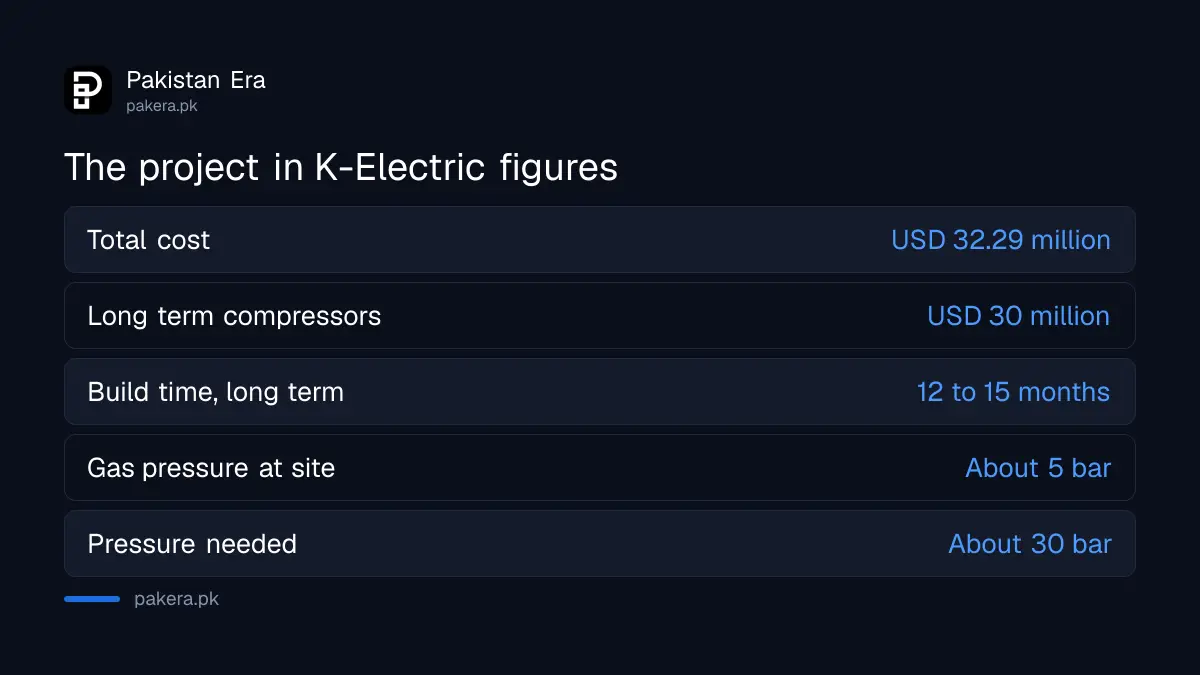
| Item | K-Electric's figure |
|---|---|
| Total project cost | USD 32.29 million |
| Long term compressors | USD 30.00 million |
| Time to build the long term system | 12 to 15 months |
| SSGC gas pressure at the complex | About 5 bar |
| Pressure BQPS III needs at full load | About 30 bar |
| Gas needed for base load, both units | About 130 MMSCFD |
The savings are K-Electric's own estimate
K-Electric's tariff impact table compares the cost per unit of electricity on RLNG with local gas. As we read the scanned table, local gas gives a cost of Rs 8.58 a unit, against Rs 21.15 on RLNG in a normal cost case and Rs 40.69 in a spot price case. The added capacity charge for the project is about Rs 0.09 a unit.
On those numbers, K-Electric puts the yearly reduction in fuel cost at Rs 63,649 million at full load, excluding winter months. It nets off Rs 741 million of added capacity cost and gets Rs 62,908 million. At the plant's current load profile of 37 per cent use, the reduction is Rs 23,831 million.
These are the company's own estimates, with a high level cost basis that it says will be firmed up. NEPRA tests such claims in its tariff work, and K-Electric says it will file a tariff modification later to make the project cost part of the plant's regulatory asset base. Until then, no Karachi bill changes.
Why the plan matters for Karachi's power supply
K-Electric cites the recent geopolitical crisis, when RLNG was not available. Our report on why Pakistan is burning more coal as an RLNG shipping route failed shows how far that supply shock went across the country.
A second fuel does not add new power plant capacity. It only makes the same plant more reliable and cheaper to run. If you want to know how outages are handled in your own area, see how to check your K-Electric load shedding schedule.
One question is left open in the papers: how much indigenous gas SSGC can spare for a power plant at all. K-Electric describes "positive discussions" with SSGC and the Petroleum Division, which is not an agreement. Households that depend on the same network will watch that closely in winter.
How to follow the case
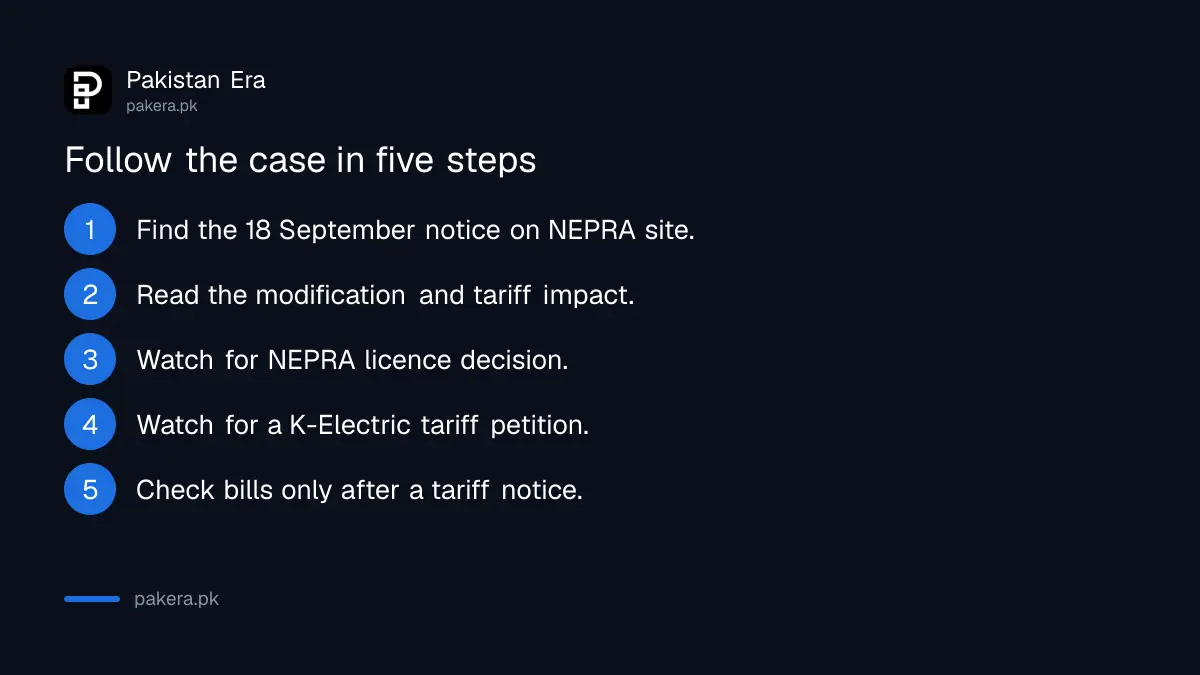
The filing is available on NEPRA's website. If NEPRA approves, K-Electric must then sign a supply agreement with SSGC and finish the build. The long term system alone is estimated at 12 to 15 months.
- Open NEPRA's news page and find the notice of 18 September 2026.
- Read the proposed modification and the statement on tariff impact.
- Watch for a NEPRA decision on the licence modification.
- Watch for a separate K-Electric tariff petition covering the project cost.
- Check any change on your bill only once NEPRA notifies a tariff.
Separately, Karachi's rates are held to the national uniform tariff. A Sindh High Court order also suspended a review of K-Electric's tariff, which we covered under NEPRA's suspended K-Electric tariff review.
Common questions
What does K-Electric want NEPRA to approve?
It wants indigenous gas added as a primary fuel for BQPS III, and SSGC added as a gas fuel supplier for both local gas and RLNG in its generation licence.
Has NEPRA approved the change?
No decision was published when we checked on 12 October 2026. The notice itself says submission is not approval.
How much would the project cost?
K-Electric estimates USD 32.29 million, of which USD 30 million is for gas compressors in the long term system.
Will this lower my electricity bill in Karachi?
Not directly. K-Electric says lower fuel cost would benefit consumers, but no tariff change has been filed or approved.
Can the plant run on local gas today?
No. K-Electric says an emergency pipeline would let it run on SSGC gas in force majeure cases, but only at a fraction of full load because of pressure and compressor limits.
How we verified this
What we checked, where we read it, and what we could not confirm.
We read NEPRA's notice of the licensee proposed modification, posted on its news page with the date 18 September 2026, and K-Electric's application of 4 August 2026, on 12 October 2026. The application is a scanned table, so we give the cost and savings figures as K-Electric states them.
About the author

Global Affairs & Political Economy Writer
Muhammad Hatim is a book lover who started writing because he enjoys it. At Pakistan Era he writes about international relations, geopolitics and the global economy, with a particular interest in South Asia and the forces behind current events.