Pakistan's Lahore Rated Extremely Poor for Ozone in EU Copernicus Report
An EU Copernicus report puts Lahore in its extremely poor ozone band for 2026, with 34% of the world exposed. What ozone is and how to check Lahore's AQI.
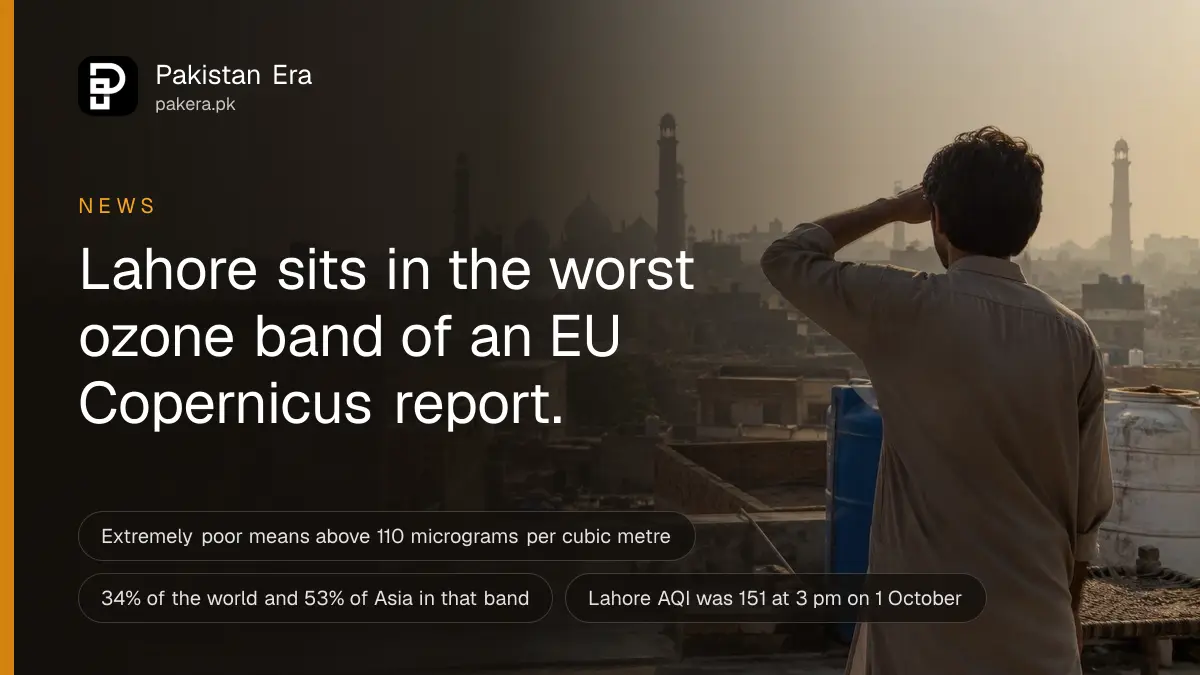
The EU's Copernicus Atmosphere Monitoring Service (CAMS) has placed Lahore in its worst band for ground-level ozone, "extremely poor", in a global review published on 30 September 2026. It also found that 34% of the world's people lived with ozone in that band this year.
The review is called CAMS Atmosphere Watch 2026. CAMS is run by the European Centre for Medium-Range Weather Forecasts (ECMWF) for the European Commission. We read the report, its press release and its chart data on 1 October.
Lahore is named in one chart, not in the text. Among the Asian cities it marks, Lahore sits at the most exposed end, past Dhaka and Chongqing.
What the EU report says about Lahore ozone pollution
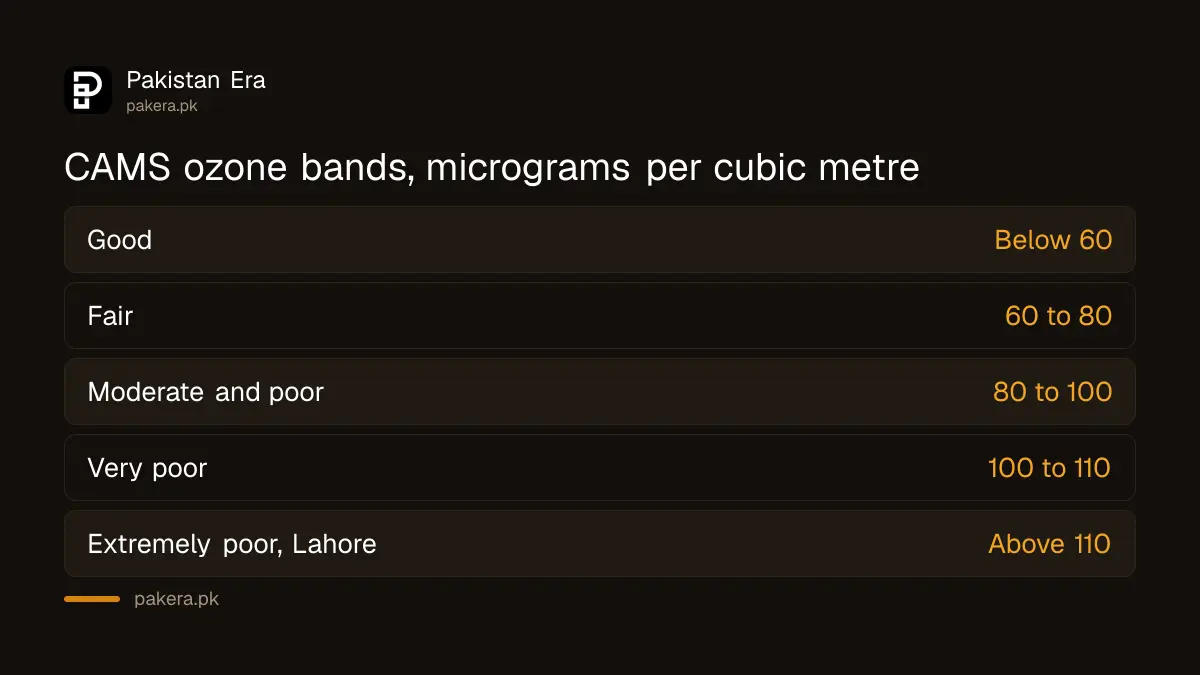
The CAMS chart on world ozone exposure places Lahore at the far right of the Asia bar, inside the "extremely poor" band. That band means a peak-season ozone level above 110 micrograms per cubic metre, well over the World Health Organization (WHO) guideline of 60.
The chart covers 1 January to 15 September 2026 and uses the average of daily highs over the six worst months. A city's place on the bar shows how many people in its region breathed less ozone. Lahore sits near the very end.
Pakistan is not named in the report's text, and Lahore is the only Pakistani city on the chart. It says nothing about Karachi or Islamabad.
One third of the world breathed extremely poor ozone in 2026
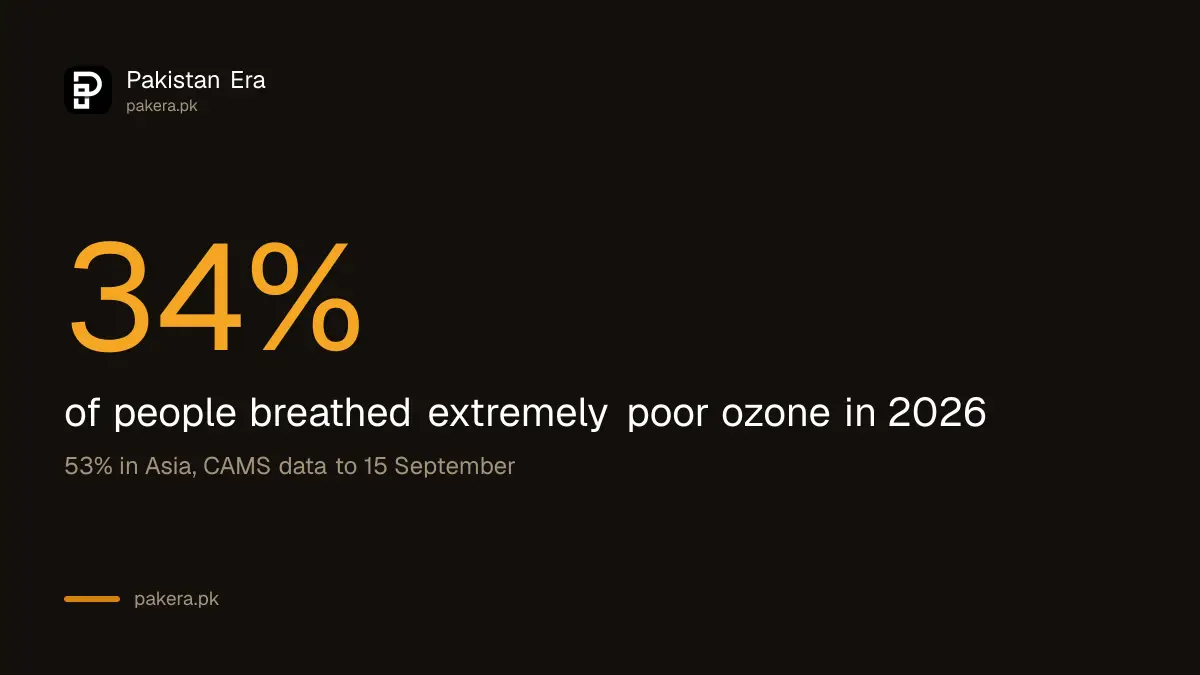
The CAMS chart data shows 33.9% of the world's population in the "extremely poor" ozone band this year, and only 5.3% in the "good" band. Asia was worst: 53.2% of its people were in the extremely poor band and 21.9% in the very poor band.
| Region | Extremely poor (above 110) | Very poor (100 to 110) | Good (below 60) |
|---|---|---|---|
| World | 33.9% | 17.3% | 5.3% |
| Asia | 53.2% | 21.9% | 0.7% |
| Africa | 8.0% | 6.4% | 14.4% |
| Europe | 4.6% | 11.8% | 0.4% |
| North America | 4.2% | 24.5% | 1.0% |
| Oceania | 0% | 0% | 66.1% |
The report's own words do not match its chart exactly. The press release says "almost two in five" people were exposed to dangerous levels. The ozone chapter says "almost 40%" faced extremely high levels, including 60% of people in Asia. The table above uses the chart's data file, which gives 34% and 53%.
The figures are CAMS model estimates built on satellite and ground data, not readings from monitors inside Lahore.
Ground-level ozone explained in simple words
Ground-level ozone is a gas that forms in the air we breathe. Smoke from vehicles, factories and burning crops reacts with strong sunlight and heat.
It is the same gas as the ozone layer, but in the wrong place. High up, ozone blocks harmful sun rays. At street level it harms people, crops and plants, CAMS says. WHO calls it one of the main parts of photochemical smog.
Timing matters for Pakistan. The CAMS report says Southern Asia gets its highest ozone in the first months of the year, before the monsoon.
That makes it different from the winter smog season in Punjab. Winter smog is mostly fine dust and smoke particles trapped near the ground. Ozone needs sun and heat, so it can build on a clear, hot day that looks clean.
How ozone harms health
Ozone can damage the lungs and heart, cause shortness of breath and make asthma and chronic obstructive pulmonary disease (COPD) worse, ECMWF says. The EPD Punjab advice for vulnerable groups names children, older people and heart and lung patients.
WHO's short-term guideline for ozone is 100 micrograms per cubic metre, averaged over the worst 8 hours of a day. Its long-term guideline is 60 for the peak season. Lahore's band starts at 110, so it is above both.
The CAMS report also quotes the State of Global Air 2025 study: South Asia has the world's highest death rate from air pollution, at 191 deaths per 100,000 people. The global figure is 92. WHO puts outdoor air pollution deaths at 4.2 million worldwide in 2019.
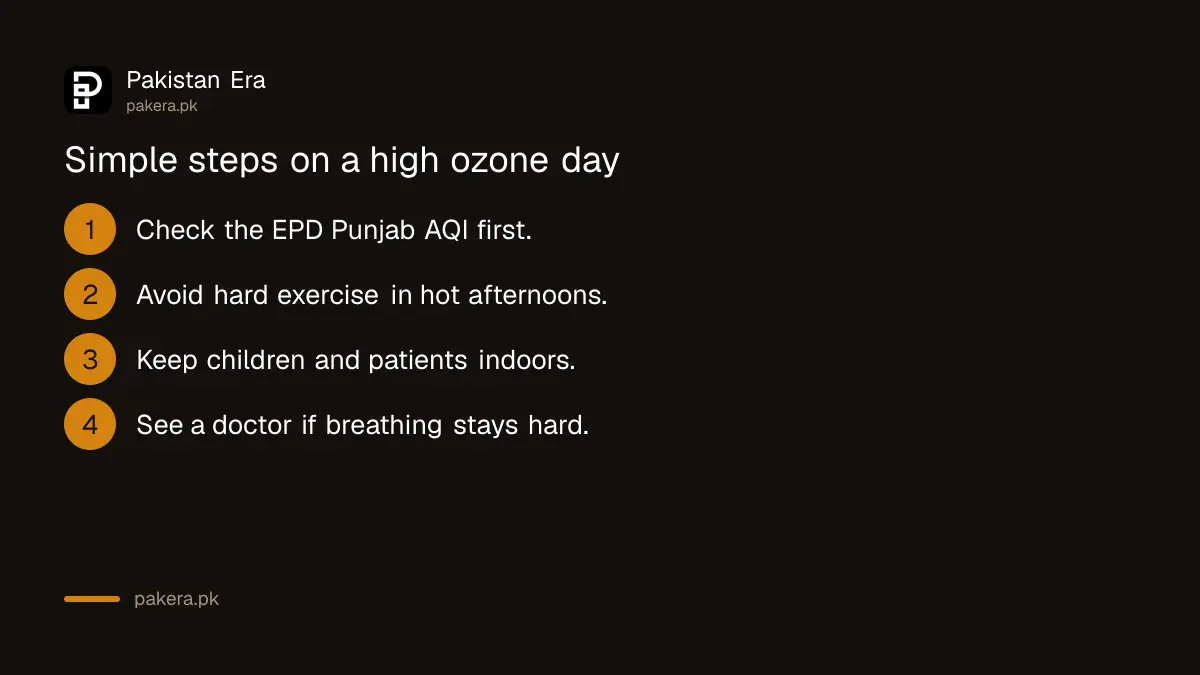
On a high ozone afternoon, the simple steps are these:
- Check the official AQI and the official weather forecast before you go out on a hot day.
- Move heavy exercise and outdoor sport away from hot, sunny afternoons, because ozone forms in sunlight and heat.
- Keep children, older relatives and asthma patients out of hard outdoor activity.
- See a doctor for chest pain, wheezing or breathlessness that does not settle.
How to check Lahore air quality officially
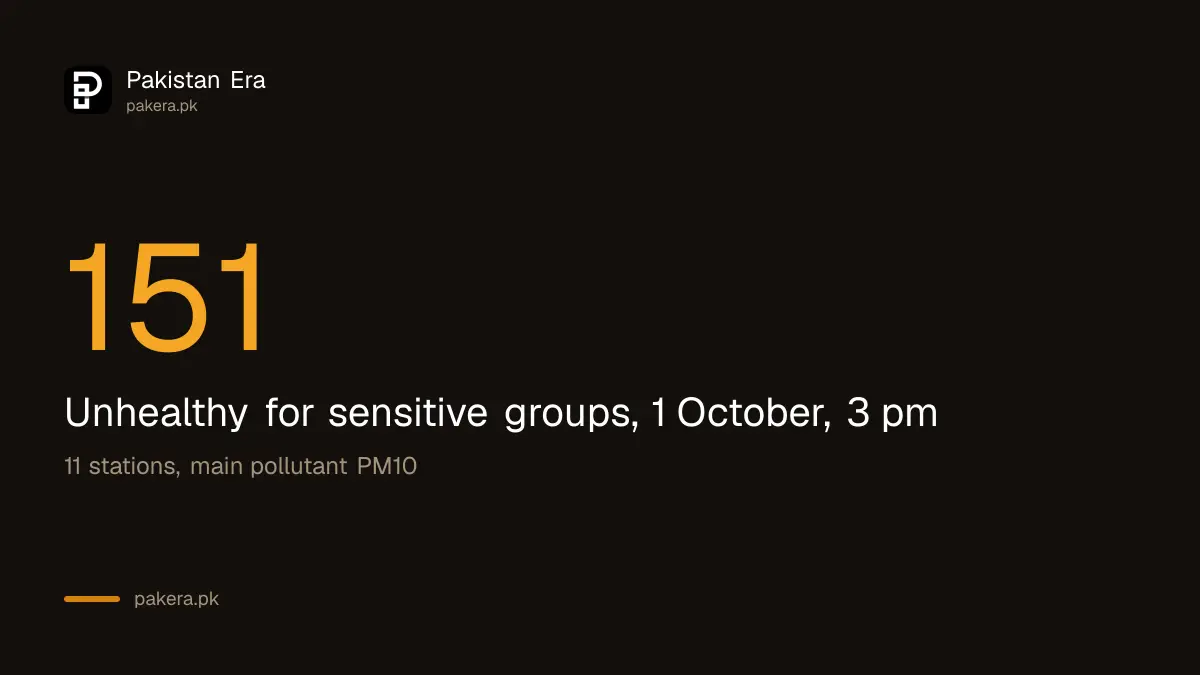
The Punjab Environment Protection Department (EPD) runs a live air quality dashboard at aqi.punjab.gov.pk. It shows Lahore's AQI from 11 monitoring stations, with readings for ozone, PM2.5 and PM10 and a health advisory.
We checked it just before 4:00 pm on 1 October. Lahore's AQI was 151 for 3:00 pm, rated "Unhealthy for sensitive groups". At the same hour a day earlier it was 134. The main pollutant was coarse dust, PM10, at 10 of the 11 Lahore stations and fine dust, PM2.5, at the other.
Ozone was not leading in Lahore that afternoon. It was the main pollutant at 5 of 56 stations across Punjab, though, including Murree, which topped the provincial ranking at an AQI of 236.
The dashboard also has an Android app. If you run an air purifier for smog at home, check whether its filter is rated for gases as well as particles, because ozone is a gas.
Common questions
Did the EU rank Lahore among the worst cities for ozone?
Yes. The CAMS Atmosphere Watch 2026 chart places Lahore in the "extremely poor" ozone band, at the most exposed end of Asia.
What is ground-level ozone?
A harmful gas formed when vehicle, factory and crop-burning smoke reacts with sunlight and heat near the ground.
Is ozone the same as winter smog in Lahore?
No. Winter smog is mostly particles. Ozone peaks in hot, sunny months, mainly before the monsoon in South Asia.
How many people breathe extremely poor ozone?
About 34% of the world's population in 2026, by the CAMS chart data, and 53% of Asia's.
Where can I check Lahore's air quality?
On the EPD Punjab dashboard at aqi.punjab.gov.pk, which shows live AQI from 11 Lahore stations.
How we verified this
What we checked, where we read it, and what we could not confirm.
Last checked on 1 October 2026 at about 4:00 pm Pakistan time. Lahore's place in the extremely poor band, the band limits, the WHO guideline marks and the regional shares are read in the chart and data file of the CAMS Atmosphere Watch 2026 release of 30 September and its full report. Health effects are from ECMWF, and the ozone definition and 4.2 million figure from WHO. Lahore's AQI readings are from the EPD Punjab AQI dashboard.
About the author

Senior Writer, Public Services and Technology
Shahid joined us in 2024 as an author. He is a senior contributor to Pakistan's leading technology websites. He writes detailed articles, mostly covering his expertise in the latest tech, mobiles, apps, gadgets, and step-by-step guides. His ideology is to help people understand the latest trends and explain complex methods through very easy-to-understand guides.