Learn Electrician or AC and Refrigeration Work at OPF's Vocational Training Centre in Peshawar
OPF's Peshawar centre teaches electrician and AC refrigeration trades and has trained 493 people since 2013. See what the page says and what to ask first.
The Overseas Pakistanis Foundation runs one vocational training centre, in Peshawar, and it teaches two trades: electrician and refrigeration and air conditioning. OPF says 493 people trained there between 1 July 2013 and 1 August 2026, and about 59,732 have trained in all since 1980.
Electricians and air conditioning technicians are among the trades that Gulf employers hire for, which is why OPF set up the centre. We read OPF's vocational training page on 21 October 2026. It explains the history and the numbers. It does not give fees, course length, entry age or an admission date, so the last section tells you what to ask.
The Peshawar centre teaches two trades and restarted in July 2013
OPF closed its vocational schools in 2006 and restarted training on 1 July 2013 at its Vocational Training Centre in Peshawar. Today it teaches only two trades there: electrician, and refrigeration and air conditioning. OPF says the aim is trades in demand overseas.
| Period | Where | Trades | People trained |
|---|---|---|---|
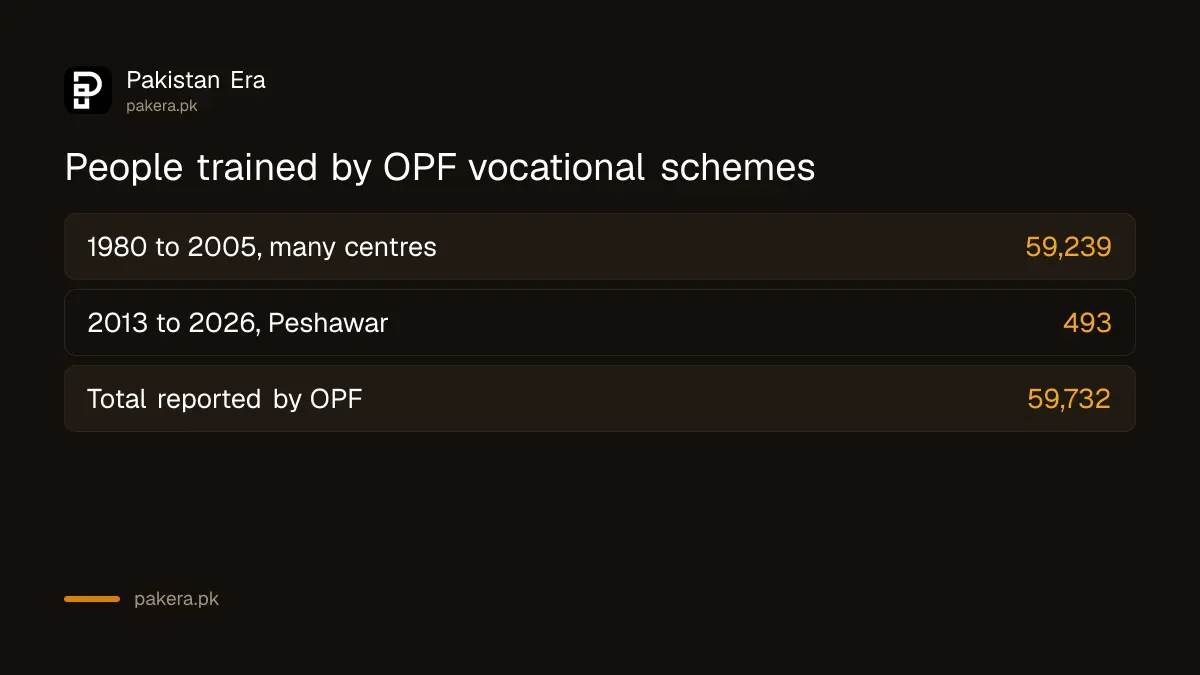
| 1980 to 2005 | OPF poly trade schools and other projects in many cities | Electrician, refrigeration and air conditioning, mechanic, draftsman, plumber, welder, carpenter, IT skills and more | 59,239 |
| 1 July 2013 to 1 August 2026 | OPF Vocational Training Centre, Peshawar | Refrigeration and air conditioning, electrician | 493 |
| Total | 59,732 |
The total is OPF's own, and our addition agrees: 59,239 plus 493 is 59,732. The scale has dropped sharply. The old network trained about 59,000 people in 26 years, while the Peshawar centre has trained 493 in 13 years, roughly 38 people a year.
Some trainees were funded by other bodies
OPF says that by 5 August 2016 about 276 people had been trained through its direct programme, partly funded by the FATA Development Authority and NAVTTC. Another 211 were trained with other institutes, namely TUSDEC and the Pakistan Poverty Alleviation Fund. That is 487 by 2016.
The page then shows 493 by 1 August 2026. By our arithmetic that leaves only six more trainees in ten years, so the two figures do not sit easily together. We cannot say which is right. Treat the 493 as OPF's reported total and ask the centre how many it trains each year.
The page gives no fees, length or entry rules
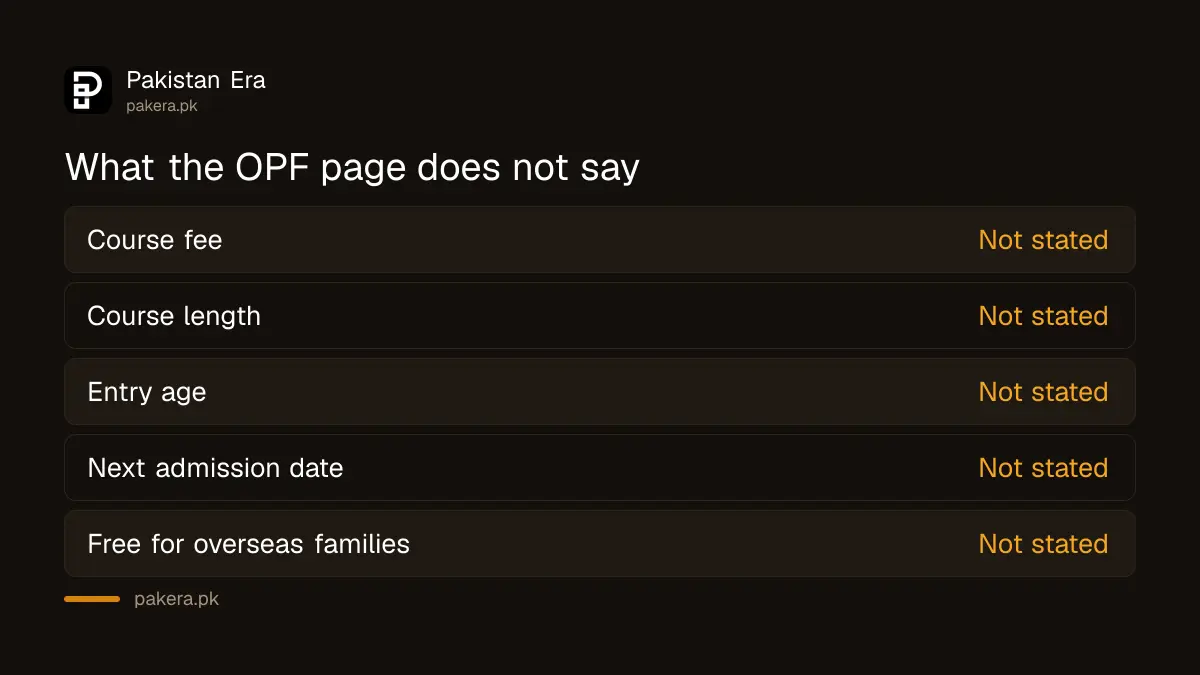
OPF's page says the centre prepares students to the standard of the international market, and that it uses "all marketing means" to attract students. It does not list a fee, a course length, a minimum age or an education level. It does not say whether the course is free for the children of overseas Pakistanis.
Do not pay anyone for a seat on the strength of a social media post. Ask OPF directly. The helpline on its website is +92 51 111 040 040, and the complaint routes are in how to lodge a complaint with the OPF complaint cell.
Ask what the course certificate is worth to an employer
A course is useful only if an employer or a testing body accepts what you get at the end. OPF's page does not name a certificate or a pass mark. So ask who issues the certificate and whether it carries a trade test. Ask also how many trainees from the last batch went on to a job, at home or abroad.
Another useful question is practical: does the course include hands on work with real wiring and cooling units, and how many hours a week? Trades are learned with the hands. A short course that is mostly lectures will not make you job ready. Visit the centre if you can, and look at the workshop before you pay.
The centre has trained about 38 people a year on average since 2013, so class sizes are likely small. That can be an advantage for learning, but it also means seats may fill early. Ask when the next batch starts and how long the waiting list is.
Pair the trade with a skills certificate before you go abroad
A trade course is only one step toward an overseas job. Many Gulf employers want a skills test or a certificate. For the certificate route read how to get a PakSoftSkills certificate for Gulf work.
Before you sign with an agent, check that the agency is licensed. The checks are in how to check an overseas job agency. Language also matters. Free short courses in Arabic and other languages are described in free NAVTTC language courses.
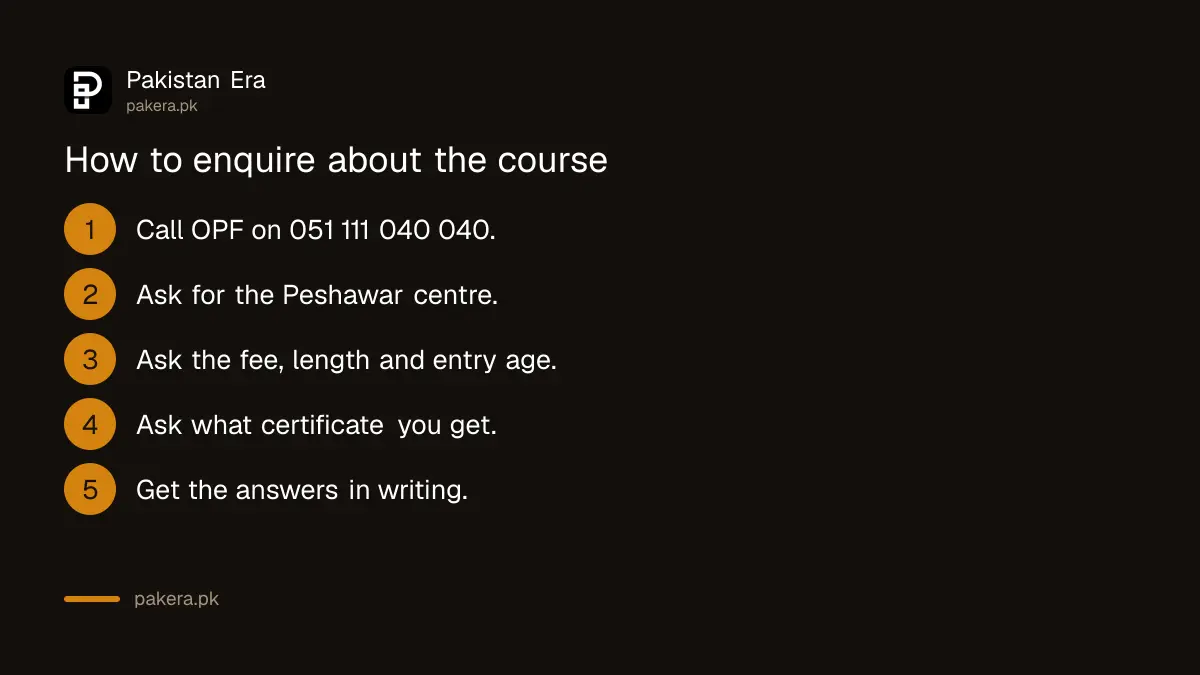
- Call OPF on +92 51 111 040 040 and ask for the Peshawar centre.
- Ask for the fee, the course length, the entry age and the next admission date.
- Ask whether the course is free or cheaper for children of overseas Pakistanis.
- Ask what certificate you get at the end and who recognises it.
- Get every answer in writing before you pay.
Common questions
Which trades does the OPF centre in Peshawar teach?
Two: electrician, and refrigeration and air conditioning. OPF says no other trade is taught there at present.
Is OPF vocational training free?
OPF's page does not say. Ask the centre for the fee, and ask whether overseas Pakistani families pay less.
How many people has OPF trained?
OPF reports about 59,732 since 1980. That is 59,239 up to 2005 and 493 at the Peshawar centre from July 2013 to August 2026.
Where is the OPF training centre?
It is the OPF Vocational Training Centre in Peshawar, in OPF's own building. OPF's page does not print a street address, so ask on the helpline.
Does the course lead to a job abroad?
OPF says the trades are chosen because they are in demand overseas. It does not promise a job, so check any job offer through a licensed agency.
How we verified this
What we checked, where we read it, and what we could not confirm.
We read OPF's vocational training page on 21 October 2026. We did not call the centre. We could not verify fees, course length, entry rules, the next admission date, or why the 2016 and 2026 trainee counts are so close.
About the author
Public Services and Education Journalist
Fajr Riaz is a journalist and content writer at Pakistan Era, based in Lahore. She covers the questions people meet in everyday life in Pakistan: how a public service works, what a change in the rules means, and where to find a reliable answer.