Sindh Recorded 58,972 Malaria Cases in a Single Week
NIH's own surveillance puts Sindh at 58,972 malaria cases in week 32, 87 per cent of the national total. All seven Karachi districts: 659.
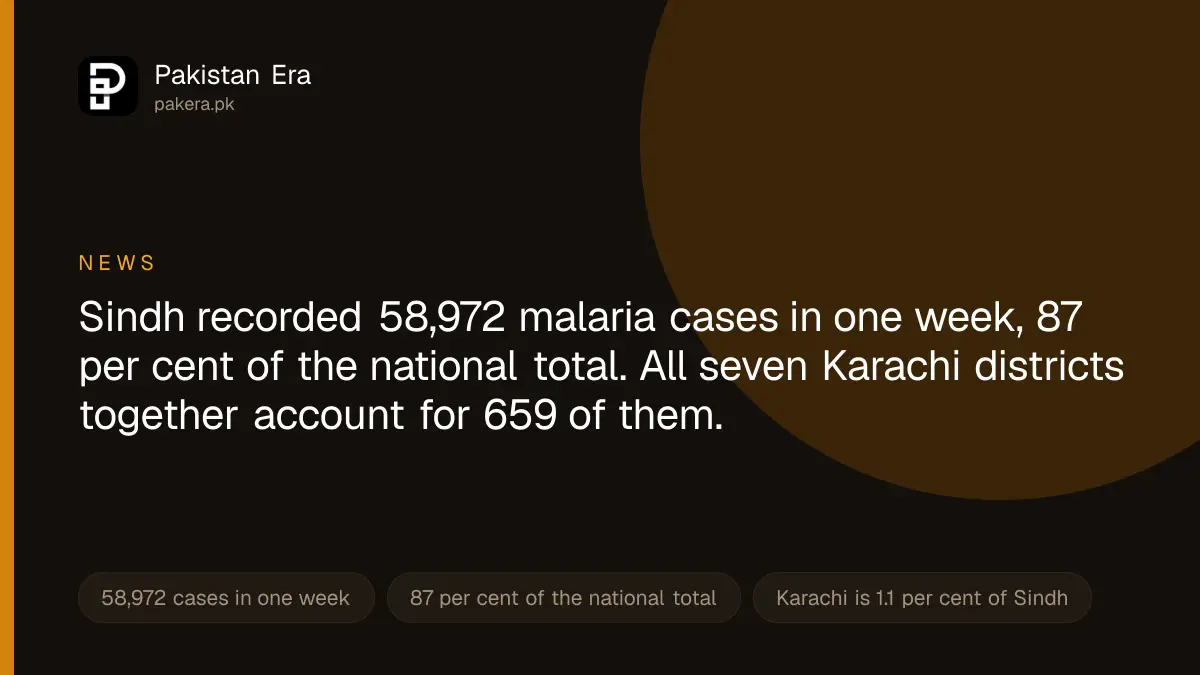
Sindh reported 58,972 malaria cases in a single week. That is 87 per cent of every case reported in the country.
Update, 10 October 2026: Sindh reported 64,318 suspected malaria cases in week 38 of 2026, down from 68,684 in week 37. Read the update.
These are not estimates. They come from the National Institutes of Health's own weekly disease surveillance bulletin, which we downloaded and read.
| Province | Malaria cases, week 32 |
|---|---|
| Sindh | 58,972 |
| Khyber Pakhtunkhwa | 7,164 |
| Balochistan | 1,285 |
| Islamabad | 2 |
| Gilgit-Baltistan | 0 |
| Punjab | Did not report |
| Azad Jammu and Kashmir | Did not report |
| Reported total | 67,423 |
Note the last two rows before you use that total anywhere. Punjab and Azad Kashmir are marked as not reporting. So 67,423 is what was returned, not what exists, and the real national number is higher by an unknown amount.
This is not a Karachi story
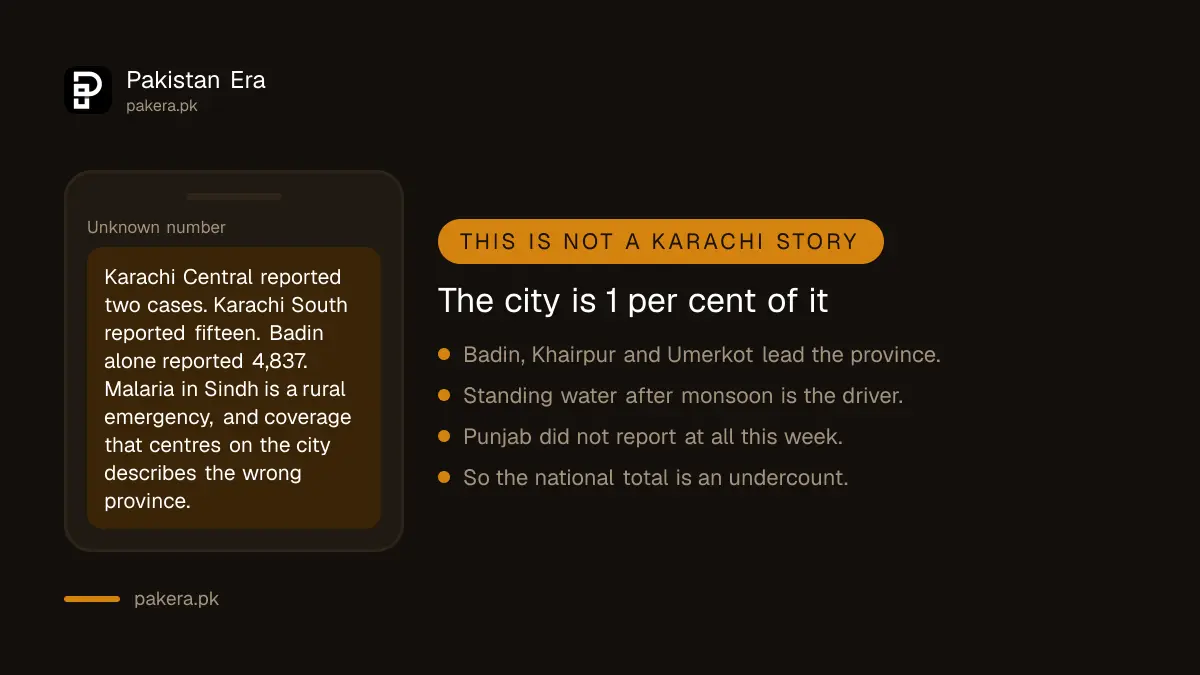
Sindh has seven Karachi districts. Together they reported 659 cases, about 1.1 per cent of the province.
Karachi Central reported two. Karachi South reported fifteen. Karachi Keamari reported twenty one.
Badin, on its own, reported 4,837.
So when this is written up as a city health scare, it describes the wrong part of the province. The burden is in rural Sindh, in districts with standing water left by the monsoon and the least health infrastructure to deal with what follows.
The districts carrying it
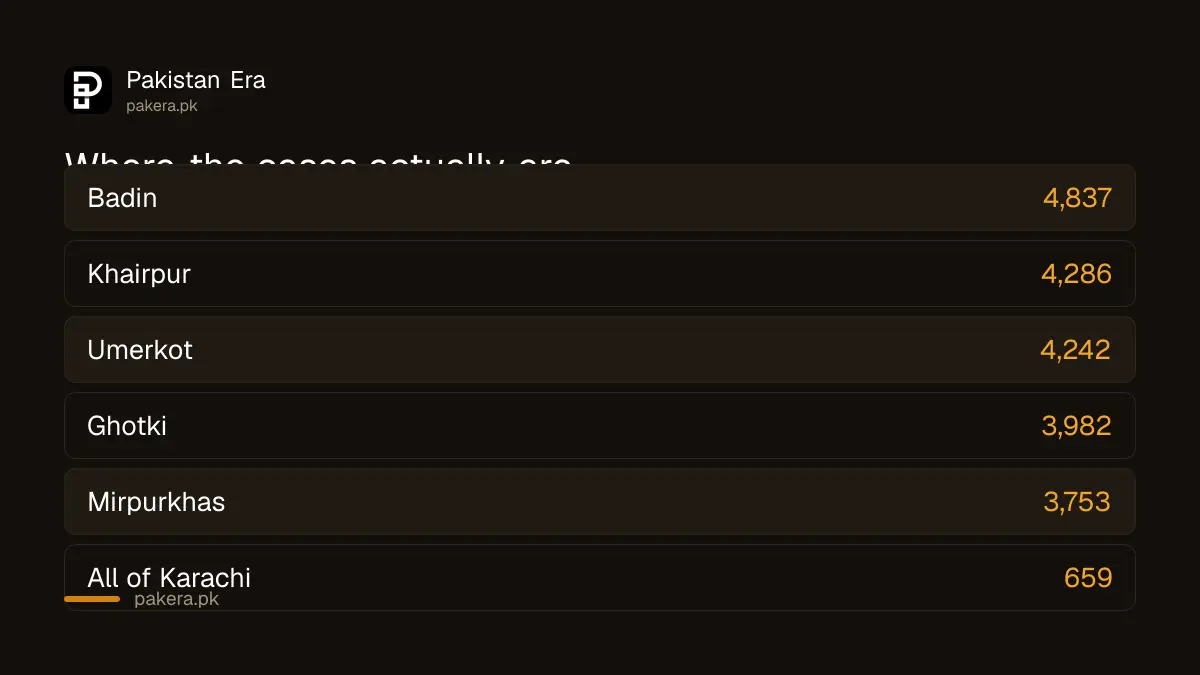
These are the leaders from the bulletin's own district table. NIH separately names Badin, Khairpur and Umerkot as the districts where cases were concentrated, which matches.
| District | Malaria cases |
|---|---|
| Badin | 4,837 |
| Khairpur | 4,286 |
| Umerkot | 4,242 |
| Ghotki | 3,982 |
| Mirpurkhas | 3,753 |
| Larkana | 3,352 |
| Matiari | 3,018 |
| Dadu | 2,921 |
| Shaheed Benazirabad | 2,712 |
| Sanghar | 2,709 |
| Tando Allahyar | 2,602 |
| Jamshoro | 2,209 |
| Kamber | 2,193 |
| Thatta | 2,069 |
| Sukkur | 2,045 |
| Shikarpur | 2,001 |
| Tharparkar | 1,875 |
| Naushero Feroze | 1,627 |
| Kashmore | 1,523 |
| Tando Muhammad Khan | 1,344 |
| Jacobabad | 1,224 |
| Hyderabad | 1,042 |
| Sujawal | 747 |
| All seven Karachi districts | 659 |
| Sindh total | 58,972 |
We added those district figures up ourselves and they come to exactly 58,972, which is what the bulletin states. The provincial figures likewise sum exactly to 67,423. That is the check that tells you the numbers on this page were read correctly.
Malaria is now the second most reported disease in Pakistan
Only one illness was reported more often in week 32.
| Disease | Cases reported |
|---|---|
| Acute diarrhoea, non cholera | 115,136 |
| Malaria | 67,423 |
| Influenza like illness | 32,236 |
| Tuberculosis | 10,700 |
| Lower respiratory infection, under 5 | 8,860 |
The bulletin also records that both malaria and dengue rose this week among mosquito borne diseases. Two different illnesses, from two different mosquitoes, climbing at the same time.
What to do if someone has a fever
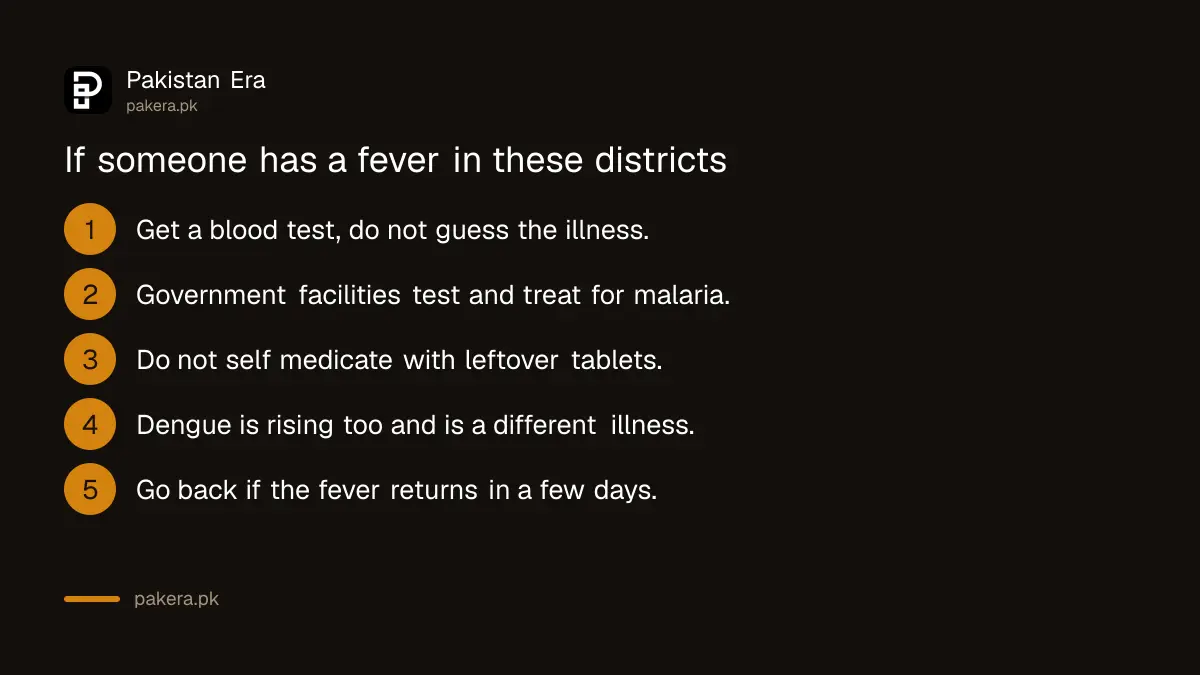
We are a news site, not a clinic, so this is deliberately limited to the things that are not medical judgement.
- Get a blood test rather than guessing. Malaria is confirmed by a test, and in these districts a fever is worth testing rather than waiting out.
- Go to a government facility. Malaria testing and treatment are run through the public health system, which is also where the cases in this bulletin were counted.
- Do not take leftover tablets from a previous illness or somebody else's prescription. The wrong drug wastes days and days matter here.
- Do not try to tell malaria from dengue at home. Both are mosquito borne, both are rising right now, and they are managed differently. Our guide to dengue symptoms and warning signs explains why the distinction is not one to make by eye.
- Go back if the fever returns. Malaria can recur, and a fever coming back after it settled is a reason to return rather than assume it is over.
On prevention, the useful part is unglamorous. The mosquito that carries malaria breeds in standing water, and after a monsoon there is a great deal of it. Emptying containers, covering stored water and using nets where you sleep are the measures that actually reduce exposure.
Standing water is also why this follows the flooding. Where a street or a yard has not drained, the same water that caused one problem in July is breeding the next one in August, and our guide to what to do when your street floods covers the clearing side of it.
Why the national number understates it
This is worth being precise about, because the total will be quoted all week.
Punjab did not report malaria figures for week 32 at all. Neither did Azad Kashmir. In the bulletin they are marked NR.
Punjab is the largest province in the country by population. A national total that excludes it is not a national total, and comparing this week to a week when Punjab did report would be comparing two different things.
We are not going to speculate about why a province did not report. We are pointing out that the figure has a hole in it, so that nobody builds an argument on it that it cannot carry.
What we could not verify
The figures above were read from NIH's own week 32 bulletin on 25 August 2026, and checked by adding them up two different ways.
We could not confirm whether malaria testing and treatment are free at Sindh government facilities. The Directorate of Malaria Control's website did not respond when we tried it, so we describe the public system as the route without making a claim about cost.
We have no death toll. The bulletin counts suspected cases, and it says so itself: these are suspected cases needing field verification.
We do not know whether week 32 is the peak or whether cases are still climbing, because that needs a run of weeks we have not analysed.
We sought no comment from the Sindh health department.
NIH publishes this bulletin every week at nih.org.pk, and anyone can download it. It refused nothing and needed no special handling, which is worth saying because many Pakistani government sites do.
One thing to hold on to about all surveillance data: it counts people who reached a facility and were recorded. In districts with the least health coverage, that is a floor rather than a measure.
Questions readers are asking
How many malaria cases are there in Sindh?
58,972 in week 32 of 2026, according to NIH's weekly surveillance bulletin. That is 87 per cent of the reported national total.
Which districts are worst affected?
Badin with 4,837, Khairpur with 4,286 and Umerkot with 4,242, followed by Ghotki, Mirpurkhas and Larkana.
Is Karachi affected?
Barely, by comparison. All seven Karachi districts together reported 659 cases, about one per cent of the province.
How does malaria compare with other diseases right now?
It is the second most reported illness in the country, behind acute diarrhoea and ahead of influenza like illness and tuberculosis.
Is dengue rising too?
Yes. The same bulletin records increases in both malaria and dengue among mosquito borne diseases this week.
What should I do about a fever in an affected district?
Get a blood test at a government facility rather than guessing, and do not take leftover medicine from a previous illness.
Why is Punjab not in the table?
It did not report malaria figures for this week, and neither did Azad Kashmir. That is why the national total is an undercount.
About the author

Tax, Bills and Technology Writer
Ali Akhtar is a young and curious voice here at Pakistan Era. He is currently pursuing his A-Levels and has a growing interest in Pakistan’s changing industrial landscape and educational trends. Ali likes to write in a way that helps him explain and explore the world around him. His writing reflects the perspective of the new generation navigating the evolving trends of Pakistan where technology, youth innovation, and shifting opportunities are reshaping the country’s future.