Mehfooz Dawa App Launched in Pakistan: Scan a Medicine Barcode to Check if It Is Fake
PM Shehbaz Sharif launched the Mehfooz Dawa app on 26 November 2026. Scan a medicine barcode to see if it is genuine, its registered price and expiry date.
یہ صفحہ اردو میں پڑھیں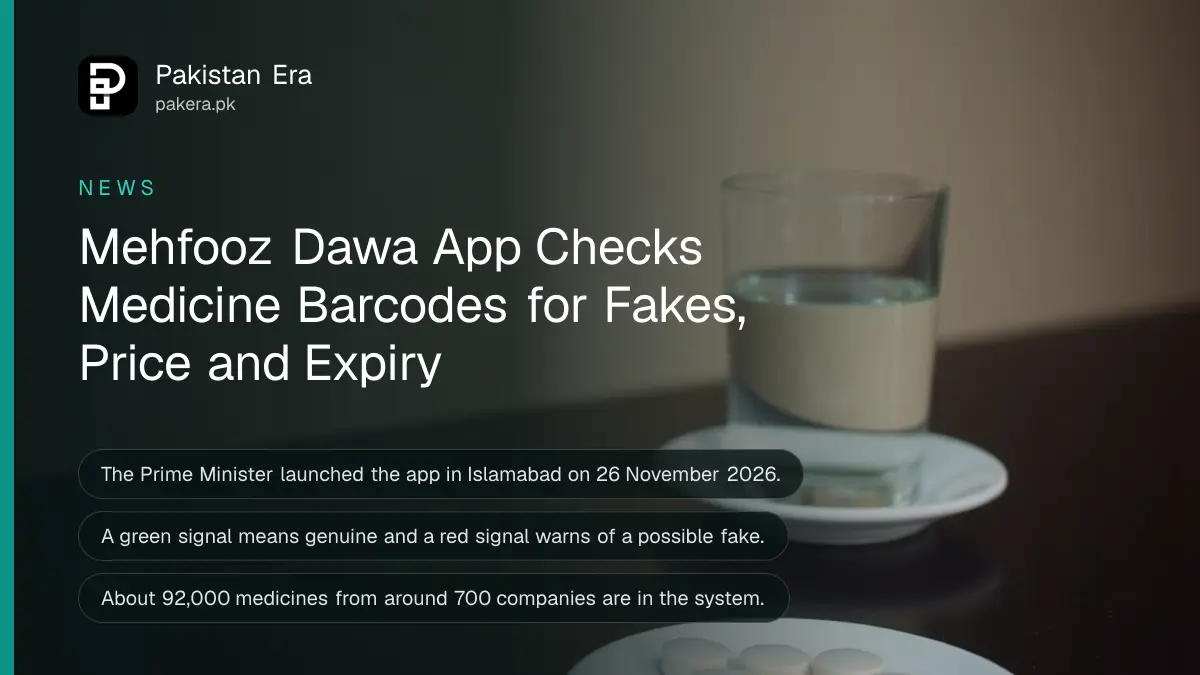
Short answer: Prime Minister Shehbaz Sharif launched the Mehfooz Dawa mobile app in Islamabad on Thursday 26 November 2026. You scan the barcode on a medicine pack with your phone. A green signal means the medicine is genuine. A red signal warns that it may be fake. The app also shows the registered price and the expiry date, and lets you file a complaint.
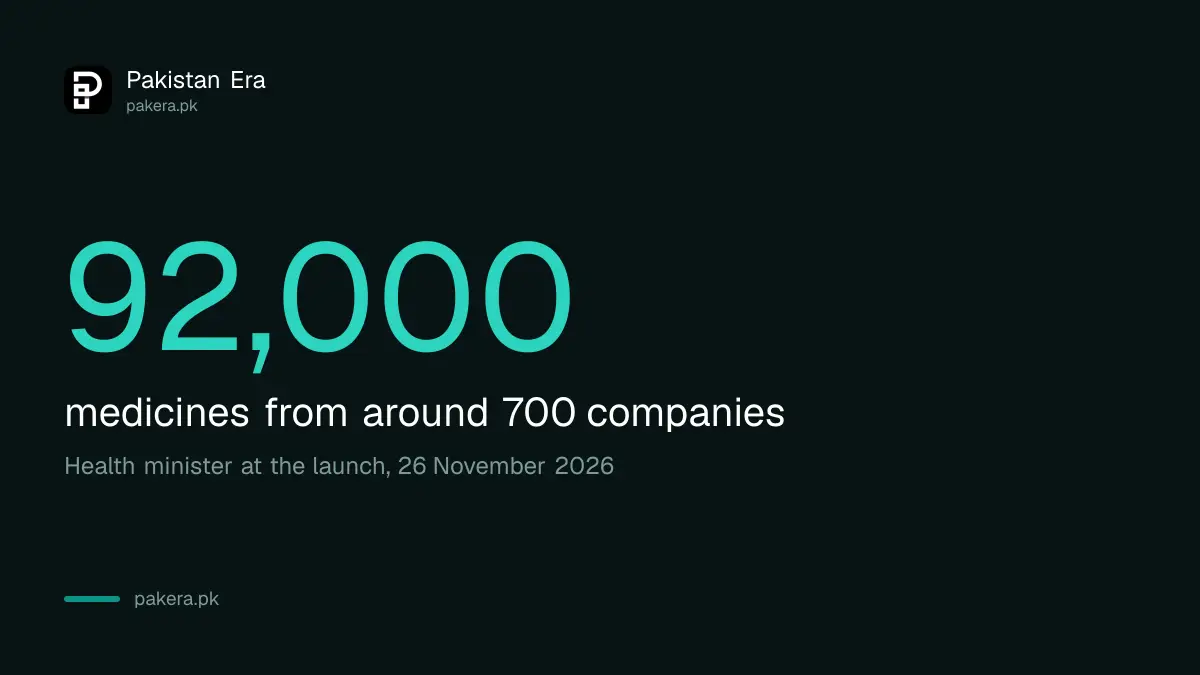
The app belongs to the Ministry of National Health Services and works with the Drug Regulatory Authority of Pakistan (DRAP). Health Minister Syed Mustafa Kamal said at the launch that around 700 pharmaceutical companies have shared data on about 92,000 medicines, and that this data is what lets the app check a pack.
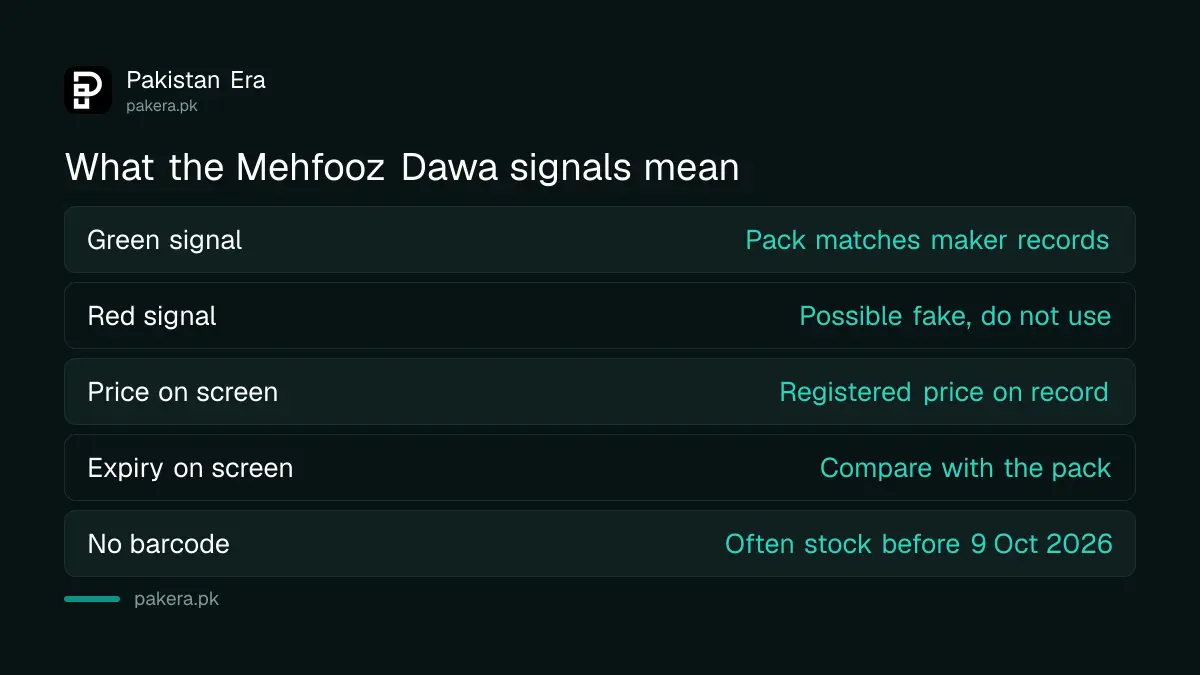
Mehfooz Dawa checks a medicine in three ways
Mehfooz Dawa reads the barcode on a medicine pack and tells you three things: whether the pack is genuine, what its registered price is, and when it expires. It also has a complaint option for a suspect medicine, which goes to DRAP's enforcement system.
| What the app does | What you see |
|---|---|
| Checks if the medicine is genuine | Green signal for genuine, red signal for a possible fake |
| Shows the registered price | The price on record, to compare with what the shop asks |
| Shows the expiry date | The expiry on record, to compare with the date printed on the pack |
| Takes complaints | A form to report a suspect medicine to DRAP |
| Coverage | About 92,000 medicines from around 700 companies |
DRAP Chief Executive Dr Ubaidullah said at the ceremony that the complaints feed into a Rapid Alert System. That is the same system behind the DRAP alerts on fake batches that we track in the full list of DRAP recall alerts for 2026.
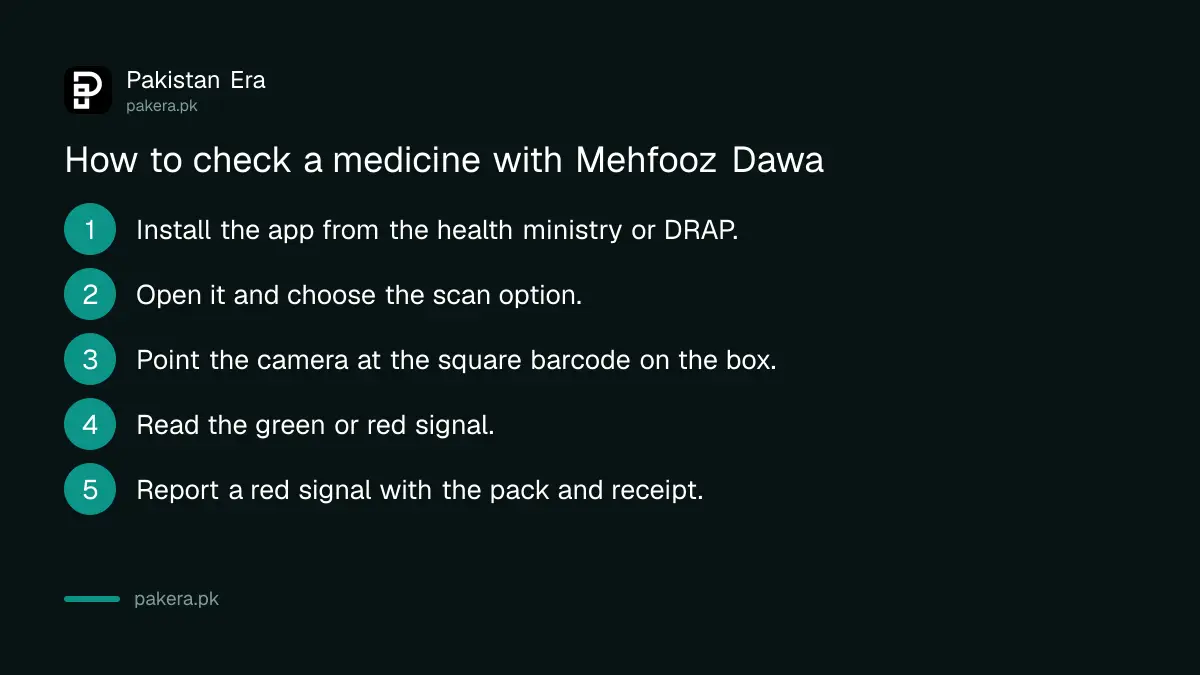
How to scan a medicine pack with Mehfooz Dawa
Open the app, point the camera at the small square barcode on the medicine box, and wait for the colour signal. Then compare the price and expiry on screen with the pack in your hand. If anything does not match, do not take the medicine and report it.
- Install the Mehfooz Dawa app on your phone. Check that the publisher is the Ministry of National Health Services or DRAP before you install, and avoid copies from other developers.
- Open the app and choose the scan option.
- Point the camera at the square 2D barcode printed on the outer box of the medicine.
- Read the signal. Green means the pack matches the records shared by its maker. Red means it does not.
- Check the price and expiry date on screen against the pack and the shop's bill.
- If the signal is red, or the details differ, keep the pack and the receipt and file a complaint in the app.
The health minister said the app was built with simple colour signals so that people who cannot read well can still use it. A family member with a smartphone can scan medicines for elderly parents too.
Older medicine packs may have no barcode at all
A pack without a barcode is not automatically fake. DRAP made the 2D barcode compulsory for medicines made or imported on or after 9 October 2026. Stock made before that date can still be sold until it runs out, so many shelves still carry older packs.
The rule comes from SRO 963(I)/2026, which changed the drug labelling rules. We set out what it requires in the explainer on the 2D barcode on medicine packs from 9 October 2026. For a pack with no barcode, use the other checks below.
| Situation | What it most likely means | What to do |
|---|---|---|
| Green signal, price and expiry match | The pack matches its maker's records | Use as prescribed |
| Red signal | The code is not in the records | Do not use it, keep the pack and report it |
| Green signal, but price on screen is lower | The shop is charging above the registered price | Ask the shop, then report overcharging |
| Expiry on screen differs from the pack | The printed date may have been changed | Do not use it and report it |
| No barcode on the box | Often older stock made before 9 October 2026 | Check registration, batch alerts and price by other means |
A red signal means stop and report
If the app shows red, do not take or give the medicine. Keep the box, the strip and the shop receipt. File the complaint inside the app, and also check whether DRAP has already issued an alert on that batch number.
The batch number is printed on the box and the strip, usually next to the manufacturing and expiry dates. You can match it against DRAP alerts in the guide to checking if a medicine batch has been recalled. If the medicine was already taken and the patient feels unwell, see a doctor first and take the pack along.
A red signal on a common medicine from a big pharmacy chain is worth reporting quickly.
The registered price shown in the app protects you from overcharging
The price in Mehfooz Dawa is the registered price on record. If a shop asks for more, you can show the screen and ask why. DRAP fixes the maximum retail price of most medicines, so a higher price on a registered product is a matter you can report.
For medicines you buy every month, keep a screenshot of the price the app shows. You can also compare prices on DRAP's price lists, which we explain in the guide on checking a medicine's price on the DRAP index.
Why the government says the app matters
Speaking at the launch, the Prime Minister recalled the deaths of around 100 heart patients at the Punjab Institute of Cardiology during his time as Punjab chief minister. He said laboratories abroad later found that a malaria medicine had been given to the heart patients. Such events, he said, show why medicine checks need modern tools.
He asked the health ministry to work with the information and IT ministries to raise awareness of the app in every household. The health minister said Pakistan has nearly 200 million mobile phones, which is the reach the government is counting on.
The Prime Minister also told the health ministry to talk to drug makers and experts about keeping medicines affordable. No new price decision was announced at the ceremony.
Common questions
Is the Mehfooz Dawa app free?
The government launched it as a public service app for citizens to check medicines. No fee for scanning was mentioned at the launch.
Does Mehfooz Dawa work on every medicine?
It works on packs whose barcode data the maker has shared. The minister said about 92,000 medicines from around 700 companies are in the system. Older packs made before 9 October 2026 may carry no barcode.
What should I do if the app shows red?
Do not use the medicine. Keep the pack and the receipt, file a complaint in the app, and check DRAP's alerts for that batch number.
Can I check the price of a medicine with Mehfooz Dawa?
Yes. After a scan the app shows the registered price, which you can compare with what the shop charges.
Who runs the Mehfooz Dawa app?
The Ministry of National Health Services, with DRAP. The Prime Minister also credited the IT ministry, the Digital Authority and the pharmaceutical industry for building it.
Is a medicine without a barcode fake?
Not necessarily. The barcode became compulsory for stock made or imported from 9 October 2026, and older stock may still be sold until it runs out.
How we verified this
What we checked and where we read it.
We checked the launch details on 27 November 2026 against the Radio Pakistan report of the ceremony on 26 November 2026 and the Associated Press of Pakistan report of the same event, both state sources. The barcode rule and its 9 October 2026 start date are from DRAP's notifications, which we covered in earlier pages. See the Drug Regulatory Authority of Pakistan and the Ministry of National Health Services for official updates.
Free on WhatsApp
Get the next change first on WhatsApp
Price changes, new rules and deadlines that affect your money, in a few short posts a day.
Follow Pakera on WhatsAppOther followers cannot see your number.
About the author

Global Affairs & Political Economy Writer
Muhammad Hatim is a book lover who started writing because he enjoys it. At Pakistan Era he writes about international relations, geopolitics and the global economy, with a particular interest in South Asia and the forces behind current events.