Money Bill in Pakistan: Article 73 Gives the Senate 14 Days to Advise, the National Assembly Decides
A money bill in Pakistan starts only in the National Assembly. The Senate gets 14 days to recommend changes and the President cannot return it. Article 73.
A money bill in Pakistan is a bill about taxes, government borrowing or the Federal Consolidated Fund. Under Article 73 it can start only in the National Assembly. The Senate gets 14 days to send recommendations, which the Assembly may accept or ignore, and the President cannot send it back. The annual Finance Bill, which carries the budget, is the best-known money bill.
That is why the budget debate in the Senate ends in recommendations, not a vote that can stop the budget. The final word on every tax change belongs to the National Assembly, and the Speaker alone decides whether a bill counts as a money bill.
What counts as a money bill under Article 73
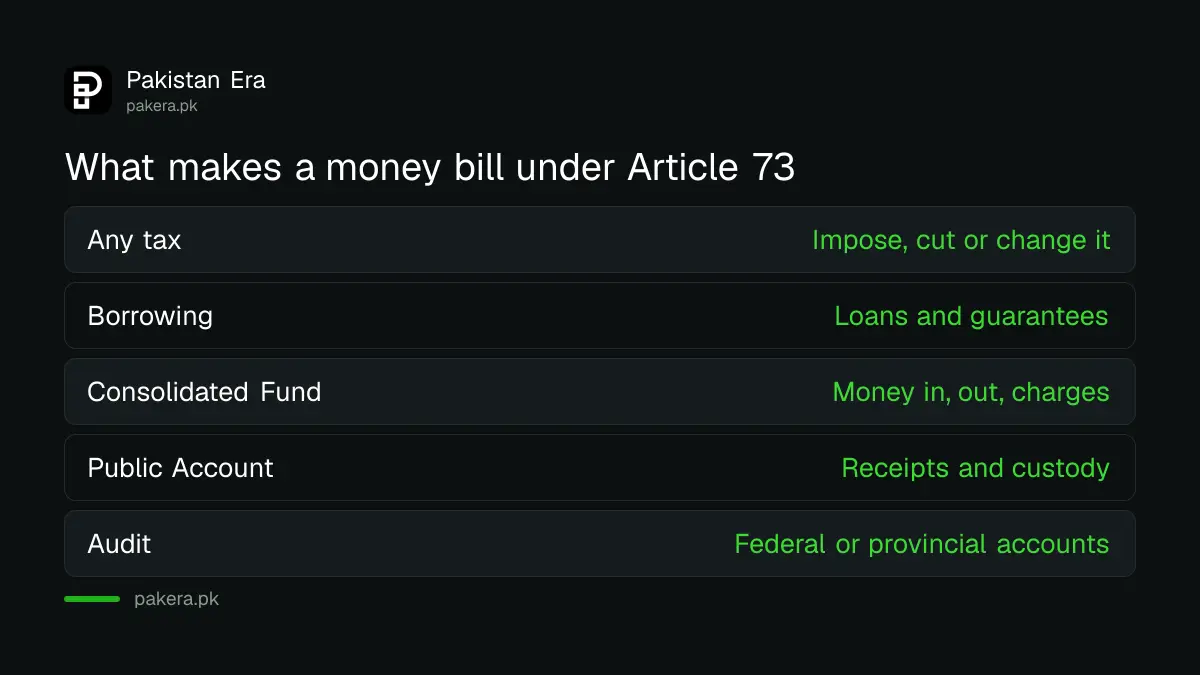
Article 73(2) lists seven subjects. A bill is a money bill if it deals with any of them: taxes, government borrowing or guarantees, the Federal Consolidated Fund, charges on that Fund, the Public Account, audit of government accounts, or anything incidental to these.
| Article 73(2) | Subject | Everyday example |
|---|---|---|
| (a) | Imposing, abolishing, cutting, changing or regulating any tax | A change in income tax or sales tax rates |
| (b) | Government borrowing, guarantees, or its financial obligations | A law on federal debt limits |
| (c) | Custody of the Federal Consolidated Fund, money paid in or out | Rules on where federal revenue is kept |
| (d) | A charge on the Federal Consolidated Fund | Salaries charged on the Fund by law |
| (e) | Money received in the Public Account of the Federation | Deposits and savings schemes held by government |
| (f) | Audit of federal or provincial government accounts | Changes to how accounts are audited |
| (g) | Any matter incidental to the above | Procedural parts of a tax law |
The examples in the last column are ours, to make each clause concrete. The Speaker decides each real case.
What does not make a bill a money bill
Article 73(3) says a bill is not a money bill only because it sets a fine or penalty, or a licence fee or charge for a service. A tax raised by a local body for local purposes also does not count. Those bills follow the normal route through both Houses.
So a law that raises the fine for a traffic offence, or a fee for a government service, still needs the Senate's vote. A law that raises a federal tax does not.
How a money bill passes, step by step
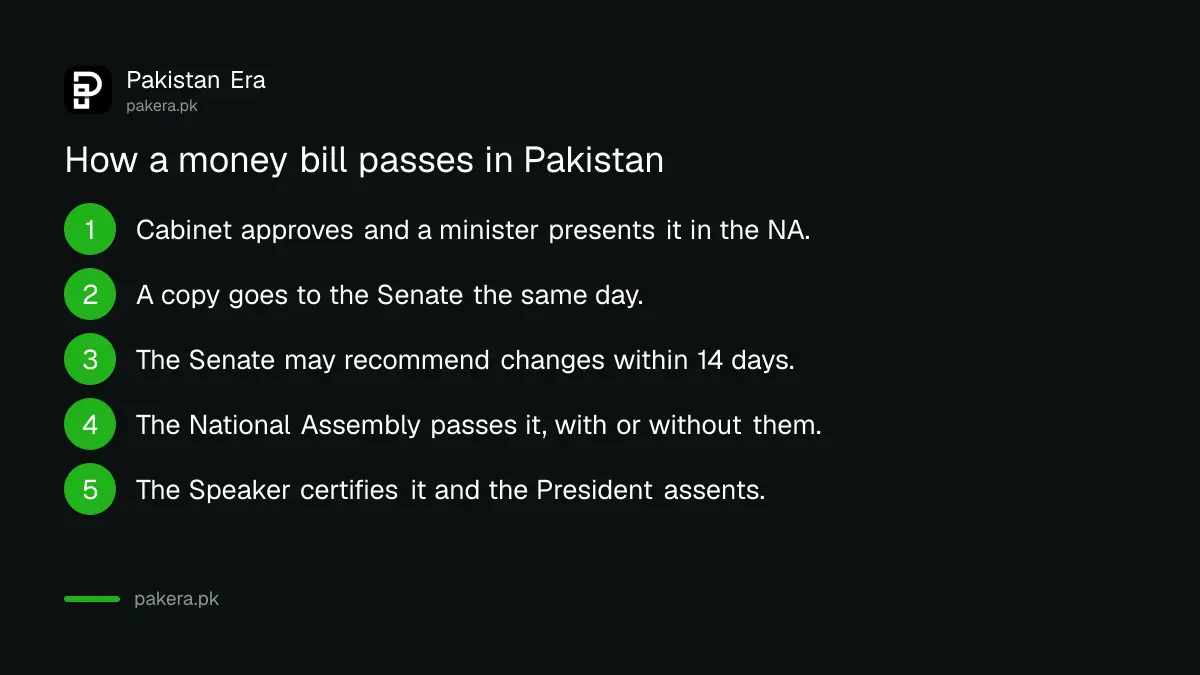
A minister presents the money bill in the National Assembly, and a copy goes to the Senate the same day. The Senate has 14 days to recommend changes. The Assembly then passes the bill, with or without those changes, and sends it to the President.
- Cabinet approval. Money bills go before the federal cabinet first, under Rule 16 of the Rules of Business, 1973.
- Federal Government consent. Under Article 74, a money bill can be introduced only by or with the consent of the Federal Government. A private member cannot bring one alone.
- Notice and certificate. The minister's notice must carry a certificate saying whether the bill is a money bill (Rule 120).
- Presentation and copy to the Senate. The bill is presented in the Assembly and a copy is sent to the Senate at the same time (Article 73(1), Rule 141).
- Senate recommendations within 14 days. The Senate may recommend changes. Its recommendations are circulated to members and taken up clause by clause.
- Assembly passes the bill. It may accept or reject any recommendation (Article 73(1A)).
- Speaker's certificate and assent. The Speaker certifies it as a money bill and sends it to the President, who must assent within ten days (Articles 73(5) and 75).
- Gazette. Once assented, it is published in the Gazette as an Act of Parliament (Rule 143).
The Senate's role is limited to 14 days of advice
The Senate cannot amend, reject or delay a money bill. It can only make recommendations within 14 days of receiving its copy. The National Assembly must consider them but is free to drop every one. This is the main difference from ordinary bills.
For an ordinary bill, the Senate's vote matters. If the Senate rejects it or does not pass it within 90 days, the bill can go to a joint sitting of both Houses. None of that applies to a money bill. Read how a bill becomes law in Pakistan for the ordinary route.
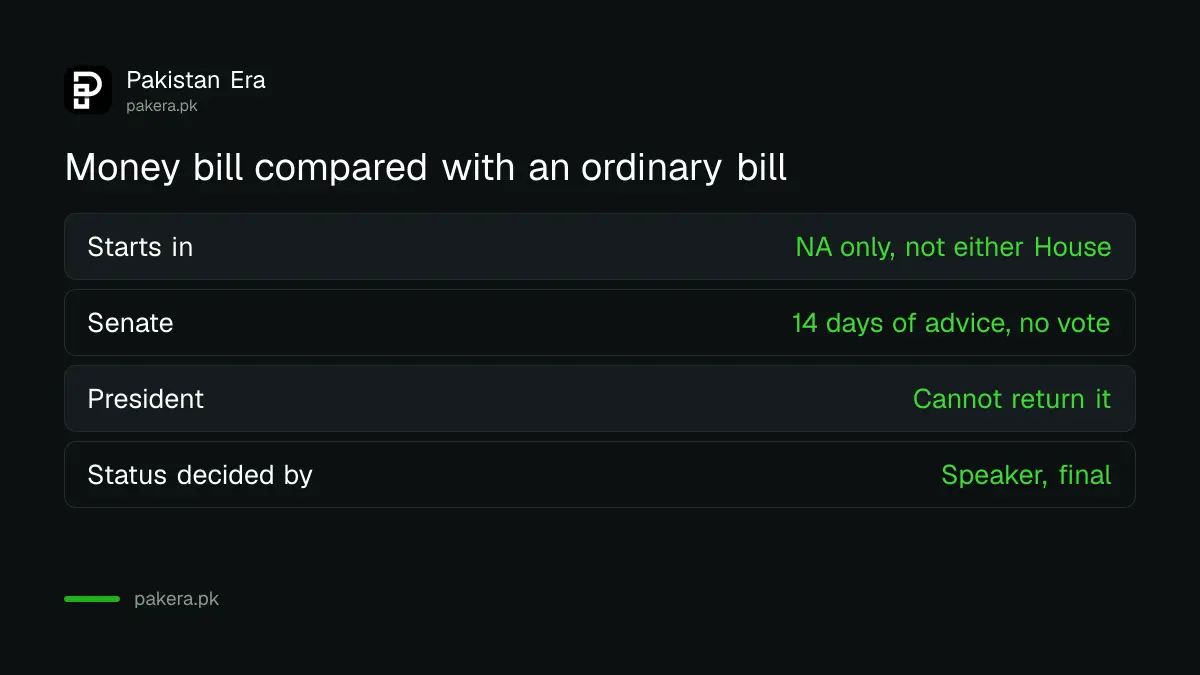
| Point | Money bill | Ordinary bill |
|---|---|---|
| Where it can start | National Assembly only | Either House |
| Senate's power | Recommendations in 14 days | Full vote |
| Can the President return it? | No | Yes, once, for reconsideration |
| Who decides its status | Speaker, final | Not applicable |
The Speaker's certificate is final
If anyone disputes whether a bill is a money bill, the Speaker of the National Assembly decides, and that decision is final under Article 73(4). Every money bill sent for assent carries the Speaker's certificate, which Article 73(5) says cannot be called in question.
That certificate is the reason a bill can skip the Senate's vote. It also binds members in another way. Under Article 63A, a member who votes against the party's direction on a money bill can be declared a defector and lose the seat.
The Finance Bill is the yearly money bill
Each June the government presents the Finance Bill with the Annual Budget Statement. It changes taxes for the next financial year. The Finance Act, 2026 (Act XLIII of 2026) is listed on the National Assembly's Acts page under 26 June 2026.
Under Rule 122, the committee examining the Finance Bill must lay its report in the House within 15 days of the bill's introduction. Many of this year's tax changes, such as the super tax change for incomes up to Rs 500 million, came through this Act. For where the budget money goes, see budget 2026-27 spending on interest.
A tax can also change by ordinance between sessions. Such an ordinance is laid only before the National Assembly, under Article 89.
Common questions about money bills in Pakistan
Can the Senate reject the budget in Pakistan?
No. The Finance Bill is a money bill, so the Senate can only send recommendations within 14 days. The National Assembly passes it.
Who decides if a bill is a money bill?
The Speaker of the National Assembly. Article 73(4) makes that decision final, and the Speaker's certificate cannot be questioned.
Can the President return a money bill?
No. Article 75 lets the President return only a bill other than a money bill. A money bill must be assented to within ten days.
Is a bill that raises fines a money bill?
No. Article 73(3) says fines, penalties, licence fees and service charges alone do not make a bill a money bill.
Can a private member introduce a money bill?
Not without the Federal Government's consent. Article 74 says such a bill can be introduced only by or with that consent.
How we verified this
What we checked and where we read it.
Last checked 15 November 2026. Articles 63A, 73, 74, 75 and 89 are from the Constitution on Pakistan Code. Rules 120, 122, 141, 142 and 143 are from the National Assembly Rules of Procedure, 2007, as modified up to 18 August 2026. The Finance Act, 2026 entry is from the National Assembly's Acts of Parliament page. Rule 16 is from the Cabinet Division's Rules of Business, 1973, amended up to 23 July 2026.
About the author

Global Affairs & Political Economy Writer
Muhammad Hatim is a book lover who started writing because he enjoys it. At Pakistan Era he writes about international relations, geopolitics and the global economy, with a particular interest in South Asia and the forces behind current events.