Super Tax in Pakistan After the Finance Act 2026: Nil Up to Rs 500 Million, 8% Above It
The Finance Act 2026 abolished section 4C super tax for income up to Rs 500 million and cut the top rate to 8%. Banks, oil and gas and fertilizer pay 10%.
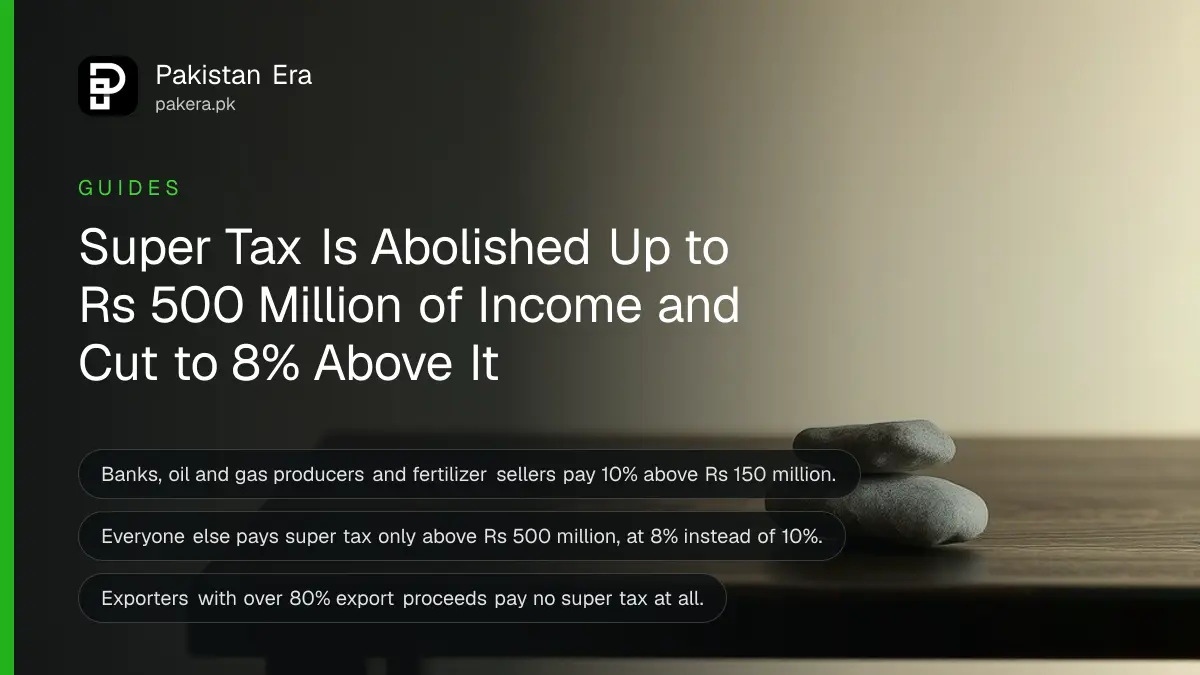
Super tax under section 4C no longer applies to anyone with income up to Rs 500 million, except banks, oil and gas producers and fertilizer sellers, who pay 10% above Rs 150 million. Everyone else pays 8% only where income exceeds Rs 500 million, down from 10%. That is the table the Finance Act 2026 put into Division IIB of the First Schedule, and FBR's Circular No. 02 of 2026-27 says super tax "has been abolished for every person having income up to Rs 500 million" outside those three groups.
Until this change a business or individual with income above Rs 150 million paid a sliding super tax of 1% to 10% on top of normal income tax. We read Division IIB and section 4C in FBR's consolidated Ordinance amended up to 30 June 2026, and the circular, on 19 October 2026.
The new table has four rows and two rates
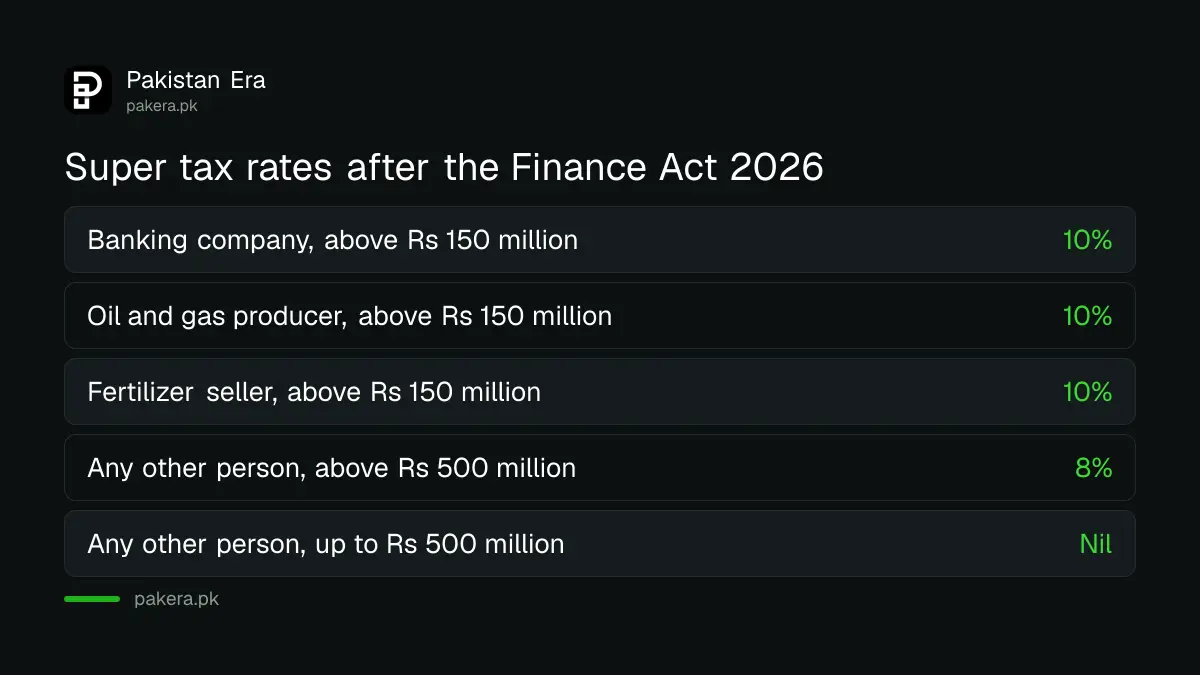
Division IIB now reads as a short list. A banking company pays 10% of income exceeding Rs 150 million. A person whose income is computed under Part I of the Fifth Schedule, which is petroleum exploration and production, pays 10% above Rs 150 million up to the limit in rule 4 of that Part. A person deriving income from the sale of any kind of fertilizer pays 10% above Rs 150 million. Any other person pays 8% where income exceeds Rs 500 million.
| Person | Income threshold | Super tax rate |
|---|---|---|
| Banking company | Exceeding Rs 150 million | 10% of the income |
| Oil and gas exploration and production (Fifth Schedule, Part I) | Exceeding Rs 150 million | 10% of the income |
| Seller of any kind of fertilizer | Exceeding Rs 150 million | 10% of the income |
| Any other person | Exceeding Rs 500 million | 8% of the income |
| Any other person | Up to Rs 500 million | Nil |
The circular adds a new clause (104B) in Part IV of the Second Schedule: an exporter with income above Rs 500 million pays no super tax at all if export proceeds realised for the year are more than 80% of total turnover.
The old sliding scale ran from 1% at Rs 150 million to 10% above Rs 500 million
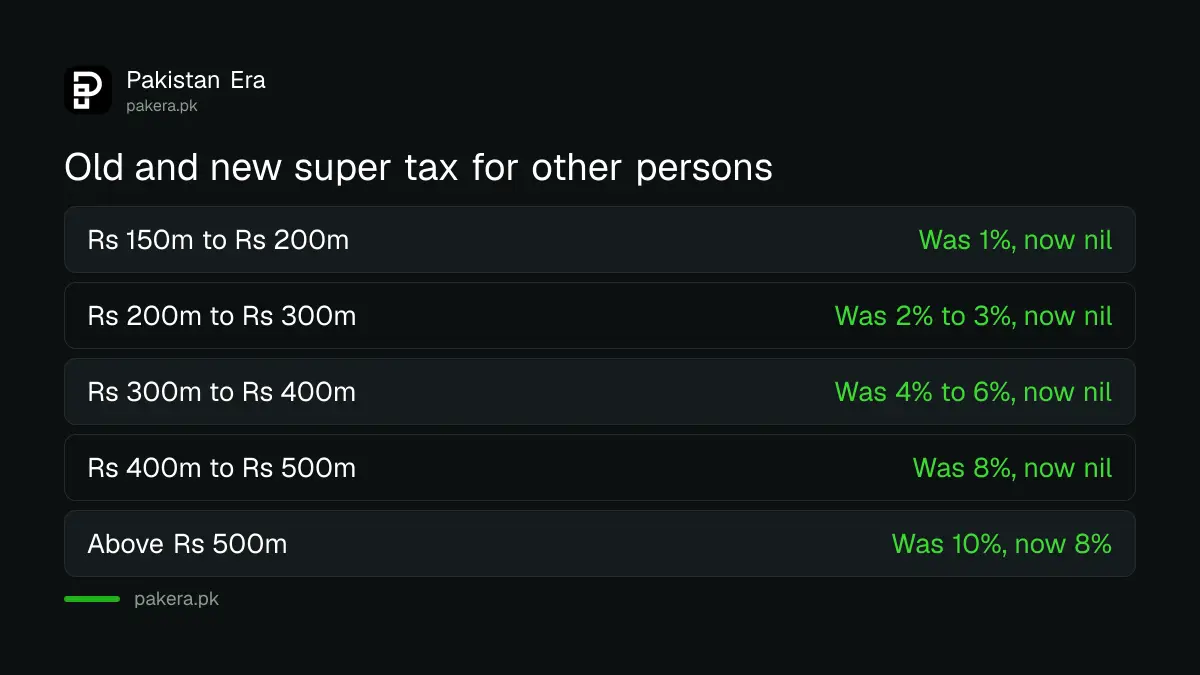
The table the Finance Act 2026 replaced, which the consolidated Ordinance keeps in a footnote, had eight bands for tax years 2023, 2024 and 2025: nil up to Rs 150 million, then 1% to Rs 200 million, 2% to Rs 250 million, 3% to Rs 300 million, 4% to Rs 350 million, 6% to Rs 400 million, 8% to Rs 500 million, and 10% above Rs 500 million. Each rate applied to the whole income once the band was crossed, not just the slice above it.
| Income under section 4C | Old rate (tax years 2023 to 2025) | New rate, other persons |
|---|---|---|
| Rs 150 million to Rs 200 million | 1% | Nil |
| Rs 200 million to Rs 250 million | 2% | Nil |
| Rs 250 million to Rs 300 million | 3% | Nil |
| Rs 300 million to Rs 350 million | 4% | Nil |
| Rs 350 million to Rs 400 million | 6% | Nil |
| Rs 400 million to Rs 500 million | 8% | Nil |
| Above Rs 500 million | 10% | 8% |
A manufacturing company with Rs 450 million of income paid Rs 36 million of super tax under the old scale and pays nothing under the new one. A company at Rs 600 million drops from Rs 60 million to Rs 48 million. Those are our arithmetic on the two tables.
"Income" for super tax is wider than taxable income
Sub-section (2) of section 4C defines the base. It is the sum of profit on debt, dividend, capital gains, brokerage and commission; taxable income under section 9 excluding those items and excluding brought-forward depreciation and business losses; imputable income under section 2(28A), which is the notional income behind final-tax receipts; and income computed under the Fourth, Fifth, Seventh and Eighth Schedules.
So a person whose dividends and capital gains are taxed at fixed rates still counts them towards the Rs 500 million line. The dividend tax rates and capital gains rules do not change; they just feed the super tax base. Section 4C applies to "every person", so an individual or an AOP with income on this scale is in, not only companies.
Super tax is paid with the return and through advance tax
Sub-section (3) says the tax is paid on the date and in the manner in section 137(1), which is with the return, and sub-section (5A) applies section 147, so it is included in quarterly advance tax instalments. If it is not paid, the Commissioner determines it by order and serves a notice of demand under sub-section (4), and recovery follows the ordinary chapters of the Ordinance.
The old table carried its own tax year columns. The new one carries none, and the circular does not say whether a tax year 2026 return, due by 31 October 2026, uses the new table or the old sliding scale for the year that ended on 30 June 2026. We could not resolve that from FBR's published documents.
How to check whether you owe it this year
The IRIS computation applies the rates it has been programmed with, which is the practical answer to the tax year question. Work the figure yourself before you accept the form.
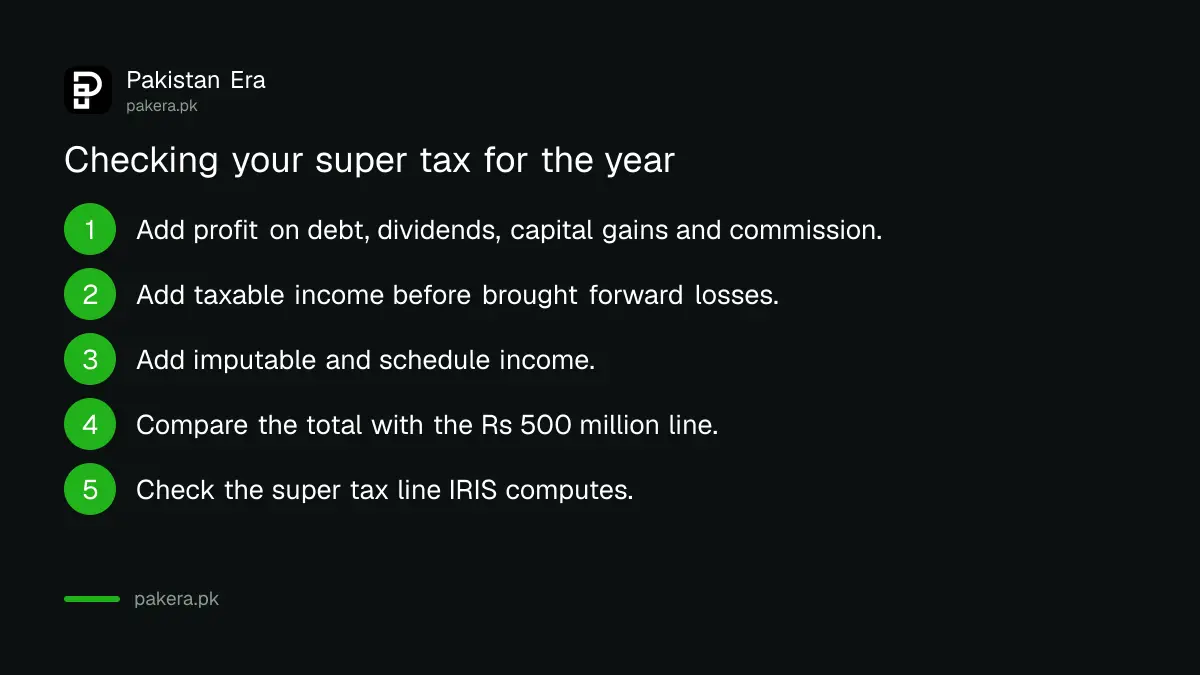
- Add profit on debt, dividends, capital gains, brokerage and commission for the year.
- Add taxable income under section 9 before any brought-forward depreciation or loss, excluding the items in step 1.
- Add imputable income for receipts taxed as final tax, and any Fourth, Fifth, Seventh or Eighth Schedule income.
- If the total is Rs 500 million or less and you are not a bank, an oil and gas producer or a fertilizer seller, super tax is nil under the new table.
- If it is above Rs 500 million, apply 8% to the whole income; check whether clause (104B) exempts you as an exporter.
- Compare with the super tax line IRIS computes and with the advance tax you paid under section 147.
Common questions
Who still pays super tax in Pakistan?
Banks, Fifth Schedule oil and gas producers and fertilizer sellers at 10% above Rs 150 million, and everyone else at 8% above Rs 500 million.
Is super tax abolished for income up to Rs 500 million?
Yes, for every person outside those three groups, according to Division IIB as amended by the Finance Act 2026 and FBR's circular.
What was the old rate above Rs 500 million?
Ten per cent. The Finance Act 2026 reduced it to 8% for persons other than banks, oil and gas producers and fertilizer sellers.
Are exporters exempt?
An exporter with income above Rs 500 million is exempt under clause (104B) if export proceeds are more than 80% of turnover for the year.
Does super tax apply to individuals?
Yes. Section 4C applies to every person, so an individual or AOP whose income under the section exceeds Rs 500 million pays it.
Does the new table apply to the tax year 2026 return?
FBR's circular does not say. The new Division IIB has no tax year column. Check the super tax line IRIS computes on your tax year 2026 return.
How we verified this
What we checked, where we read it, and what we could not confirm.
Last checked 19 October 2026. We read section 4C and Division IIB of Part I of the First Schedule, including the footnoted old table, in FBR's consolidated Income Tax Ordinance, 2001 amended up to 30 June 2026, and item 20 of Circular No. 02 of 2026-27 dated 8 September 2026, on the FBR website. The rupee examples are our arithmetic. We could not verify which tax year the new table first applies to, because neither document says.
About the author

Senior Writer, Public Services and Technology
Shahid joined us in 2024 as an author. He is a senior contributor to Pakistan's leading technology websites. He writes detailed articles, mostly covering his expertise in the latest tech, mobiles, apps, gadgets, and step-by-step guides. His ideology is to help people understand the latest trends and explain complex methods through very easy-to-understand guides.