Gas Connection for a Mosque or Madrassa in Pakistan: Domestic Rate, RLNG and Charges
Mosques, madrassas and attached hostels pay the domestic gas rate in Pakistan. See the RLNG charges for a new connection, the steps, and what changes the rate.
A mosque, madrassa, church or temple pays the domestic gas rate in Pakistan, not the commercial rate. OGRA's price notification and SNGPL's tariff definition put religious places, and the hostels attached to them, in the domestic category. A new connection for a mosque is now processed on RLNG, at the same Rs 20,000 security and Rs 1,500 or Rs 3,000 service line charges as a home.
Mosque committees often worry that a gas meter for the wuzu khana, the imam's quarter or a madrassa kitchen will be billed like a hotel. It will not. But the meter must be used for the religious place and its attached hostel. A shop in the mosque building is a different matter.
| Point | Rule for a mosque or madrassa |
|---|---|
| Tariff category | Domestic, same as standalone homes |
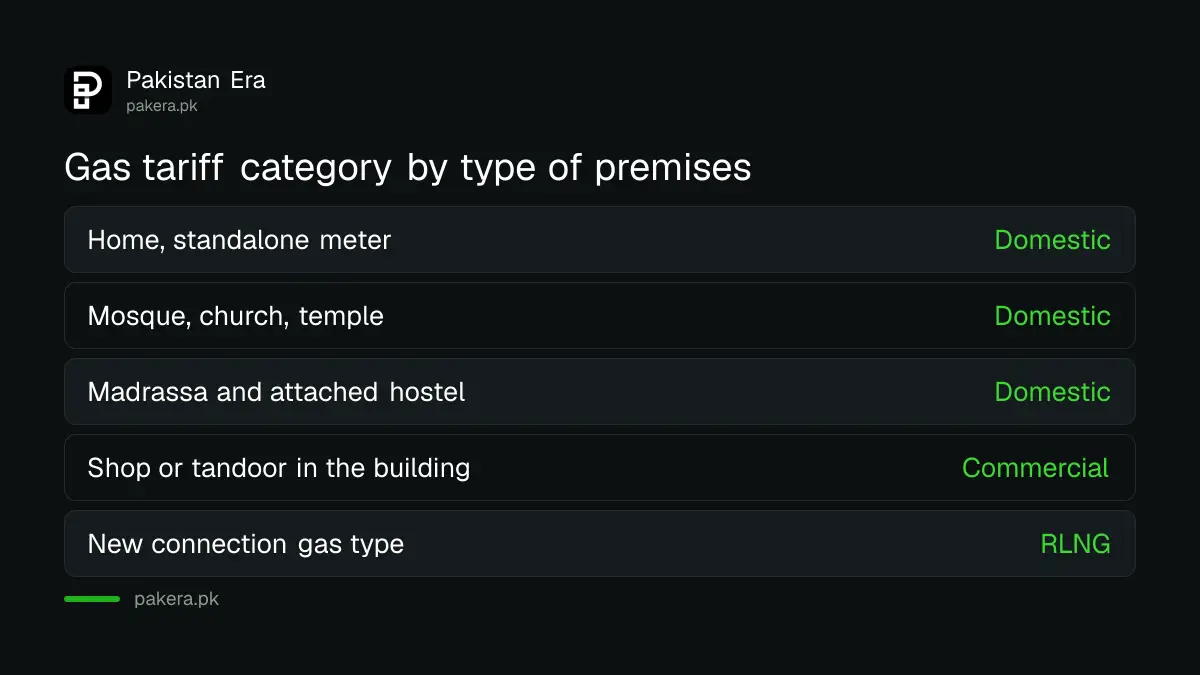
| Who is covered | Mosques, churches, temples, madrassas, other religious places and attached hostels |
| New connection gas type | RLNG (SNGPL says mosques are processed on RLNG) |
| Security deposit (SNGPL, RLNG) | Rs 20,000, refundable |
| Service line charges | Rs 1,500 up to 10 marla, Rs 3,000 above |
Religious places are billed in the domestic gas category
SNGPL's tariff definition lists two kinds of domestic consumer: standalone meters for homes, and mosques, churches, temples, madrassas, other religious places and the hostels attached to them. OGRA's price notification for SNGPL and SSGC uses the same domestic sector. So the same slab rates apply.
The commercial category is for establishments registered as commercial units or selling to the public: cafes, bakeries, tea stalls, hotels, private offices and the like. Its minimum bill is far higher. A mosque meter wrongly coded as commercial will show it at once in the tariff line of the bill.
For an old system gas meter, the domestic slabs, the protected limit and the fixed charges are explained in the guide to sui gas slab rates for 2026. The commercial rates, for comparison, are in sui gas commercial rates for 2026.
A new mosque connection is RLNG and costs the same as a home
SNGPL's FAQ says connections for mosques and other religious places are processed on RLNG. The charges are those of a domestic RLNG connection: Rs 20,000 refundable security, plus Rs 1,500 service line charges up to 10 marla or Rs 3,000 above. Fast track adds Rs 25,000.
RLNG is billed at one flat rate per unit that OGRA notifies each month, with no monthly fixed charges. It costs more than system gas, but SNGPL's FAQ says it is cheaper than LPG. For a mosque that heats wuzu water in winter, that comparison matters.
| Charge | Amount |
|---|---|
| Security deposit | Rs 20,000 (refundable) |
| Service line, plot up to 10 marla | Rs 1,500 |
| Service line, plot above 10 marla | Rs 3,000 |
| Fast track urgent fee | Rs 25,000 (optional) |
| Instalments | Not allowed |
Apply for a mosque or madrassa gas meter in five steps
The mosque committee applies on SNGPL's normal domestic RLNG form, with a CNIC and the property document. SNGPL surveys the site, issues a demand notice and house line plan, and installs the meter once the house line is certified and the charges are paid.
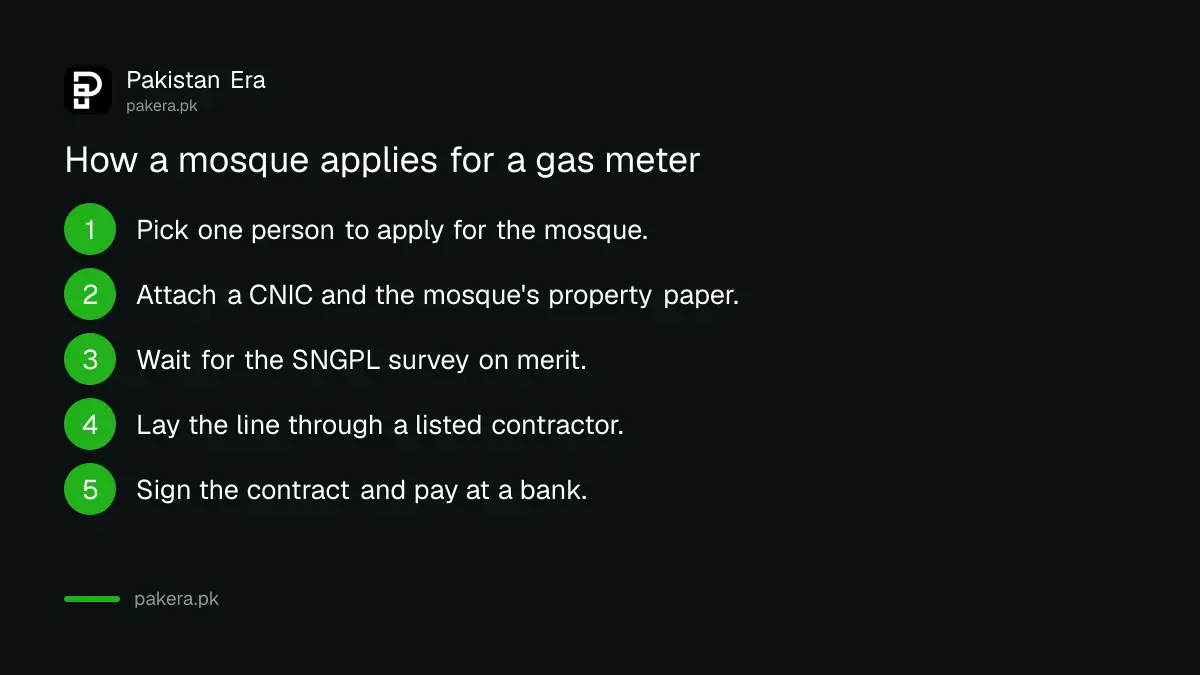
- Pick one responsible person, usually the mutawalli or the committee head, to apply. Fill SNGPL's domestic RLNG form online or at the nearest SNGPL office.
- Attach that person's valid CNIC and the property document of the mosque, such as the registry, transfer letter, fard or waqf deed. Add an NOC from the owner if the land is in someone else's name.
- Wait for the survey on turn and merit. The survey decides the house line plan.
- Get the house line laid and tested by an SNGPL listed contractor and take the installation certificate.
- Sign the supply contract, collect the challan and pay the security and service line charges at a bank or online channel. Keep the bank receipt with the mosque's records.
The full new connection process, with waiting times, is in the guide to a new SNGPL or SSGC gas connection. In Sindh and Balochistan, SSGC's RLNG process is set out in SSGC's domestic RLNG connection.
Keep the mosque meter for the mosque only
The domestic rate applies because the gas serves a religious place and its attached hostel. Using the same meter for a shop, a tandoor or a rented hall on the mosque's land risks a change of category and a back bill. SNGPL's contract also bars using gas for other purposes without its written consent.
- Shops or a tandoor in the mosque building need their own commercial meter.
- A madrassa hostel attached to the mosque stays in the domestic category.
- Extending the gas line to a new building needs SNGPL's written approval first.
- Fit conical baffles in water geysers. SNGPL's contract makes them compulsory and lets SNGPL fit them and bill the cost in 12 instalments if missing.
If the bill shows the commercial category, write to SNGPL with the mosque's property document and ask for correction, then complain on 1199. The geyser saving tips that also suit a mosque are in the guide to saving sui gas in winter.
Common questions
Do mosques pay commercial gas rates in Pakistan?
No. OGRA's notification and SNGPL's tariff definition put mosques, churches, temples, madrassas and attached hostels in the domestic category.
Can a mosque get a new system gas connection?
No. New connections are processed on RLNG. SNGPL's FAQ says mosque and religious place connections are processed on RLNG too.
How much does a mosque gas connection cost?
On SNGPL's RLNG terms, Rs 20,000 refundable security plus Rs 1,500 service line up to 10 marla or Rs 3,000 above. The house line work is paid to the contractor.
Is a madrassa hostel billed as domestic?
Yes, if it is attached to the religious place. The domestic category covers hostels attached to mosques, madrassas and other religious places.
Can the mosque meter also supply the shops in the building?
No. Shops are commercial users. Give them their own meters, or the mosque's category and bill can be changed.
Who should sign the application for a mosque?
One responsible person, usually the mutawalli or committee head, with a CNIC copy and the mosque's property or waqf document.
How we verified this
What we checked and where we read it.
We checked SNGPL's tariff definition page, its FAQs for domestic RLNG connections (mosques processed on RLNG, charges, instalments, fast track), the brief procedure for domestic RLNG connections, the types of bill page and the domestic RLNG supply contract PDF on 24 November 2026, all on sngpl.com.pk. The domestic sector definition that includes religious places comes from OGRA's gas sale price notification effective 1 July 2025, listed on OGRA's consumer gas prices page.
About the author

Tax, Bills and Technology Writer
Ali Akhtar is a young and curious voice here at Pakistan Era. He is currently pursuing his A-Levels and has a growing interest in Pakistan’s changing industrial landscape and educational trends. Ali likes to write in a way that helps him explain and explore the world around him. His writing reflects the perspective of the new generation navigating the evolving trends of Pakistan where technology, youth innovation, and shifting opportunities are reshaping the country’s future.