Muslim 500 2027: Shehbaz Sharif and Asim Munir Are Joint No. 1, Shared With Saudi and Turkish Leaders
Is the viral claim true? The Muslim 500 2027 puts Shehbaz Sharif and Asim Munir at joint No. 1 with King Salman, MBS and Erdogan. Six Pakistanis in the Top 50.
یہ صفحہ اردو میں پڑھیں
Short answer: Yes, the viral claim is true, but only half the story. The Muslim 500 list for 2027 puts Prime Minister Shehbaz Sharif and Field Marshal Asim Munir at joint No. 1. They share the top spot with Saudi Arabia's King Salman and Crown Prince Mohammed bin Salman, and with Türkiye's President Recep Tayyip Erdoğan.
The list is published every year by the Royal Islamic Strategic Studies Centre (RISSC) in Amman, Jordan. This is the first time in its history that it has named a joint No. 1. The 2027 book says the reason is the Makkah Joint Defence Agreement between Pakistan, Saudi Arabia and Türkiye.
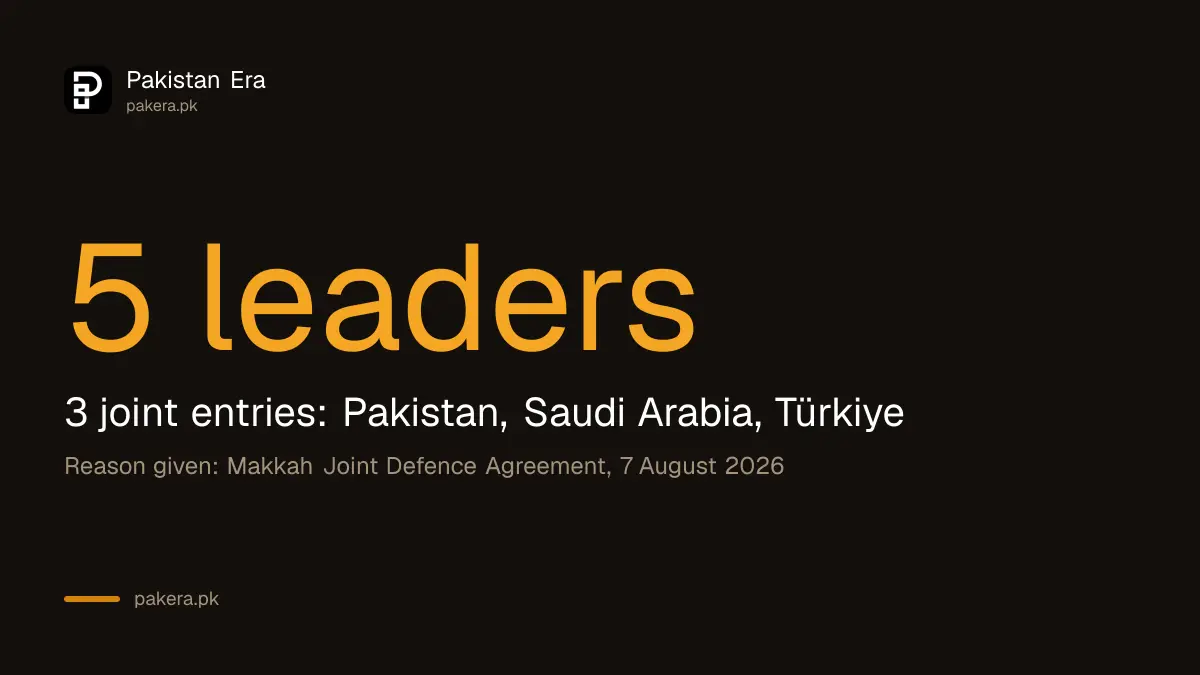
Shehbaz Sharif and Asim Munir share No. 1 in the Muslim 500 2027
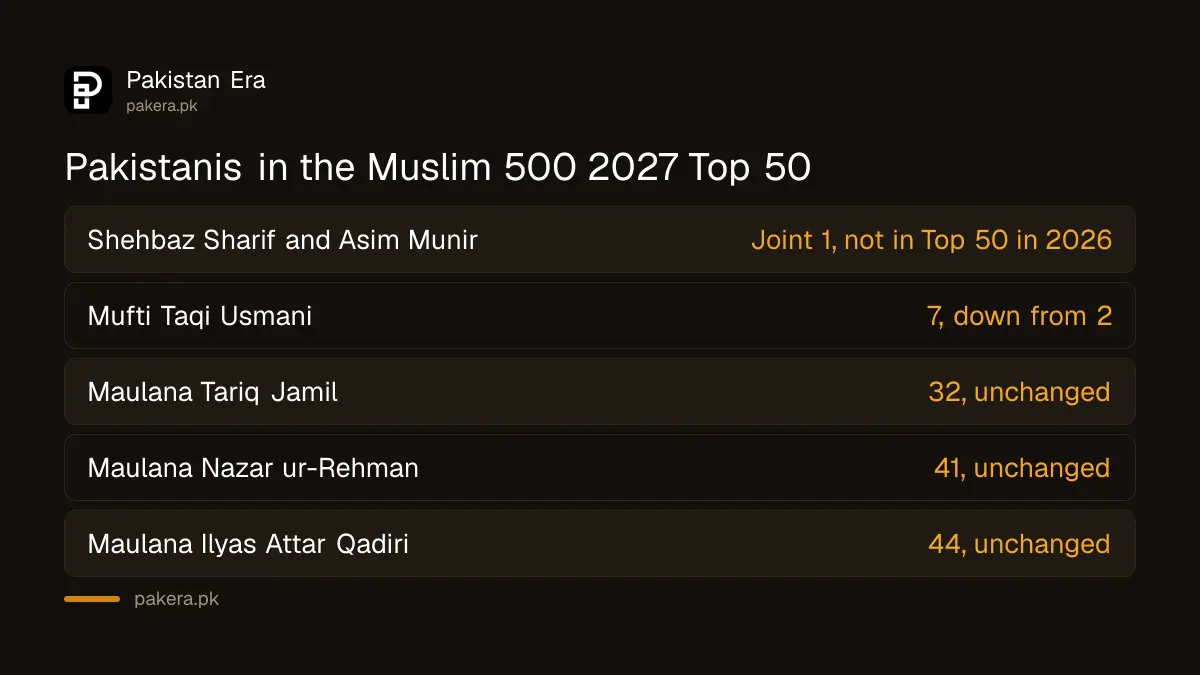
The 2027 edition of the Muslim 500 lists three joint No. 1 entries covering five people. Pakistan's entry is Prime Minister Shehbaz Sharif together with Field Marshal Asim Munir, Chief of Defence Forces and Chief of the Army Staff.
The viral posts say "Pakistan's leaders named the most influential Muslims in the world". That is correct as far as it goes. What they usually leave out is that the top spot is shared with three other leaders, and that the list is a yearly book by a research centre, not an official ranking by any government.
| Joint No. 1 entry, 2027 | Country | Place in the 2026 list |
|---|---|---|
| King Salman bin Abdul-Aziz Al-Saud | Saudi Arabia | 8 |
| Crown Prince Mohammed bin Salman | Saudi Arabia | 14 |
| Prime Minister Shehbaz Sharif | Pakistan | Outside the Top 50 |
| Field Marshal Asim Munir | Pakistan | Outside the Top 50 |
| President Recep Tayyip Erdoğan | Türkiye | 7 |
Both Pakistani leaders were in the list in 2024, 2025 and 2026, but in the wider group of 450 names that the book does not rank. So 2027 is the first year either of them is in the Top 50 at all, and they went straight to the top.
The Makkah defence pact is the reason the book gives
The 2027 book says it chose a joint No. 1 because of the Makkah Joint Defence Agreement, signed on 7 August 2026. It names the leaders of the three signing countries, Pakistan, Saudi Arabia and Türkiye, as the leaders who built that alliance.
The pact says an armed attack on any one of the three countries will be treated as an attack on all of them. The book describes Pakistan's part as the military strength of the alliance. Its profile of Prime Minister Shehbaz Sharif also credits him with Pakistan's role as a mediator in this year's crisis involving the United States, Israel and Iran. Its profile of Field Marshal Asim Munir centres on the May 2025 conflict with India and the ceasefire of 10 May 2025.
For what the agreement actually commits each country to, read our explainer on the Makkah Joint Defence Agreement, and for the post Asim Munir holds, how the Chief of Defence Forces role works under Article 243.
Six Pakistanis are in the 2027 Top 50
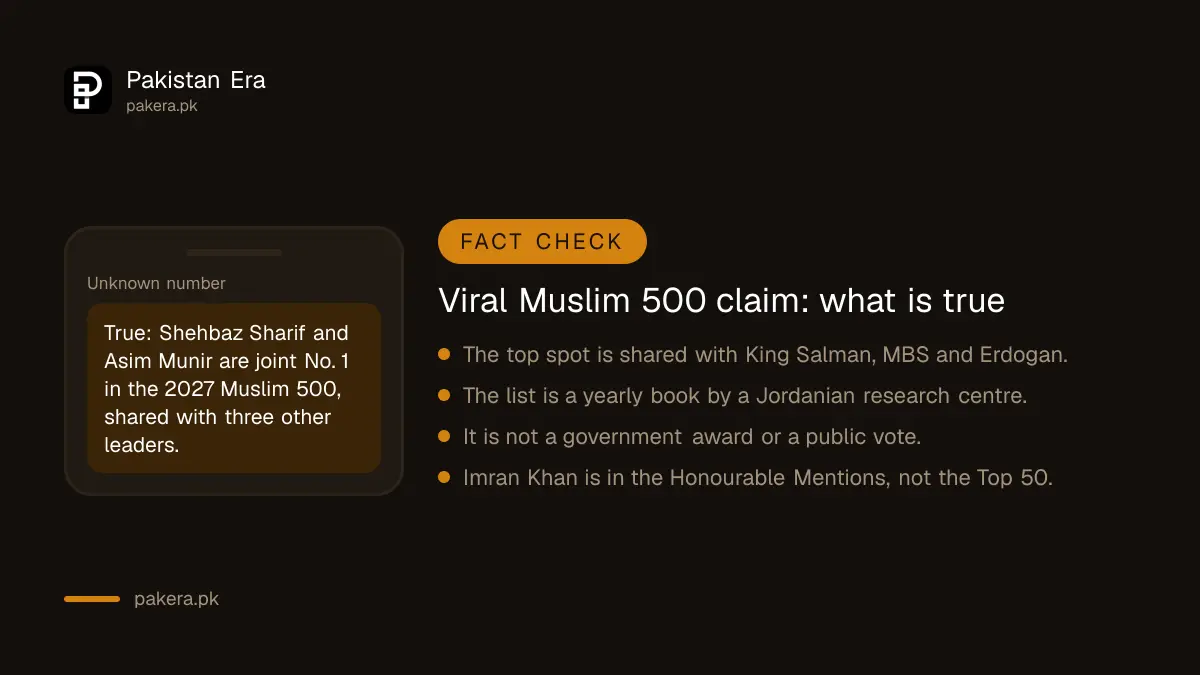
Pakistan has six names in the 2027 Top 50: the two leaders at joint No. 1 and four religious scholars and preachers. Mufti Taqi Usmani is Pakistan's highest-placed scholar at No. 7, down from No. 2 last year.
| Name | Described as | 2027 place | 2026 place |
|---|---|---|---|
| Shehbaz Sharif | Prime Minister | Joint 1 | Not in Top 50 |
| Asim Munir | Field Marshal, Chief of Defence Forces | Joint 1 | Not in Top 50 |
| Mufti Muhammad Taqi Usmani | Mufti and leading scholar | 7 | 2 |
| Maulana Tariq Jamil | Scholar and preacher | 32 | 32 |
| Maulana Nazar ur-Rehman | Amir of Tablighi Jamaat | 41 | 41 |
| Maulana Muhammad Ilyas Attar Qadiri | Preacher and spiritual guide | 44 | 44 |
Former Prime Minister Imran Khan is not in the Top 50. He appears in the book's Honourable Mentions section, which sits outside the numbered ranking.
Qatar's Emir dropped from No. 1 to No. 6
Last year's sole No. 1, Qatar's Emir Sheikh Tamim bin Hamad Al-Thani, is No. 6 in 2027. The joint top entries take the first three places, so the next names start at No. 4.
- Joint No. 1: King Salman and Crown Prince Mohammed bin Salman (Saudi Arabia), Shehbaz Sharif and Asim Munir (Pakistan), Recep Tayyip Erdoğan (Türkiye).
- No. 4: Ayatollah Sayyid Mojtaba Khamenei, Supreme Leader of Iran, new to the list.
- No. 5: King Abdullah II of Jordan, the same as last year.
- No. 6: Emir Sheikh Tamim bin Hamad Al-Thani of Qatar, down from No. 1.
- No. 7: Mufti Taqi Usmani of Pakistan, down from No. 2.
The book's Man of the Year is Dr Hussam Abu Safiya, the paediatrician who ran Kamal Adwan Hospital in northern Gaza. He is also new to the Top 50, at No. 50.
The list is a research centre's yearly book, not a government award
The Muslim 500 is a yearly book, not a vote or an official award. It is published by the Royal Islamic Strategic Studies Centre in Amman, Jordan, and its own pages say the views in it do not necessarily reflect those of the centre or its advisory board.
The book has been published every year since 2009, and its editors choose the names and the order. It defines influence as the power to make a change with a significant impact on the Muslim world, and says that impact can be positive or negative. Being listed does not mean the editors endorse a person's views. That is why the same book also has a category for extremists.
In Pakistan, Senate Chairman Syed Yousaf Raza Gilani congratulated both leaders on 15 November in a statement issued through the Press Information Department. He called the ranking a recognition of the joint work of the country's civil and military leadership.
If you are forwarding the news, the accurate version is short: Shehbaz Sharif and Asim Munir are joint No. 1 in the Muslim 500 2027, shared with the Saudi and Turkish leaders, because of the Makkah defence pact. For more on Pakistan's diplomacy this week, Islamabad also hosted the ECO Council of Ministers on 15 and 16 November.
Common questions
Are Shehbaz Sharif and Asim Munir really No. 1 in the Muslim 500?
Yes. The 2027 edition lists them at joint No. 1, together with King Salman and Crown Prince Mohammed bin Salman of Saudi Arabia and President Erdoğan of Türkiye.
Who publishes the Muslim 500?
The Royal Islamic Strategic Studies Centre (RISSC) in Amman, Jordan. The list has been published every year since 2009.
Why is there a joint No. 1 this year?
The book says it is the first joint No. 1 in its history and gives the Makkah Joint Defence Agreement of 7 August 2026 as the reason.
Who was No. 1 in the Muslim 500 last year?
Qatar's Emir, Sheikh Tamim bin Hamad Al-Thani, was No. 1 in the 2026 edition. He is No. 6 in 2027.
Is Imran Khan in the Muslim 500 2027?
Yes, but not in the Top 50. He is listed in the Honourable Mentions section of the book.
Which Pakistani scholars are in the Top 50?
Mufti Taqi Usmani at No. 7, Maulana Tariq Jamil at No. 32, Maulana Nazar ur-Rehman of Tablighi Jamaat at No. 41 and Maulana Ilyas Attar Qadiri at No. 44.
Maulana Nazar ur-Rehman died in Lahore on 16 November 2026, a day after the list was reported. Details are in Tablighi Jamaat Ameer Maulana Nazar ur-Rehman passes away.
Where can I read the full list?
The full 2027 book is free to download as a PDF from the Muslim 500's own website.
How we verified this
What we checked and where we read it.
We checked every name, place and previous-year figure on 17 November 2026 in the 2027 edition PDF on The Muslim 500 website: the Top 50 list (page 63 to 64), the Top 50 by category, the joint No. 1 explanation and the profiles of Shehbaz Sharif and Asim Munir (pages 71 and 72), and the Honourable Mentions (page 136). Previous-year places are the figures the book prints in brackets after each name. The Senate Chairman's statement is Press Release No. 181 of 15 November 2026 on the Press Information Department website.
About the author

Global Affairs & Political Economy Writer
Muhammad Hatim is a book lover who started writing because he enjoys it. At Pakistan Era he writes about international relations, geopolitics and the global economy, with a particular interest in South Asia and the forces behind current events.