NCCIA Peshawar Returns Rs 300,000 to an Online Fraud Victim in Pakistan
NCCIA Peshawar says it traced and returned Rs 300,000 lost to online fraud. What was reported, what to do in the first hour, and where to complain in Pakistan.
The National Cyber Crime Investigation Agency (NCCIA) in Peshawar says it traced and recovered Rs 300,000 lost in an online fraud, and handed the money back to the person who complained. The agency's statement was reported on 8 October 2026. We could not open NCCIA's own website to read it there, because the site sat behind a bot check when we tried.
Recoveries like this are not common news, so the case is worth reading for one reason. It shows what helps a fraud victim get money back in Pakistan: a quick complaint, clear details, and a money trail that investigators can still follow.
Here is what NCCIA is reported to have said, what you should do in the first hour if it happens to you, and where to complain.
NCCIA Peshawar says it returned Rs 300,000 to a fraud victim
NCCIA Peshawar says a citizen reported losing money in an online fraud. Investigators traced the transactions with digital forensic methods, recovered Rs 300,000 and returned it to the complainant. The statement does not name the victim, the scheme or the bank.
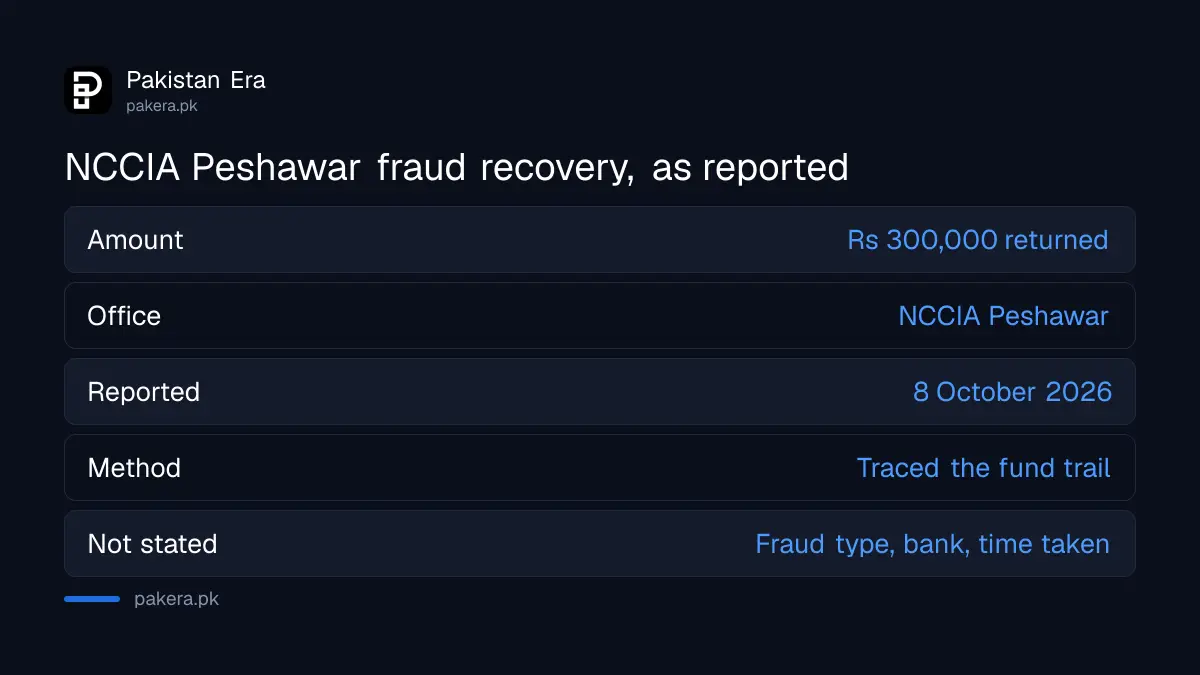
According to the reported statement, the agency ran a detailed investigation and "technical" action to follow the money. It used the fund trail to find the transactions linked to the complaint. Then it got the money back and returned it.
The statement leaves out the details most readers want. It does not say what kind of fraud it was, how long the case took, or whether the money was frozen in a bank account or a mobile wallet. We have not seen an FIR number or a court order either. So treat this as one reported case, not a promise that every complaint ends the same way.
| Detail | What was reported |
|---|---|
| Agency | NCCIA, Peshawar |
| Amount | Rs 300,000 recovered and returned |
| Date reported | 8 October 2026 |
| Method | Digital forensics to trace the fund trail |
| Not stated | Type of fraud, bank or wallet, time taken |
Reporting fast is what gives investigators a trail to follow
NCCIA's own advice in the statement is to report online fraud as quickly as possible. Money that sits in the receiving account can still be blocked. Money that has been withdrawn as cash, or moved through several accounts, is much harder to reach.
The agency also repeated a warning that sounds basic but still catches people. Do not share passwords, account details, PINs or one-time codes (OTPs) with anyone who calls or messages you. A real bank, wallet or government office does not need your OTP to help you.
Speed matters at your bank too. If someone took money from your account without your permission, the bank has its own complaint process and its own deadlines under State Bank rules. The bank's response time on a fraud complaint is set out in the 30 day answer rule for fraud complaints, and that clock starts only when you complain.
What to do in the first hour after online fraud
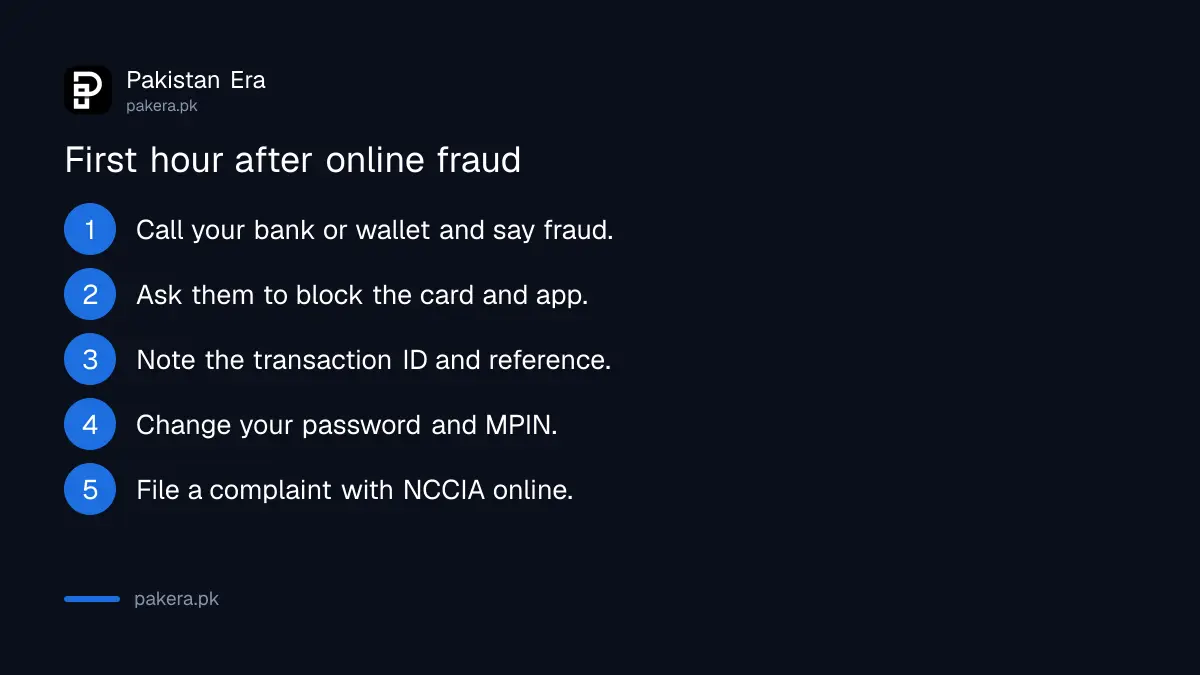
Call your bank or wallet first and ask them to block the account and stop the transfer. Then file a complaint with NCCIA online, with the transaction ID, time, amount and receiving number. Keep screenshots of every message and call.
- Call your bank or wallet helpline and say the word "fraud". Ask them to block your card, app and account.
- Give them the transaction ID, the amount, the time, and the receiving account or mobile number.
- Ask for a complaint reference number and write it down.
- Change your app password and MPIN from a safe phone.
- File an online complaint with NCCIA with the same details and your CNIC.
- Save screenshots of the chat, SMS, call log and payment receipt. Do not delete anything.
For JazzCash, the helpline on JazzCash's own website is 051-111-124-444, open 24 hours. The site also shows 4444 for Jazz customers. For a bank, use the number printed on the back of your debit card, not a number someone sends you.
If the money left a mobile wallet without your approval, the steps to get a refund from the wallet are laid out in an unauthorised Easypaisa or JazzCash transfer. The fuller NCCIA filing route is in how to report a cybercrime in Pakistan.
Where to complain about online fraud in Pakistan
Your bank or wallet is always the first stop, because only it can block the account. NCCIA investigates the crime. PTA deals with the phone number used in the scam. The State Bank's Sunwai portal is for a bank that does not resolve your complaint.
| Where | What it does | When to use it |
|---|---|---|
| Your bank or wallet | Blocks the account, raises a dispute | Straight away |
| NCCIA | Investigates and can trace the money | Same day, after the bank |
| PTA | Acts on the scam phone number | When a call or SMS was used |
| SBP Sunwai | Escalates a bank complaint | If the bank does not resolve it |
Helpline numbers for NCCIA are often shared as 1799, and PTA's as 0800-55055. We could not confirm either on the agencies' own pages in this check, so confirm the number before you rely on it.
NCCIA Lahore also reported 26 arrests on the same day
On 8 October 2026, NCCIA's Lahore Zone was reported to have arrested 26 people in two operations. One group allegedly ran an online honey trap. The other was a call centre accused of cheating people in the United Kingdom.
According to the reports, 17 women were held over a scheme that persuaded men on online platforms to send gifts and money. Nine men were held at a call centre in Allama Iqbal Town that allegedly took payments for mobile phones and packages that were never delivered. These are allegations at the arrest stage, not findings of a court.
The same Lahore pattern has come up before. Earlier in the week, NCCIA was reported to have arrested 39 people at a Lahore call centre in the fake loan app blackmail case.
What we could not confirm about the Peshawar case
We could not read the NCCIA statement on the agency's own site, because nccia.gov.pk returned a security check when we opened it on 9 October 2026. Every detail of the Peshawar recovery here is therefore reported, not read at source.
We also do not know the fraud type, the time from complaint to recovery, or whether a bank froze the money first. If NCCIA publishes more, we will add it here.
Common questions
Can NCCIA really get my money back after online fraud?
Sometimes. NCCIA Peshawar says it recovered Rs 300,000 in one case reported on 8 October 2026. Recovery depends on reporting fast, before the money is withdrawn or moved on.
Who should I call first, my bank or NCCIA?
Your bank or wallet. Only they can block your account and try to stop the transfer. File with NCCIA right after, on the same day.
What details do I need for an NCCIA complaint?
Your CNIC, the transaction ID, the amount, the date and time, the receiving account or number, and screenshots of the messages or calls.
Does a bank ever ask for my OTP on a call?
No. A real bank, wallet or government office does not need your OTP or PIN. Anyone asking for it on a call or message is a warning sign.
What is the JazzCash helpline for a fraud complaint?
JazzCash's website lists 051-111-124-444, open 24 hours a day, and 4444 for Jazz customers.
How we verified this
What we checked, where we read it, and what we could not confirm.
Last checked on 9 October 2026, Pakistan time. We tried NCCIA's website, nccia.gov.pk, and its complaint site, and both returned a bot check, so the Peshawar and Lahore details are reported, not read at source. We read the JazzCash helpline on JazzCash's own website. The NCCIA and PTA helpline numbers are widely reported but were not confirmed on official pages in this check.
About the author

Technology Journalist & Multimedia Producer
Ahmad Ali is a technology journalist and multimedia producer at Pakistan Era, joining the team in October 2026. He covers consumer technology and digital life for Pakistani readers, combining research with hands-on product testing.