How NEPRA Cut Rs 17.3 Billion From Plant Fuel Claims to Set the Rs 1.1086 Charge
NEPRA cut Rs 17,279 million from plant fuel claims, mostly gas plants, before setting the Rs 1.1086 a unit charge. See why and how to check your bill.
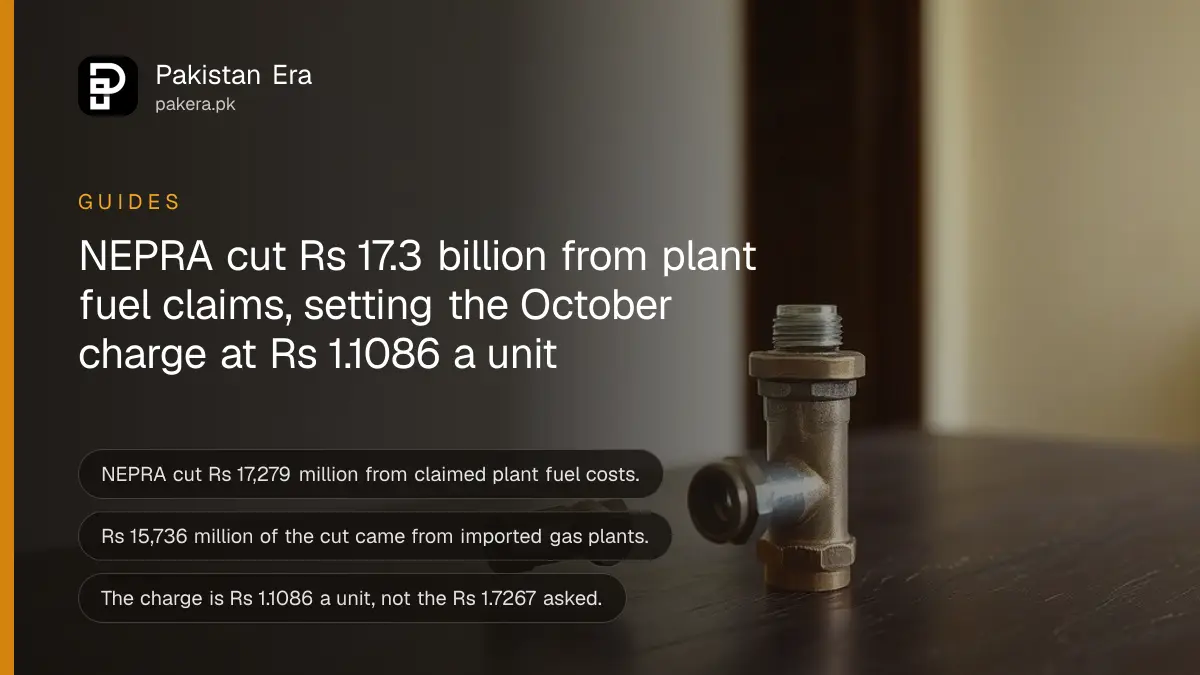
NEPRA set the October fuel charge at Rs 1.1086 a unit, not the Rs 1.7267 the power purchasing agency asked for, mainly because it cut Rs 17,279 million from what some power plants billed for fuel. Of that cut, Rs 15,736 million came from plants that run on imported gas. We read the decision to see where the 62 paisa went.
The decision is dated 7 October 2026. Our piece on the decision gives the headline numbers and what 100 to 500 units add to a bill. This page explains how NEPRA got there, using the text of the decision itself.
NEPRA approved less because it trimmed plant costs
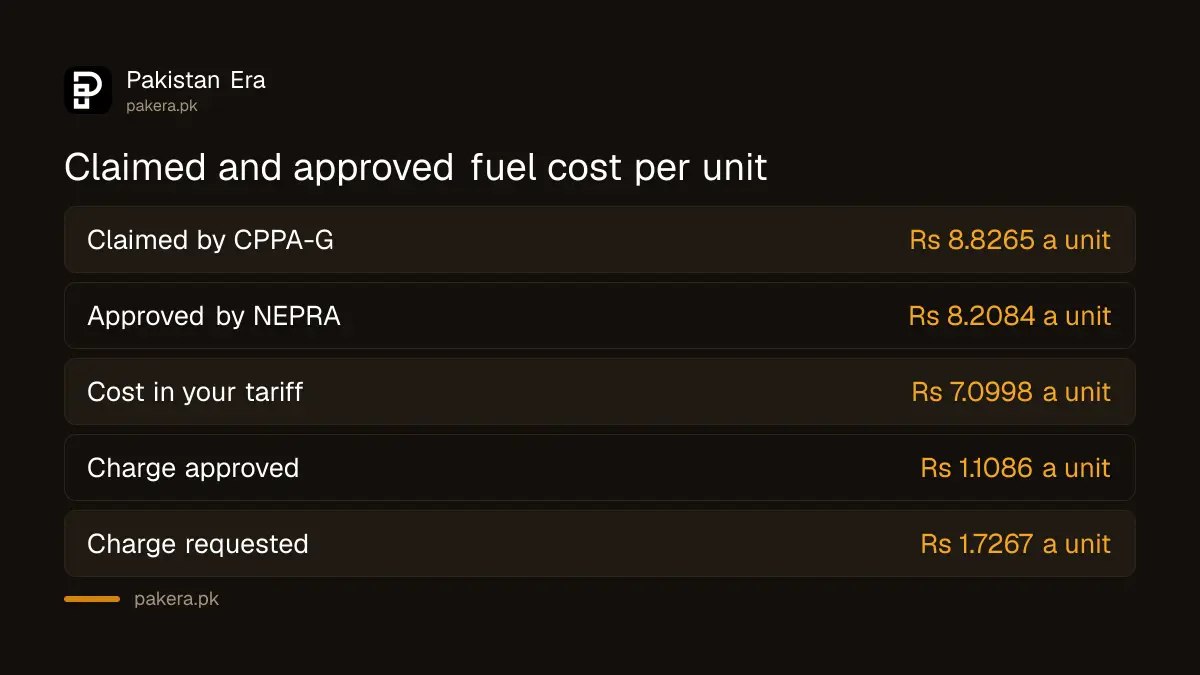
The agency that buys power, CPPA-G, claimed an actual fuel cost of Rs 8.8265 a unit. NEPRA worked it out at Rs 8.2084, against a reference cost of Rs 7.0998 built into tariffs. The gap between those two costs is the charge: Rs 1.1086.
Behind that is a cut of Rs 17,279 million. NEPRA says it adjusted the fuel cost of certain plants "based on the available approved fuel cost components". In plain words, it replaced the amounts CPPA-G claimed with the cost rates NEPRA had already approved for those plants.
The cut covers several plants, and the biggest part, Rs 15,736 million, is for plants that burn imported gas, called RLNG.
The RLNG price cut replaced a smaller claim
CPPA-G had asked to count a negative adjustment of Rs 10.617 billion for lower RLNG prices as a previous-period item. NEPRA found no plant-wise or month-wise detail. It also noted that its own fuel cost decisions for RLNG plants already used lower prices.
So NEPRA dropped that claimed Rs 10.617 billion and used a larger Rs 17.279 billion negative adjustment, which includes the Rs 15.736 billion for RLNG plants.
Behind the lower RLNG prices is a Cabinet decision. At the hearing, CPPA-G said indigenous gas supplied by SNGPL to RLNG plants may be charged at Rs 2,000 per MMBtu from 1 April to 31 October 2026, and that OGRA notified the tariff on 16 September 2026.
Past adjustments net to a credit of Rs 20.7 billion
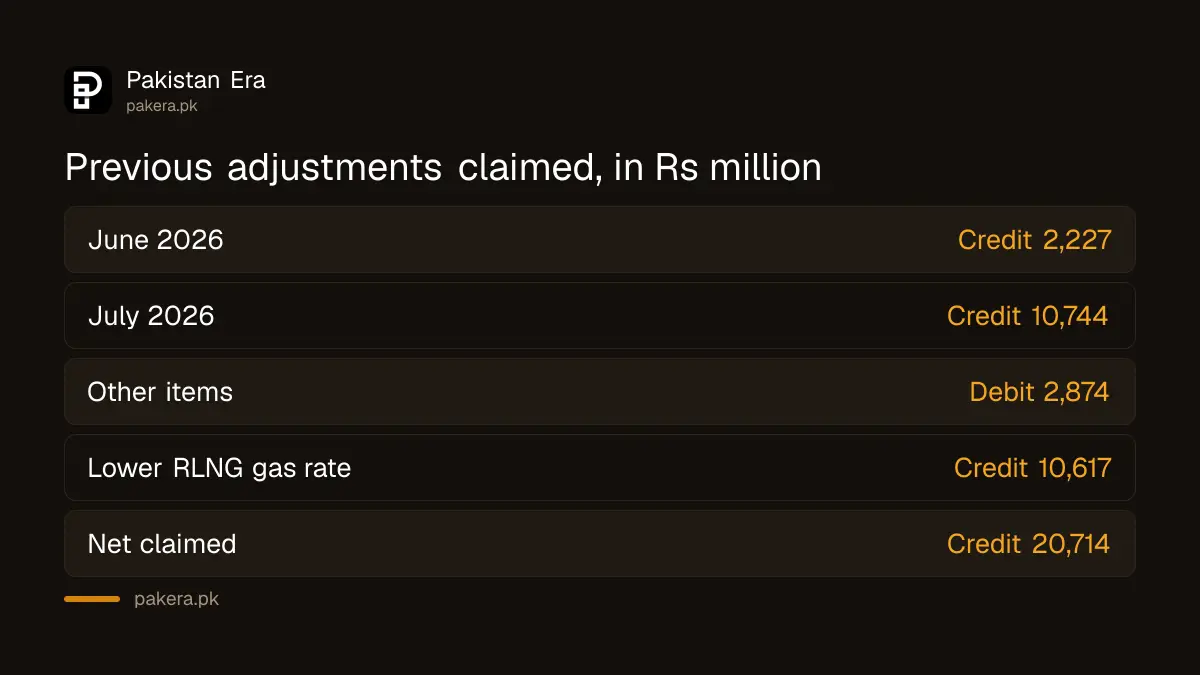
CPPA-G also asked NEPRA to add net negative "previous adjustments" of Rs 20,714 million. A negative previous adjustment means consumers were overcharged earlier and get it back. NEPRA kept the June and July items and excluded the RLNG item that it counted elsewhere.
| Previous adjustment | Rs million |
|---|---|
| June 2026 | (2,227) |
| July 2026 | (10,744) |
| Other previous adjustments | 2,874 |
| Lower RLNG gas rate provision | (10,617) |
| Total claimed | (20,714) |
Brackets mean a credit to consumers. NEPRA allowed the June and July items, with trims where CPPA-G had used company invoices instead of NEPRA-approved rates, and removed the RLNG line because it had moved into the current month's plant costs.
The hearing raised winter and demand questions
NEPRA heard on 29 September 2026. Commentators asked about plant costs, fuel prices and demand. One suggested NEPRA ask for a winter plan to keep fuel charges low. ISMO, the system operator, said the Power Division, ISMO, SNGPL and SSGC were already coordinating one.
On demand, PPMC said the rise came mainly from captive consumers shifting to the grid and from higher industrial use under the Industrial Consumption Package. CPPA-G told the hearing that generation in the month was 3.28 per cent above what the reference tariff assumed.
These are statements recorded in the decision. They are not NEPRA's own findings. The drop from the claimed charge comes from the plant cost adjustments set out above.
The decision also notes that the charge shows separately on your bill, on the units you used in August, so you can tell it apart from the base tariff.
What you can check on your own bill
The charge is Rs 1.1086 on the units you used in August, shown as a separate line on the October bill. Lifeline consumers, EV charging stations and prepaid consumers are exempt. See our guide to the October fuel charge on bills for the line by line check.
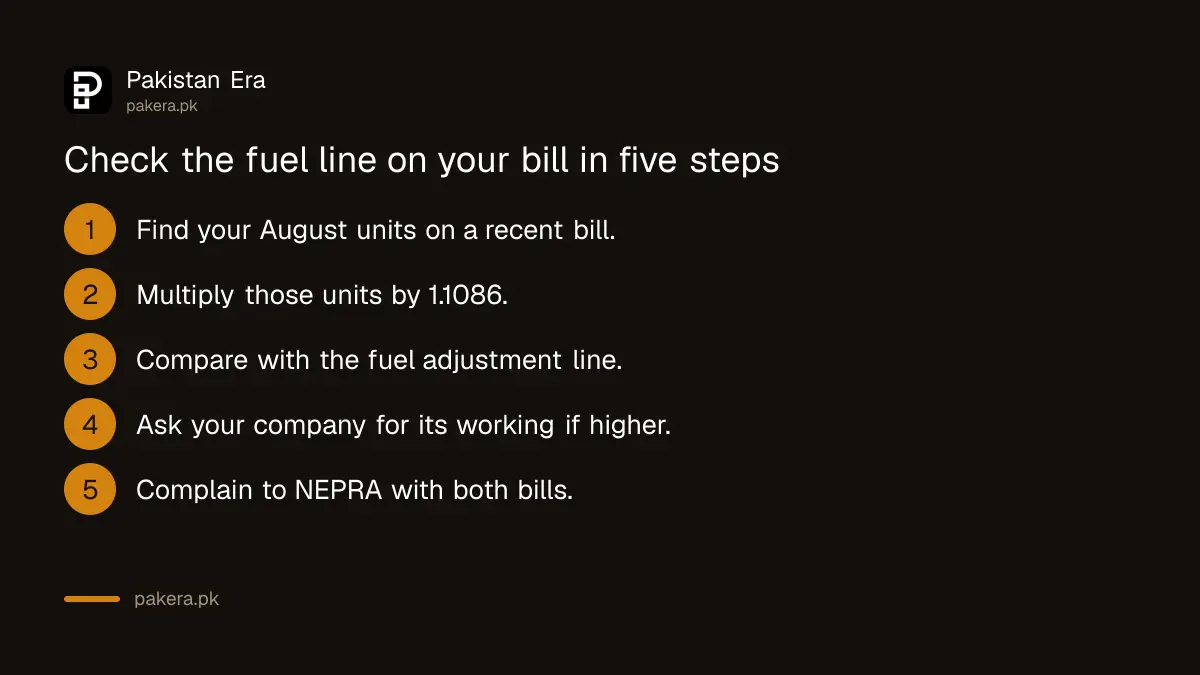
- Find your August units on a recent bill.
- Multiply them by 1.1086.
- Compare with the fuel adjustment line on the October bill.
- If it is much higher, ask your company for its working.
- If the reply is not clear, complain to NEPRA with both bills.
Common questions
Why was the fuel charge cut from Rs 1.7267 to Rs 1.1086?
NEPRA cut Rs 17,279 million from plant fuel costs that CPPA-G claimed, using cost rates it had already approved. That lowered the actual fuel cost per unit from Rs 8.8265 to Rs 8.2084.
Which plants were cut the most?
Plants that run on imported gas, called RLNG plants, took Rs 15,736 million of the Rs 17,279 million cut.
What is a previous adjustment?
It is a correction for earlier months, positive if consumers were undercharged and negative if overcharged. The decision lists a net negative claim of Rs 20,714 million.
Does K-Electric apply the same charge?
Yes. The decision says the charge applies to K-Electric consumers over the same period.
Will there be another fuel charge next month?
NEPRA decides one each month for the earlier month's fuel cost. The September cost will be heard separately.
How we verified this
What we checked, where we read it, and what we could not confirm.
Last checked on 13 October 2026, Pakistan time. We downloaded and read NEPRA's fuel charges adjustment decision for August 2026. The PDF is a scan, and some plant by plant tables did not read cleanly, so we quote only the totals and paragraphs we could read in full. The comparison table is our own layout of NEPRA's figures.
About the author

Tax, Bills and Technology Writer
Ali Akhtar is a young and curious voice here at Pakistan Era. He is currently pursuing his A-Levels and has a growing interest in Pakistan’s changing industrial landscape and educational trends. Ali likes to write in a way that helps him explain and explore the world around him. His writing reflects the perspective of the new generation navigating the evolving trends of Pakistan where technology, youth innovation, and shifting opportunities are reshaping the country’s future.