Overseas Job Agents in Pakistan Can Charge Only Rs 15,000: Check and Complain
An overseas job agent in Pakistan may charge Rs 15,000, held by a bank until you join. See the legal fees, the licence check and how to complain to BEOE
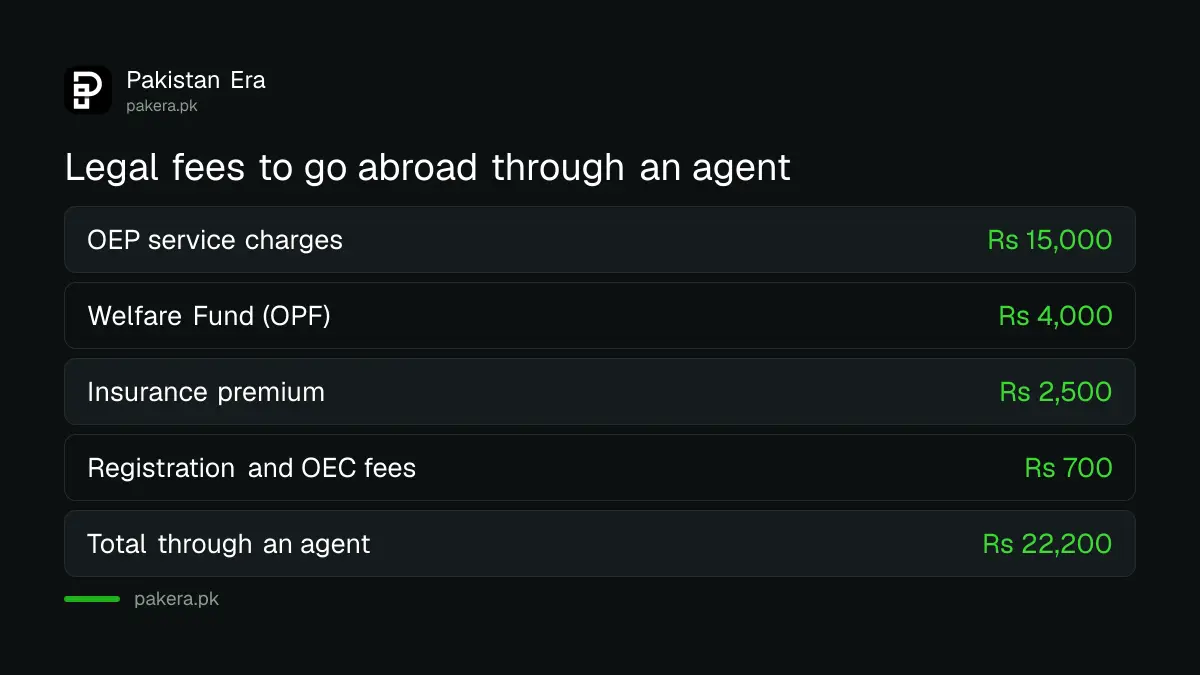
A licensed overseas job agent in Pakistan may charge you Rs 15,000 in service charges, and no more. You pay it into a bank, not into the agent's hand, and the agent only gets it after you have joined the job abroad. With government fees, the full cost through an agent is Rs 22,200.
That is the rule in the Emigration Rules 1979, as updated in August 2023. We read the rules, the Emigration Ordinance 1979 and the Bureau of Emigration and Overseas Employment's own pages on 30 September 2026. The Bureau calls these agents overseas employment promoters, or OEPs.
Anything an agent asks above that limit is outside the law, and the law gives you a way to complain.
The legal fee an overseas employment promoter can charge
Rule 15 of the Emigration Rules sets the service charge at Rs 15,000 for a worker selected through an OEP. If you found the job yourself and only need an OEP to get the visa endorsed, the charge is Rs 6,000, and the OEP may charge only the actual cost of that work.
| Fee | Through an OEP | Direct employment |
|---|---|---|
| OEP service charges | Rs 15,000 (Rs 6,000 for processing cases) | None |
| Welfare Fund (OPF) | Rs 4,000 | Rs 4,000 |
| Insurance premium | Rs 2,500 | Rs 2,500 |
| Registration fee | Rs 500 | Rs 2,500 |
| OEC fee | Rs 200 | Rs 200 |
| Total | Rs 22,200 | Rs 9,200 |
The table is the Bureau's own fee structure. "Direct employment" means you got the job without an agent, through a relative, a friend or an employer's website.
The OEP's code of conduct, in rule 25 of the same rules, is blunt about the rest. No OEP "shall charge any fee other than the service charges" in rule 15. So a separate "visa fee", "file charge" or "processing fee" paid to the agent has no legal basis.
The Rs 15,000 is held by the bank until you join the job
You deposit the service charges in a bank, which gives you a certificate. You hand that certificate to the OEP. The bank pays the OEP only after the Protector of Emigrants confirms you got the job and joined it. If the OEP fails, the money comes back to you.
This is the part most people never hear. The rule turns the fee into a payment on results. An agent who wants cash up front, before any contract, is asking you to skip the one protection the law built in.
The steps, as rule 15 sets them out:
- You deposit Rs 15,000 in the bank and get a certificate on the official form.
- You give the original certificate to the OEP, who has it countersigned at the bank's zonal office.
- Your job contract, called the Foreign Service Agreement, is registered with the Protector of Emigrants.
- The OEP shows the bank certificate and the registration to the bank.
- The OEP is paid only once the Protector certifies you have joined the job. If the OEP fails its duties, the deposit is returned to you.
Registration is the same emigrant protection at the Protector of Emigrants that every worker going abroad needs. The Bureau now takes its fees through a QR code with National Bank of Pakistan, launched in July 2026, so a cash payment with no receipt is a warning sign.

Check the agent's licence and job permission before paying
Search the agent's licence number on the Bureau's list of OEPs and confirm it says active. Then ask to see the Protector of Emigrants' permission for the job. Each permission is numbered and is valid for 120 days.
On 30 September 2026 the Bureau's site showed 2,869 active licences out of 5,308 ever issued. The rest are cancelled, surrendered, expired or invalid. Each status means something different when you check an overseas job agency, and the Bureau also keeps two blacklists.
The permission matters as much as the licence. An OEP must apply to the Protector with a demand letter and power of attorney from the foreign employer, attested by the host country's foreign ministry or an embassy. Once permission is given, the demand is advertised in a newspaper. No permission means no real job order.
The Bureau's own warnings against illegal recruitment add a few more rules of thumb:
- Do not pay more than the allowed fee.
- Do not pay anything until you have a valid employment contract and an official receipt.
- Do not deal with anyone who is not an authorised representative of a licensed agency.
- Do not do business away from the agency's registered address.
- Do not accept a tourist visa for a job.
- Do not trust training centres or travel agents that promise jobs abroad.
Overcharging is a crime with up to 14 years in prison
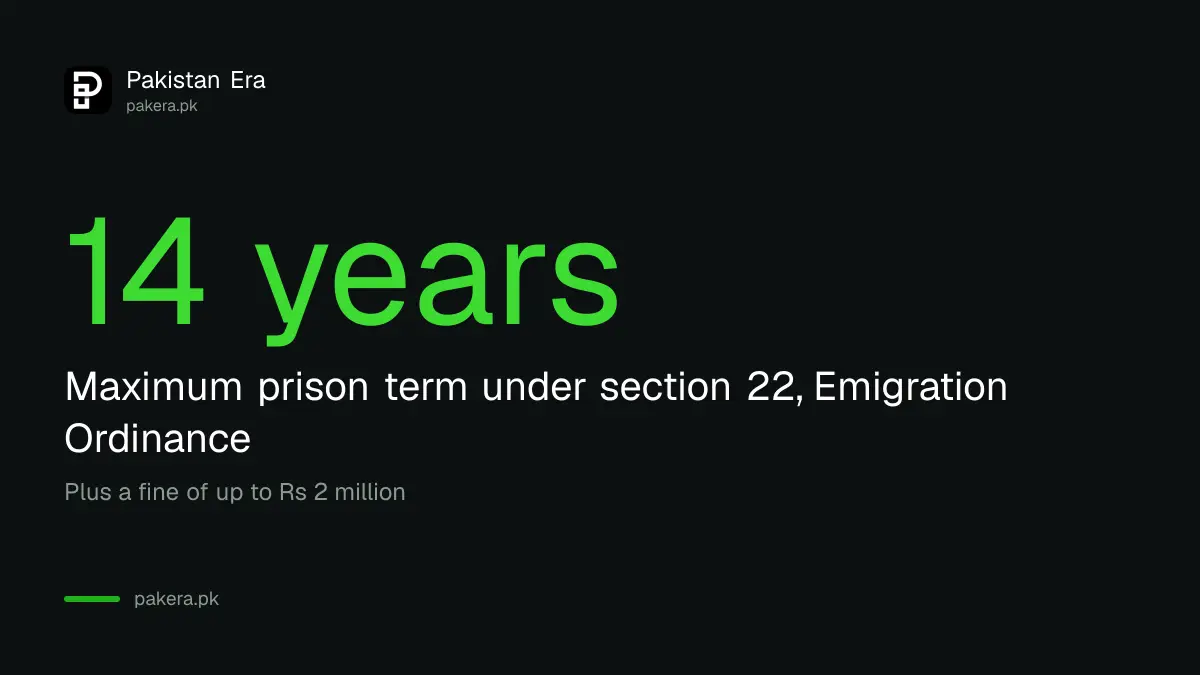
Section 22 of the Emigration Ordinance makes it an offence for an OEP to charge more than the prescribed amount. It also covers anyone without a licence who takes money for a foreign job. The punishment is up to 14 years in prison and a fine of up to Rs 2 million.
Section 18 carries the same punishment for forging emigration documents or pushing someone to emigrate by fraud. The Bureau's copy of the Ordinance notes that these fines were set by a change dated 20 March 2025.
So an agent who took a large sum from your family for a "Saudi visa" is not just a bad businessman. If he had no licence, or charged above the limit, the law calls it a crime. Families often borrow that money, and private loans on interest in Punjab are now illegal too, which matters if the lender comes asking.
How to complain against an overseas job agent
Complain to the Bureau by email at complaints@beoe.gov.pk, by phone on 051-910-7267 or on WhatsApp at 0332-9107265. You can also complain through the Pakistan Citizen Portal. Keep every receipt, message and bank slip as proof.
Under rule 29, the Director General sends a routine complaint to the Protector of Emigrants to investigate. After the report, the agent can get a show cause notice and a personal hearing before a decision. A serious complaint is sent onward for investigation by the Federal Investigation Agency. A complaint against someone who is not a licensed OEP is sent for prosecution.
Every Protector of Emigrants office must also keep a locked complaint box at its gate, under rule 28. Anyone can drop a written complaint there.
The Bureau publishes its complaints register online, with the agent's licence number, the status and any fine. It showed 853 complaints when we checked, and new ones were being added daily. You can track yours there by complaint ID.
If the Bureau itself does not act, the Grievance Commissioner for Overseas Pakistanis at the Federal Ombudsman takes complaints against federal departments. Its helpline in Pakistan is 1055. The steps for the Pakistan Citizen Portal complaint route are the same as for any federal body.
Common questions
How much can an overseas job agent charge in Pakistan?
Rs 15,000 in service charges, or Rs 6,000 if you found the job yourself and only need visa processing. Government fees bring the total to Rs 22,200.
Do I pay the agent directly?
No. Under rule 15 you deposit the service charges in a bank. The agent is paid only after you have joined the job.
Can I get my Rs 15,000 back?
Yes, if the agent fails to meet its obligations under the rules. The deposit is then returned to you.
What is the punishment for taking extra money?
Up to 14 years in prison and a fine of up to Rs 2 million, under section 22 of the Emigration Ordinance.
Where do I complain about an overseas job agent?
To the Bureau at complaints@beoe.gov.pk, 051-910-7267 or WhatsApp 0332-9107265, or through the Pakistan Citizen Portal.
How we verified this
What we checked, where we read it, and what we could not confirm.
Last checked on 30 September 2026. The service charges, the bank deposit and refund, and the code of conduct are read in the Emigration Rules 1979, updated to 2023 by S.R.O. 1058(I)/2023 dated 8 August 2023, and the offences in the Emigration Ordinance 1979, both from the Bureau's legal framework page. The fee table is the Bureau's emigrant fee structure. The licence count, permission rules, illegal recruitment warnings, complaint contacts, complaints register and Grievance Commissioner details are from the Bureau's own pages. We did not file a complaint or test the helplines.
About the author

Tax, Bills and Technology Writer
Ali Akhtar is a young and curious voice here at Pakistan Era. He is currently pursuing his A-Levels and has a growing interest in Pakistan’s changing industrial landscape and educational trends. Ali likes to write in a way that helps him explain and explore the world around him. His writing reflects the perspective of the new generation navigating the evolving trends of Pakistan where technology, youth innovation, and shifting opportunities are reshaping the country’s future.