Nearly Half of Banaspati Ghee Samples Failed the Government's Tests
PCSIR tested 491 packaged samples. 176 failed. Banaspati ghee was the worst at 98 of 204. The full breakdown by product.
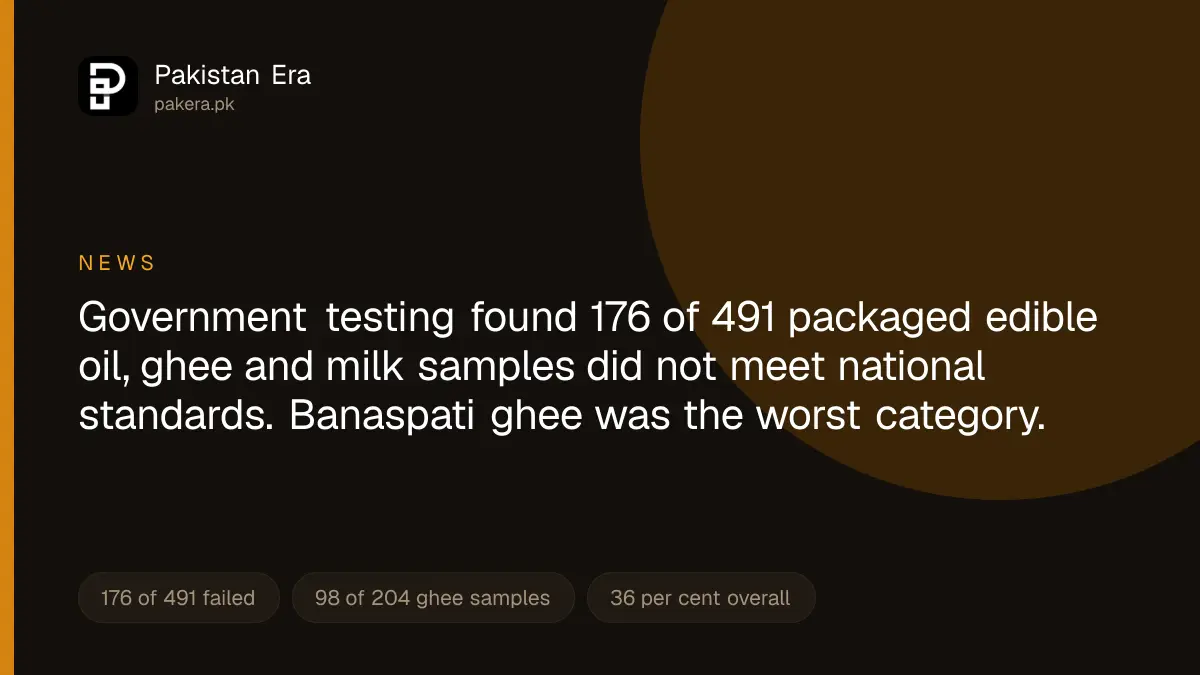
Government laboratories tested 491 samples of packaged edible oil, ghee and milk. 176 of them did not meet national standards.
The overall figure being reported is 36 per cent. That average hides the part that matters.
Banaspati ghee, the cooking fat in most Pakistani kitchens, failed at 98 out of 204 samples. Nearly one in two.
The results, by product
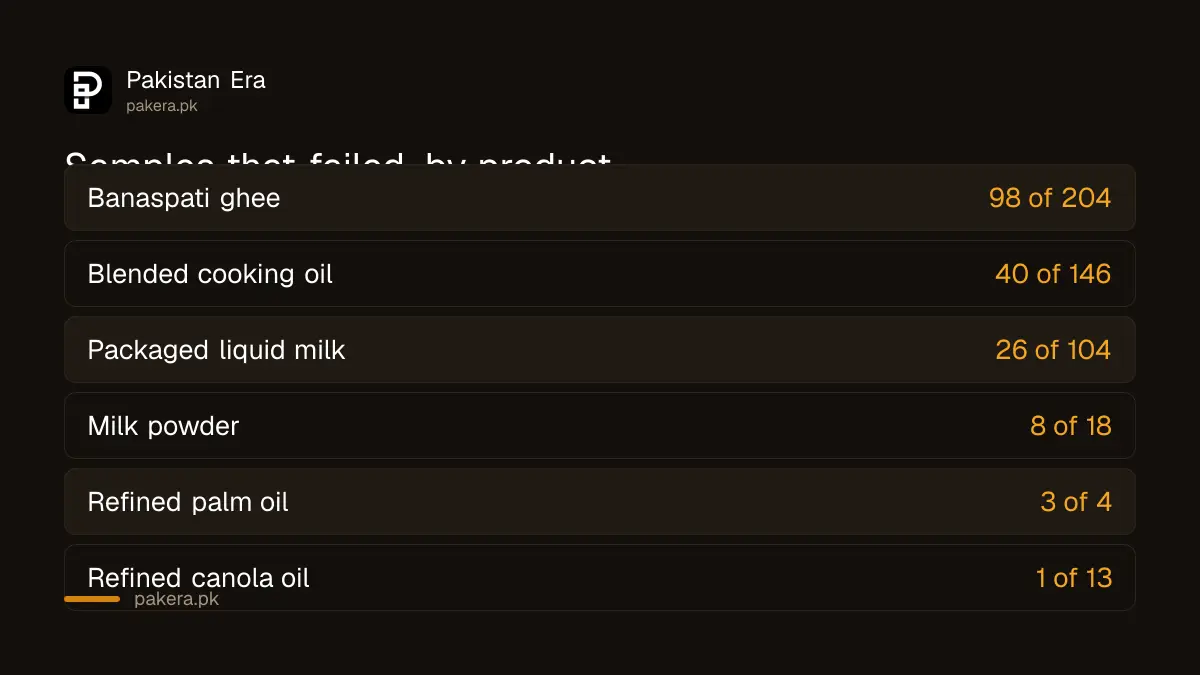
| Product | Failed | Tested |
|---|---|---|
| Banaspati ghee | 98 | 204 |
| Blended cooking oil | 40 | 146 |
| Packaged liquid milk | 26 | 104 |
| Milk powder | 8 | 18 |
| Refined palm oil | 3 | 4 |
| Refined canola oil | 1 | 13 |
| Total | 176 | 491 |
The testing was carried out through the Pakistan Council of Scientific and Industrial Research under the Ministry of Science and Technology. The consolidated findings were prepared by the Pakistan Standards and Quality Control Authority.
Read the small categories carefully
Refined palm oil failed three samples out of four. That is 75 per cent, and you will see it quoted that way.
Four samples is not enough to conclude anything about a product category, and we are not going to present it as though it were. The same caution applies to milk powder at 8 of 18.
The categories worth taking seriously here are the three with real sample counts: banaspati ghee, blended cooking oil and packaged liquid milk. Those account for 454 of the 491 samples, and their failure rates are 48 per cent, 27 per cent and 25 per cent.
A quarter of packaged liquid milk failing is not a small finding either. It is simply not the biggest one.
What "failed" actually means
This needs stating plainly, because the alternative is a panic that helps nobody.
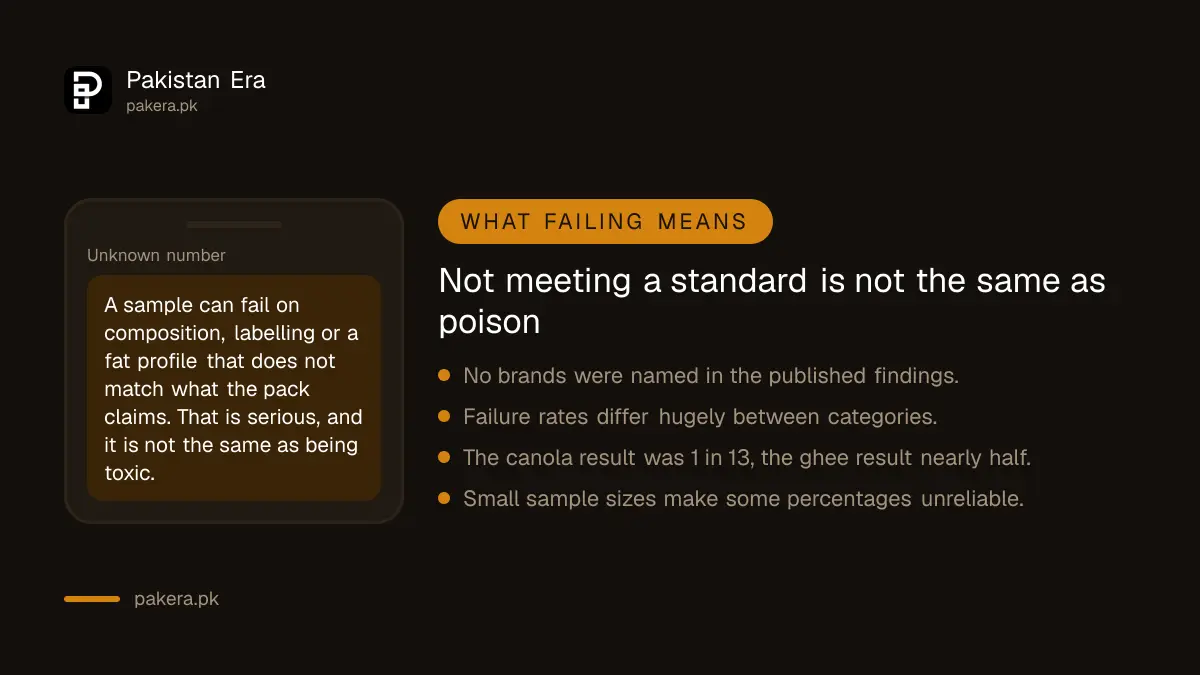
Non-conformance with a national standard means the sample did not match what the standard requires. That can be composition, the fat profile, the declared contents, or labelling that does not match what is inside.
That is a genuine problem. If a pack says one thing and contains another, you are being sold something you did not agree to buy, and for anyone managing cholesterol or feeding a child it can matter medically.
It is not the same as saying the product is toxic or unsafe to eat. The published findings describe standards failures, not contamination findings, and we are not going to blur the two.
No brands were named
The published findings did not identify brands, and neither will we.
You may see brand lists circulating on social media attached to this story. Treat them as unverified, because the testing bodies did not release one. Naming a company on the strength of a forwarded image is how a legitimate business gets damaged and how a genuinely bad one escapes attention.
If a list is officially released, that becomes a different article.
The loose survey is the more important half
Here is the part that has been mostly overlooked.
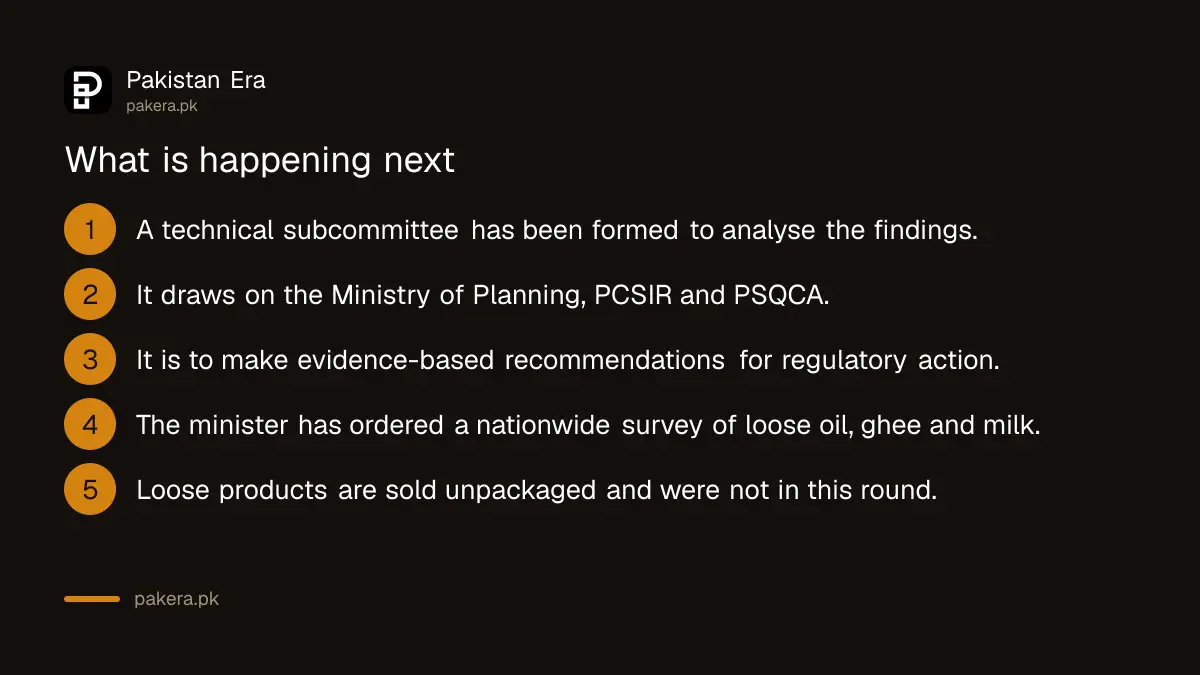
Everything above is about packaged product. The minister has now ordered a nationwide quality survey of loose edible oil, ghee and milk, meaning product sold unpackaged from a container.
That matters because loose is what lower income households buy. It is cheaper, it is bought in small daily quantities, and it carries none of the labelling, sealing or traceability that a packaged product has.
If the packaged product that is regulated, labelled and sealed is failing at these rates, the loose survey is the one to watch. It has not reported, so we are not going to guess at what it will find, and we are not telling anyone to switch between the two on the strength of nothing.
A technical subcommittee drawing on the Ministry of Planning, PCSIR and PSQCA has been formed to analyse the laboratory findings and recommend regulatory action.
What you can reasonably do
- Buy sealed, and check the seal. It is not a guarantee of quality, but a tampered pack is a problem you can actually see.
- Read the label against the price. Banaspati and blended oils are different products from pure oils, and the pack should say which you are buying.
- Keep the packaging if you have a complaint, because a complaint without the batch details goes nowhere.
- Complain to the provincial food authority rather than only to the shop. Punjab's is at pfa.gop.pk, and note that suffix is .gop.pk rather than .gov.pk. That single letter sends a lot of people to a dead address, a pattern we found across roughly forty domains when testing Pakistani government websites.
- Do not act on a forwarded brand list. None was officially published.
If a purchase goes wrong and the seller will not resolve it, the formal route is set out in our guide to taking a complaint to consumer court.
Why this keeps happening
Pakistan has standards, a standards authority and a testing council. This exercise is those institutions working, not failing, and it is worth saying so.
The gap is between testing and consequence. A sample that fails in a laboratory changes nothing on a shelf unless something follows it, and what follows is exactly what the new subcommittee is being asked to recommend.
That is the thing to watch over the next few months, rather than the headline percentage.
It is also worth knowing which body does what, because complaints get bounced otherwise. PSQCA sets and consolidates standards, PCSIR runs the laboratories, and provincial food authorities are the ones who can act on a shop or a factory in your district. Numbers we have read off institutions' own pages are collected in our verified helplines directory.
Questions readers are asking
How many packaged food samples failed the tests?
176 of 491 samples of packaged edible oil, ghee and milk did not meet prescribed national standards, an overall non-conformance rate of about 36 per cent.
Which product performed worst?
Banaspati ghee, with 98 of 204 samples failing, which is close to half. Blended cooking oil failed 40 of 146 and packaged liquid milk 26 of 104.
Does failing a standard mean the food is unsafe?
Not necessarily. Non-conformance can relate to composition, fat profile or labelling that does not match the pack. That is a real problem but it is not the same as a contamination finding.
Which brands failed?
No brands were named in the published findings. Brand lists circulating on social media are not official and we are not repeating them.
Who carried out the testing?
PCSIR, under the Ministry of Science and Technology, with the consolidated findings prepared by PSQCA.
Is loose ghee and oil being tested?
A nationwide survey of loose edible oil, ghee and milk has been ordered but has not reported. Loose product was not part of this round.
What happens now?
A technical subcommittee from the Ministry of Planning, PCSIR and PSQCA is to analyse the findings and recommend regulatory and policy action.
About the author

Tax, Bills and Technology Writer
Ali Akhtar is a young and curious voice here at Pakistan Era. He is currently pursuing his A-Levels and has a growing interest in Pakistan’s changing industrial landscape and educational trends. Ali likes to write in a way that helps him explain and explore the world around him. His writing reflects the perspective of the new generation navigating the evolving trends of Pakistan where technology, youth innovation, and shifting opportunities are reshaping the country’s future.