Pak Army Officer Medical Standards: Height, BMI, Flat Feet and Joint Angles
Pak Army officer medical standards: 162.5 cm for men, 152.4 cm for women, BMI 17 to 23, the flat feet test and joint angle limits. Check yourself before ISSB.
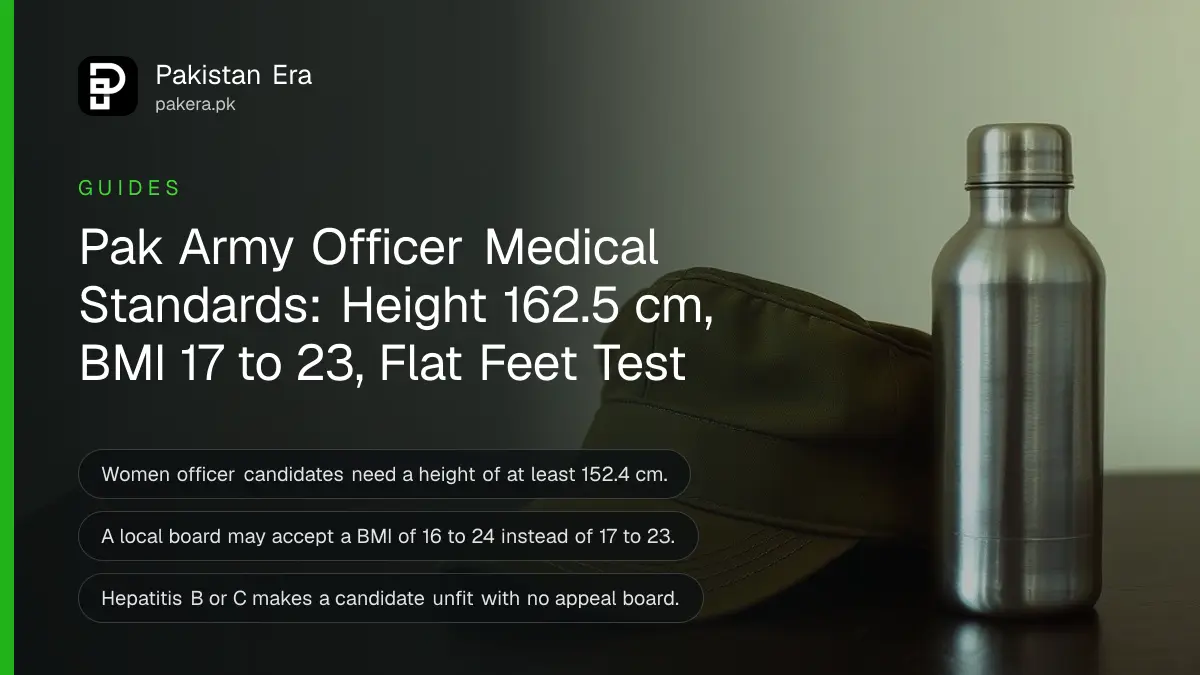
Pak Army's medical standards for officer candidates ask for a height of at least 162.5 cm for men and 152.4 cm for women, and a Body Mass Index (BMI) of 17 to 23, which a local board may stretch to 16 to 24. Flexible flat feet are fit, rigid flat feet are unfit, and the Army also measures the elbow, knee and big toe angles. Hepatitis B or C makes a candidate unfit with no appeal.
Many candidates prepare for the written test and the 1.6 km run, then fail on a measurement they never checked. The Army publishes its medical standards for commissioned courses on joinpakarmy.gov.pk, in two sets: one for male officer courses and one for lady officers, doctors and nurses. Checking yourself against them first takes ten minutes.
Men need 162.5 cm and women 152.4 cm for a commission
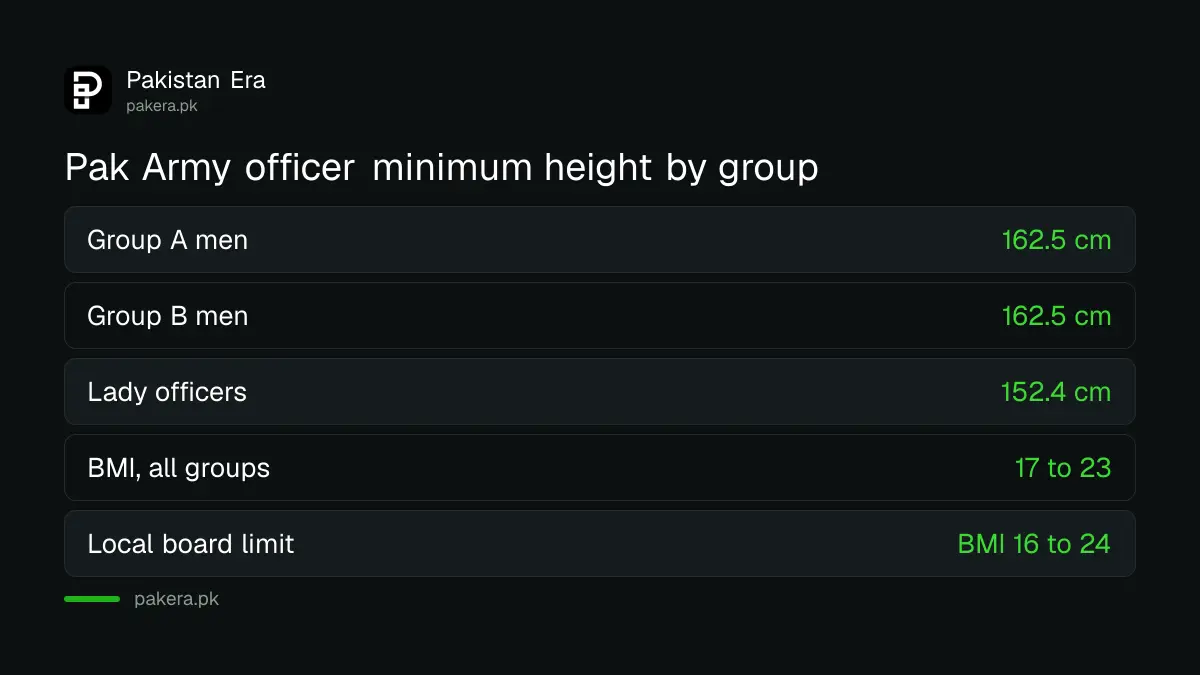
The Army's medical standards set the minimum height for commission at 162.5 cm, or 5 feet 4 inches, for every male officer course. For the Lady Cadet Course, the Armed Forces Nursing Service and women doctors, the minimum is 152.4 cm, or 5 feet. There is no maximum height listed.
The Army sorts male candidates into two medical groups. The height and BMI rules are the same for both, but Group B gets slightly more room on two joint angles.
| Group | Courses | Minimum height |
|---|---|---|
| Medical Group A | PMA Long Course, Graduate Course, Technical Cadet Course, Direct Short Service Course (Technical) | 162.5 cm |
| Medical Group B | Short Service Regular Commission doctors and dentists, Direct Short Service (AEC, RV and FC, Ordnance, Psychologist), Army Medical Cadets | 162.5 cm |
| Lady officers | Lady Cadet Course, AFNS, women doctors and dentists | 152.4 cm |
Your BMI must be 17 to 23, with some room at the local board
Every group must have a BMI of 17 to 23. The local medical board may accept 16 to 24. The Army also says it will complete the full medical even if your BMI is above the standard, so a slightly high reading does not end the visit on its own.
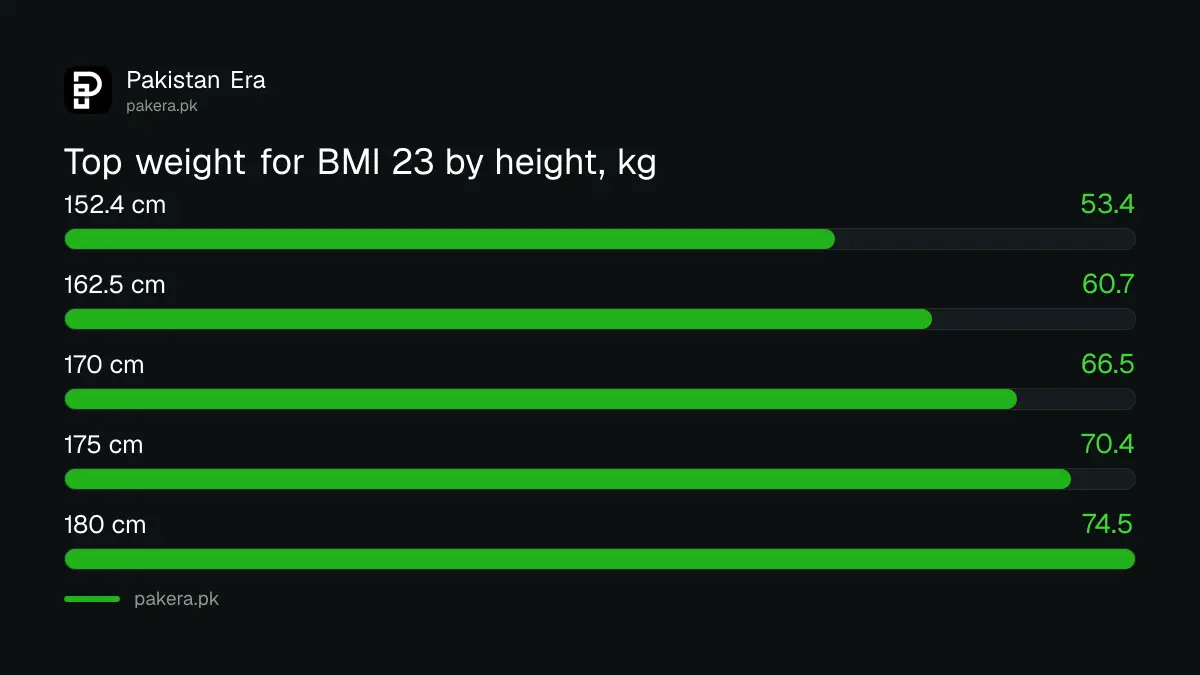
BMI is your weight in kilograms divided by the square of your height in metres. We worked out the weight range for common heights below, so you can see where you stand without a calculator.
| Height | Weight for BMI 17 to 23 | Weight for BMI 16 to 24 |
|---|---|---|
| 152.4 cm (5 ft) | 39.5 to 53.4 kg | 37.2 to 55.7 kg |
| 162.5 cm (5 ft 4 in) | 44.9 to 60.7 kg | 42.3 to 63.4 kg |
| 170 cm (5 ft 7 in) | 49.1 to 66.5 kg | 46.2 to 69.4 kg |
| 175 cm (5 ft 9 in) | 52.1 to 70.4 kg | 49.0 to 73.5 kg |
| 180 cm (5 ft 11 in) | 55.1 to 74.5 kg | 51.8 to 77.8 kg |
Flexible flat feet pass, rigid flat feet fail
The Army does not measure angles for flat feet. It asks you to stand on your toes. If an arch appears and you have no pain, it is flexible flat feet and you are fit. If the foot stays flat on your toes, or the sole is tender, it is rigid flat feet and unfit.
You can do this check at home in front of a mirror. Stand normally, then rise onto your toes and look at the inner side of each foot. For a high arched foot (pes cavus), the Army's recommended maximum angle is 32 degrees, because a higher arch makes military boots hard to wear.
The board also measures four joint angles
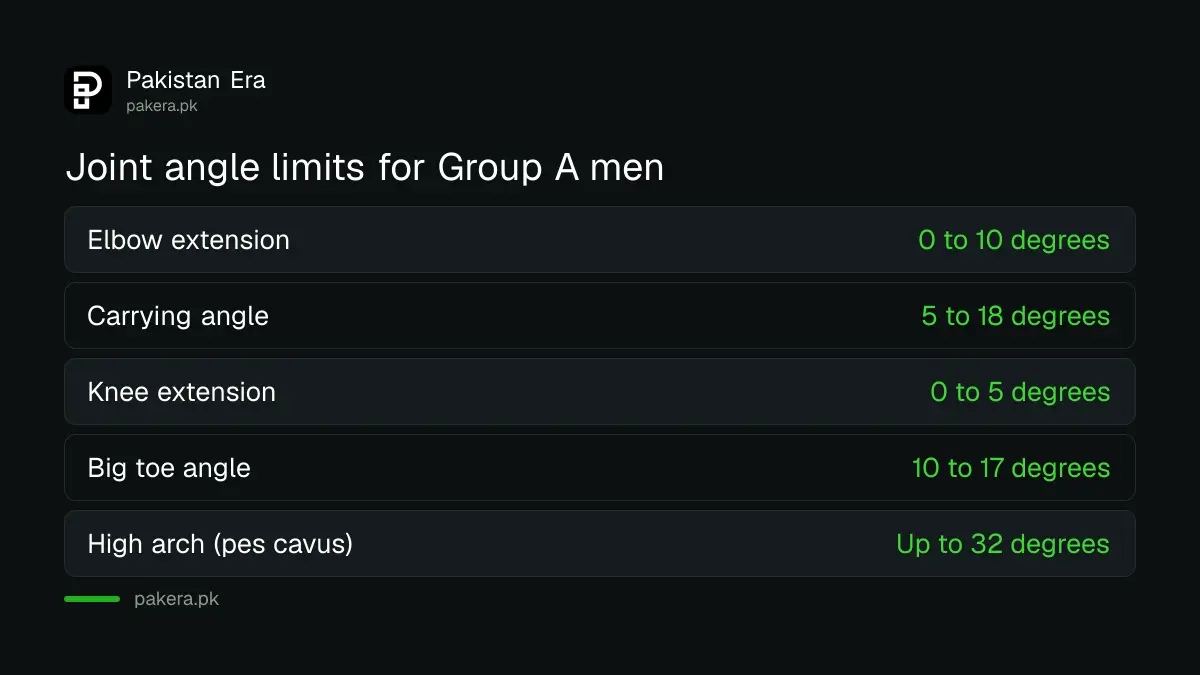
Beyond height, weight and feet, the medical board measures how far your elbows and knees bend back, the angle of your elbow when your arm hangs straight, and the angle of your big toe. Multiple loose joints must be absent in every group.
| Measurement | Group A men | Group B men | Lady officers |
|---|---|---|---|
| Elbow extension, bending back | 0 to 10 degrees | 0 to 15 degrees | 0 to 15 degrees |
| Carrying angle of the elbow | 5 to 18 degrees | 5 to 20 degrees | 5 to 22 degrees |
| Knee extension, bending back | 0 to 5 degrees | 0 to 5 degrees | 0 to 5 degrees |
| Big toe angle (hallux valgus) | 10 to 17 degrees | 10 to 17 degrees | 10 to 17 degrees |
For the big toe, the angle is not the only test. There must be no bunion, hard skin, or toe riding over the next toe, because the Army treats those as a deformity that will get worse. An angle above 17 degrees is outside the limit.
The medical happens in three stages, and only one can be appealed
You first face a preliminary medical at the Army Selection and Recruitment Centre, on the day of your initial tests. Candidates recommended by ISSB then have a detailed medical at a Combined Military Hospital. A candidate found unfit can ask for an Appeal Medical Board, except for hepatitis.
- Preliminary medical at the Army Selection and Recruitment Centre, during your initial tests.
- Detailed medical at a nearby Combined Military Hospital, after an ISSB recommendation.
- Appeal Medical Board, if you are declared unfit and the reason can be appealed.
The course pages are firm on two points. A candidate declared permanently unfit by an Appeal Medical Board cannot apply again. A candidate unfit due to hepatitis B or C cannot request an Appeal Medical Board at all. Submit your medical papers with an attested photograph, as the standards page asks.
Soldiers follow a separate set of standards. The soldier physical test and medical standards list those. The officer routes themselves are set out in the Pak Army intakes and registration steps, and the ISSB stage in the ISSB schedule and centres.
Common questions
What is the minimum height for a Pak Army officer?
162.5 cm, or 5 feet 4 inches, for men, and 152.4 cm, or 5 feet, for women, on every commissioned course.
What BMI does Pak Army accept?
17 to 23. The local board may accept 16 to 24, and the full medical goes ahead even if your BMI is higher.
Can I join Pak Army with flat feet?
Yes, if they are flexible. If an arch appears when you stand on your toes and you have no pain, you are fit. Rigid flat feet are unfit.
Is hepatitis B or C allowed in Pak Army selection?
No. A candidate unfit due to hepatitis B or C cannot request an Appeal Medical Board.
Is there a maximum height for Pak Army?
No maximum height appears in the Army's medical standards for commissioned courses.
Do women have different joint angle limits?
Only for the elbow carrying angle, which allows up to 22 degrees for lady officers. Elbow extension, knee extension and the big toe angle follow the same limits as Group B men.
How we verified this
What we checked and where we read it.
We opened the Join Pak Army website on 24 November 2026 and read its two medical standards panels, "Medical Standards for Commissioned Courses" and "Medical Standards for Lady Officers/ Doctors/ Nurses", from the Required Medical Standards section of the home page.
The medical groups, heights, BMI ranges and joint angles come from those panels. The three medical stages and the hepatitis and Appeal Medical Board rules come from the Army's course pages for the Lady Cadet Course, Technical Cadet Course, Direct Short Service Commission, Medical Cadet and AFNS, read the same day. The weight ranges in the BMI table are our own arithmetic from the Army's BMI limits.
Free on WhatsApp
Get last dates and rule changes on WhatsApp
We post new last dates, fee changes and fixes for common problems, a few short posts a day.
Follow Pakera on WhatsAppOther followers cannot see your number.
Pakera Solves It
Which online process wasted your time this week?
A portal that will not load, a form nobody explains, a complaint that went nowhere. Tell us. Every week we pick one, solve it step by step and publish the answer.
About the author

Public Services and Education Journalist
Fajr Riaz is a journalist and content writer at Pakistan Era, based in Lahore. She covers the questions people meet in everyday life in Pakistan: how a public service works, what a change in the rules means, and where to find a reliable answer.