Your Hajj Money Goes Through an App. We Found Three Called Pak Hajj.
Payments open on 17 August and run through the app. Searching either store returns two government apps with the same name. Which is which.
From 17 August, Hajj payments in Pakistan run through the Pak Hajj app. The minister was explicit that financial transactions will not be conducted by any other method.
Around 400,000 registered pilgrims are in the process, and the packages cost Rs 1.2 million and Rs 1.3 million.
So we did the obvious check. We searched both app stores for Pak Hajj to see what a pilgrim would actually find.
We found more than one government app with that name.
What the stores returned
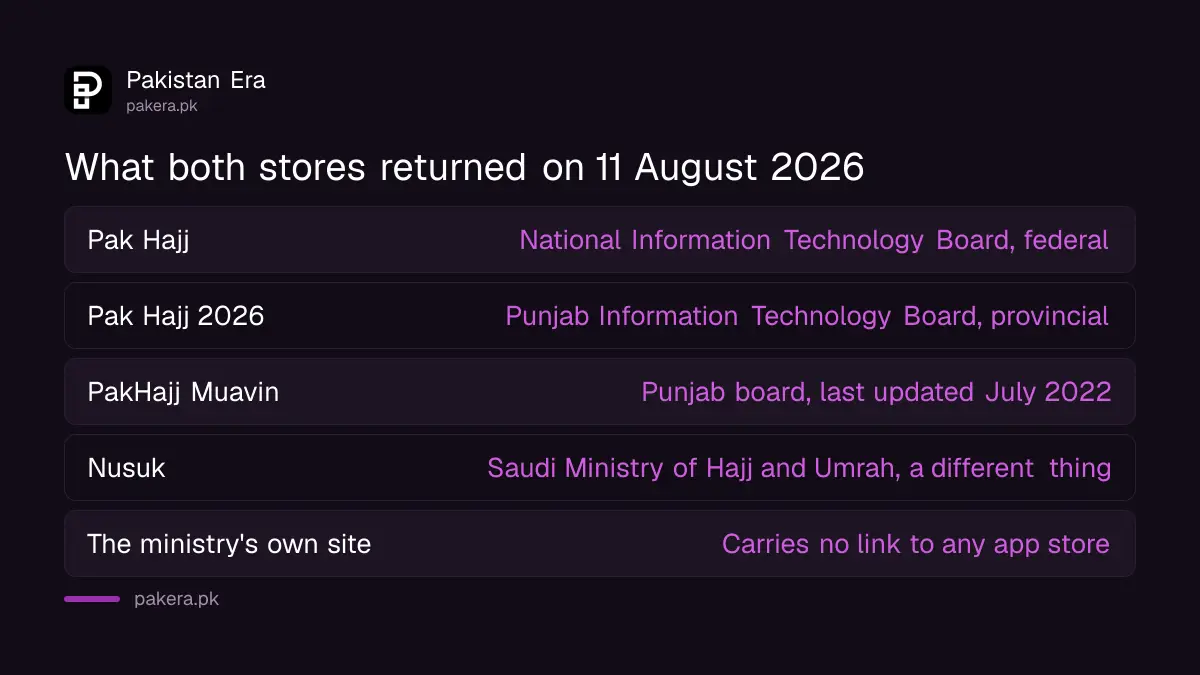
Searched on 11 August 2026, from the Pakistan storefront.
| App name | Developer shown | Last updated |
|---|---|---|
| Pak Hajj | National Information Technology Board | 4 August 2026 |
| Pak Hajj 2026 | Punjab Information Technology Board | 16 to 27 July 2026 |
| PakHajj Muavin | Punjab Information Technology Board | 8 July 2022 |
| PakHajj Guide | Punjab board, appeared in search | Listing did not open |
| Nusuk | Saudi Ministry of Hajj and Umrah | June 2026 |
Two of those are current, actively maintained, and both are called Pak Hajj. One is federal. One is provincial.
Be clear about what this is and is not. These are all real government apps. None of them is a fake, and we are not suggesting either board has done anything wrong. The problem is not that an app is bad. The problem is that a pilgrim being told to pay Rs 1.2 million "through the Pak Hajj app" gets more than one answer.
Nusuk is a different thing again. It is Saudi Arabia's own official Hajj and Umrah platform, run by its Ministry of Hajj and Umrah, and it is not where Pakistani government scheme dues are paid.
The ministry's own site does not link to any of them
This is the part that turns an untidy search result into a real problem.
We checked mora.gov.pk the same day. Its homepage carries no link to Google Play or the Apple App Store.
So the instruction is "pay through the app", and the responsible ministry does not provide a link to the app. The pilgrim is sent to a store to search a name that several government apps share, and told to move over a million rupees through whichever one they pick.
A single link on the ministry homepage would close this entirely.
The answer is in the policy document
There is a way to resolve it, and it is not on any app listing.
The Hajj Policy and Plan 2027 to 2030, published as a PDF on the ministry's own website, sets out the reforms behind this cycle. One of them reads that Hajj operations are being fully digitalised in partnership with the National Information Technology Board.
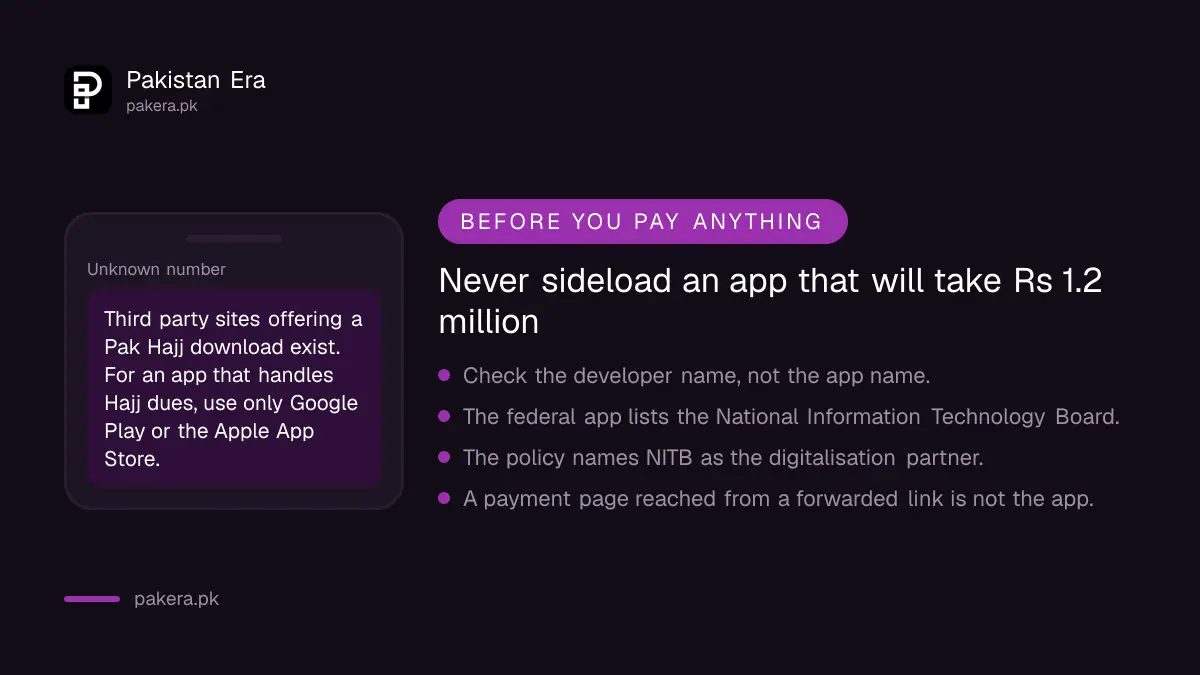
NITB is the federal body. That points to the app whose developer line reads National Information Technology Board, updated on 4 August 2026, which is also the most recently updated of them.
We downloaded and read that policy last week for our piece on what Hajj 2027 will cost. Nobody would find this by looking at the app store, which is precisely why the primary document is worth opening.
One honest limit. The policy names NITB as the digitalisation partner. It does not publish a package name or a store link, and the ministry has not said which listing the payment flow finally sits in. So read the developer line, and if you are in any doubt, ask before you pay rather than after.
A four year old app is still sitting in the store
PakHajj Muavin is listed by the Punjab Information Technology Board with its last release dated 8 July 2022.
Four years on, it is still there, still findable by anyone searching Pak Hajj, and still carrying a government board's name.
It is not dangerous in itself. It is clutter, and clutter around a payment instruction is what confusion is made of. An old app that is no longer part of the process is better removed than left to appear beside the current one.
Do not sideload an app that takes Rs 1.2 million
While checking, we found a third party website offering a Pak Hajj download outside the official stores. It loaded normally.
We are not accusing that site of anything and we are not linking to it. What we will say plainly is the general rule, because it matters more this month than usual.
An app that handles your Hajj dues should only ever come from Google Play or the Apple App Store. Not from a download site, not from a link in a WhatsApp group, not from a QR code on a poster outside an agent's office.
The reason is simple. A sideloaded copy of a payment app can look identical and send your money somewhere else, and you will not find out until the ministry has no record of your instalment.
What to do before 17 August
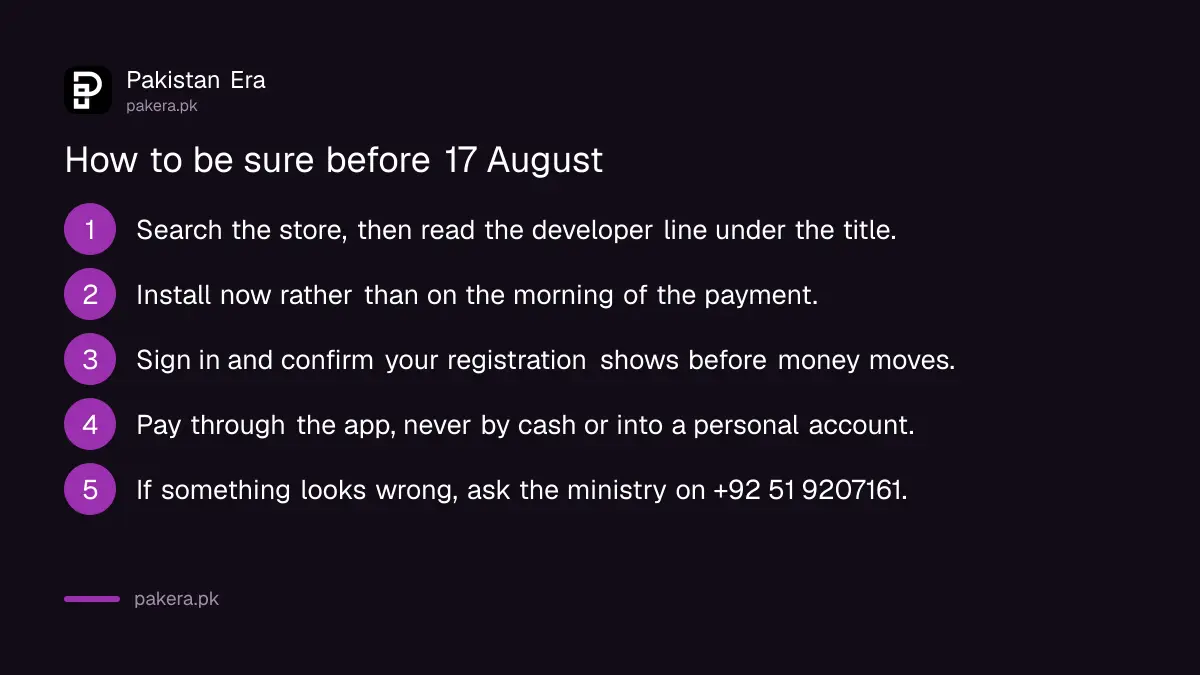
- Search the store, then read the developer line under the title. The name of the app is the thing that is duplicated. The developer is what tells them apart.
- Install it now, not on the day. The morning the collection opens is the worst possible time to discover a download problem.
- Sign in and check your registration appears before any money moves.
- Pay through the app only. The policy requires all Hajj dues, government and private, to go through designated bank accounts by formal banking channels, and rules out cash and informal channels.
- If anything looks wrong, ask. The ministry's number is +92 51 9207161, which we read on its own site.
One timing point that catches people out. Banks close on 14 August for Independence Day and stay shut through the weekend, reopening on Monday 17 August, which is the same day the collection opens. If your instalment needs funds moved between accounts, do it by Thursday. We set that out in what is closed on 14 August.
How we checked
Google Play and the Apple App Store were both searched for "pak hajj" on 11 August 2026 from the Pakistan storefront, using ordinary requests and Apple's public search interface. Developer names, versions and release dates are as the stores reported them on that date.
Listings change. An app can be renamed, updated, delisted or added at any time, and the position may look different when you read this. If it does, or if we have a detail wrong, tell us and we will recheck, as set out in our corrections policy.
This is the sixth time we have run this kind of test. Earlier rounds covered government websites and flood warning sources.
Questions readers are asking
Which Pak Hajj app is the official one?
Check the developer line. The Hajj Policy 2027 to 2030 names the National Information Technology Board as the digitalisation partner, and the app listing showing that developer was updated on 4 August 2026. The ministry has not published a store link.
Is the Punjab Pak Hajj app fake?
No. It is a genuine app from the Punjab Information Technology Board. It is simply a different app with a very similar name, which is why the developer line matters.
Where do I download the Pak Hajj app?
Google Play or the Apple App Store only. Never from a third party download site or a forwarded link, because the app will be handling a payment of over a million rupees.
When do Hajj payments start?
The first instalment is collected from 17 August 2026, with the second due in the second week of October.
Can I pay my Hajj dues in cash?
No. The policy requires all Hajj dues for both the government and private schemes to be deposited through formal banking channels, and rules out cash and informal channels.
Does the ministry link to the app anywhere?
Not on its homepage, which we checked on 11 August 2026. That is the gap that makes the duplicate names a problem rather than an annoyance.
Is Nusuk the same as Pak Hajj?
No. Nusuk is Saudi Arabia's own platform from its Ministry of Hajj and Umrah. Pakistani government scheme dues are not paid through it.
About the author

Tax, Bills and Technology Writer
Ali Akhtar is a young and curious voice here at Pakistan Era. He is currently pursuing his A-Levels and has a growing interest in Pakistan’s changing industrial landscape and educational trends. Ali likes to write in a way that helps him explain and explore the world around him. His writing reflects the perspective of the new generation navigating the evolving trends of Pakistan where technology, youth innovation, and shifting opportunities are reshaping the country’s future.