Pakistan Repaid $1.47 Billion of Foreign Loans in July and August 2026, Three Times Last Year
Pakistan repaid $1,465 million of foreign loans in July and August 2026, against $905 million of new loans. See the SBP figures and how to find them yourself.
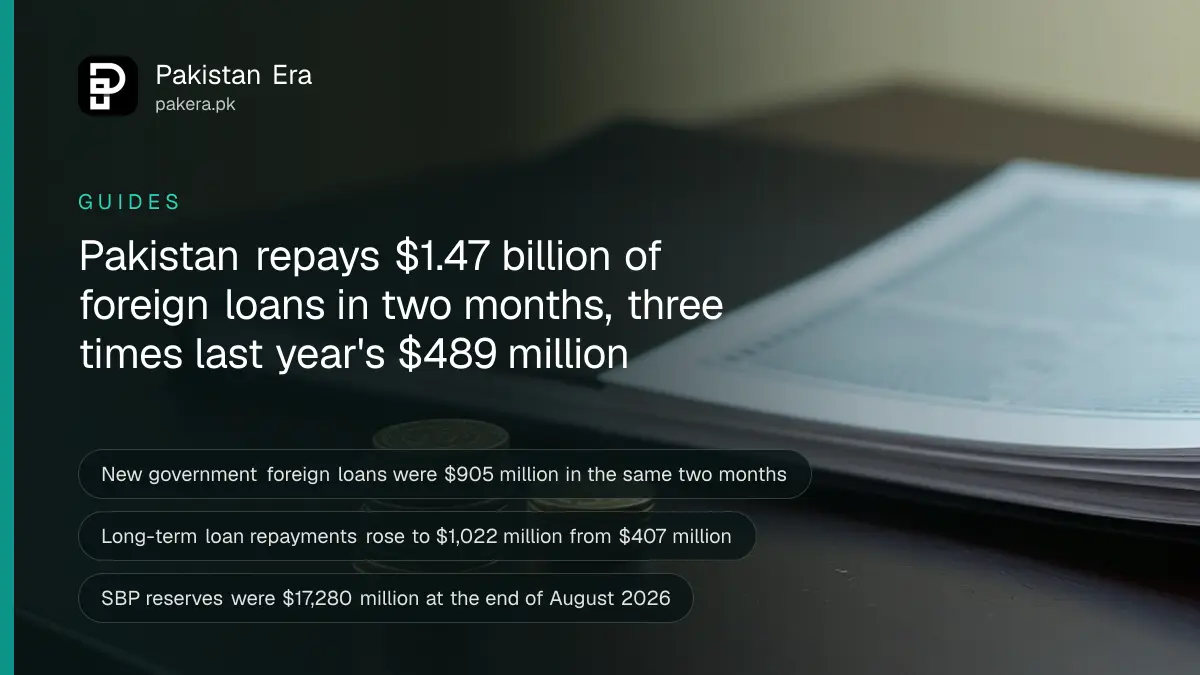
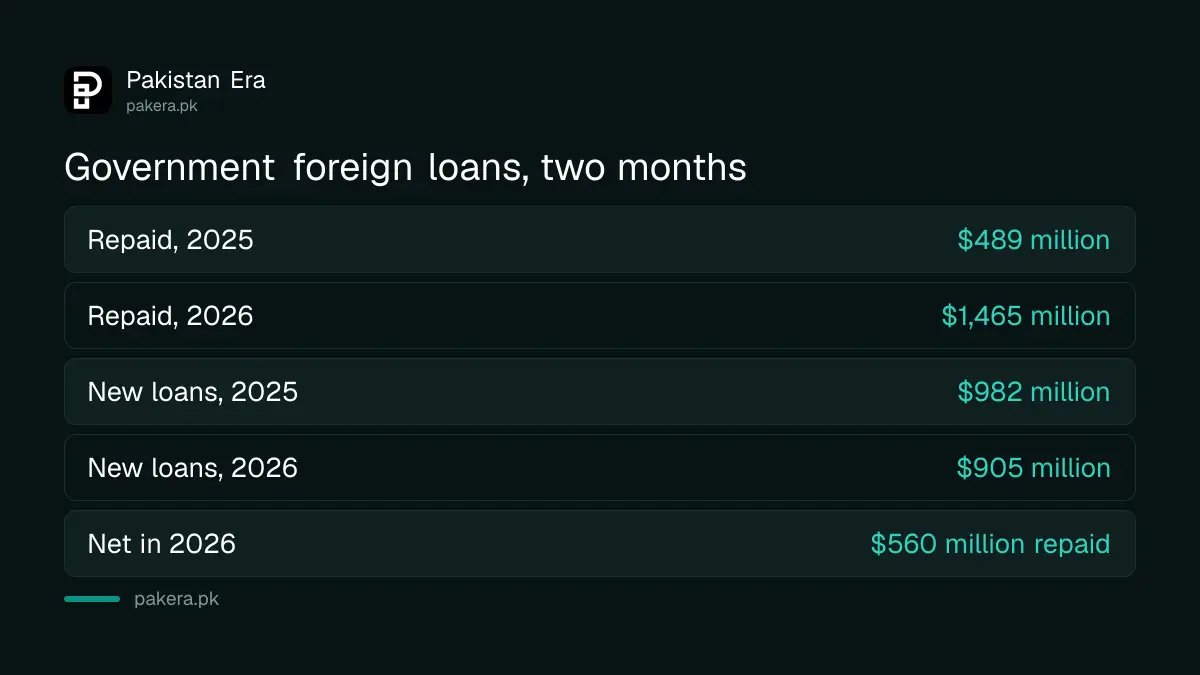
The Pakistan government repaid $1,465 million of foreign loans in July and August 2026, three times the $489 million repaid in the same two months last year. New foreign loans were $905 million. So the government repaid about $560 million more than it borrowed. The figures are from the State Bank of Pakistan (SBP), published on 16 September 2026.
Most people hear about foreign debt only when a new loan is announced. The repayment side is quieter, but it decides how many dollars leave the country. This report reads the SBP's own balance of payments table and sets out what went out, what came in, and what to watch next.
The term to know is "amortization". It means repaying the original loan amount, not the interest. Interest is counted separately, under primary income.
The government repaid three times as much as a year earlier
In the SBP table, the general government line shows two flows. Disbursements are new loan money received. Amortization is principal repaid. Here are the two months, against last year.
| General government, foreign loans | Jul to Aug FY26 | Jul to Aug FY27 |
|---|---|---|
| New loans received (disbursements) | $982 million | $905 million |
| Principal repaid (amortization) | $489 million | $1,465 million |
| Difference | $493 million more received | $560 million more repaid |
July's repayments were $893 million and August's were $572 million. The "difference" row is our own subtraction. The SBP's own net line for the government, which also counts other liabilities, shows a net repayment of $430 million this year, against net borrowing of $536 million a year ago.
Long-term loans made up most of the repayment
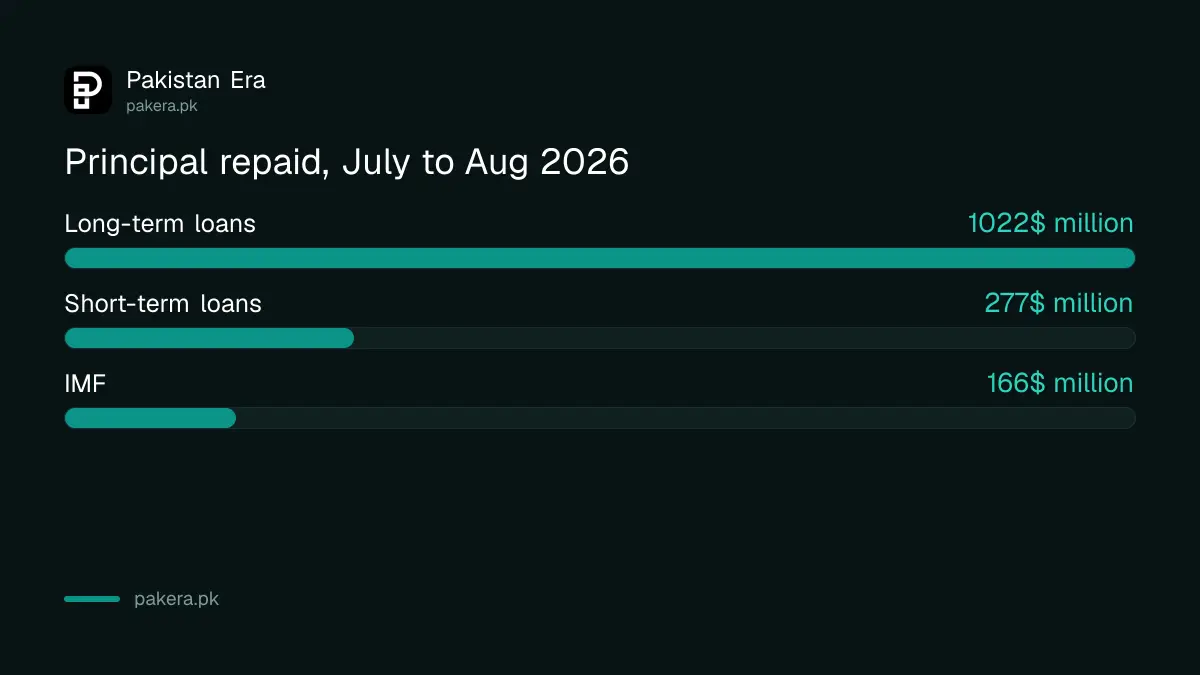
The table splits the repayments by type of loan. Long-term loans, such as those from other governments and development banks, were the largest part. IMF repayments and short-term loans were smaller but both grew.
| Type of loan repaid | Jul to Aug FY26 | Jul to Aug FY27 |
|---|---|---|
| Other long-term loans | $407 million | $1,022 million |
| Short-term loans | $0 | $277 million |
| IMF credit and loans | $82 million | $166 million |
| Total principal repaid | $489 million | $1,465 million |
On the borrowing side, new long-term loans were $713 million, up from $471 million. New short-term loans were $192 million, down from $511 million. The IMF disbursed nothing in these two months, which matches the sequence in our report on the IMF staff-level agreement: the next payment waits for the Executive Board.
Repayments are not always cash leaving the country
A repayment line does not always mean money is lost for good. Some lenders, including friendly governments, let Pakistan roll a loan over. In the accounts it can appear as a repayment and then as a new loan. The SBP's table does not say which repayments were rolled over, so we cannot tell you how much of the $1,465 million was refinanced.
What we can say is this. SBP reserves, excluding bank cash reserves, were $17,280 million at the end of August, up from $14,466 million a year before. The reserves absorbed the repayments and still rose year on year. Our report on SBP reserves on 2 October has the latest weekly number.
Why more repayments matter for your wallet
Every dollar repaid must be bought or earned. The government gets dollars from exports, remittances, new loans and reserves. When repayments rise, the country needs more of those four, and the rupee feels pressure if they fall short.
- Rupee: large dollar payments make the SBP's job of holding the rupee steady harder, unless remittances and exports cover them.
- Taxes: interest on the debt comes out of the budget. Our report on Pakistan's public debt shows interest taking two thirds of revenue.
- Future years: the heavy years are still ahead. Our IMF repayment schedule shows a peak of $2.47 billion in 2028.
How to find the repayment lines yourself
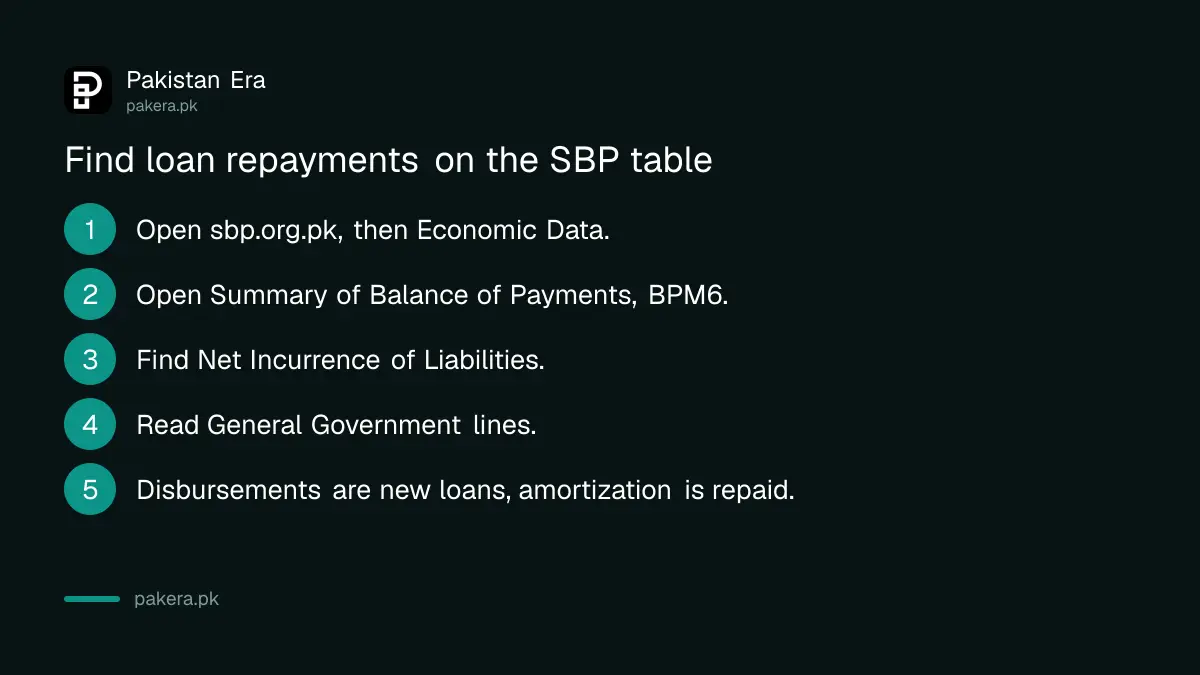
- Open sbp.org.pk and go to Publications and Data, then Economic Data.
- Find "Summary of Balance of Payments as per BPM6" and open the PDF.
- Scroll to "Net Incurrence of Liabilities" and find "General Government".
- Read "Disbursements" for new loans and "Amortization" for principal repaid.
- Check the column header. "P" means provisional and "R" means revised.
The headline current account line is on the same table, and we explain it in our report on Pakistan's current account for July and August.
Common questions
How much foreign debt did Pakistan repay in July and August 2026?
The government repaid $1,465 million of principal, by the SBP's provisional table. Interest is counted separately.
How much new foreign loan money did Pakistan receive?
New government loans were $905 million in the two months, down from $982 million a year earlier.
Did the IMF send money in these two months?
No. The table shows no IMF disbursement. The IMF pays only after its Executive Board approves a review.
Is a repayment the same as dollars leaving Pakistan?
Not always. A lender can roll a loan over, so it appears again as a new loan. The SBP table does not split these.
Where can I see the figures?
On the SBP's Economic Data page, under the Balance of Payments summary. The steps are above.
How we verified this
What we checked, where we read it, and what we could not confirm.
Last checked 11 October 2026, about 5:30 am PKT. We downloaded the SBP's "Summary of Balance of Payments as per BPM6 - August 2026" from its Economic Data page and read the general government lines. The sums, the three-times comparison and the "more repaid" difference are our own arithmetic. We could not tell from the table how much was rolled over.
About the author

Global Affairs & Political Economy Writer
Muhammad Hatim is a book lover who started writing because he enjoys it. At Pakistan Era he writes about international relations, geopolitics and the global economy, with a particular interest in South Asia and the forces behind current events.