Pakistan Reports 79,781 Suspected Malaria Cases in a Week, Sindh 67,795
Pakistan reported 79,781 suspected malaria cases in week 39 of 2026, up 3,322, NIH says. Sindh sent 67,795, led by Sanghar and Badin. See districts and tests.
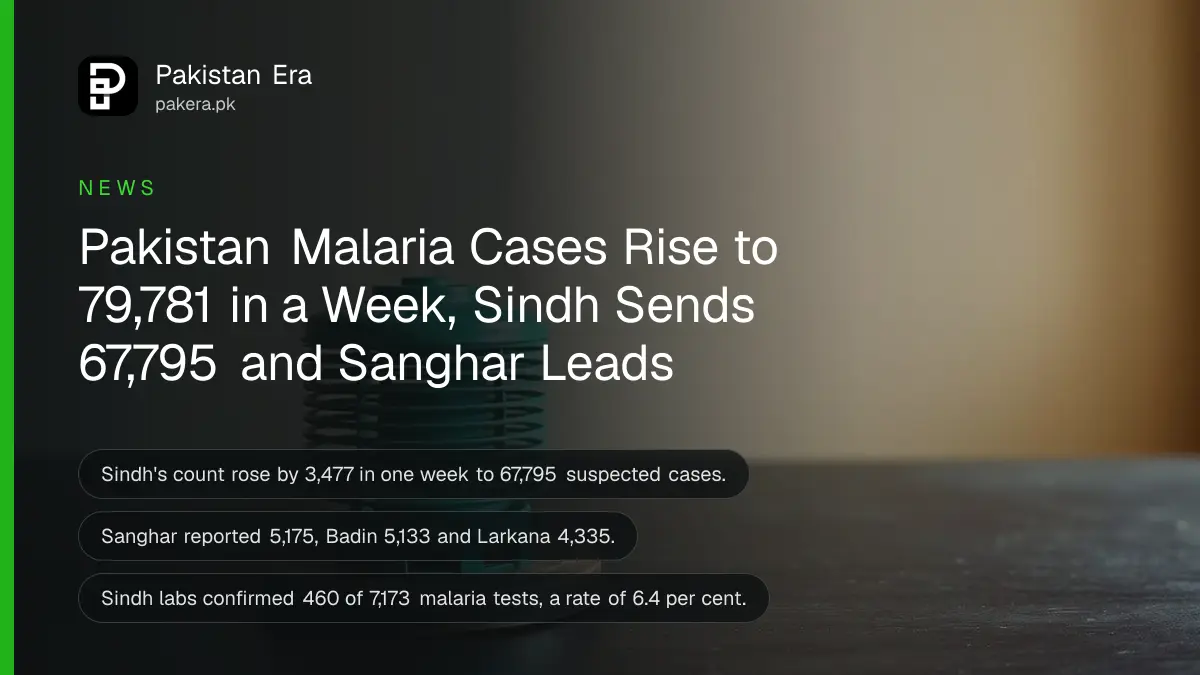
Short answer: Pakistan reported 79,781 suspected malaria cases in week 39 of 2026, up from 76,459 the week before, the National Institutes of Health (NIH) says. Sindh sent 67,795 of them, a rise of 3,477 in one week. Sanghar, Badin and Larkana reported the most. Sindh labs confirmed 460 of 7,173 tests. A fever with chills needs a parasite test before any malaria medicine.
The NIH put the week 39 bulletin online on Friday 16 October 2026. We downloaded the week 39 and week 38 PDFs and read every table ourselves. Punjab did not report in either week, so the national count leaves out the largest province. All figures are suspected cases from clinics unless we say they are lab results.
Malaria rose to 79,781 cases in week 39
The national count went from 76,459 in week 38 to 79,781 in week 39, a rise of 3,322 cases, or 4.3 per cent, our arithmetic. The bulletin lists malaria among the vector-borne diseases that increased this week. Malaria was the second most reported disease in the country after non-cholera diarrhoea, ahead of flu-like illness.
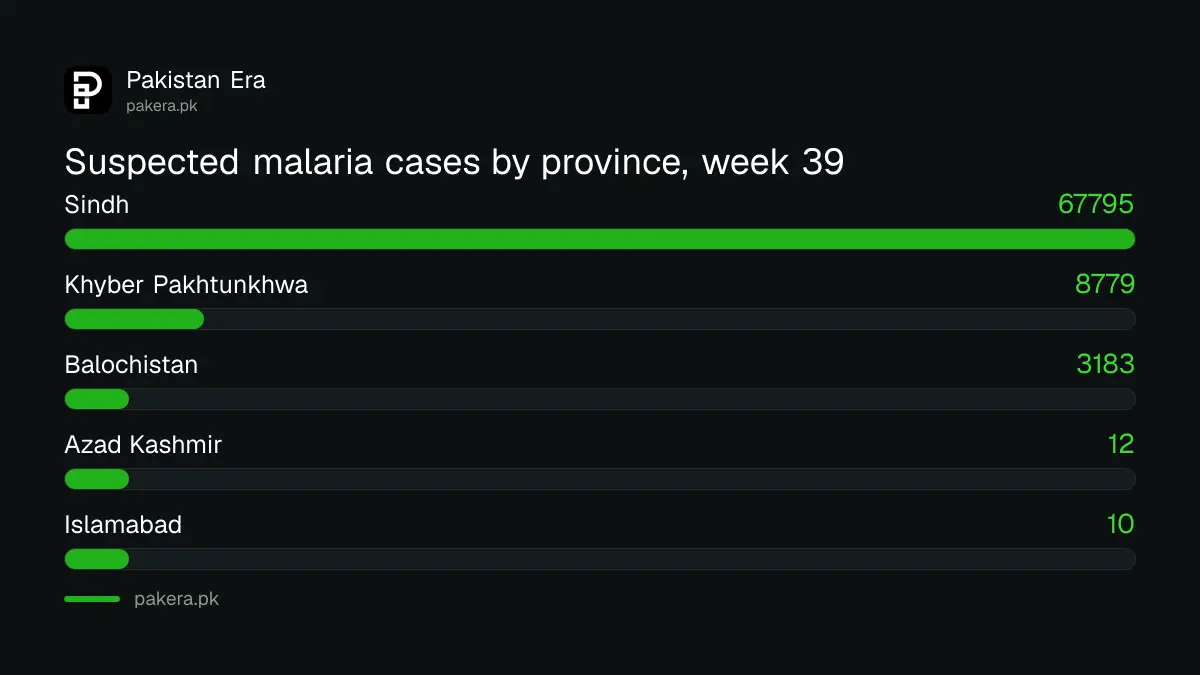
| Province or area | Week 38 | Week 39 | Change |
|---|---|---|---|
| Sindh | 64,318 | 67,795 | up 3,477 |
| Khyber Pakhtunkhwa | 9,455 | 8,779 | down 676 |
| Balochistan | 2,661 | 3,183 | up 522 |
| Azad Jammu and Kashmir | 17 | 12 | down 5 |
| Islamabad | 8 | 10 | up 2 |
| Gilgit-Baltistan | 0 | 2 | up 2 |
| Punjab | not reported | not reported | |
| Pakistan | 76,459 | 79,781 | up 3,322 |
On the standard week calendar, week 39 runs from 21 to 27 September 2026. The week 38 malaria count had fallen from 68,684 to 64,318, so week 39 reverses about half of that fall. Sindh's week 32 figure in late August was 58,972, so the province is still well above its August level.
Sanghar, Badin and Larkana lead Sindh's districts
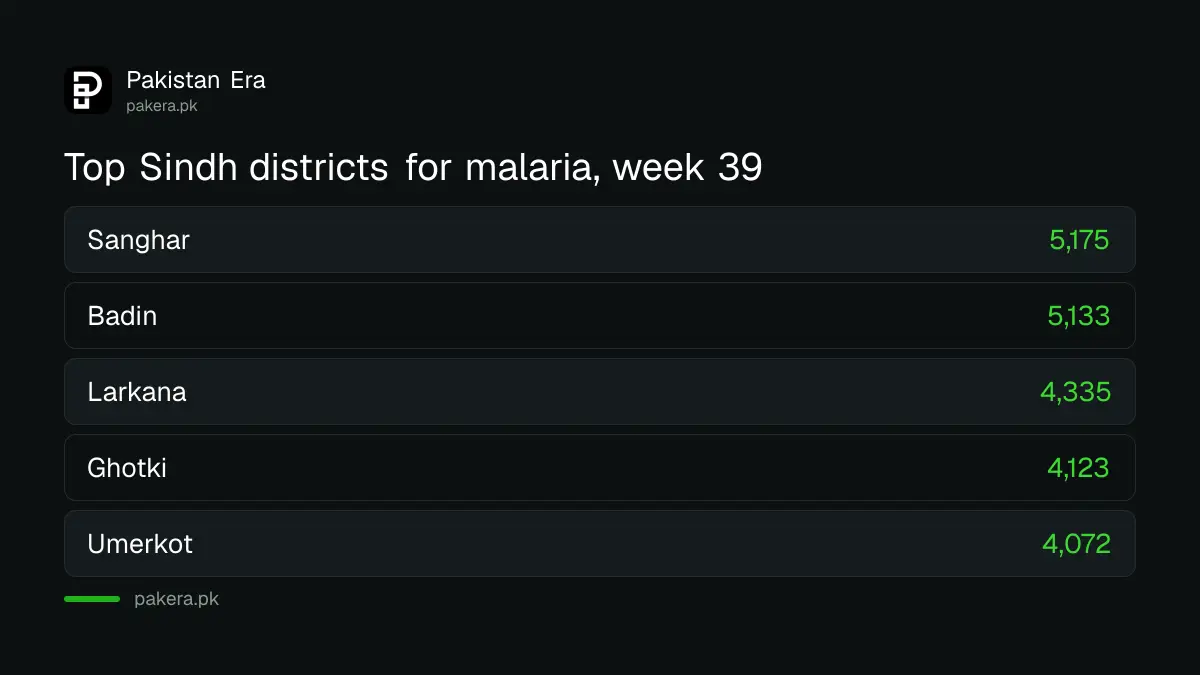
Sindh reported 67,795 suspected cases, 85 per cent of the national total, our arithmetic. Sanghar sent 5,175, Badin 5,133 and Larkana 4,335. Ghotki reported 4,123 and Umerkot 4,072. The bulletin's own note says cases were mostly from Sanghar, Badin and Larkana. Karachi's seven districts reported 956 between them.
| Sindh district | Week 39 cases |
|---|---|
| Sanghar | 5,175 |
| Badin | 5,133 |
| Larkana | 4,335 |
| Ghotki | 4,123 |
| Umerkot | 4,072 |
| Khairpur | 3,923 |
| Dadu | 3,742 |
| Matiari | 3,562 |
| Kamber | 3,462 |
| Mirpurkhas | 3,217 |
| Karachi, all seven districts | 956 |
The top five districts reported 22,838 cases, about a third of Sindh's total. Within Karachi, West reported 300, Malir 232, Central 225, East 87, Korangi 70, and Keamari and South 21 each. The city's low numbers reflect its drier ground and piped water, not an absence of the parasite.
Khyber Pakhtunkhwa fell to 8,779 while Balochistan rose to 3,183
Khyber Pakhtunkhwa's count dropped by 676 to 8,779, and the bulletin lists malaria among the diseases that declined there. Nowshera reported 1,205, Bannu 1,078, Mardan 791, Khyber 771 and Dera Ismail Khan 664. Balochistan rose by 522 to 3,183, led by Kech with 385, Mastung 326 and Musakhel 239.
In Balochistan the bulletin notes an increase in malaria along with diarrhoea, flu-like illness and typhoid. Three districts, Bashore, Dera Bugti and Tump, did not report at all. Gwadar, the province's biggest reporter of diarrhoea and flu, sent only 43 malaria cases.
Labs confirmed 460 of 7,173 Sindh tests
Public health laboratories in Sindh tested 7,173 samples for malaria in week 39 and found 460 positive, which is 6.4 per cent, our arithmetic. Balochistan tested 1,262 and found 90 positive, or 7.1 per cent. Gilgit-Baltistan tested 176 and found none. Azad Kashmir tested 1 and found none.
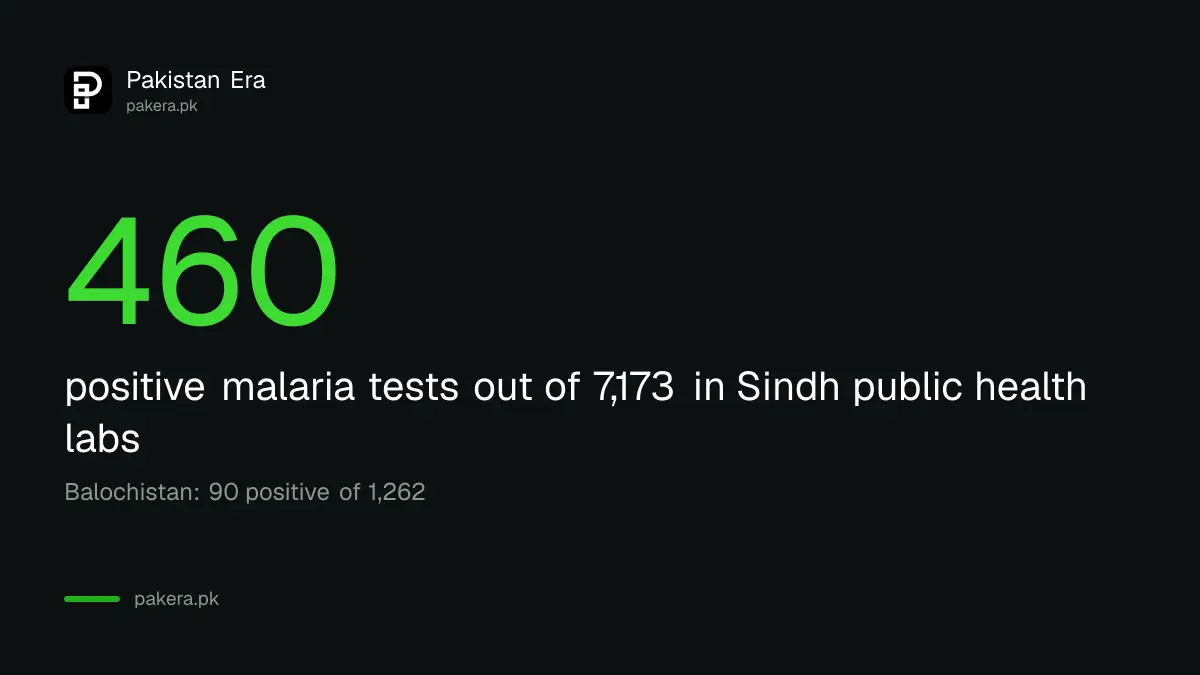
The gap between 67,795 suspected cases and 460 lab positives does not mean the suspected cases are wrong. Most clinics use rapid test kits or a microscope slide on the spot and do not send samples to the public health lab. But it is a reminder that the weekly count measures fevers treated as malaria, not proven infections.
Get a parasite test before you take malaria medicine
The World Health Organization (WHO) says every suspected malaria case should be confirmed by a microscope slide or a rapid diagnostic test before treatment. Treating on symptoms alone wastes medicine, delays the real diagnosis if it is dengue or typhoid, and breeds resistance. These steps are ours, built on the WHO guidance.
- Go to a government health centre or lab for a rapid test or blood slide.
- Do not start chloroquine or artemisinin tablets from a medical store on your own.
- If positive, take the full course the doctor gives, even when the fever drops on day two.
- If negative but the fever continues, ask about dengue and typhoid tests.
- Sleep under a treated net and clear standing water, because the same household gets reinfected.
Which test to ask for, and why the type of malaria matters for treatment, is in the guide on how to check a fever for malaria. If the fever comes with severe headache and pain behind the eyes, the dengue signs in dengue warning signs apply as well.
Common questions about the week 39 malaria figures
How many malaria cases did Pakistan report in week 39 of 2026?
79,781 suspected cases, up from 76,459 in week 38, according to the NIH bulletin published on 16 October 2026. Punjab is not included.
How many were in Sindh?
67,795, up from 64,318. Sanghar, Badin and Larkana reported the most.
Are these confirmed cases?
No. They are suspected cases reported by clinics. Sindh's public health labs confirmed 460 of 7,173 samples in the same week.
Is a malaria test free?
Government health facilities test for malaria with a slide or a rapid kit. Ask at the nearest basic health unit or district hospital, and insist on the test before any tablets.
Which week is week 39?
The bulletin does not print dates. On the standard week calendar it runs from 21 to 27 September 2026.
How we verified this
What we checked, where we read it, and what we could not confirm.
Last checked 19 October 2026. All case counts come from Table 1, Table 2, Table 3, Table 4 and Table 5 of the NIH Integrated Disease Surveillance and Response bulletins for weeks 38 and 39 of 2026, listed on the NIH weekly bulletin page. The week 39 PDF carries a server date of 16 October 2026. The week 32 Sindh figure comes from our earlier reading of that bulletin. Percentages, changes and the Karachi and top-five sums are our own arithmetic. Testing advice is from the WHO malaria fact sheet. We could not verify why Punjab does not report or the exact dates of the reporting week.
About the author

Tax, Bills and Technology Writer
Ali Akhtar is a young and curious voice here at Pakistan Era. He is currently pursuing his A-Levels and has a growing interest in Pakistan’s changing industrial landscape and educational trends. Ali likes to write in a way that helps him explain and explore the world around him. His writing reflects the perspective of the new generation navigating the evolving trends of Pakistan where technology, youth innovation, and shifting opportunities are reshaping the country’s future.