Pakistan and Türkiye Sign Security Pact as Illegal Migration Falls From 70% to 17%
Pakistan and Türkiye signed a pact on terrorism, drugs and organised crime on 9 October 2026. What the 70% to 17% migration claim means and the legal routes.
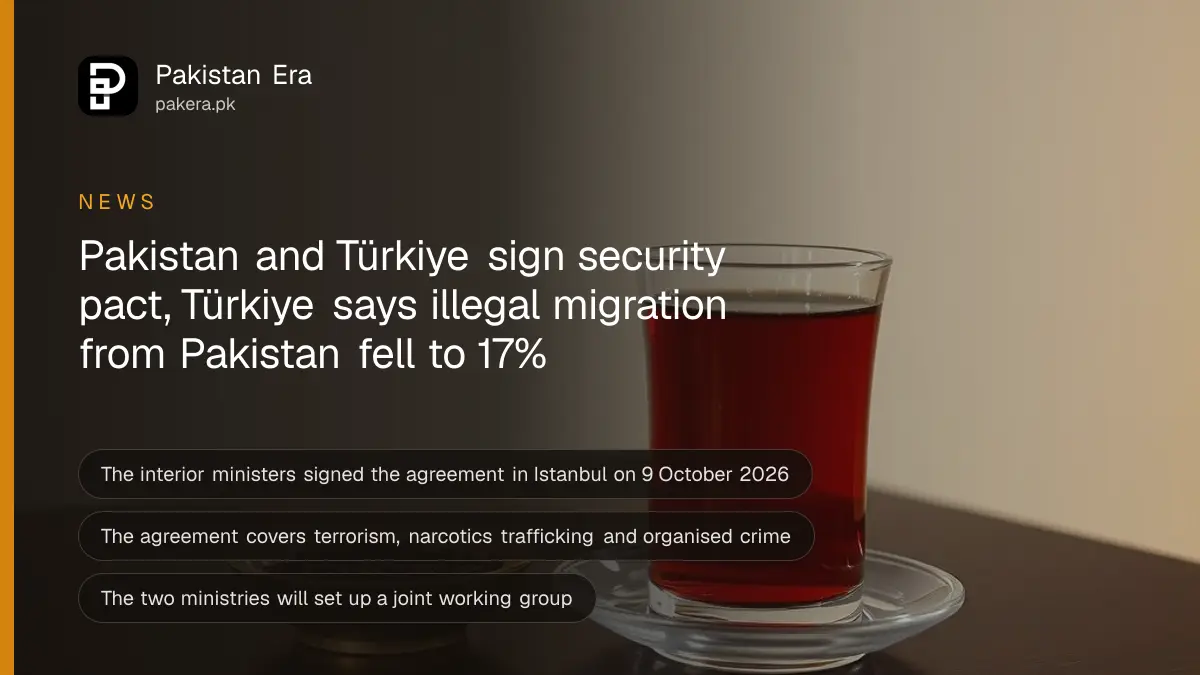
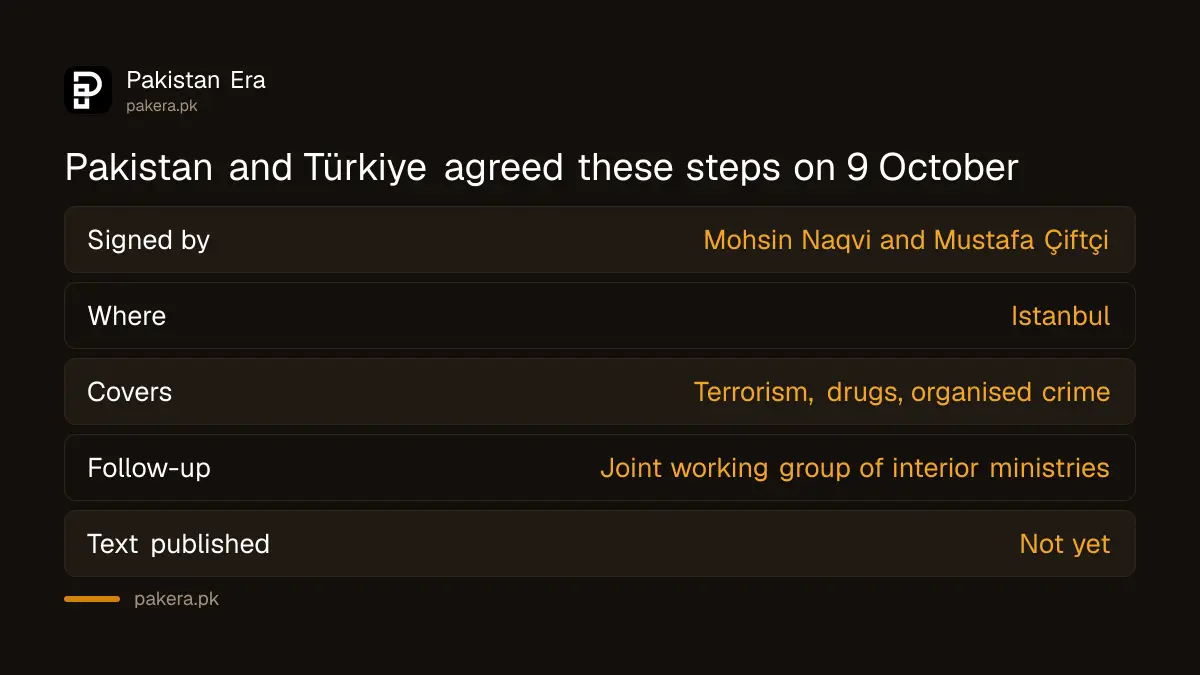
Pakistan and Türkiye signed an agreement in Istanbul on 9 October 2026 to work together against terrorism, drug trafficking and organised crime. At the same meeting, Türkiye's Interior Minister said the rate of illegal migration from Pakistan to Türkiye has fallen from 70 per cent to 17 per cent.
Interior Minister Mohsin Naqvi signed for Pakistan and Interior Minister Mustafa Çiftçi for Türkiye. The two ministries also agreed to set up a joint working group. For Pakistanis, the practical message is simple: the Türkiye route is watched more closely than before, and the only safe way in is a real visa.
Pakistan and Türkiye signed a security agreement in Istanbul
The agreement covers three areas: combating terrorism, narcotics trafficking and organised crime. The same meeting covered Pakistan's crackdown on illegal migration, so human smuggling, which means moving people across borders illegally for money, was part of the talks.
The two sides agreed on four follow-up steps:
- A joint working group between the two interior ministries.
- Technical assistance between their agencies.
- Exchange of experts.
- Joint measures, which were not spelled out.
The full text of the agreement has not been published. We could not find it on Pakistan's Interior Ministry website when we checked on 10 October, so the list above is everything that is on the record.
Türkiye says illegal migration from Pakistan fell to 17 per cent
Mr Naqvi briefed his Turkish counterpart on Pakistan's crackdown on what the government calls the illegal immigration mafia. Mr Çiftçi then praised Pakistan's measures. He said the rate of illegal immigration from Pakistan to Türkiye had come down from 70 per cent to 17 per cent.
That is a large drop, but the figure needs care. The statement does not say what the percentage measures or over which years. It could be a share of all Pakistani arrivals, a share of a particular group, or a comparison of two periods. Until Türkiye publishes the data behind it, treat 17 per cent as the Turkish minister's description, not a precise statistic.
| What we know | What we do not know |
|---|---|
| The figure fell from 70% to 17%, per Türkiye's minister | What the percentage is a share of |
| It was said in Istanbul on 9 October 2026 | Which years are being compared |
| Türkiye credited Pakistan's crackdown | Whether Türkiye will publish the data |
Why the Türkiye route matters to Pakistanis
Türkiye sits between Asia and Europe. For years, smugglers have sold Pakistanis a journey through Iran and Türkiye towards Greece and the rest of Europe. The road is dangerous. People who take it risk their savings, detention, deportation and their lives.
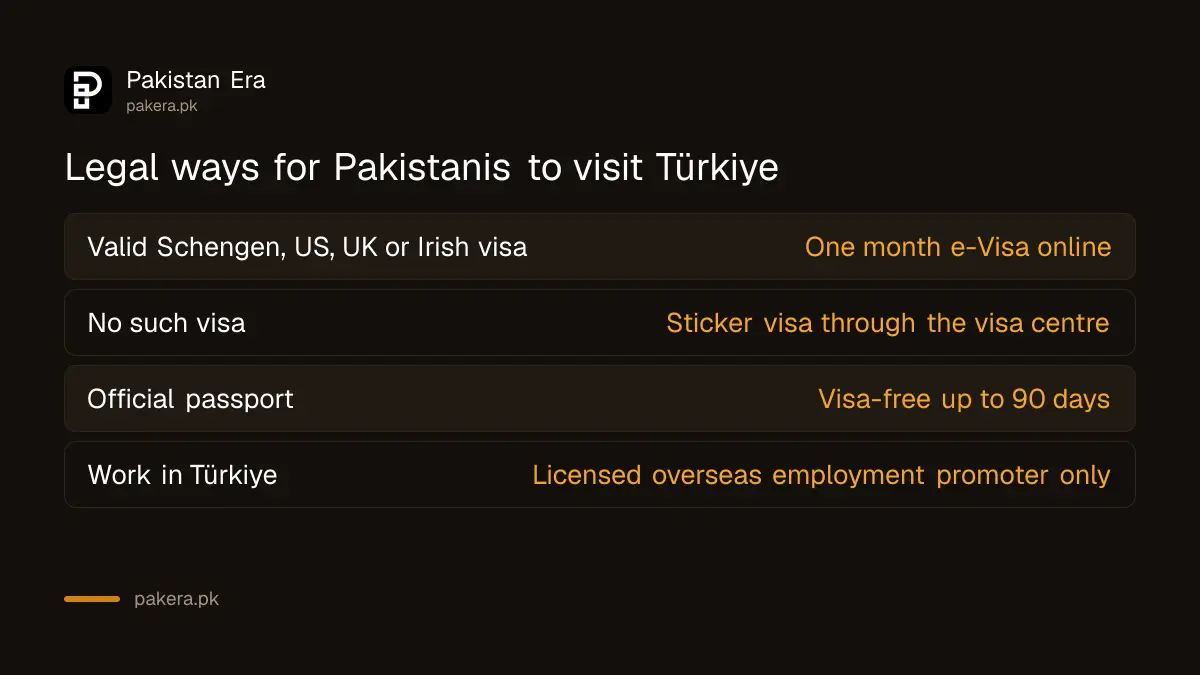
A legal visit is possible, and it is not complicated. Türkiye's Ministry of Foreign Affairs says Pakistani ordinary passport holders need a visa. Those who hold a valid Schengen, US, UK or Irish visa or residence permit can get a one month, single entry e-Visa online. Everyone else applies for a sticker Türkiye visa for Pakistanis through the Turkish visa centre.
Work is a different matter. A job abroad has to go through a licensed overseas employment promoter registered with the Bureau of Emigration. You can check whether an overseas job agency is licensed before you pay anyone, and then get emigrant protection before you fly.
How to spot a smuggler's offer and report it
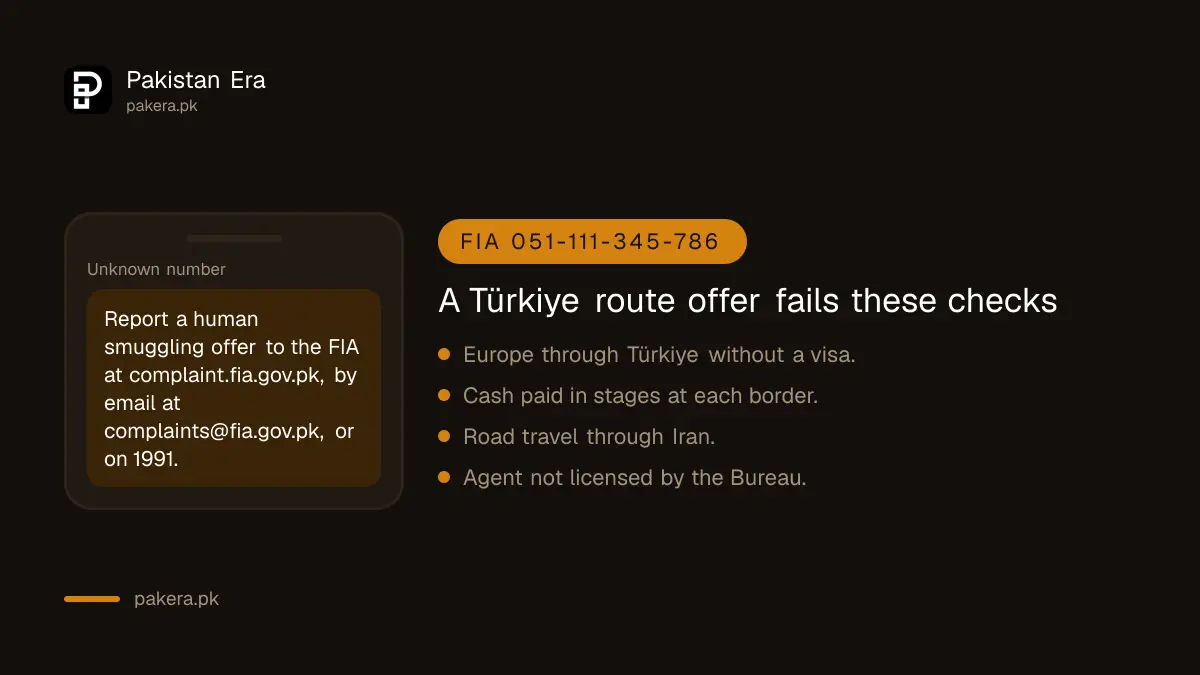
A smuggler rarely calls himself one. The offer usually sounds like a shortcut. These signs should stop you:
- A promise of Europe "through Türkiye" without a visa for the final country.
- Payment asked in cash or in stages "at each border".
- Travel by road through Iran instead of a direct flight.
- An agent who is not on the Bureau of Emigration's licensed list.
- A "guaranteed" job with no written contract.
If you are offered such a route, report it to the Federal Investigation Agency (FIA). Its website lists the complaint portal complaint.fia.gov.pk, the email complaints@fia.gov.pk, and the numbers 051-111-345-786 and 1991. Fake job and visa offers have led to arrests before, as in the Karachi Canada work visa scam last month.
Pakistan and Türkiye are already close security partners
This agreement sits on top of a wider defence tie. Pakistan, Saudi Arabia and Türkiye are members of the Makkah Joint Defence Agreement. Their foreign and defence ministers met in Riyadh on 5 October and agreed on the rapid deployment of forces in Saudi Arabia. The Istanbul deal is different. It is about police and interior ministry work, not the military.
The joint working group is the part to watch. If it meets and publishes results, the 17 per cent figure may get a clearer meaning.
Common questions
What did Pakistan and Türkiye sign on 9 October 2026?
An agreement to cooperate against terrorism, narcotics trafficking and organised crime, signed by the two interior ministers in Istanbul.
What is the 70 to 17 per cent figure?
Türkiye's Interior Minister said illegal immigration from Pakistan to Türkiye fell from 70 per cent to 17 per cent. He did not say what the percentage measures.
Can Pakistanis get a Türkiye e-Visa?
Only if they hold a valid Schengen, US, UK or Irish visa or residence permit. Others need a visa through the visa centre.
How do I report a human smuggler in Pakistan?
Complain to the FIA at complaint.fia.gov.pk, by email at complaints@fia.gov.pk, or call 051-111-345-786 or 1991.
Has the agreement text been published?
No. As of 10 October 2026, only the summary from the signing was public.
How we verified this
What we checked, where we read it, and what we could not confirm.
Last checked 10 October 2026, about 7:15 am PKT. The signing, its scope, the joint working group and the 70 to 17 per cent remark are from Radio Pakistan's report of 9 October 2026. The visa rule is from the Turkish Ministry of Foreign Affairs visa page. FIA contacts are from the FIA website. The agreement text was not available.
About the author

Global Affairs & Political Economy Writer
Muhammad Hatim is a book lover who started writing because he enjoys it. At Pakistan Era he writes about international relations, geopolitics and the global economy, with a particular interest in South Asia and the forces behind current events.