PCB School Cricket Talent Hunt: 6 Lahore Schoolboys Bowl to the Pakistan Team at Gaddafi Stadium, and How to Get In
Six schoolboys aged 14 to 16 from the PCB School Cricket Talent Hunt bowled to Pakistan at Gaddafi Stadium on 23 October. What Hesson said and how to get in.
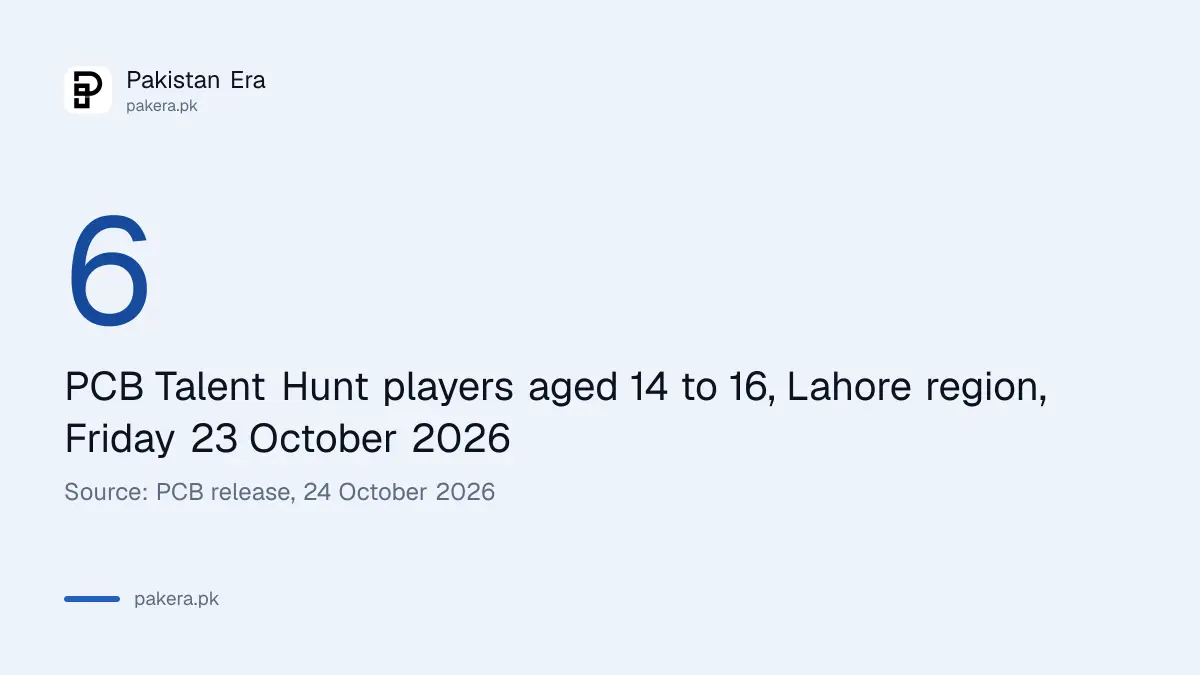
Six schoolboys aged 14 to 16, picked through the PCB School Cricket Talent Hunt Programme, watched the Pakistan men's team train at Gaddafi Stadium, Lahore, on Friday 23 October 2026 and bowled to the national players in the nets, the Pakistan Cricket Board (PCB) said on 24 October. Head coach Mike Hesson singled out "a nice traditional leg-spinner and a couple of quick bowlers".
It was Pakistan's first training session in Lahore after two tri-series wins in Rawalpindi, two days before they play England on 25 October. Below is what the boys did, what Hesson and the players said, and how a schoolboy gets into the same programme.
Six Lahore schoolboys bowled to Pakistan in the Gaddafi nets
The PCB invited six young cricketers from the Lahore region to Pakistan's training session at Gaddafi Stadium on Friday 23 October 2026. They watched the session, bowled to Pakistan batters in the nets and spoke with players and coaching staff, the board said.
We read the PCB release on its website on 25 October 2026. It says the boys were aged between 14 and 16 and were "identified through the PCB School Cricket Talent Hunt Programme". It names two of the six.
| Detail | What the PCB release says |
|---|---|
| Date | Friday, 23 October 2026, released 24 October |
| Venue | Gaddafi Stadium, Lahore |
| Players | Six, from the Lahore region |
| Ages | 14 to 16 |
| Named | Abdul Rehman, right-arm fast; Muhammad Husnain, leg-spinner |
| Pakistan players named | Babar Azam and Fakhar Zaman spoke to the boys |
Mike Hesson praised a leg-spinner and two quick bowlers
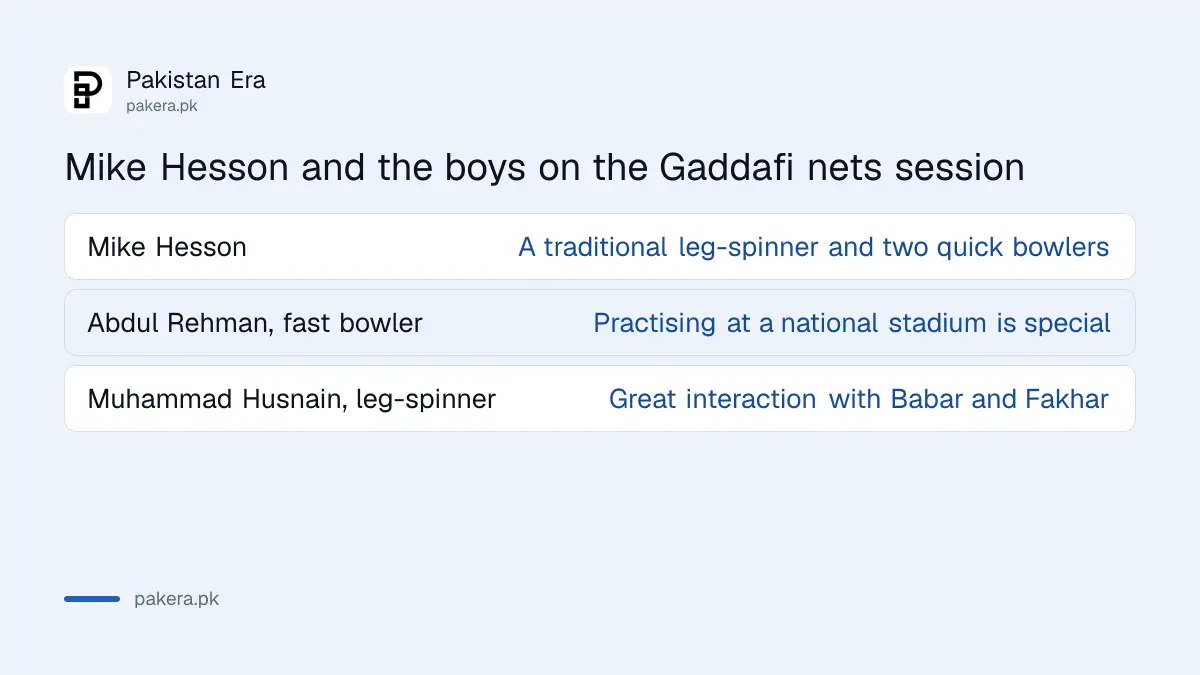
Pakistan head coach Mike Hesson told PCB Digital the group included "a nice traditional leg-spinner and a couple of quick bowlers who have beautiful actions, good seam release and they hit a great length". He credited the PCB for finding them.
Hesson added that Babar Azam and Fakhar Zaman talked to the boys, and that "a few of them have integrated with the group". He also made a point that applies to any young player: "It is not just the skill, it's also the work ethic."
The board describes the programme as an initiative of PCB Chairman Mohsin Naqvi, aimed at finding and developing talent at school level. That is its own wording. The release gives no figure for how many players the programme has moved on to academies so far.
The two named boys spoke about training with Babar and Fakhar
Right-arm fast bowler Abdul Rehman said practising "at a national stadium alongside Pakistan team is special". Leg-spinner Muhammad Husnain said he had "a great interaction with Babar Azam and Fakhar Zaman" and called it a great learning experience.
The other four boys are not named in the release. A leg-spinner and fast bowlers fit what Hesson described, so the two named boys are likely among those he praised, but the PCB does not link his comments to any one player.
Pakistan were in Lahore for the second half of the tri-series
The session was Pakistan's first in Lahore after arriving from Rawalpindi, where they beat Sri Lanka and England. The PCB release confirms Pakistan play England in the fourth match of the tri-series on Sunday 25 October at Gaddafi Stadium.
Pakistan lead the tri-series points table with four points. The time and squads for Sunday are in our page on Pakistan vs England on 25 October.
How a schoolboy gets into the PCB Talent Hunt
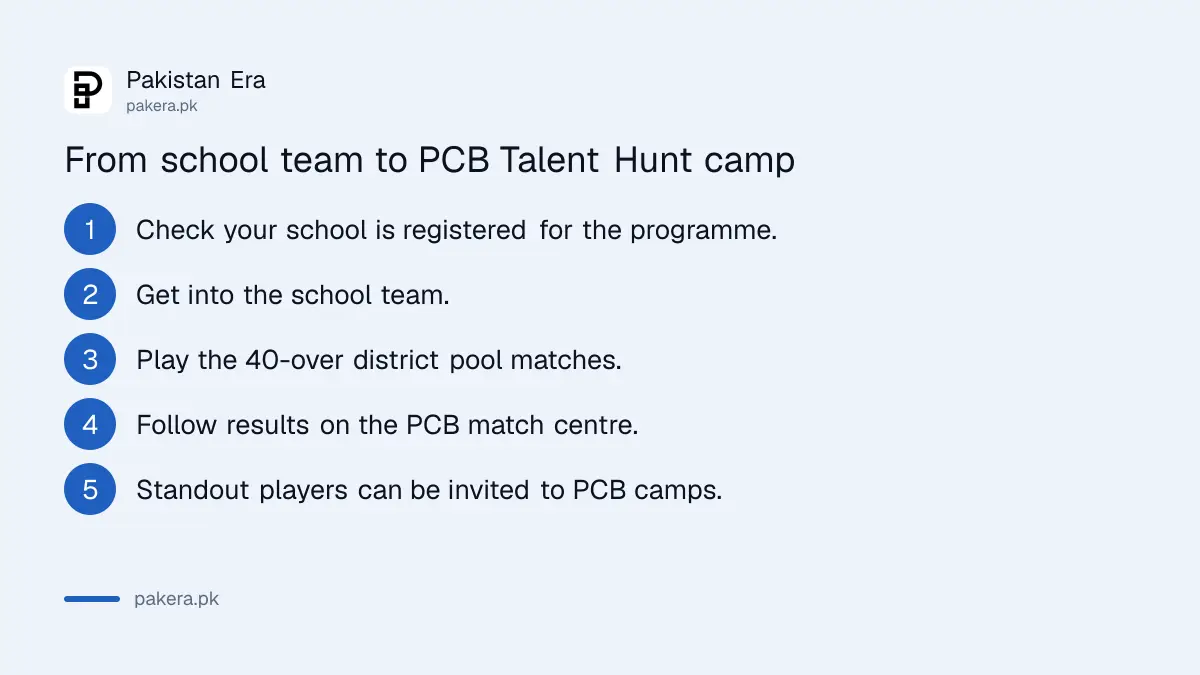
A boy enters the programme through his school team, not on his own. Schools register, play pool matches in their district, and coaches watch for players. The PCB then invites the best to camps and, as this week showed, sometimes to the national team's nets.
School matches were still running on the PCB match centre when we checked on 25 October. On 24 October it listed 40-over school games across Pakistan, including a district final in Mansehra, semi-finals in Haripur, and pool matches in Pakpattan, Karachi and Muzaffargarh.
- Ask your school's sports teacher whether the school is registered for the PCB Talent Hunt School Programme 2026-27.
- Get into the school team, since only registered school sides play.
- Play the district pool matches, which are 40 overs a side.
- Follow your school's results on the PCB match centre.
- Players who stand out can be invited to PCB camps and regional academies, under the board's plan for this season.
The season's schools, districts and stages are set out in our page on the PCB Talent Hunt School Programme 2026-27. Older players outside school can try the regional PCB U15, U17 and U19 trials.
Common questions
Which schoolboys bowled to the Pakistan team in Lahore?
Six players aged 14 to 16 from the Lahore region. The PCB named two: fast bowler Abdul Rehman and leg-spinner Muhammad Husnain.
When did the talent hunt players train with Pakistan?
On Friday 23 October 2026 at Gaddafi Stadium. The PCB release came out on 24 October.
What did Mike Hesson say about the boys?
He praised a traditional leg-spinner and two quick bowlers with good actions and length.
Can a boy apply to the PCB Talent Hunt on his own?
No. Players come through registered school teams. Individual players can try the regional age-group trials instead.
Which Pakistan players met the boys?
Babar Azam and Fakhar Zaman talked to them, according to Hesson and Husnain.
What format do the school matches use?
40 overs a side, as listed on the PCB match centre.
How we verified this
What we checked, where we read it, and what we could not confirm.
We read the PCB release of 24 October 2026 and the recent matches list on the PCB match centre on 25 October 2026. We could not confirm the names of the other four boys, their schools, or whether every school match on the match centre belongs to the Talent Hunt programme rather than another school event.
About the author

Tax, Bills and Technology Writer
Ali Akhtar is a young and curious voice here at Pakistan Era. He is currently pursuing his A-Levels and has a growing interest in Pakistan’s changing industrial landscape and educational trends. Ali likes to write in a way that helps him explain and explore the world around him. His writing reflects the perspective of the new generation navigating the evolving trends of Pakistan where technology, youth innovation, and shifting opportunities are reshaping the country’s future.