PNMC Act 2026: Up to 2 Years Jail for Unregistered Nursing in Pakistan, and New Rules for Hospitals
The PNMC Act 2026 makes unregistered nursing punishable by 2 years in jail and a Rs 1 million fine, bars hospitals from hiring such nurses and adds the NLE.
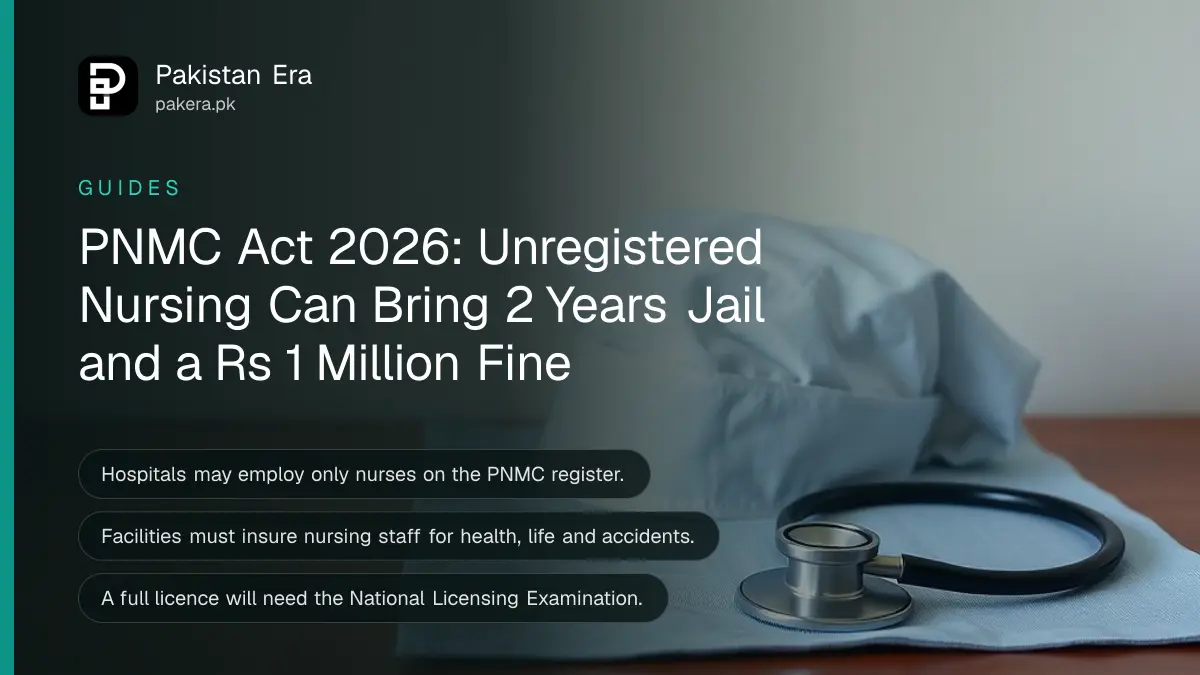
Short answer: Under the Pakistan Nursing and Midwifery Council Act, 2026, practising as a nurse, midwife or nursing auxiliary without being registered can bring up to two years in jail, a fine of Rs 100,000 to Rs 1 million, or both. Pretending to be registered carries up to one year. No hospital or clinic may employ an unregistered nurse. The Act has applied across Pakistan since 4 June 2026 and replaced the Pakistan Nursing Council Act, 1973.
The new law matters to three groups: nurses and midwives, the hospitals that hire them, and patients who want to know the person caring for them is qualified. Here is what each one has to do now, with the penalties from the Act's own schedules.
Unregistered nursing now carries up to 2 years in jail
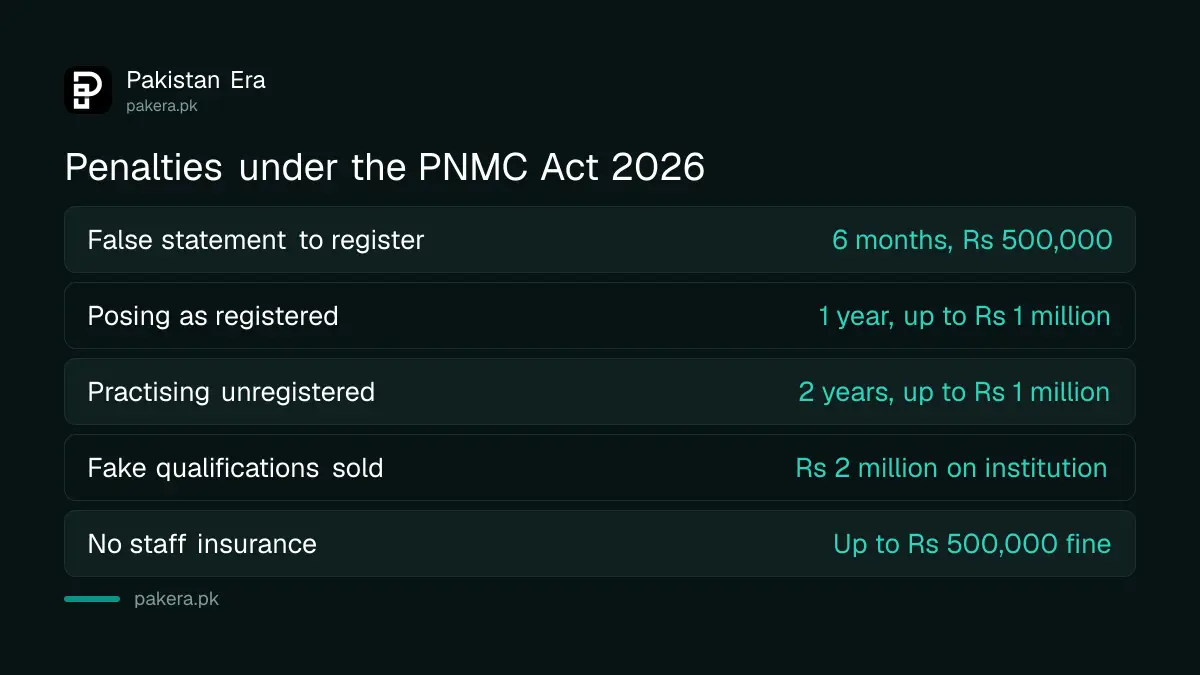
The Fourth Schedule of the Act lists five offences tried by the Court of Sessions. The heaviest is practising in breach of the Act, its rules or regulations. A repeat offender can also lose registration or licence. The table sets out each offence and its punishment.
| Offence | Punishment |
|---|---|
| Getting registration by a false or fraudulent statement | Up to 6 months in jail, a fine up to Rs 500,000, or both |
| Claiming to be a registered nurse, midwife or nursing auxiliary without registration, or using a title that implies it | Up to 1 year in jail, a fine of Rs 100,000 to Rs 1 million, or both |
| Practising as a nurse, midwife, midwifery associate or nursing auxiliary in breach of the Act | Up to 2 years in jail, a fine of Rs 100,000 to Rs 1 million, or both |
| Repeating the same offence more than three times | Suspension or cancellation of registration or licence, plus the punishment above |
| Issuing or selling forged or unauthorised nursing or midwifery qualifications | A fine on the institution up to Rs 2 million |
The Court of Sessions tries these offences under the Criminal Procedure Code. A separate Fifth Schedule lists offences the Council itself acts on, mostly against institutions.
Hospitals may employ only registered nurses
Section 38 bars any healthcare facility from employing a person as a nurse, midwife, midwifery associate or nursing auxiliary unless that person is on the Council's register. There is one exception: a trainee at a recognised institution whose head certifies that the trainee can already work safely.
Section 40 adds a new duty for employers. Every healthcare facility must give its nursing staff adequate health, life and accidental insurance, at its own cost. Nursing schools must cover their students for health and accidents during training, and may recover that cost through fees. Both must send the Council proof of insurance every year.
Failing to provide that insurance, on purpose or knowingly, can bring a fine of up to Rs 500,000 on the facility or institution. The Council can also suspend or cancel the institution's registration or recognition. Section 39 lets the Council set minimum nursing standards for hospitals, covering staffing, duty rosters, wages, leave and grievance handling.
How a nurse gets registered and licensed under the new Act
Registration and licensing are now two separate steps. You join the register with a recognised qualification, then hold a licence to practise. The National Licensing Examination (NLE) is how a graduate moves from a provisional to a full licence.
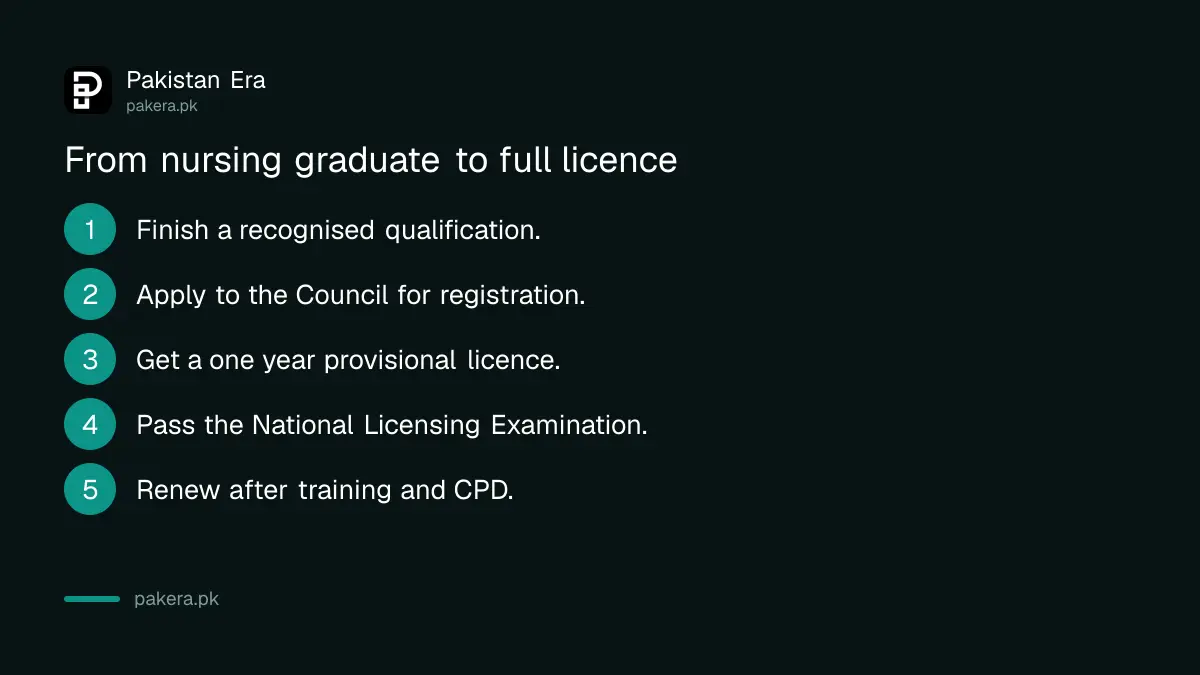
- Finish a recognised qualification. The First Schedule lists them, from the four year BS Nursing to the LHV and Community Midwife diplomas and the Certified Nursing Assistant course.
- Apply for registration. Send the application with the prescribed fee to the Council. It cannot reject you without giving you a hearing.
- Get a provisional licence. On graduation, the Council issues a provisional licence for one year.
- Pass the NLE for a full licence. There is no limit on attempts. The Council must start the NLE within two years of the Act, that is by June 2028.
- Renew on time. Renewal depends on completing the Council's training courses and its Continuous Professional Development (CPD) programme.
Universities and boards must send graduates' results to the Council within ten days of the final exams, so students can register for the NLE. Graduates of foreign nursing schools sit the National Registration Examination (NRE) before full registration. The current renewal fee and steps are on the PNMC licence renewal page.
Nurses licensed abroad need the NLE unless they hold a recognised postgraduate degree
A registrant who got a licence in another country, after qualifying in Pakistan or at a recognised foreign institution, must pass the NLE to get a full licence in Pakistan. The exception is a nurse who also holds a postgraduate qualification recognised by the Council, who gets a full licence on that basis.
This affects nurses coming home from the Gulf or the UK. Check your status with the Council before you accept a job here. Nurses heading the other way can get a PNMC good standing certificate for a foreign regulator.
Existing registrations carry over to the new Council
Section 53 repealed the Pakistan Nursing Council Act, 1973 and the Pakistan Nursing and Midwifery Council Ordinance, 2025. Anyone already on the old register is treated as registered under the new Act. Actions already started under the old law continue as if taken under the new one.
The Council must publish lists of qualified and disqualified registrants on its website, and keep a digital verification system. A person can be removed from the register after a hearing, for example after a conviction or a finding of misconduct. Patients and employers can check any nurse with the PNMC licence verification by CNIC.
Common questions
What is the punishment for working as an unregistered nurse in Pakistan?
Up to two years in jail, a fine of Rs 100,000 to Rs 1 million, or both, under the Fourth Schedule of the PNMC Act 2026.
Can a hospital hire a nurse who is not registered?
No. Section 38 bars it, except for certified trainees from a recognised institution.
When did the PNMC Act 2026 come into force?
At once, on the President's assent on 4 June 2026. It extends to the whole of Pakistan.
Do I need to register again under the new Act?
No. People on the register kept under the old law are treated as registered under the new Act.
Is the National Licensing Examination compulsory?
Yes, for a full licence. The Council must start it within two years of the Act, and there is no limit on attempts.
Must a hospital insure its nurses?
Yes. Section 40 requires health, life and accidental insurance for nursing staff, paid by the facility.
How we verified this
What we checked and where we read it.
We checked the full text of the Pakistan Nursing and Midwifery Council Act, 2026 (Act No. XXXVII of 2026) on 15 November 2026, from the National Assembly's list of Acts. The Gazette of Pakistan copy is dated 12 June 2026, records the President's assent on 4 June 2026, and says the Act came into force at once. Penalties are from the Fourth and Fifth Schedules, the hiring bar from section 38, insurance from section 40, licensing from sections 32 to 35 and the repeal from section 53. Fees are set by the Council's regulations, not in the Act.
About the author

Global Affairs & Political Economy Writer
Muhammad Hatim is a book lover who started writing because he enjoys it. At Pakistan Era he writes about international relations, geopolitics and the global economy, with a particular interest in South Asia and the forces behind current events.