Tax Credit for POS Machine Under Section 64D in Pakistan: Claim 10% With Final Rule 33U (What Counts, What Does Not)
Section 64D now gives a 10% credit on POS and FBR integration costs, with final Rule 33U of 26 October 2026. See what counts, what is left out and how to claim.
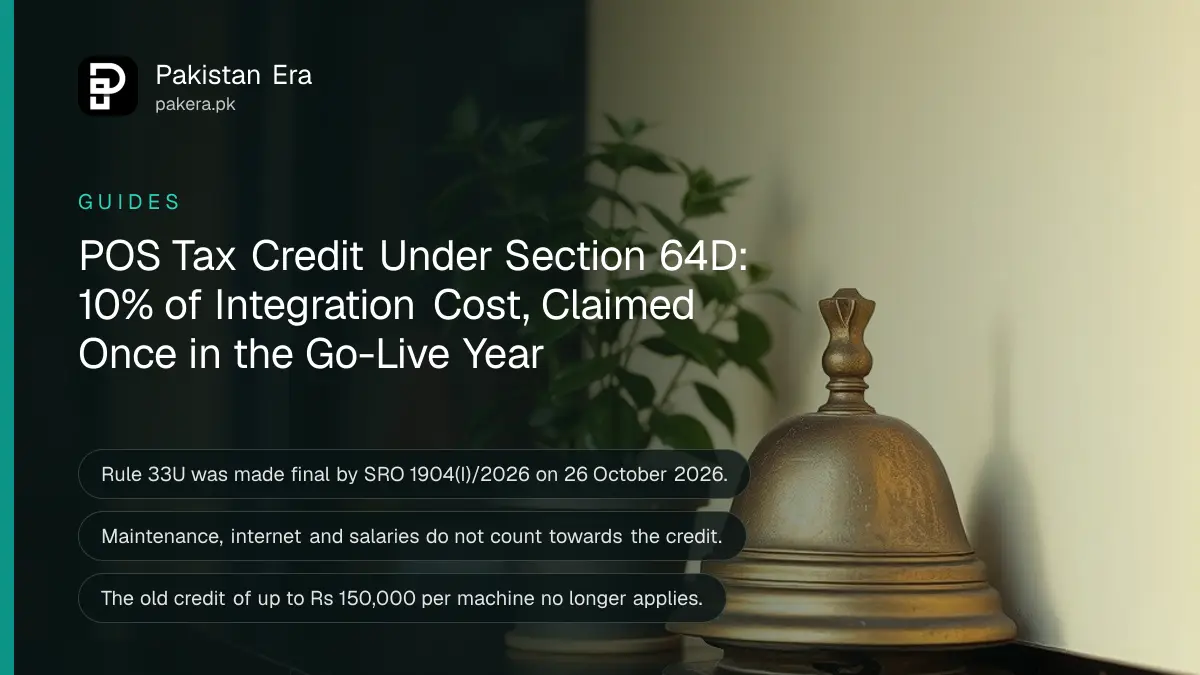
The tax credit for a POS machine under section 64D is now 10 per cent of what you actually spent on FBR integration, claimed in the return for the year the system goes live. FBR made the claim rules final in Rule 33U through SRO 1904(I)/2026, dated 26 October 2026. The old credit of up to Rs 150,000 per machine is gone.
Retailers, manufacturers and anyone FBR requires to connect a system to its servers can claim it. We read the final rule and the current section 64D on FBR's website on 1 November 2026. The draft version was covered when FBR first published Rule 33U for comments; below is what the final text says and how to claim it.
Section 64D now gives 10 per cent of the integration cost
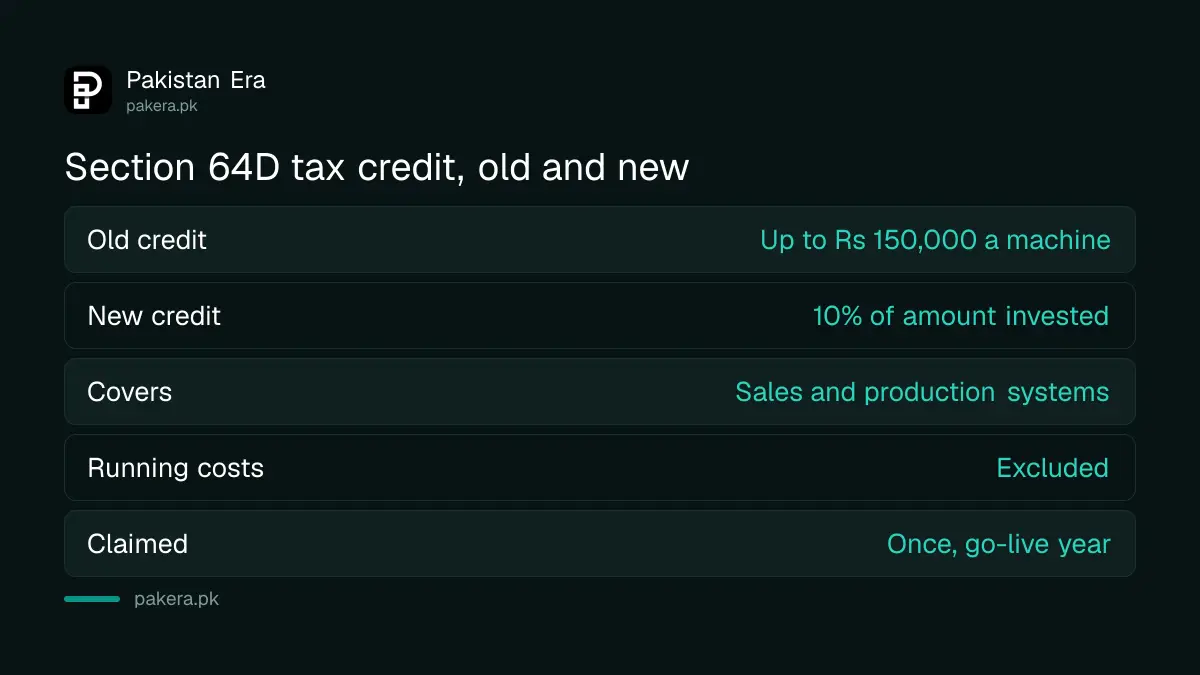
The Finance Act 2026 replaced section 64D. The credit is now 10 per cent of the amount actually invested in equipment, hardware, software or components used only for integration with FBR's system. It no longer covers just POS machines, and the per-machine limit has gone.
The change is large for small shops. Under the old section, a person who bought a POS machine got a credit equal to its cost, up to Rs 150,000 per machine. Under the new one, the same purchase earns a tenth of the cost.
| Point | Old section 64D (2021) | New section 64D (Finance Act 2026) |
|---|---|---|
| What is covered | Point of sale machine | Any equipment, hardware or software used only for integration |
| Who can claim | Persons required to report sales in real time | Persons required to integrate under income tax, sales tax or excise law, including production monitoring |
| Amount | Lesser of cost or Rs 150,000 per machine | 10% of the amount actually invested |
| Running costs | Not mentioned | Excluded |
| Set against | Tax payable | Normal tax under Division I or II of Part I, First Schedule only |
Rule 33U sets five conditions you must meet
Rule 33U(1) lists five conditions. The law must require you to integrate in that tax year. The system must go live in that year. It must be used only for integration. FBR's system must record its activation. And you need invoices and proof of payment.
- You are required to integrate under the Ordinance, the Sales Tax Act 1990 or the Federal Excise Act 2005 in that tax year.
- The equipment or software is bought, installed and successfully integrated with FBR's system in the same tax year.
- It is used directly and only for the required integration.
- FBR's computerised system shows an integration, activation or commissioning record naming you, the equipment and the date.
- You hold the tax invoice, bill, agreement or licence, and evidence of payment.
Point four is the one shops forget. Keep a screenshot or record of the activation date from FBR's side. Without it, the claim can be refused on verification.
Only one-time costs count as amount invested
Rule 33U(2) counts the purchase price plus one-time costs to bring the system into use: installation, configuration, interface development, integration, testing and implementation. Discounts, rebates, grants and subsidies are deducted. Running costs and refundable taxes are left out.
| Counts towards the credit | Does not count |
|---|---|
| Purchase price of the POS or monitoring equipment | Tax or duty you can adjust or get refunded |
| Software or licence bought for integration | Annual maintenance and repair |
| Installation and configuration | Recurring service or support charges |
| Interface development and testing | Internet, telecom and utility bills |
| Implementation to bring it into operation | Salaries, training, consumables, financing costs |
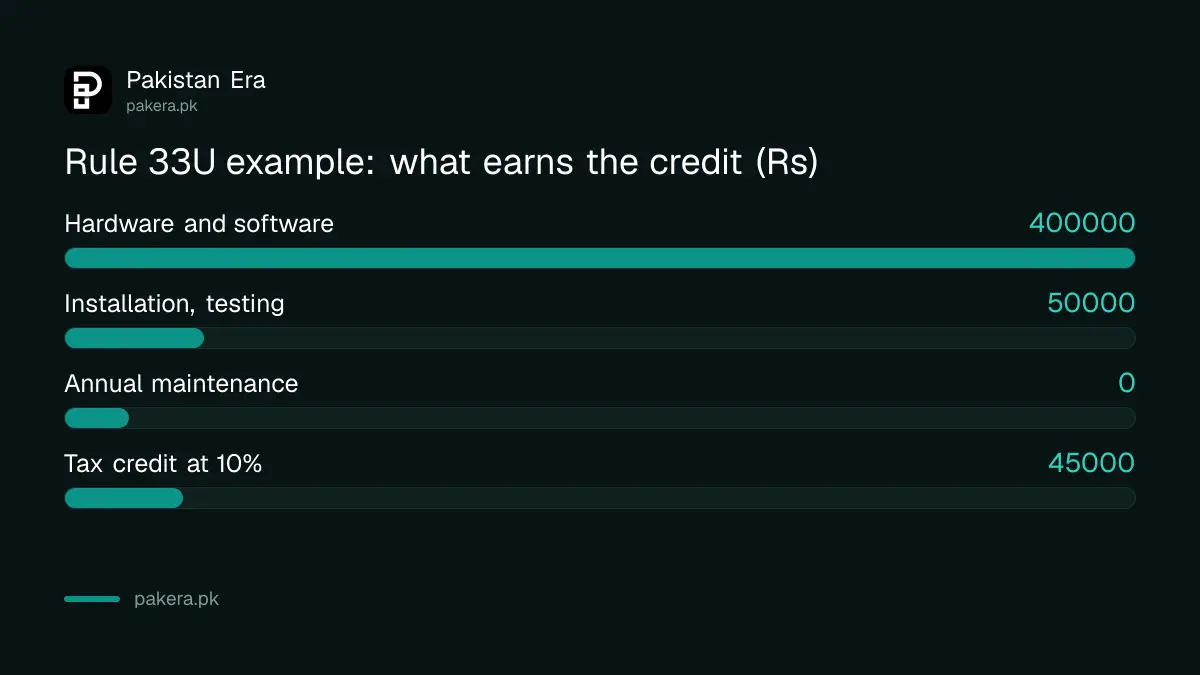
A general-purpose computer is excluded too, unless a separate part of it is dedicated only to integration. Here is a worked example of our own. A shop spends Rs 400,000 on POS hardware and software, plus Rs 50,000 on installation and testing, and pays Rs 30,000 a year for maintenance. The credit is 10 per cent of Rs 450,000, which is Rs 45,000. The Rs 30,000 maintenance earns nothing.
You claim the credit once, in the return for the go-live year
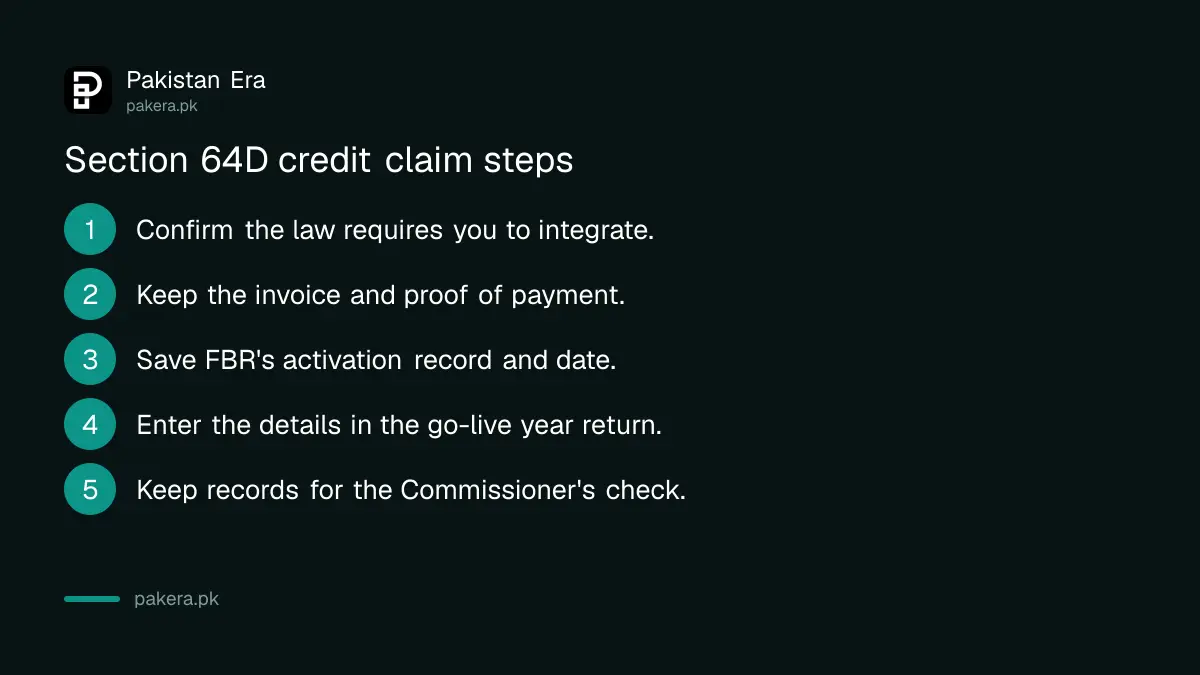
Rule 33U(4) says the credit is claimed in the return for the tax year in which the system is installed, integrated and configured. The same spending cannot be claimed twice. Rule 33U(5) lists the details you must enter in the return or an IRIS schedule.
Those details are: a description of the equipment, the vendor's particulars, the invoice or agreement reference, the date of purchase or implementation, the amount invested, the integration or resource identification number, and the activation date. The Commissioner can verify the claim from your records under section 174, so keep them.
Timing matters. For most businesses the tax year runs from 1 July to 30 June. By our reading, a system that goes live in November 2026 belongs to tax year 2027, so the claim goes in that return, not the one just filed. If the credit is more than your normal tax, section 64D does not say it carries forward, and it applies only against normal tax, not against final or minimum taxes.
Production monitoring now qualifies, including the tyre sector
The new section 64D covers integration for real-time production monitoring, not only sales reporting. That matters for manufacturers. FBR's Sales Tax General Order No. 32 of 2026, dated 30 October 2026, orders every tyre manufacturer to install production monitoring by 30 November 2026.
The order names an authorised vendor and says the manufacturer must pay the fees set under the Sales Tax Rules. The one-time cost of that installation fits the Rule 33U definition, as we read it; recurring fees do not. Other sectors are being brought under monitoring too, as in the production monitoring push for all sectors. For retailers, FBR's count of POS-integrated retailers shows how many outlets are already connected.
Common questions
How much is the tax credit for a POS machine?
Ten per cent of the amount actually invested in integration equipment and one-time setup, under section 64D as replaced by the Finance Act 2026.
Is the Rs 150,000 per machine credit still available?
No. That was the old section 64D. The Finance Act 2026 replaced it with the 10 per cent credit.
Is Rule 33U final?
Yes. SRO 1904(I)/2026, dated 26 October 2026, inserted Rule 33U into the Income Tax Rules 2002. The draft was SRO 1692(I)/2026 of 6 October 2026.
Can I claim the annual maintenance fee?
No. Rule 33U excludes maintenance, repair, annual maintenance, support and recurring service charges, as does section 64D(3).
Which return do I claim it in?
The return for the tax year in which the system was installed, integrated and configured with FBR's system. It can be claimed only once.
Can a company claim it?
Yes, if it is required to integrate. The credit works against normal tax under Division I or II of Part I of the First Schedule, which covers individuals, associations and companies.
How we verified this
What we checked, where we read it, and what we could not confirm.
Last checked 1 November 2026. We read SRO 1904(I)/2026 inserting Rule 33U, section 64D and its footnote in FBR's Income Tax Ordinance amended up to 30 June 2026, and Sales Tax General Order No. 32 of 2026, all on FBR's website, on 1 November 2026. The Rs 450,000 example and the tax year timing are our own reading. FBR had not, when we checked, shown the IRIS schedule for the claim, so we cannot describe its screens.
About the author

Global Affairs & Political Economy Writer
Muhammad Hatim is a book lover who started writing because he enjoys it. At Pakistan Era he writes about international relations, geopolitics and the global economy, with a particular interest in South Asia and the forces behind current events.