FBR Drafts Rule 33U: How Businesses Claim the 10% Tax Credit for POS and Integration Equipment
FBR's draft rule 33U sets the conditions to claim the 10 per cent tax credit for POS and other equipment that links a business to its system. See what counts.
FBR has drafted the conditions for the income tax credit that businesses can claim for connecting to its system, such as a point of sale machine. The credit is 10 per cent of the amount actually invested. The draft is rule 33U, published on 6 October 2026, and it is not in force yet.
A shopkeeper told to link the till to FBR has one obvious question: who pays for the machine? The law gives part of the answer. The new draft rule says how to claim it, and what FBR will refuse.
The same set of drafts also covers electronic scrutiny of tax returns on IRIS, which matters once you claim a credit in your return.
We read the draft, S.R.O. 1692(I)/2026, on FBR's own website on 8 October 2026, together with section 64D of the Income Tax Ordinance, 2001. This is what a business needs to know.
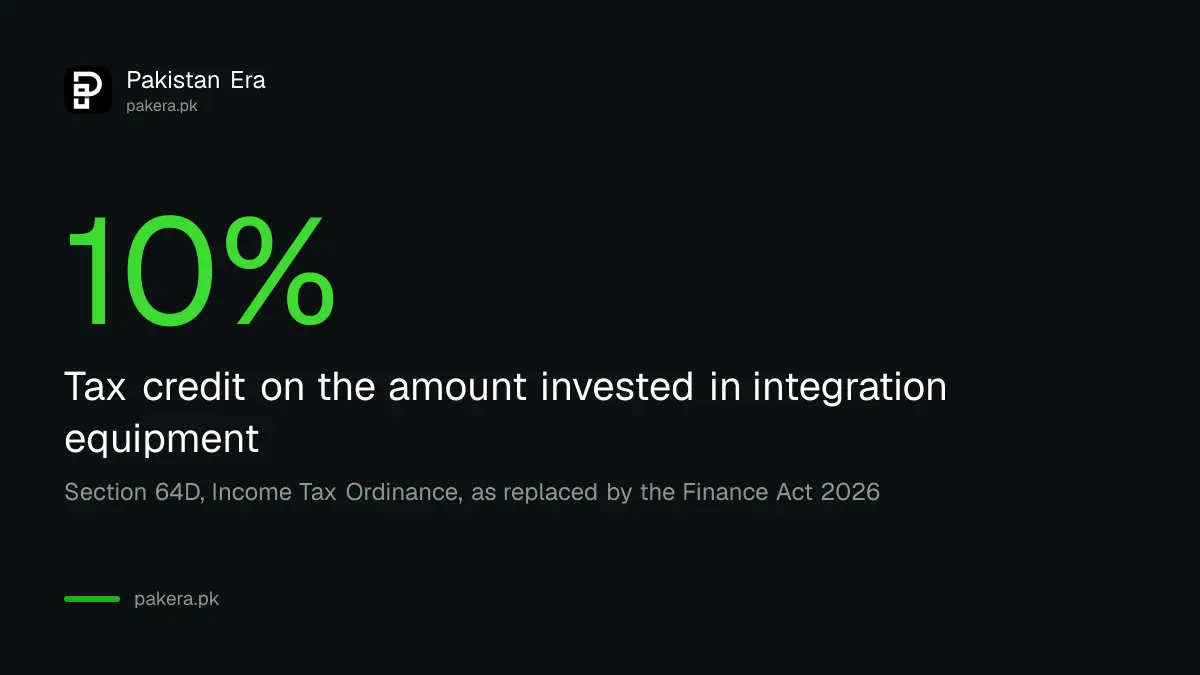
The Finance Act 2026 changed the credit to 10 per cent
Section 64D gives a tax credit to any person who must integrate with FBR's computerised system. The duty can arise under the Income Tax Ordinance, the Sales Tax Act, 1990 or the Federal Excise Act, 2005. The system is used for real-time production monitoring or for recording and reporting sales or receipts.
The Finance Act 2026 replaced the old section. The old credit covered only a point of sale machine, and it was the lower of the amount spent or Rs 150,000 per machine. The new section covers equipment, hardware, software and other electronic parts used directly and only for the integration. The credit is 10 per cent of the amount actually invested.
We found no rupee cap in the new text. The old Rs 150,000 limit is gone from the section, though FBR may set "limitations, conditions and restrictions" by rule. This draft is that rule.
| Point | Old section 64D | New section 64D |
|---|---|---|
| What is covered | Point of sale machine | Equipment, hardware, software and electronic parts used only for integration |
| Amount | Lower of cost or Rs 150,000 per machine | 10 per cent of the amount actually invested |
| Running costs | Not stated | Operation and maintenance not allowed |
| Set against | Not stated | Normal tax payable only |
As an example, if you invest Rs 400,000 in qualifying equipment and software, the credit would be Rs 40,000. That is our arithmetic on the 10 per cent rate, not an FBR example.
The draft is dated 6 October 2026 and objections are open
The notification is S.R.O. 1692(I)/2026, a draft under section 237 of the Ordinance. It would insert rule 33U in Chapter VIIA of the Income Tax Rules, 2002. FBR asks for objections and suggestions within seven days of publication in the official Gazette. We did not find the Gazette date.
The draft is not law until FBR notifies it. A business that has already bought equipment should keep every paper, because the final text may change.
The draft sets five conditions for a claim
Under draft rule 33U(1), you must meet all of these.
- You are required to integrate. The Income Tax Ordinance, the Sales Tax Act or the Federal Excise Act must require you to link with FBR's system.
- The equipment is installed and working in that tax year. It must be bought, installed, integrated and configured with FBR's system during the year.
- It is used directly and only for integration. A general-purpose computer does not qualify.
- FBR's system confirms it. There must be an integration, activation, commissioning or configuration record that names you, the equipment and the activation date.
- You can prove the cost. A tax invoice, bill, agreement, licence or other paper, plus proof of payment or the liability.
The word "directly and exclusively" is the one to watch. A machine that also runs your accounts or stock is the sort of item FBR may question.
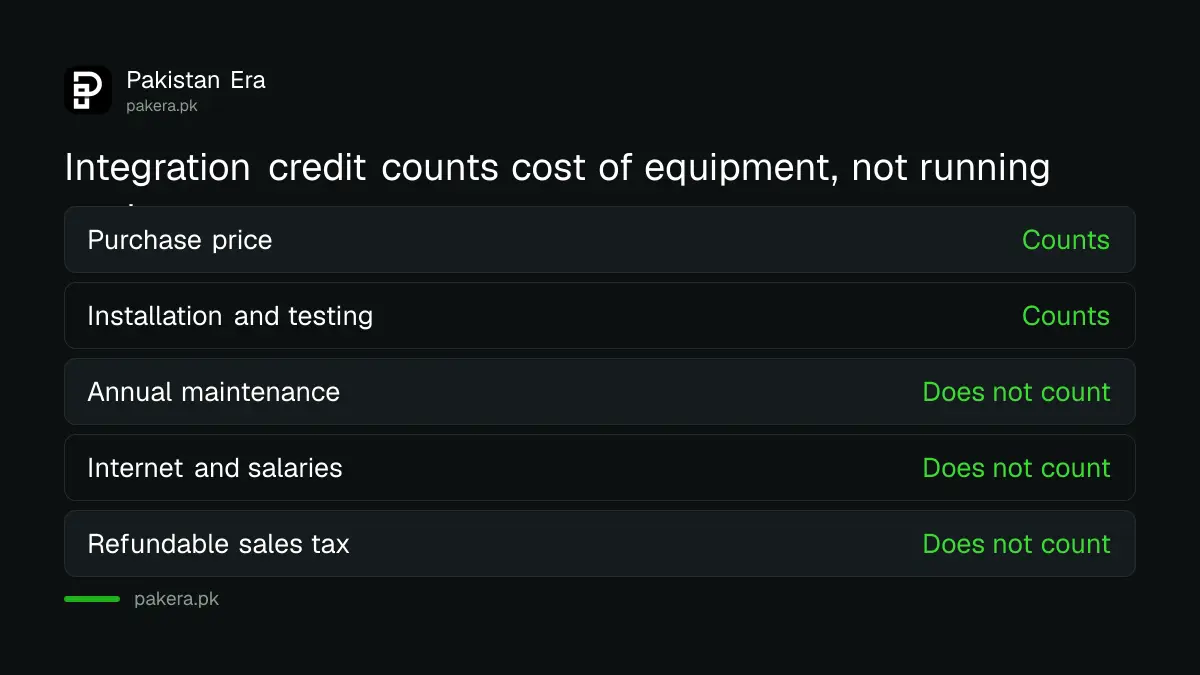
What counts as the amount invested and what does not
Draft sub-rules (2) and (3) set the cost. It includes the purchase price and one-time costs of installation, configuration, building the interface, integration, testing and implementation needed to start the equipment.
It is reduced by any discount, rebate, refund, grant or subsidy you receive or can receive. It does not include these:
- Tax or duty that you can get back, adjust or recover.
- Operation, routine maintenance, repair, annual maintenance, support after commissioning or recurring service charges.
- Internet, telecom or utility charges, salaries, training, consumables or financing costs.
- A general-purpose system or part not used exclusively for integration, except a separately identifiable part that is.
If your supplier charges sales tax that you can adjust, it is out. That is the point most likely to cut a claim, so ask the supplier to show it on the invoice.
You claim it in the return for the year of installation
Draft sub-rule (4) says the credit is claimed in the return for the tax year in which the equipment is installed, integrated and configured. The same spending cannot be claimed twice under section 64D.
Under sub-rule (5) you must give, in the return or a schedule on IRIS, a description of the equipment, supplier details, invoice or agreement reference, acquisition date, amount invested, the integration or resource identification number and the activation date. The Commissioner can verify the claim against the records you keep under section 174.
So the claim is in the return, and the proof is in the file. If you are a shopkeeper who joined FBR's simpler scheme, the Asan Tax rules in our report on the Asan Tax scheme for shopkeepers are separate and this draft does not mention them. For the wider rules on registering a business, see the documents FBR can ask for in the sales tax registration guide.
Common questions
Is the 10 per cent credit already law?
Yes, section 64D as replaced by the Finance Act 2026 says 10 per cent. The draft rule 33U, which sets the conditions, is not in force yet.
Does it cover only a POS machine?
No. The new section covers equipment, hardware, software and other electronic components used directly and only for integration. The old section covered only the machine.
Is there still a Rs 150,000 limit?
We found none in the new section. FBR may add limits by rule, and the draft does not state one.
Can I claim the maintenance cost?
No. The section and the draft both exclude operation and maintenance, support after commissioning and recurring service charges.
Which tax does the credit reduce?
Normal tax payable under the main rate tables of the First Schedule, Division I or II of Part I. It does not reduce other taxes.
When do I claim it?
In the return for the tax year when the equipment is installed, integrated and configured with FBR's system.
How we verified this
What we checked, where we read it, and what we could not confirm.
Last checked on 8 October 2026. We read the draft notification S.R.O. 1692(I)/2026, dated 6 October 2026, from FBR's SRO page, and section 64D of the Income Tax Ordinance, 2001, both the current text and the version it replaced, in FBR's consolidated copy amended up to 30 June 2026. We found no Gazette date for the draft. The Rs 40,000 example is our own arithmetic. Nothing here is tax advice.
About the author

Tax, Bills and Technology Writer
Ali Akhtar is a young and curious voice here at Pakistan Era. He is currently pursuing his A-Levels and has a growing interest in Pakistan’s changing industrial landscape and educational trends. Ali likes to write in a way that helps him explain and explore the world around him. His writing reflects the perspective of the new generation navigating the evolving trends of Pakistan where technology, youth innovation, and shifting opportunities are reshaping the country’s future.