World Bank Sees South Asia Growing 6.9%, but Pakistan Is Not in the Forecast
The World Bank forecasts 6.9% growth for South Asia in 2026, but Pakistan sits in another region and has no figure. Here is what the oil section says.
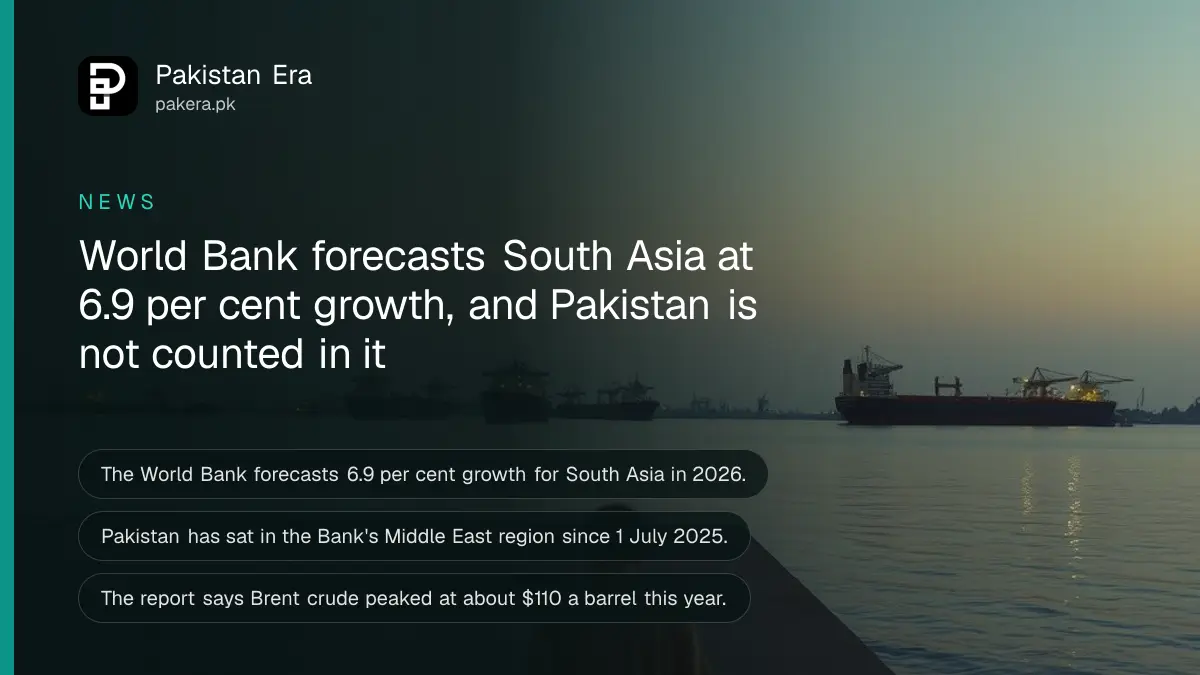
The World Bank said on 6 October 2026 that South Asia will grow 6.9 per cent this year, ahead of earlier forecasts. Pakistan is not in that number. The Bank moved Pakistan out of its South Asia region in July 2025, so the new report gives no growth forecast for it.
Update, 10 October 2026: The World Bank has now published its Pakistan forecast: 3.8% growth and 8.2% inflation in FY27. Read the update.
That detail is easy to miss, and it matters. Headlines about "South Asia" will read as good news for Pakistan. The report itself says otherwise: the region it measures has six economies, and Pakistan is not one of them.
We read the World Bank's press release, its summary and the full South Asia Economic Update for October 2026. Here is what it says, what it leaves out, and why the oil section still concerns Pakistan.
South Asia is forecast to grow 6.9 per cent in 2026
The report, titled Adopting AI for Growth, puts regional growth at 6.9 per cent in 2026, up from 6.8 per cent in 2025. It expects 6.7 per cent in 2027. The 2026 figure is 0.6 percentage points higher than the Bank's previous forecast.
The Bank gives a plain reason: strong domestic demand, helped by strong remittance inflows and recent reforms. It also warns that persistently high energy prices could push inflation up, that a severe El Niño could hurt crops, and that a sharp fall in global AI investment could cause financial strain.
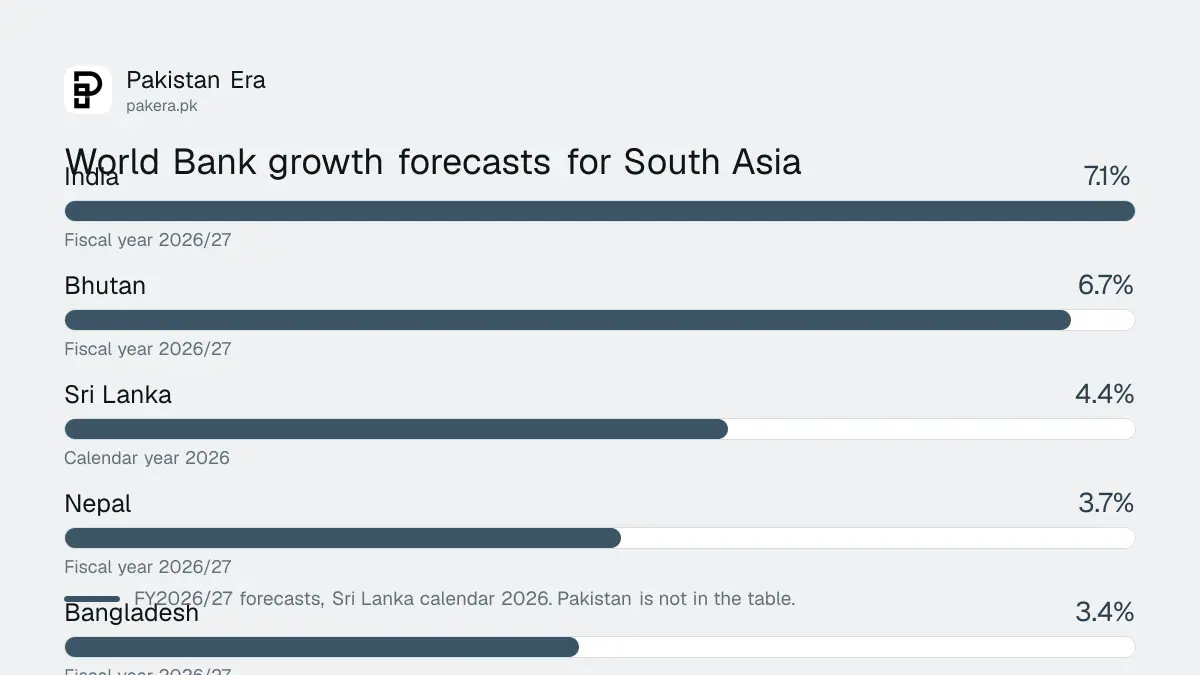
The regional average hides large gaps. India is forecast at 7.1 per cent in its 2026-27 fiscal year. Bangladesh is at 3.4 per cent. The Bank says the region without India would grow 3.6 per cent in 2026.
Pakistan is not in the forecast table
A note under the Bank's growth table explains it. As of 1 July 2025, Afghanistan and Pakistan are part of the Bank's Middle East and North Africa region, called MENAAP, and are no longer grouped with South Asia. The six economies in the table are Bangladesh, Bhutan, India, the Maldives, Nepal and Sri Lanka.
So you cannot read Pakistan's growth outlook from this report. We also opened the Bank's Pakistan overview page. The latest development update it links is from October 2025, and we did not find a newer Pakistan forecast there. The International Monetary Fund's latest World Economic Outlook edition was an update dated 8 July 2026, and its October edition had not appeared when we checked.
The oil section describes Pakistan's problem too
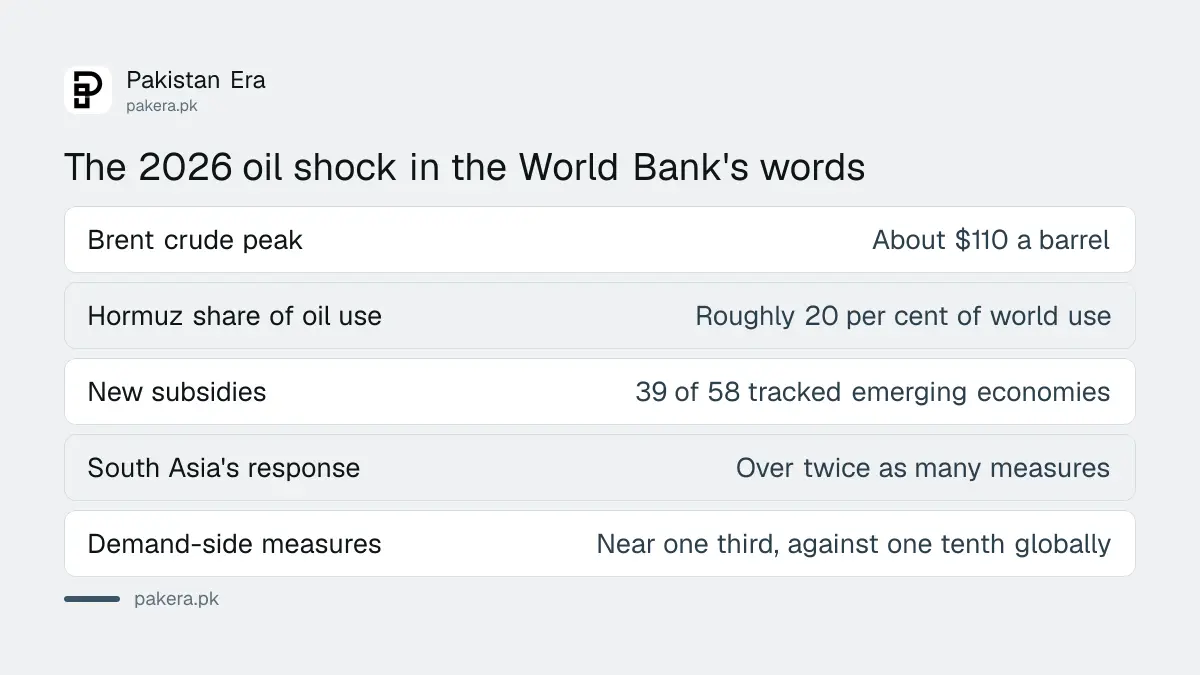
The report's energy chapter is about the region's biggest shock this year. Since the conflict in the Middle East, shipping through the Strait of Hormuz has been disrupted. The Bank says the strait carries roughly 20 per cent of global petroleum consumption and 20 per cent of global LNG trade.
Brent crude peaked at about $110 a barrel, it says. Diesel and jet fuel rose even more. Countries drew down oil stocks, and imports of solar panels surged. The Bank says South Asia is a major net oil importer, so its inflation rose by more than in other regions.
| Measure | What the World Bank reports |
|---|---|
| Brent crude peak | About $110 a barrel |
| Hormuz share of oil use | Roughly 20 per cent of global petroleum consumption |
| Subsidies in emerging economies | 39 of 58 tracked gave at least one new subsidy |
| South Asia's response | More than twice as many measures per economy as the rest of the world |
| Demand-side measures | Close to one third of South Asia's measures, about a tenth globally |
Demand-side measures are steps that cut fuel use directly: rationing, driving limits, work-from-home and shorter weeks. Pakistan has used some of these. Its cabinet's fuel-saving notification of 17 September 2026 kept shop closing times in place, and our guide to market closing times has the table.
Pakistan's own numbers show the same squeeze
We cannot compare Pakistan with the Bank's six economies, because the Bank does not publish a matching forecast. We can read Pakistan's own official data.
- The Pakistan Bureau of Statistics put consumer inflation at 10.3 per cent in September 2026, down from 11.1 per cent in August.
- The Oil and Gas Regulatory Authority's price sheet shows petrol at Rs 396.65 a litre and diesel at Rs 394.94 from 8 October.
- That sheet shows a seven-day average of Dubai crude at $107.29 a barrel.
The September inflation detail is in our September inflation report, and the fuel history is in the 7 October petrol price report. These are Pakistani figures. They are not part of the World Bank's forecast, so do not read them as one.
What is still unresolved
Three questions remain. First, what the Bank forecasts for Pakistan, which will come in a separate MENAAP or Pakistan publication. Second, whether the IMF's October outlook, still to come, gives its own Pakistan number. Third, whether oil falls back from its peak, which the Bank does not predict. Its report says only that persistently high prices are a risk.
Until then, treat "South Asia grows 6.9 per cent" as a statement about India, Bangladesh, Sri Lanka, Nepal, Bhutan and the Maldives. The remittance point does touch Pakistan, since money sent home by workers abroad is a large inflow for Pakistan as well, as our report on record remittances shows.
Common questions
Does the World Bank's South Asia forecast include Pakistan?
No. Since 1 July 2025 the Bank counts Pakistan and Afghanistan in its Middle East and North Africa region, so the 6.9 per cent figure covers six other economies.
What did the World Bank say about South Asia on 6 October 2026?
It forecast growth of 6.9 per cent in 2026 and 6.7 per cent in 2027, helped by strong domestic demand and remittances, with energy prices and El Niño as risks.
How high did oil prices go, according to the World Bank?
The report says Brent crude peaked at about $110 a barrel after shipping through the Strait of Hormuz was disrupted. It does not forecast a price for the coming months.
Where can I find the World Bank's Pakistan forecast?
On the Bank's Pakistan country pages and in its Pakistan Development Update. The latest one we found linked is from October 2025.
Has the IMF released its October outlook?
Not when we checked on 8 October. The IMF's latest World Economic Outlook edition was the update of 8 July 2026.
How we verified this
What we checked, where we read it, and what we could not confirm.
Last checked on 8 October 2026 at about 12:30am PKT. We read the World Bank press release of 6 October 2026, the South Asia Economic Update page and its executive summary, and the full report, including Table 1.1 and its note on Pakistan. We also opened the World Bank's Pakistan overview page and the IMF's World Economic Outlook page. For Pakistan we read the Pakistan Bureau of Statistics monthly review for September 2026 and the Oil and Gas Regulatory Authority price sheet effective 8 October 2026. The Bank's statements are its own findings and forecasts, not confirmed outcomes.
About the author

Global Affairs & Political Economy Writer
Muhammad Hatim is a book lover who started writing because he enjoys it. At Pakistan Era he writes about international relations, geopolitics and the global economy, with a particular interest in South Asia and the forces behind current events.