Avoid a PPSC Ban: 161 Violations Since 2018 and the 5 Mistakes Behind Them
PPSC lists 161 disqualified or debarred cases since 2018. See the five mistakes behind them, the penalties and the habits that keep your exam record clean.
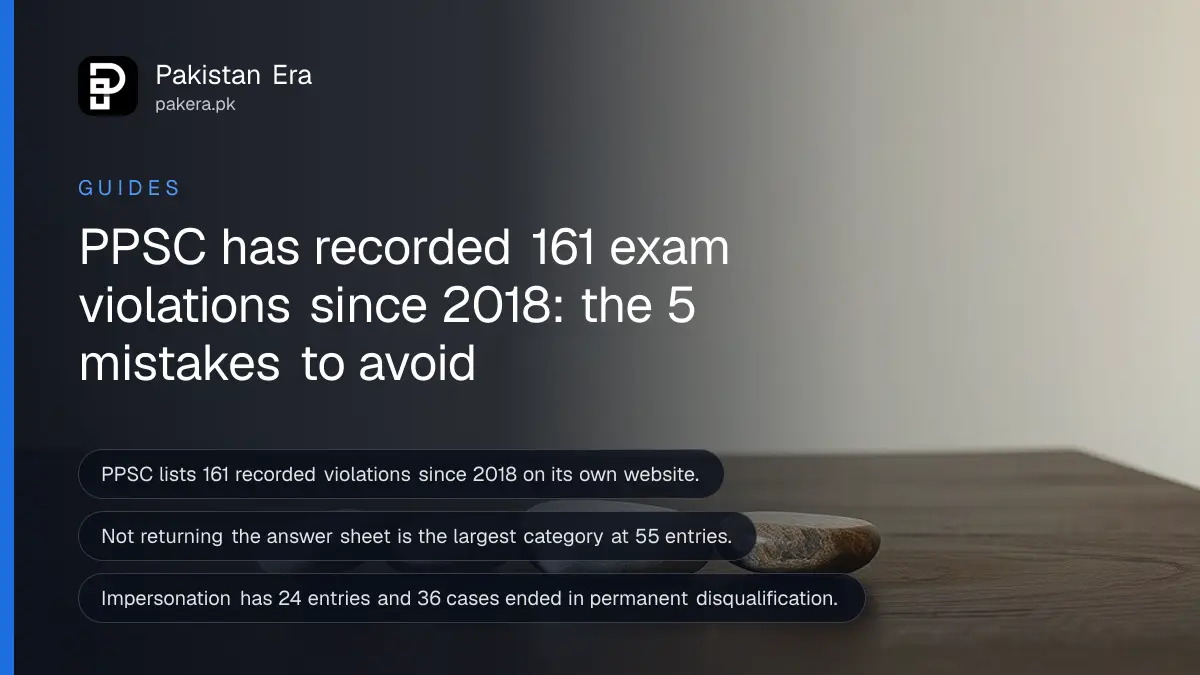
Short answer: PPSC lists 161 recorded violations since 2018 on its own page. The commonest mistake is not handing back the question paper and answer sheet (55 entries). Phones and smart watches come next (35 entries). Impersonation (24 entries) brings permanent disqualification. Follow the exam instructions and you stay off the list.
Most people think a ban comes from cheating. The Punjab Public Service Commission's own numbers show something plainer. A large share of the list is candidates who walked out with a paper, kept a phone in a pocket or ignored a written instruction.
We opened the Summary of Disqualified / Debarred Candidates page on the PPSC website on 11 October 2026 and read every table on it. This guide turns those tables into five things to avoid on exam day and in your application.
PPSC publishes every violation, and the total is 161 since 2018
The page is titled "Summary of Disqualified / Debarred Candidates (2018 and onward)". It shows a total of 161 violations. Of these, 2 cases ended in an FIR or dismissal from service, 121 in disqualification and 146 in cancellation of candidature.
The page opens with a warning that violations of examination rules are dealt with under a strict disqualification policy, leading to cancellation, debarment or legal action. It also lists recent cases with the post, the department, the violation, the action and the date.
Three recent entries are dated 22 September 2026. Two were candidates for the post of Sergeant (Lahore) in the Punjab Enforcement and Regulatory Authority. Both were recorded for impersonation and permanently disqualified. The third was a candidate for Audit Officer in the Punjab Revenue Authority, recorded for not returning the question paper or answer sheet, and the candidature was cancelled. We have left the names out.
Five mistakes make up the whole list
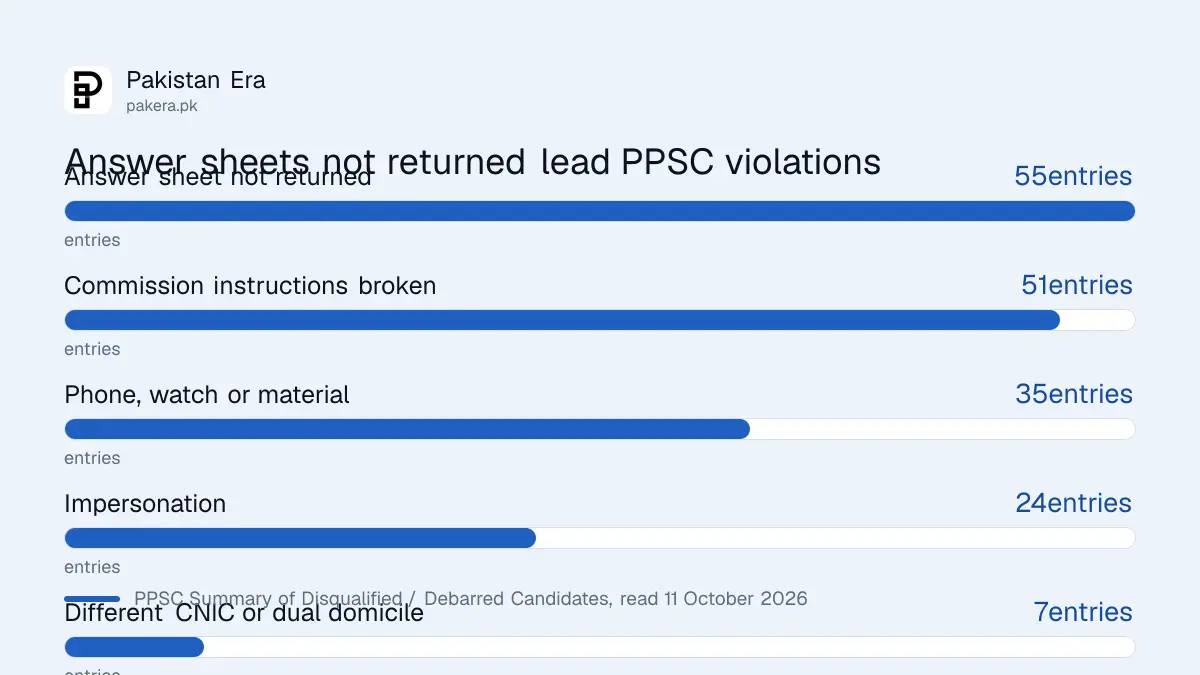
PPSC groups every violation into five categories. Not returning the question paper or answer sheet leads with 55 entries. Violating the Commission's instructions has 51. Phones, smart watches or exam related material have 35. Impersonation has 24 and a different CNIC or dual domicile has 7.
| Violation category | Current year | Total since 2018 | Share on the page |
|---|---|---|---|
| Did not return question paper or answer sheet | 4 | 55 | 31.98% |
| Violation of the Commission's instructions | 10 | 51 | 29.65% |
| Mobile phone, smart watch or exam related material | 3 | 35 | 20.35% |
| Impersonation | 4 | 24 | 13.95% |
| Different CNIC number or dual domicile | 0 | 7 | 4.07% |
The five totals add up to 172, not 161. So one candidate can appear under more than one category. The percentages in this table are shares of 172 entries.
The current year column is already 21 entries
The current year column adds up to 21 in the category table and 21 in the action table. Violating the Commission's instructions has the highest current year count at 10. That is a reminder that written instructions on the roll number slip and in the hall are rules, not advice.
The page does not say which year "current year" means. Its newest entries are dated September 2026, so we read it as 2026. Treat that reading as ours.
Cancellation is the usual action, but permanent bans are not rare
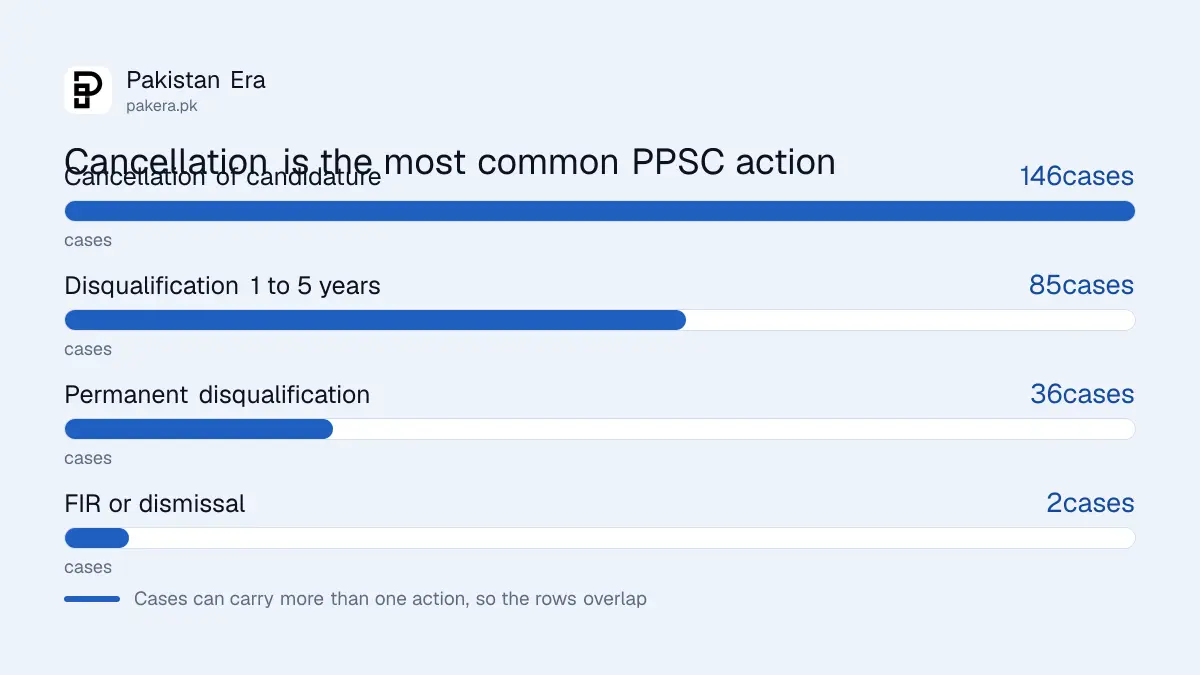
Cancellation of candidature is the most common action at 146 cases, which is 90.68% of the 161. Disqualification for a fixed period of 1 to 5 years has 85 cases. Permanent disqualification has 36. FIR or dismissal from service has 2.
| Action taken | Current year | Total since 2018 | Share of 161 |
|---|---|---|---|
| Cancellation of candidature | 12 | 146 | 90.68% |
| Disqualification for 1 to 5 years | 3 | 85 | 52.80% |
| Permanent disqualification | 6 | 36 | 22.36% |
| FIR or dismissal from service | 0 | 2 | 1.24% |
The shares add up to more than 100%, so one case can carry more than one action. Disqualification in total is 121 cases, which is 85 fixed period plus 36 permanent. The page does not map each category to a specific action, so we cannot tell you that one mistake always brings one penalty.
Follow five habits on exam day to stay off the list
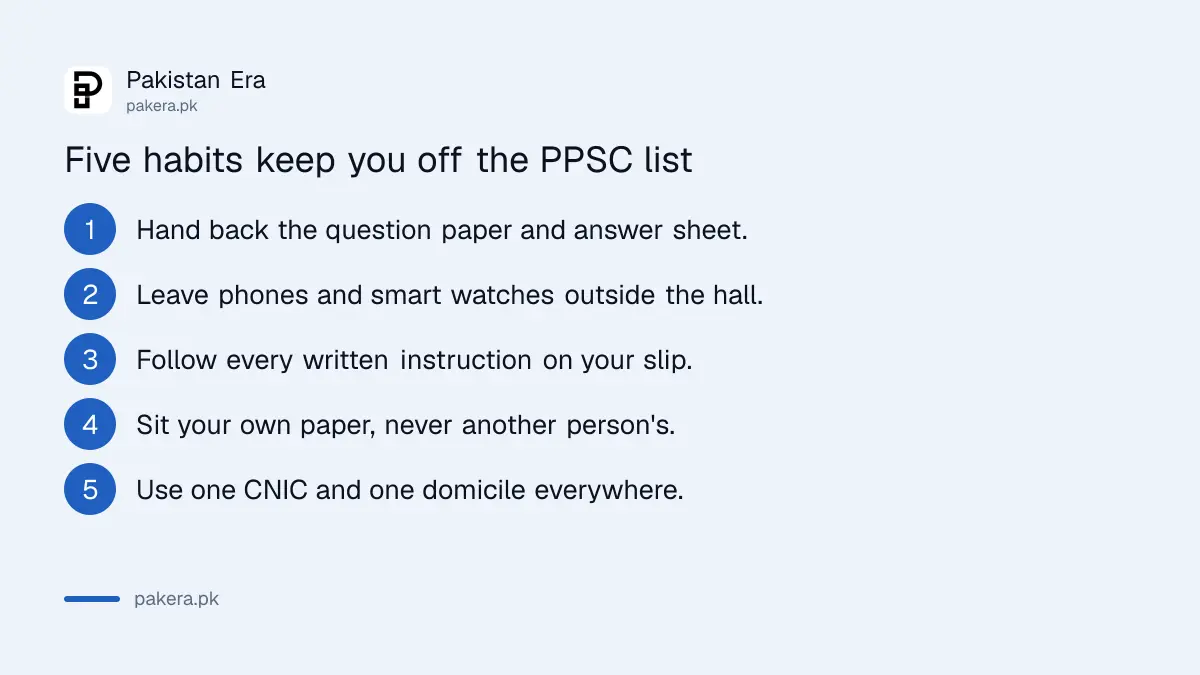
Each habit answers one category on the page. Hand back everything you are given. Leave phones and watches out of the hall. Follow the written instructions. Sit your own paper. Use one CNIC and one domicile on every application.
- Hand the question paper and the answer sheet to the invigilator before you stand up. This is the largest category on the page, at 55 entries, and it is the easiest to avoid.
- Leave your phone, smart watch and any notes at home or in the place the centre staff show you. The page counts a phone, a smart watch and "exam related material" in one category.
- Read the instructions on your roll number slip and listen to the hall staff. The "Commission's instructions" category is the second largest with 51 entries.
- Never send someone else to sit your paper and never sit another person's paper. The page lists impersonation at 24 entries, and both impersonation entries dated 22 September 2026 ended in permanent disqualification.
- Use the same CNIC and the same domicile on every application. Dual domicile and a different CNIC number are a separate category with 7 entries.
Check the official page, not a forwarded message
The list lives only on the PPSC website. PPSC's own disclaimer says its official website is the sole authoritative source and that candidates are responsible for checking it regularly. Messages and screenshots that arrive by chat are not a substitute.
Before you pay a fee or share a CNIC, make sure the address in your browser is the real one. The steps are in the real PPSC website check. For the exam itself, your roll number slip comes from the process in applying and downloading the slip.
If you have a genuine reason to be elsewhere on test day, there is a route. PPSC's policy accepts a centre change request within seven days on listed grounds. That is better than turning up late or not at all.
Common questions
How many candidates has PPSC disqualified since 2018?
PPSC's page shows 161 violations in total, with 121 cases of disqualification and 146 of cancellation of candidature. The two numbers overlap, because one case can carry more than one action. The list is for 2018 and onward.
What is the most common violation on the PPSC list?
Not returning the question paper or answer sheet is the largest category, with 55 entries. Violating the Commission's instructions follows with 51, and carrying a phone, smart watch or exam related material has 35.
Does carrying a smart watch count as a violation?
Yes, according to the category name on the page: "caught with mobile phone / smart watch / exam-related material". It has 35 entries in total and 3 in the current year column.
Is a PPSC disqualification always permanent?
No. The page lists 85 cases of disqualification for a specific period of 1 to 5 years and 36 of permanent disqualification. The page does not say which violation gets which length.
Can I appeal if I am on the PPSC list?
The page does not describe an appeal process, and we did not find one on it. If this affects you, write to PPSC through the contact details on its official website and keep a copy of what you send.
Where is the official list?
It is on the PPSC website under Publications, as "Summary of Disqualified / Debarred Candidates". The direct page is ppsc.gop.pk/PressRelease.aspx.
How we verified this
What we checked, where we read it, and what we could not confirm.
We read the PPSC page Summary of Disqualified / Debarred Candidates on 11 October 2026, including the recent violations list, the category breakdown, the action breakdown and the disclaimer. We did not contact PPSC. The numbers can change when PPSC adds entries.
About the author

Public Services and Education Journalist
Fajr Riaz is a journalist and content writer at Pakistan Era, based in Lahore. She covers the questions people meet in everyday life in Pakistan: how a public service works, what a change in the rules means, and where to find a reliable answer.