PTA Proposes 90-Day Limit on Foreign SIMs and Travel eSIMs in Pakistan
PTA's draft roaming rules of 9 October 2026 would flag foreign SIMs used 90 days in 180 and need passport checks. See who is hit and comment by 10 November.
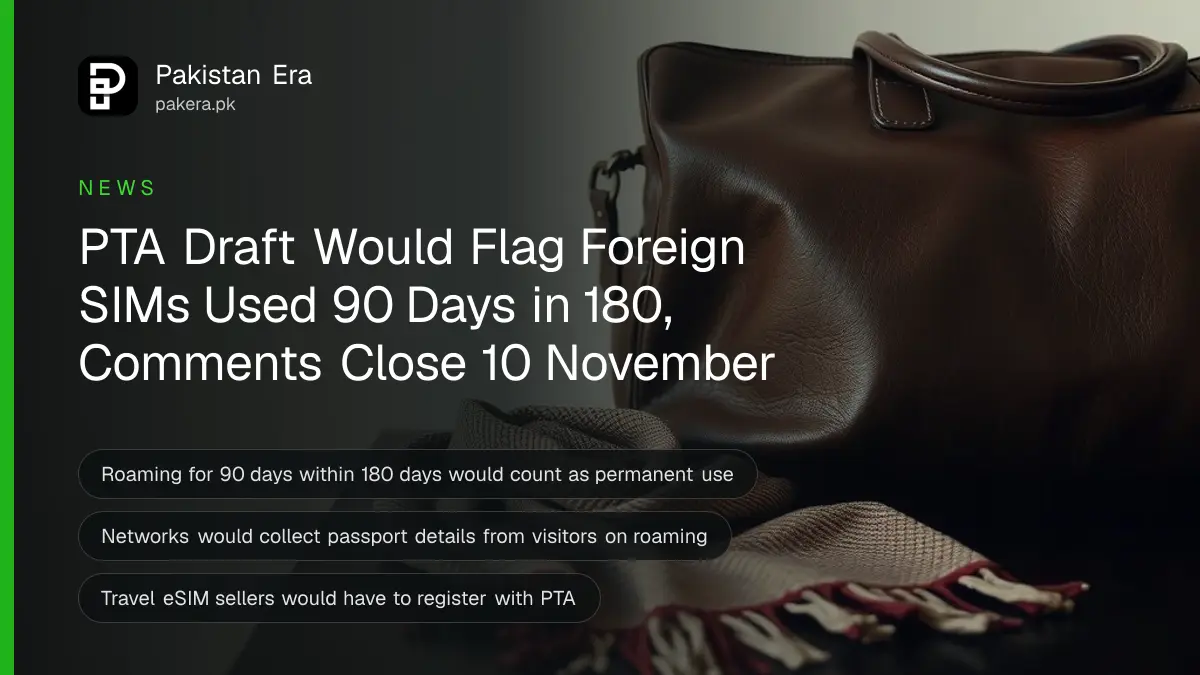
The Pakistan Telecommunication Authority (PTA) published draft rules on 9 October 2026 that would treat any foreign SIM or travel eSIM used in Pakistan for 90 days within 180 days as "permanent roaming", which networks could then suspend. The draft also asks for passport details from every visitor on roaming and makes travel eSIM sellers register with PTA. Anyone can send comments until 10 November 2026.
Today a UK, Gulf or US SIM works in Pakistan on roaming for as long as its owner keeps paying the home network. Nobody in Pakistan checks who is using it. A local SIM, by contrast, needs a fingerprint check against NADRA and expires after 180 days without use. PTA says that gap is now being used for fraud, and the draft "International Roaming (Inbound) Regulations, 2026" is its answer.
We read the full 15-page consultation paper and draft on PTA's consultation page on 10 October 2026. Here is what it proposes, who it would affect, and what is still only a proposal.
PTA's draft would flag foreign SIMs used for 90 days in Pakistan
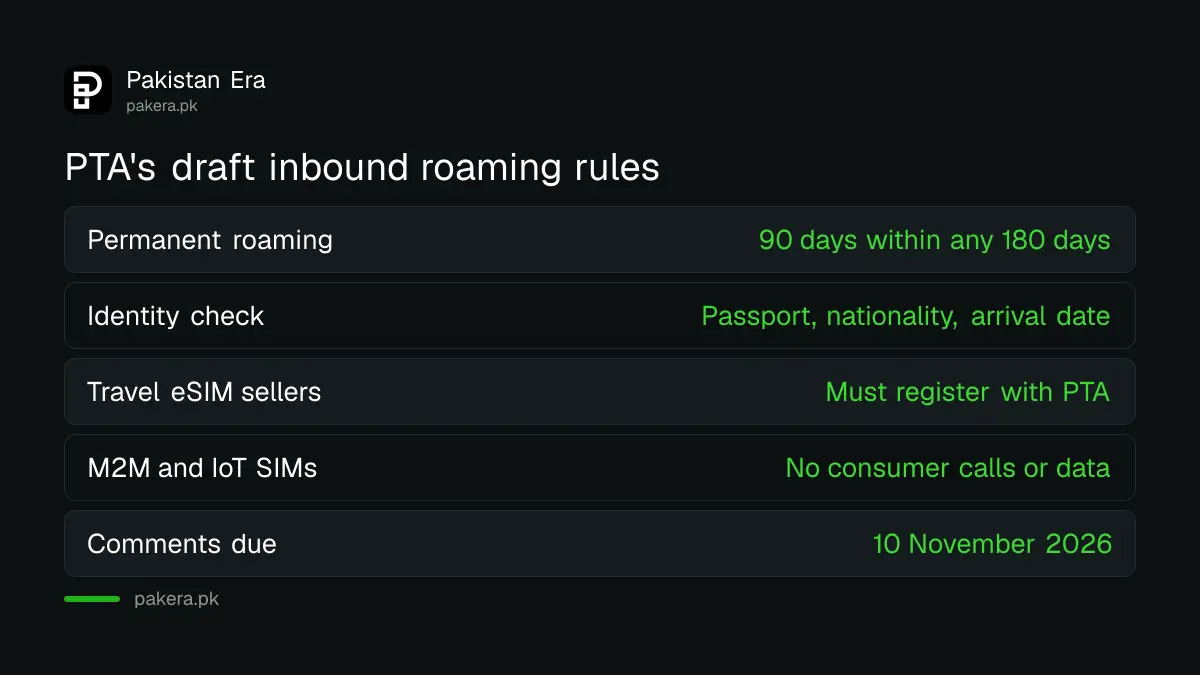
The draft defines "permanent roaming" as 90 days or more of roaming use, added up, within any 180 days. It counts by SIM number and also by phone, using the IMEI, so swapping eSIM profiles on one handset would not reset the clock. Pakistani networks would have to watch for this automatically.
When a network spots a SIM over the limit, it must ask the foreign home network to confirm the user is a genuine traveller. The home network gets 7 days, or 72 hours if fraud is suspected. If no good answer comes back, the Pakistani network may suspend roaming on that SIM and report it to PTA.
PTA's paper explains the reason plainly. A local SIM expires after 180 days of inactivity, but roaming "may be used in Pakistan without any time limit". PTA also says foreign SIMs can be used with phones that were never registered or taxed through DIRBS, PTA's device registration system, so some users are shifting to them for good.
The draft lets PTA exempt some groups from the 90-day rule. It names diplomats, staff of international organisations, airline and ship crews, genuine business users and technical testing staff.
Visitors on roaming would give passport details for a KYC check
Mobile networks would have to collect basic identity details from every inbound roamer. KYC means "know your customer", the identity check banks and networks run. The minimum list is the passport or travel document number and nationality, the SIM's numbers, the arrival date and expected stay, and the home network.
The draft does not fix one method. It lists options: a check when roaming starts, a link sent in a welcome SMS, a PTA-approved web portal, a link with the FIA's arrival records at airports and borders, or collection by registered eSIM sellers. For data-only eSIMs, where an SMS link may not work, PTA says it would set another method.
Networks would keep these records for at least 12 months after the roamer leaves. The draft says the data must be kept confidential and handled under Pakistan's data protection law.
Travel eSIM sellers would need to register with PTA
The consultation paper names seven travel eSIM apps that, in PTA's words, can be "downloaded and activated for use in Pakistan without any KYC": Airalo, Holafly, Nomad, Saily, Ubigi, GigSky and Eskimo. It also names four wholesale providers behind such services.
Under the draft, no one could run a travel SIM or eSIM business in Pakistan without registering with PTA first. A registered seller would pay a yearly fee and a security deposit, both still to be set, name a local contact person, and share activation and KYC data with PTA through a portal or API.
The draft is silent on what happens to an unregistered app that keeps selling. It gives PTA a general power to order blocking where roaming is "provided or availed in contravention" of the rules.
The draft also covers SIM boxes, IoT SIMs and Wi-Fi calling
Several other parts target misuse rather than ordinary travellers. The draft lists what PTA would treat as abuse:
- Using roaming SIMs in a SIM box to bypass international call charges.
- Bulk selling of roaming SIMs to people who are not travelling.
- Reselling roaming data, including through a hotspot business.
- Machine SIMs, called M2M or IoT SIMs, used for normal calls and data.
Networks would also need PTA's approval before offering Wi-Fi calling to foreign roamers, and that traffic would pass through Pakistani licensed networks. PTA would keep a central list of blocked roamers so a blocked SIM could not simply move to another Pakistani network.
| Who | What the draft would mean |
|---|---|
| Tourist or family visitor for 2 to 8 weeks | Roaming continues; passport details may be asked |
| Overseas Pakistani staying over 90 days in 180 | Roaming may be flagged and suspended after checks |
| Diplomats, crews, business and test users | May be exempted from the 90-day limit |
| Travel eSIM sellers | Must register, pay a fee and share KYC data |
| Pakistanis roaming abroad on a local SIM | Not covered, the draft is inbound only |
If you are a Pakistani travelling out on Jazz, Zong or Ufone, nothing here applies to you. The steps for that are in turning on international roaming before you fly.
The draft is not law yet, and comments close on 10 November
This is a consultation draft. It takes effect only after PTA finalises it and publishes it in the Gazette of Pakistan, and no date has been set. After notification, networks would get 180 days to bring their roaming systems in line with GSMA and ITU standards.
Until then nothing changes. A visitor's foreign SIM keeps working as before. A phone used with a Pakistani SIM still needs DIRBS registration, and visitors can use PTA's free 120-day phone registration for that.
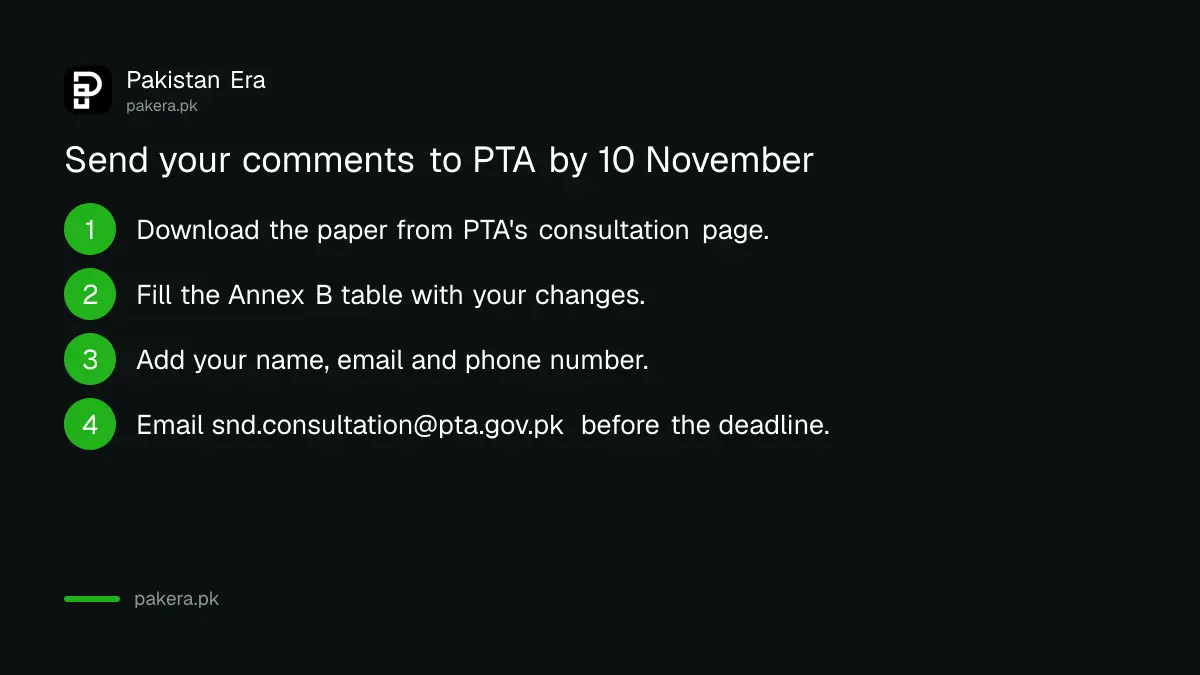
PTA asks for written comments within 30 days of the paper, which its page sets as 10 November 2026. Anyone can send them: travellers, overseas Pakistanis, businesses and operators.
- Download the consultation paper from PTA's Consultation Papers page.
- Fill the comment table in Annex B: the regulation number, your comment or change, and your reason.
- Add your name, contact person, email, phone number and the date at the top.
- Email it to snd.consultation@pta.gov.pk before 10 November 2026.
- Or post it to the Director General (Strategy and Development), PTA Headquarters, F-5/1, Islamabad.
A practical point worth raising is how overseas Pakistanis on long family visits, often three or four months, would prove they are genuine travellers. The draft leaves that to the foreign home network, which may not answer quickly.
Common questions
Will my foreign SIM stop working in Pakistan now?
No. These are draft rules open for comment until 10 November 2026. Nothing changes until PTA finalises them and publishes them in the Gazette.
How long could I use a foreign SIM in Pakistan under the draft?
Up to 90 days, added up, in any 180 days. Beyond that, the network asks your home network to confirm you are a traveller and may suspend roaming if it does not.
Would travel eSIMs like Airalo be banned?
The draft does not ban them. It says sellers must register with PTA, pay a fee and share KYC data. Unregistered services could face blocking orders.
Do I still need to register my foreign phone with PTA?
Yes, if you use it with a Pakistani SIM. Visitors can register one phone free for 120 days from arrival through DIRBS.
Who can send comments to PTA?
Anyone. PTA invites all stakeholders to email snd.consultation@pta.gov.pk or post comments in the Annex B format by 10 November 2026.
How we verified this
What we checked, where we read it, and what we could not confirm.
We checked on 10 October 2026. Every rule above, including the 90-in-180-day test, the 7-day and 72-hour deadlines, the KYC fields, the aggregator registration, the M2M and Wi-Fi calling rules, the 180-day alignment period, the exemptions and the Annex B format, is from PTA's "Consultation Paper: Draft International Roaming (Inbound) Regulations, 2026", uploaded on 9 October 2026 to the PTA Consultation Papers page, which lists the 10 November 2026 deadline. The paper gives the phone number 051-9881527 for queries. The fees for eSIM seller registration are not set in the draft.
About the author

Technology Journalist & Multimedia Producer
Ahmad Ali is a technology journalist and multimedia producer at Pakistan Era, joining the team in October 2026. He covers consumer technology and digital life for Pakistani readers, combining research with hands-on product testing.