Punjab Air Quality at 11 pm on 22 October 2026: Lahore 318, Nankana Sahib 500
Punjab AQI at 11 pm on 22 October 2026: Lahore 318, Gujranwala 344, Nankana Sahib 500. See the 31 city ranking, Lahore stations and the helpline 1373 advice.
Punjab's air quality was in the Very Unhealthy band late on 22 October 2026: Lahore stood at an AQI of 318 at 11 pm, Gujranwala at 344 and Nankana Sahib at 500, the top of the scale. Thirteen of the 31 cities on the Punjab government's dashboard were above 200, which is the Unhealthy band or worse.
We read the Punjab Environmental Protection Agency's live air quality dashboard around midnight, when it showed its 11 pm update for 22 October. AQI means air quality index, a single number that sums up how dirty the air is. Higher is worse. The dashboard caps its scale at 500.
Lahore reached 318 at 11 pm, up from 289 at the same hour a day earlier
The dashboard averages 11 stations to give one Lahore figure. At 11 pm on 22 October that figure was 318, in the Very Unhealthy band. The same hour on 21 October read 289, so Lahore's night air was worse by 29 points.
The weather panel showed 25 degrees Celsius, 83 per cent humidity and a wind of 0.3 metres per second from the south. That is almost still air, which lets smoke and dust stay close to the ground. This reading is general science, not a statement from the Punjab EPA. Our earlier page on Lahore's 149 at 1 pm on 20 October shows how far the same city can swing between a hazy afternoon and a still night.
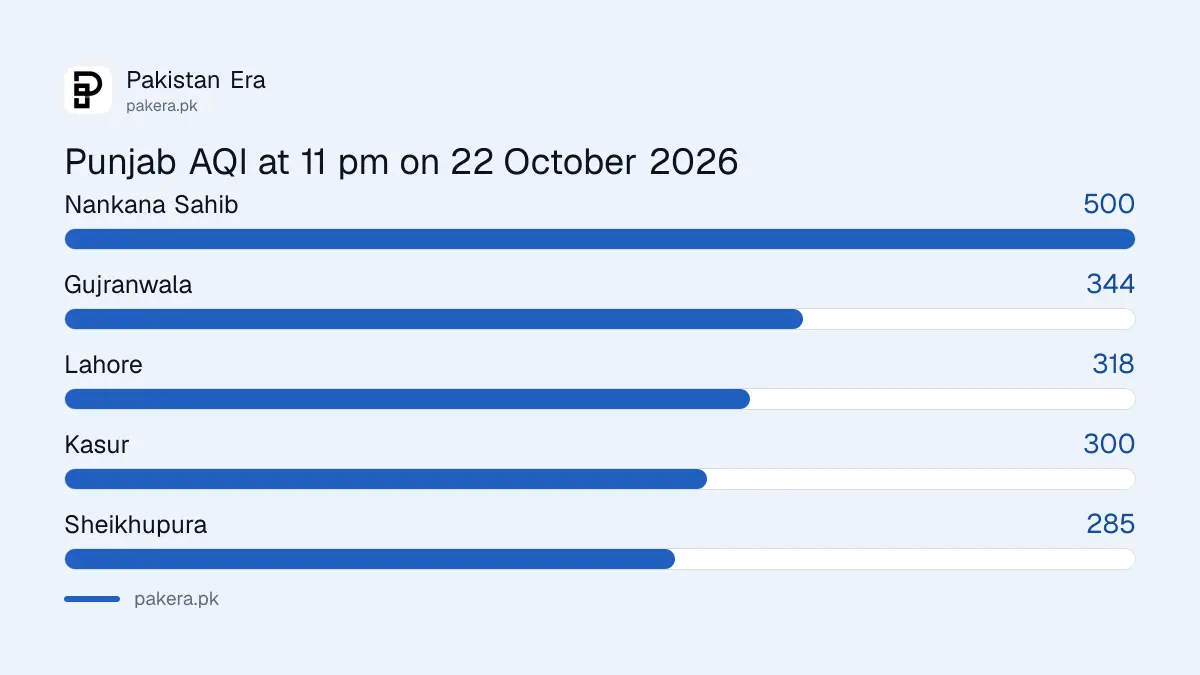
Nankana Sahib hit the 500 ceiling and three cities were above 300
Nankana Sahib read 500, Gujranwala 344 and Lahore 318. Kasur sat exactly on 300, the top of the Unhealthy band. Sheikhupura followed at 285, then Sahiwal at 277, Okara at 267 and Faisalabad at 257.
| Rank | City | AQI at 11 pm | Band on the dashboard |
|---|---|---|---|
| 1 | Nankana Sahib | 500 | Hazardous |
| 2 | Gujranwala | 344 | Very Unhealthy |
| 3 | Lahore (11 stations) | 318 | Very Unhealthy |
| 4 | Kasur | 300 | Unhealthy |
| 5 | Sheikhupura | 285 | Unhealthy |
| 6 | Sahiwal | 277 | Unhealthy |
| 8 | Faisalabad | 257 | Unhealthy |
| 11 | Multan | 222 | Unhealthy |
| 26 | Rawalpindi | 147 | Moderate |
| 31 | Wazirabad | 87 | Satisfactory |
The cleanest city on the list was Wazirabad at 87. Murree read 118 and Rajanpur 124. The dashboard's note on connectivity trouble names no stations in its text, so we cannot say which readings, if any, were affected.
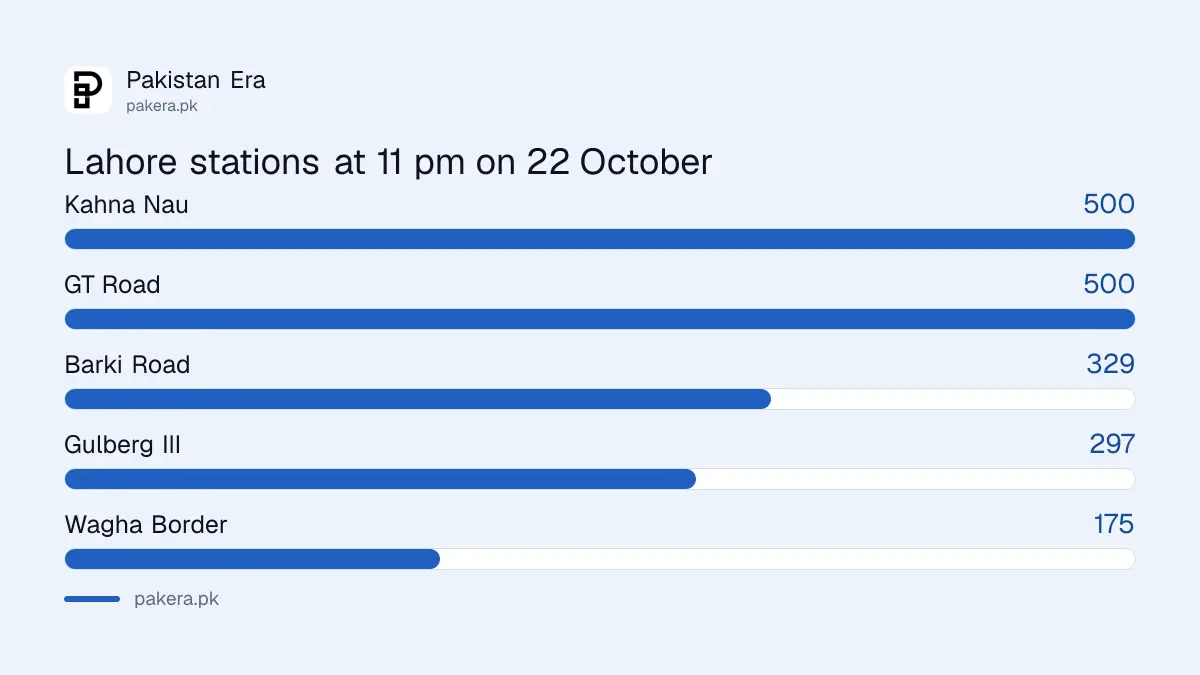
Three Lahore stations read 500 while Wagha Border read 175
Kahna Nau, Multan Road and GT Road each showed 500 in Lahore, all marked Hazardous. Barki Road read 329. Gulberg III showed 297 and DHA Phase 6 292. Wagha Border was the lowest of the 11 at 175.
The city figure of 318 is an average, so a street near one of the 500 stations can be much worse than the number suggests. The PM2.5 values at those three stations were 295.0, 287.1 and 297.2 on the dashboard, which does not print the unit. PM2.5 means particles smaller than 2.5 microns, small enough to reach deep into the lungs.
The dashboard's advice is to limit outdoor activity and use N95 masks for vulnerable groups
The dashboard tells the general public to limit outdoor activity on poor air days and use indoor exercise instead. For vulnerable groups it says to stay indoors, use an N95 mask and protective glasses if going out, and check AQI and health vitals regularly.
It adds that people with COPD or heart and blood vessel disease should ask a doctor which mask suits them. We are not doctors and this page is not medical advice. If a child, an older relative or someone with asthma has chest tightness, wheezing or breathlessness, call a doctor or go to a hospital. Our pages on wearing an N95 or KN95 mask in smog and on protecting pregnant women and heart and asthma patients set out the National Institute of Health advice.
- Check your own city on the dashboard before you leave, not only Lahore.
- Close windows facing the road in the evening and night hours.
- Keep children, older people and anyone with lung disease indoors if the figure is above 200.
- Wear a well fitted N95 if you must go out, as the dashboard advises vulnerable groups.
- Call a doctor early if breathing gets harder. Do not wait for morning.
The Punjab EPA helpline is 1373 for air quality questions and reports
The dashboard footer gives the Environmental Protection Agency's helpline as 1373 and the email address info@punepepa.gov.pk. The agency's winter plan covers burning and industry rules, which we explain in the 32 actions in the pre-smog plan.
This is a single reading, not a forecast. The dashboard also has a forecast tab based on PM2.5 and a seven day history, but those panels load by script and we did not read their numbers. Readings change every hour.
Common questions
What was the AQI in Lahore at 11 pm on 22 October 2026?
The Punjab dashboard showed 318 for Lahore, the average of 11 stations, in the Very Unhealthy band. The same hour on 21 October read 289.
Which Punjab city had the worst air that night?
Nankana Sahib, at 500, the highest value on the dashboard's scale. Gujranwala was second at 344.
What does an AQI of 318 mean?
The dashboard calls 301 to 400 Very Unhealthy. Unhealthy is 201 to 300 and Hazardous is 401 to 500.
Is the air better in the daytime?
Often, but not always. On 20 October Lahore fell from 207 at 5 am to 149 at 1 pm. We have no daytime reading for 22 October.
Who should stay indoors?
The dashboard says vulnerable groups should stay indoors. Ask your doctor if you have a lung or heart condition.
Where can I report smoke or burning?
Call the Punjab EPA helpline 1373, which the dashboard lists.
How we verified this
What we checked, where we read it, and what we could not confirm.
Last checked around midnight at the end of 22 October 2026. We read the Punjab EPA air quality dashboard at aqi.punjab.gov.pk, which showed its 11 pm update for 22 October: city ranking, Lahore station table, weather panel, health advice and helpline. We counted cities above 200 ourselves. We did not read the forecast or history panels, and we could not verify which stations the connectivity notice refers to. Readings change hourly, so check the dashboard itself.
About the author

Public Services and Education Journalist
Fajr Riaz is a journalist and content writer at Pakistan Era, based in Lahore. She covers the questions people meet in everyday life in Pakistan: how a public service works, what a change in the rules means, and where to find a reliable answer.