Punjab AQI Today, 4 November 2026: Lahore 378, Nankana Sahib 500 (All 31 Cities)
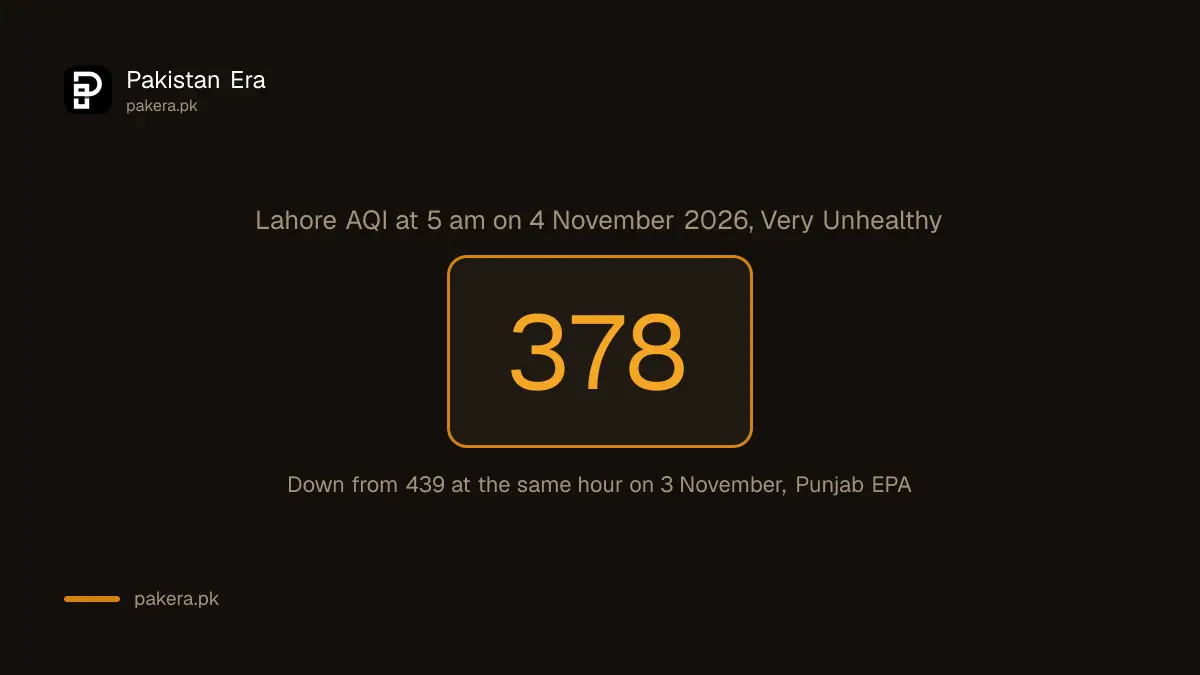
Punjab EPA put Lahore's AQI at 378 at 5 am on 4 November 2026, with Nankana Sahib at 500. See all 31 cities, Lahore's 11 stations and the official advice.
Short answer: Punjab's air was very poor at 5 am on Wednesday, 4 November 2026. The Punjab Environment Protection Agency (EPA) dashboard put Lahore at an AQI of 378, which it labels Very Unhealthy. Nankana Sahib was the worst city at 500, the top of the scale. Five cities were in the Hazardous band and not one of the 31 cities listed was below 101.
We read the official dashboard at aqi.punjab.gov.pk just before 6 am. It said "Last updated: 5:00 AM, Nov 4". Lahore was slightly better than the same hour a day earlier, when it read 439. But the wind was almost still, at 0.3 metres a second, and humidity was 86 per cent. Those are the conditions that keep smoke and dust close to the ground.
Nankana Sahib, Kot Addu and Vehari led Punjab's AQI ranking
Nankana Sahib read 500, Kot Addu 443 and Vehari 429 at 5 am on 4 November. Kasur (424) and Rajanpur (403) were also in the Hazardous band. Lahore was eighth of 31 cities at 378, behind Pakpattan and Multan.
The table below gives every city the dashboard listed, in its own order. AQI stands for Air Quality Index. It turns the level of fine dust and gases into one number from 0 to 500. A higher number means dirtier air.
| Rank | City | AQI at 5 am | Punjab EPA band |
|---|---|---|---|
| 1 | Nankana Sahib | 500 | Hazardous |
| 2 | Kot Addu | 443 | Hazardous |
| 3 | Vehari | 429 | Hazardous |
| 4 | Kasur | 424 | Hazardous |
| 5 | Rajanpur | 403 | Hazardous |
| 6 | Pakpattan | 394 | Very Unhealthy |
| 7 | Multan | 387 | Very Unhealthy |
| 8 | Lahore | 378 | Very Unhealthy |
| 9 | Jhang | 371 | Very Unhealthy |
| 10 | Sahiwal | 318 | Very Unhealthy |
| 11 | Khanewal | 295 | Unhealthy |
| 12 | Sheikhupura | 292 | Unhealthy |
| 13 | Hafizabad | 265 | Unhealthy |
| 14 | Faisalabad | 261 | Unhealthy |
| 15 | Okara | 237 | Unhealthy |
| 16 | Gujranwala | 236 | Unhealthy |
| 17 | DG Khan | 235 | Unhealthy |
| 18 | Bhakkar | 234 | Unhealthy |
| 19 | Narowal | 233 | Unhealthy |
| 20 | Bahawalpur | 220 | Unhealthy |
| 21 | Khushab | 216 | Unhealthy |
| 22 | Sialkot | 183 | Unhealthy for sensitive groups |
| 23 | Mandi Bahauddin | 176 | Unhealthy for sensitive groups |
| 24 | Mianwali | 172 | Unhealthy for sensitive groups |
| 25 | Attock | 166 | Unhealthy for sensitive groups |
| 26 | Sargodha | 163 | Unhealthy for sensitive groups |
| 27 | Wazirabad | 150 | Moderate |
| 28 | Jhelum | 149 | Moderate |
| 29 | Rawalpindi | 142 | Moderate |
| 30 | Murree | 115 | Moderate |
| 31 | Talagang | 113 | Moderate |
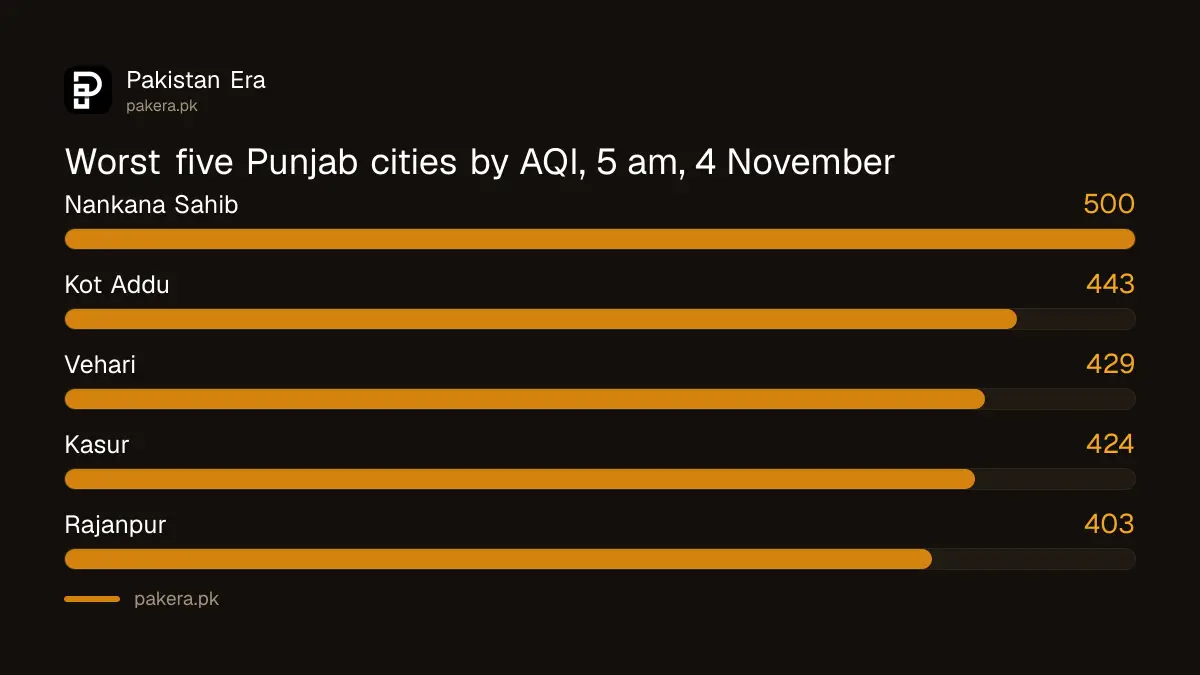
The south and centre of the province were worst. The north was cleaner. Rawalpindi, Murree, Jhelum and Talagang were all in the Moderate band, which is still above the Satisfactory range.
Ten of 31 cities were Very Unhealthy or worse
Five cities were Hazardous and five were Very Unhealthy at 5 am. Eleven more were Unhealthy. So 21 of the 31 cities listed were above 200, the level where Punjab EPA's scale says the air is unhealthy for everyone, not only sensitive people.
| Band | AQI range | Cities on 4 November, 5 am |
|---|---|---|
| Hazardous | 401 to 500 | 5 |
| Very Unhealthy | 301 to 400 | 5 |
| Unhealthy | 201 to 300 | 11 |
| Unhealthy for sensitive groups | 151 to 200 | 5 |
| Moderate | 101 to 150 | 5 |
| Satisfactory or Good | 0 to 100 | 0 |
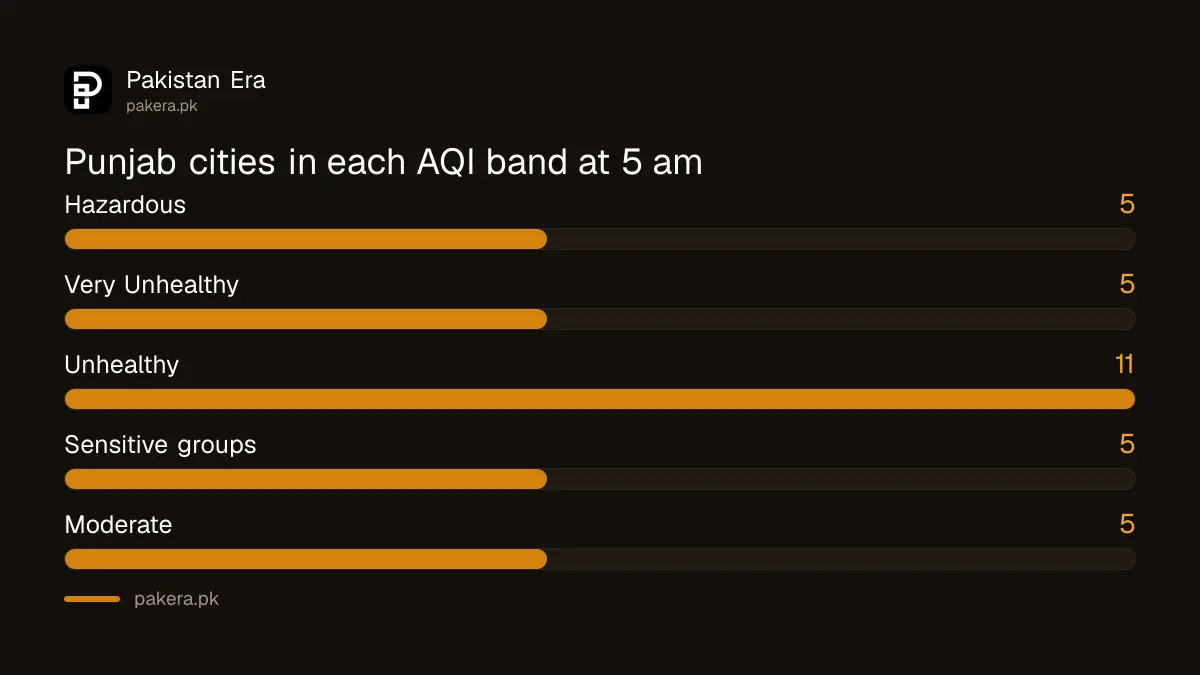
The count is our own, from the city list on the dashboard. Earlier this season the dashboard showed 36 cities. This morning it showed 31, and it carried a notice that some stations had connectivity problems. Cities missing from the list may simply not have sent data.
Lahore read 378, with Shahdara at the top of the scale
Lahore's city reading was 378 at 5 am, down from 439 at the same hour on 3 November. Its 11 monitoring stations ranged from 500 at Shahdara to 289 at Punjab University. Every station in the city was above 280.
Station readings matter because smog is not even across a city. GT Road read 499 and Barki Road 429. Kahna Nau, Egerton Road and Safari Park were all between 358 and 374. Gulberg III read 351, Multan Road 337, DHA Phase 6 334 and Wagha Border 323. For what each station covers and how to find the one nearest you, see our guide to checking Lahore's air quality live.
Still air and high humidity kept the smog low
The dashboard's Lahore weather box showed 20°C, 86 per cent humidity and a wind of 0.3 metres a second at 5 am. The National Disaster Management Authority (NDMA) lists low wind and high humidity among the conditions that form smog.
Cool, still nights let a layer of warm air sit on top of cooler air near the ground. Smoke from vehicles, kilns, factories and burning cannot rise through it. That is why the worst readings are often at night and early morning. The NDMA's seasonal outlook expects the smog risk to rise from mid November into December, which we cover in our smog forecast for 2026.
Punjab EPA's own advice is to stay indoors if you are at risk
The dashboard's health advisory tells vulnerable groups to stay indoors and to wear an N95 mask and protective glasses if going out is necessary. It tells everyone else to limit outdoor activity on poor air days and exercise indoors.
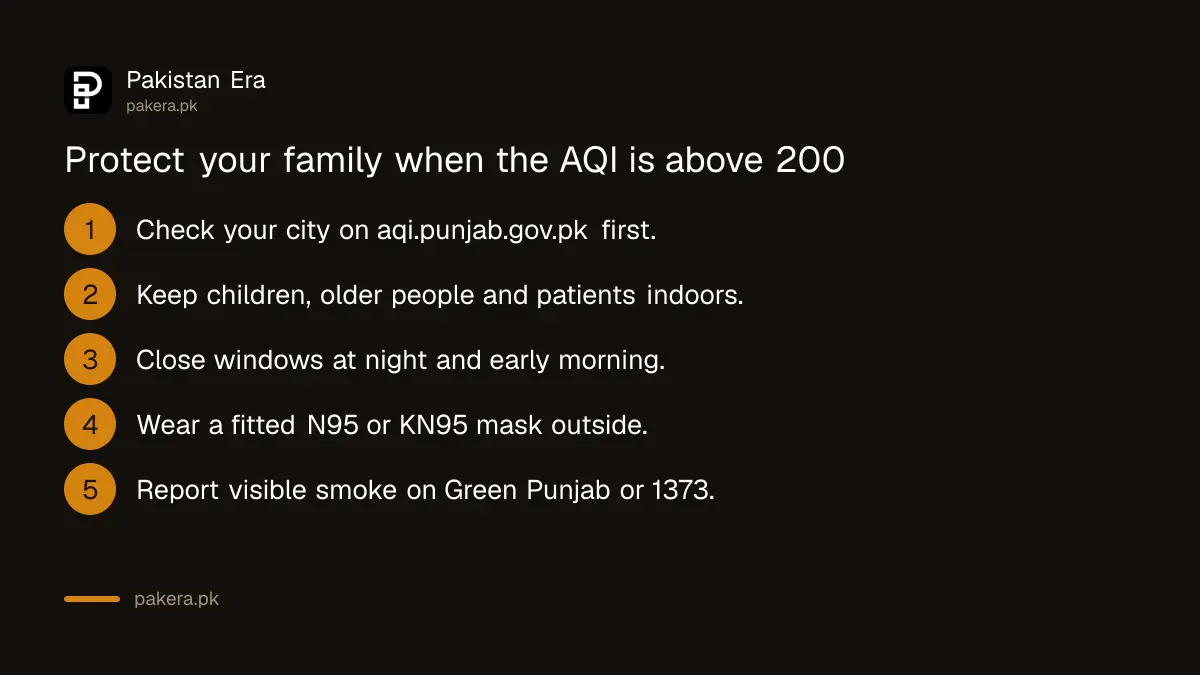
Here is what to do this morning, using only official sources:
- Open aqi.punjab.gov.pk and check your city's latest hourly reading before you go out.
- If your city is above 200, keep children, older people and anyone with asthma or heart disease indoors where you can.
- Close windows during the night and early morning, when readings are highest.
- If you must go out, wear a well fitted N95 or KN95 mask. Our page on wearing an N95 mask for smog explains the fit check.
- Report smoke you can see, such as burning rubbish or a smoky kiln, through the Green Punjab app or the EPA helpline 1373.
The advisory also says people with lung or heart disease (COPD or CVD) should ask a doctor which mask suits them. We give no medical advice beyond that. Anyone with breathing trouble should see a doctor.
No new school closure order had been posted by 6 am
We found no smog closure notice for schools or offices on the EPA dashboard on the morning of 4 November. Closures in Punjab come through a formal order from the Environment Protection Department, followed by a School Education Department notification.
Do not rely on forwarded messages. Our guide on how to check if Punjab schools are closed for smog shows where a real order appears. We will report any order once it is published.
Common questions
What is Lahore's AQI today, 4 November 2026?
Punjab EPA's dashboard showed Lahore at 378 at 5 am, in the Very Unhealthy band. The reading updates every hour at aqi.punjab.gov.pk.
Which city in Punjab had the worst air on 4 November?
Nankana Sahib, at 500, the highest value on the scale. Kot Addu (443), Vehari (429), Kasur (424) and Rajanpur (403) followed.
Was any Punjab city in the Good band?
No. The cleanest city listed was Talagang at 113, which is Moderate. No city was at 100 or below.
Why is the AQI higher in the early morning?
On cool, still nights a layer of warm air traps smoke and dust near the ground. On 4 November the wind in Lahore was 0.3 metres a second and humidity 86 per cent.
Are Punjab schools closed for smog on 4 November?
We found no new closure order by 6 am. A real closure comes as an Environment Protection Department order and a School Education Department notification.
Where can I report smog causing activities?
Use the Green Punjab app or call the EPA helpline 1373. EPA Punjab also lists a WhatsApp complaint number, 0335-9232227, on its website.
How we verified this
What we checked, where we read it, and what we could not confirm.
We read the Punjab EPA air quality dashboard at aqi.punjab.gov.pk just before 6 am PKT on 4 November 2026. It showed "Last updated: 5:00 AM, Nov 4", the city ranking, Lahore's 11 station readings, the weather box and the health advisory. The band counts are our own. The smog conditions come from the NDMA seasonal outlook. Readings change every hour, so check the dashboard for the latest figure.
About the author

Tax, Bills and Technology Writer
Ali Akhtar is a young and curious voice here at Pakistan Era. He is currently pursuing his A-Levels and has a growing interest in Pakistan’s changing industrial landscape and educational trends. Ali likes to write in a way that helps him explain and explore the world around him. His writing reflects the perspective of the new generation navigating the evolving trends of Pakistan where technology, youth innovation, and shifting opportunities are reshaping the country’s future.