Punjab Sales Tax on Services Rates 2026-27: 16% Standard, and Every 8%, 5% and 0% Service
Punjab sales tax on services rates for 2026-27: 16% standard, 19.5% telecom, and every 8%, 5% and 0% service on the PRA list, including the 1 July 2026 changes.
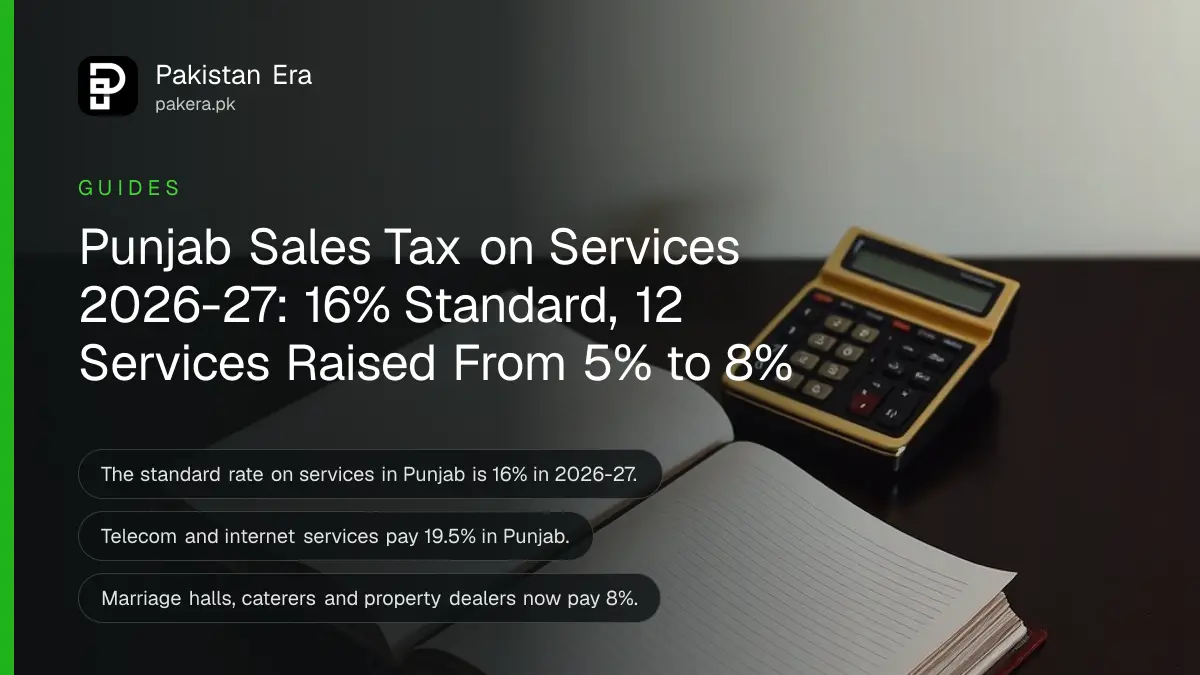
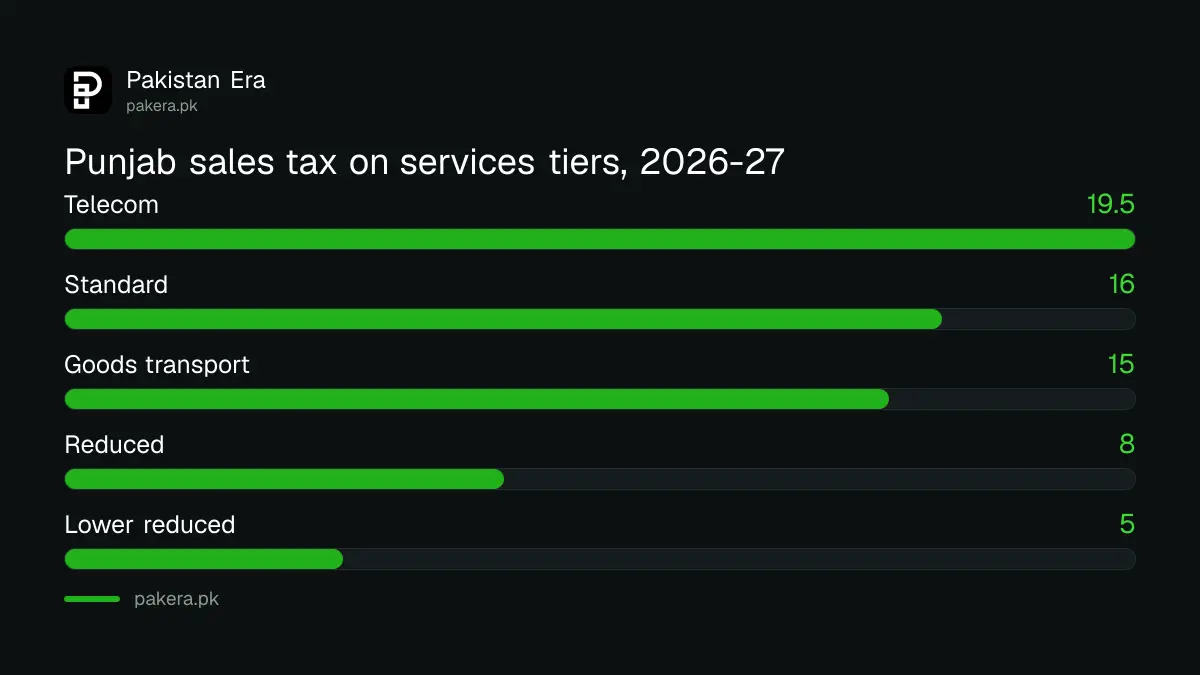
Punjab charges 16% sales tax on services in 2026-27, unless the service is on the reduced rate list. Telecom and internet pay 19.5%. Goods transport pays 15%. Dozens of services pay 8%, 5% or 0%, and many 5% rates rose to 8% on 1 July 2026.
The Punjab Revenue Authority (PRA) collects this tax under the Punjab Sales Tax on Services Act 2012. Its Second Schedule has three parts: Part I for the main rates, Part II for fixed amounts, and Part III for reduced rates. This page lists all three as they stand after the Punjab Finance Act 2026.
The standard rate in Punjab is 16%
Any taxable service not named in Part II or Part III of the Second Schedule pays 16%. Telecom and internet services pay 19.5%. Carriage of goods by road or rail pays 15%, and both the provider and the customer can adjust input tax on it.
| Part I service | Rate |
|---|---|
| All services not named elsewhere | 16% |
| Carriage of goods by road or rail | 15%, with input tax adjustment |
| Telephone, mobile, SMS, internet, broadband, tracking and alarm services | 19.5% |
Mobile and internet bills carry this 19.5% inside Punjab, alongside federal advance income tax. How the two add up on a bill is covered in tax on mobile and internet bills.
Builders and freight forwarders pay fixed amounts
Part II replaces a percentage with a fixed charge. Property developers, builders and promoters pay Rs 100 per square yard of land developed and Rs 50 per square foot of building built. Freight forwarding agents pay Rs 1,000 per bill of lading.
On a project with 1,000 square yards of land and 20,000 square feet of building, the tax is Rs 100,000 for the land and Rs 1,000,000 for the building. Affordable housing under government programmes and PHATA-notified schemes is tax-free under the First Schedule.
Services that went from 5% to 8% on 1 July 2026
The Punjab Finance Act 2026 replaced the word "Five" with "Eight" in 12 entries and rewrote the hotel entry. All are charged without input tax adjustment. Restaurants and hotels moved to 8% only for card, wallet and QR payments; cash stays at 16%.
| Service | 2025-26 | 2026-27 |
|---|---|---|
| Restaurants and hotels, paid by card, wallet or QR | 5% | 8% |
| Marriage halls, lawns, pandal and shamiana | 5% | 8% |
| Catering, including decoration | 5% | 8% |
| Tour operators and travel agents | 5% | 8% |
| Property dealers and realtors | 5% | 8% |
| Architects, town planners, interior designers | 5% | 8% |
| Rent-a-car to end consumers | 5% | 8% |
| Health care centres, gyms, indoor sports, amusement parks | 5% | 8% |
| Laundries and dry cleaners | 5% | 8% |
| Accountants, auditors, tax and corporate law consultants | 5% | 8% |
| Warehouses, depots and cold storage | 5% | 8% |
| Rental of cranes, generators, scaffolding and similar | 5% | 8% |
| Apartment management, real estate management, rent collection | 5% | 8% |
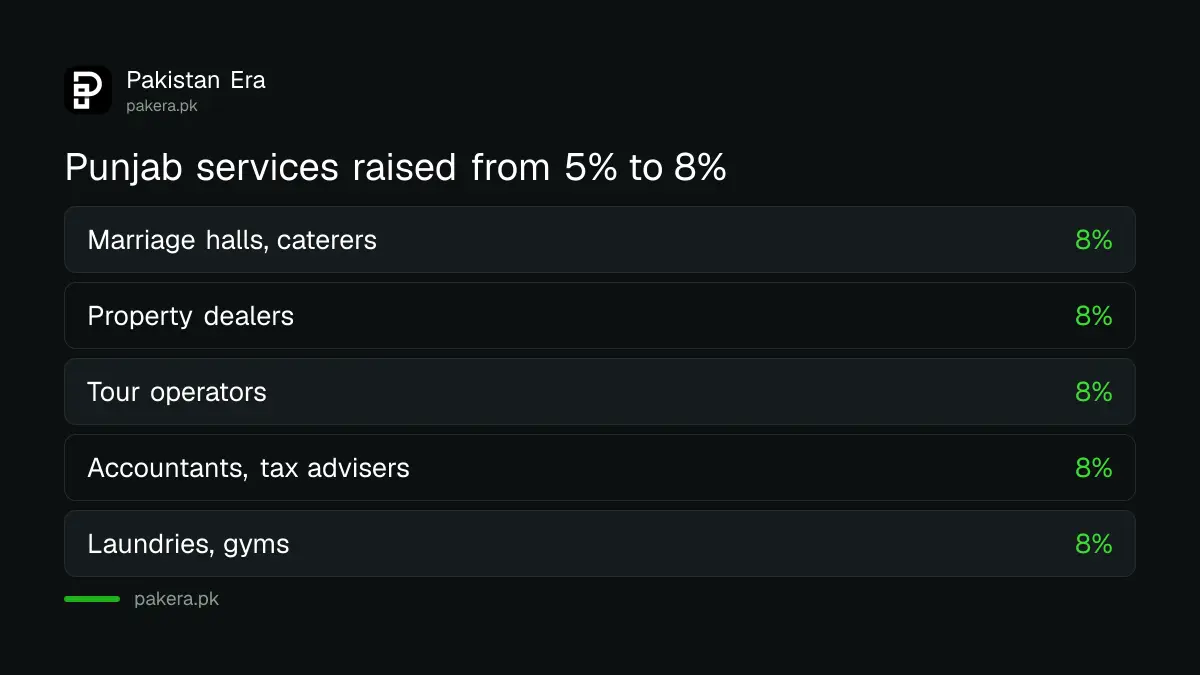
Two new lines were added. Foreign exchange services by exchange companies and money changers pay 3% on the spread. Event management services pay 8%. Before this, event management sat in the 16% consultancy line. Restaurant and hotel bills paid in cash still carry the full 16%.
Services that stay at 5% in Punjab
Many personal and small business services still pay 5% without input tax adjustment. These include beauty parlours, photographers, dress stitching, fashion designers, cable TV, ride-hailing, parking, skin and laser clinics, and IT services other than software development.
- Beauty parlours, salons, slimming clinics, spas and saunas
- Photography studios and event photographers or film makers
- Dress designing and stitching; fashion designers using a brand name
- Skin and laser clinics, cosmetic and plastic surgeons, hair transplants
- Ride-hailing services, including cab aggregators
- Parking services and cable TV operators
- Air travel originating from Punjab, domestic and international
- Textile and leather treatment, embroidery, dyeing and shoe making
- Insurance agents and brokers; car dealers that are not companies or authorised dealers
- Brokers of agricultural produce and home chefs
- Manpower recruitment where the Bureau of Emigration fixes the fee
Services charged at 0% in Punjab
Part III lists some services at zero percent without input tax adjustment. They include software and IT system development, IT training, health insurance for individuals, entertainment such as cinemas and concerts, and doctor fees above Rs 1,500 or hospital rooms above Rs 6,000 a day.
| Service at 0% | Condition |
|---|---|
| Software or IT system development | By software or IT-based system development persons |
| Training related to IT | IT training only; other training pays 16% |
| Franchise services | For IT educational institutions; 5% for other educational institutions |
| Health insurance | For individuals; other insurance pays 16% of gross premium |
| Medical consultation and hospital rooms | Consultation above Rs 1,500 a visit; room above Rs 6,000 a day |
| Entertainment | Cinemas, theatres, concerts, circus, sports events, fashion shows |
The First Schedule makes other services fully tax-free. Examples are general education, public sector hospital care, renting a house for living in, crop insurance, and small road-side photographers declared by the PRA.
How to use these rates as a business
Find your service in Part III first, then Part II, then Part I. A reduced rate means no input tax adjustment. With PRA permission, a business on a Part III reduced rate can choose the 16% standard rate and claim input tax instead.
- Find your service and its classification code in the Second Schedule.
- Check whether a reduced rate has a condition, such as card payment or a fee limit.
- Register with the PRA on its e-registration portal if you provide a taxable service in Punjab.
- Charge the right rate on every invoice and show the tax separately.
- File the monthly return and pay the tax collected.
Registration steps are in registering for PRA sales tax on services, and filing is in filing the PRA return, including a nil return. The option to move to the standard rate cannot be reversed without the PRA's permission.
Common questions
What is the sales tax on services rate in Punjab for 2026-27?
The standard rate is 16%. Telecom and internet pay 19.5%, goods transport pays 15%, and the reduced rates are 8%, 5%, 3% and 0% for the services listed in Part III.
Which Punjab rates changed on 1 July 2026?
Twelve reduced rate entries rose from 5% to 8%, including marriage halls, caterers, property dealers, tour operators, accountants and laundries. Restaurant and hotel card payments rose to 8%. Event management at 8% and foreign exchange at 3% were added.
What does "without input tax adjustment" mean?
The business cannot subtract the sales tax it paid on its own purchases from the tax it collects. The reduced rate is the final cost.
Is renting out a house taxed in Punjab?
Renting a personal dwelling for residential use is in the First Schedule of tax-free services. Rent collection and real estate management services pay 8%.
Do beauty parlours in Punjab charge 5% or 8%?
5%. Beauty parlours, salons and spas were not part of the 2026 change. Gyms, health centres and body massage services moved to 8%.
Who collects sales tax on services in Islamabad?
Not the PRA. Islamabad's services tax is federal and is run by FBR. The PRA's rates apply only to services in Punjab.
How we verified this
What we checked and where we read it.
We went through the Second Schedule line by line on 15 November 2026 in the Punjab Sales Tax on Services Act 2012, 17th edition for 2026-27, downloaded from the PRA downloads page. The 5% to 8% changes are taken from each entry's footnote, which cites the Punjab Finance Act 2026 (Act L of 2026), assented on 1 July 2026. The standard rate is from section 2(41A), the standard rate option from section 10A, and the tax-free services from the First Schedule. The PRA site also hosts an older "Updated 2nd Schedule" PDF dated 2021-22; we did not use it, because it predates both the 2025 and 2026 changes.
About the author

Tax, Bills and Technology Writer
Ali Akhtar is a young and curious voice here at Pakistan Era. He is currently pursuing his A-Levels and has a growing interest in Pakistan’s changing industrial landscape and educational trends. Ali likes to write in a way that helps him explain and explore the world around him. His writing reflects the perspective of the new generation navigating the evolving trends of Pakistan where technology, youth innovation, and shifting opportunities are reshaping the country’s future.