Rape Survivor Rights in Pakistan Under the Anti-Rape Act 2021: Crisis Cell, One Statement, Trial in 4 Months
Pakistan's Anti-Rape Act 2021 gives women and children a crisis cell, one recorded statement, a closed trial in 4 months and free legal aid. Know each right.
Short answer: Under the Anti-Rape (Investigation and Trial) Act, 2021, a woman or child who survives rape in Pakistan has the right to a medical examination without delay, an FIR, a trained investigation unit, a single recorded statement, a closed trial and free legal help. The court should decide the case within 4 months, and the two-finger test is banned.
Families often do not know these rights exist, and that gap costs evidence in the first hours. We read the full Act on the Pakistan Code, the federal law portal, on 20 October 2026. It extends to the whole of Pakistan. In an emergency, call the police on 15 first. This guide explains what the law then requires of police, hospitals and courts.
The Act protects women and children of any age
The Act's special procedure covers a "victim", meaning a woman or a child, and a child is anyone under 18 of either sex. Where the offence is against an adult man, the case runs under the ordinary criminal courts and procedure.
The offences it covers are listed in two schedules. Schedule II carries rape, gang rape, sexual abuse of a child, acid attacks on women and similar crimes. Schedule I covers offences such as sexual material involving children and some online crimes under the Prevention of Electronic Crimes Act, 2016. Those offences are tried only in Special Courts, under section 23.
An anti-rape crisis cell must act without delay
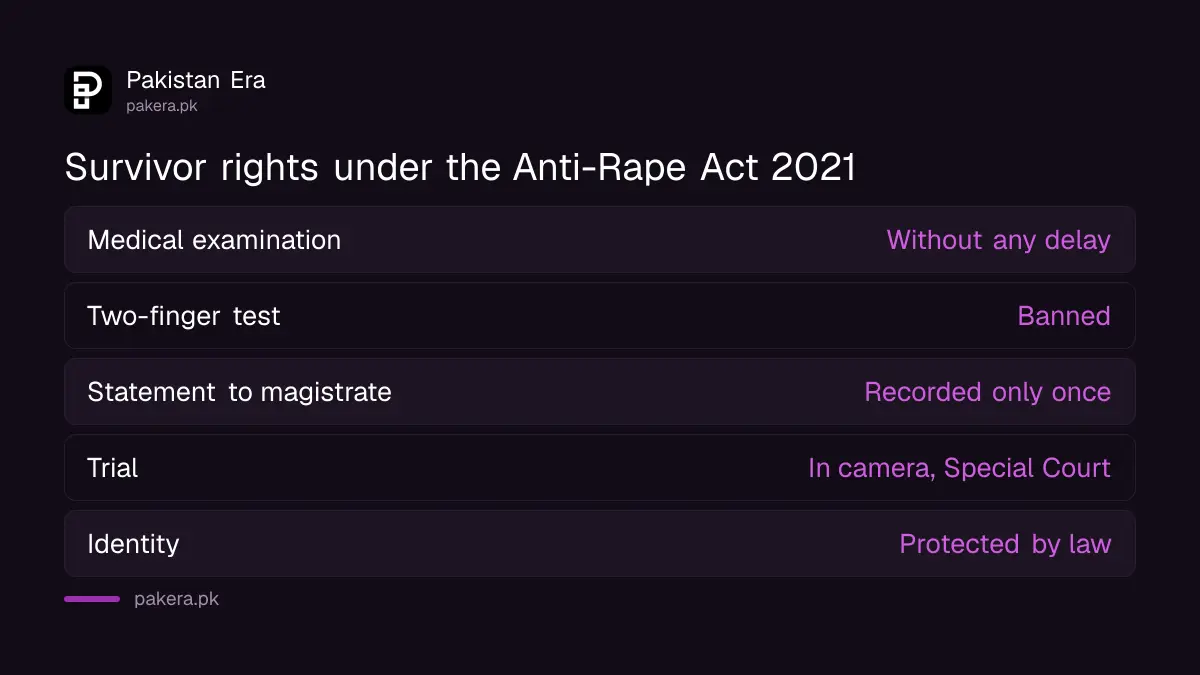
Crisis cells sit in public hospitals and are headed by a commissioner or deputy commissioner. Once a cell hears of a rape, from anyone and in any form, it must arrange the medical examination, evidence collection, forensic tests and the FIR, all without delay.
That is section 5(1). Section 5(3) adds a duty on police: the officer in charge of a police station must pass any report of such an offence to the crisis cell without delay. So a family does not have to choose between the hospital and the police station. Either one is supposed to bring in the other.
The cell includes the hospital's medical superintendent and a police officer, and the Act says at least one member should preferably be a woman. We did not find a published list of crisis cell locations, so ask the nearest district headquarters hospital or the police helpline which hospital hosts the cell in your district.
A trained police unit must investigate the case
Every district must have a special sexual offences investigation unit, with officers trained in these cases and preferably one female officer. For rape and the other Schedule II offences, a police officer of at least BPS-17 supervises the unit.
If the complainant has reasonable grounds to be unhappy with the investigation, section 9(4) says it shall be moved to the district head of investigation. A police officer who investigates carelessly or falsely in these cases faces up to 3 years in prison and a fine under section 22. The same section punishes a knowingly false complaint with up to 3 years.
If you face trouble at the station itself, the procedure for a woman complainant is set out in how to report an offence as a woman with a female officer present.
What happens after a report, in five steps
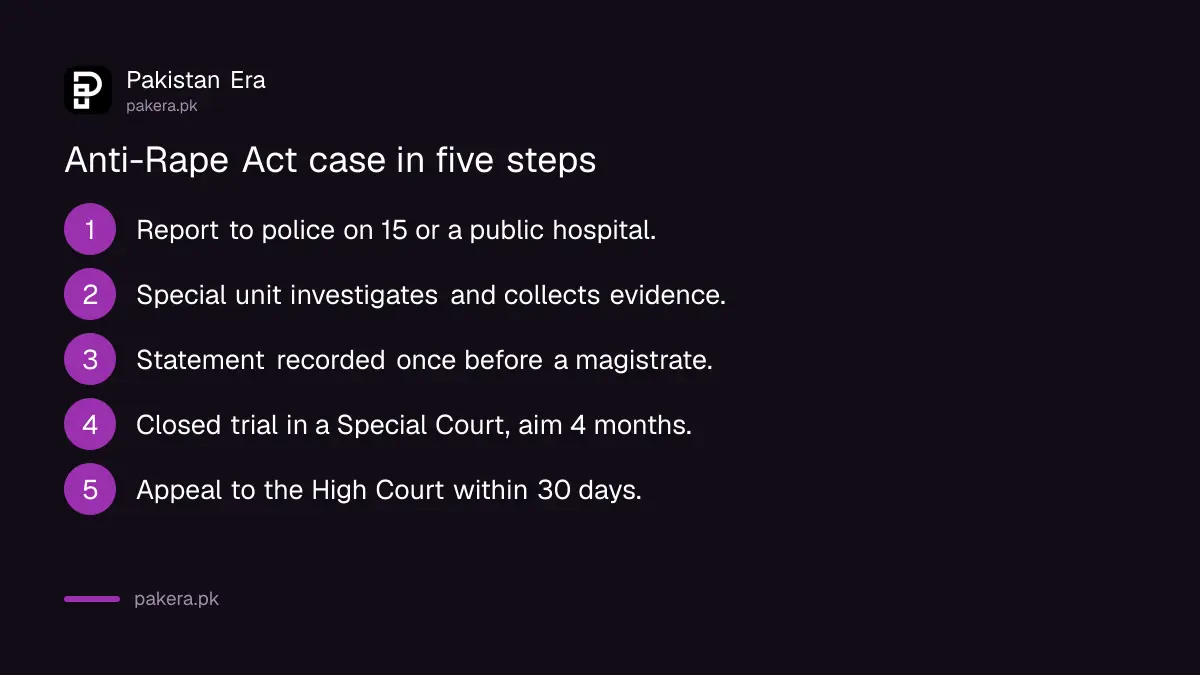
The law sets an order of events: examination and FIR, investigation by the special unit, one statement before a magistrate, a closed trial in a Special Court, and an appeal to the High Court. Each step has its own rule.
- Report to police on 15 or go to a public hospital. Either must bring in the crisis cell for the medical examination and the FIR.
- The special investigation unit collects evidence and sends the final report to the Special Court through a special prosecutor.
- The survivor's statement is recorded before a magistrate under section 164 of the Criminal Procedure Code only once, and it is video recorded.
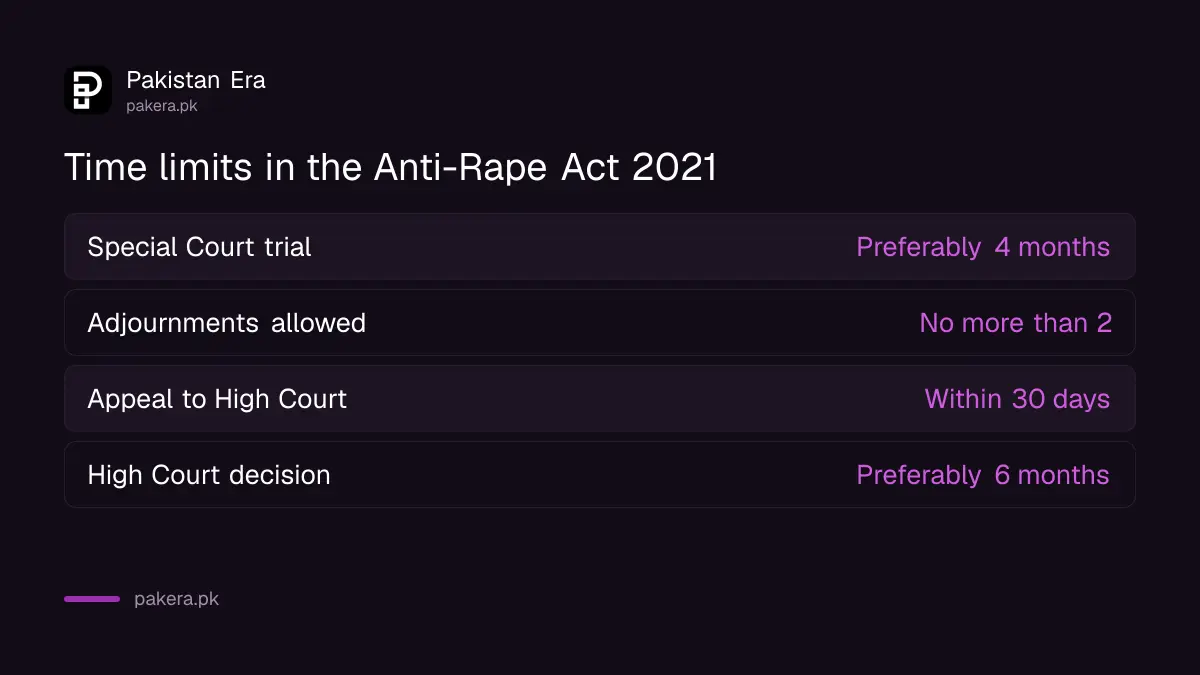
- The trial is held in camera, and the court should decide it preferably within 4 months, with no more than two adjournments.
- Either side may appeal to the High Court within 30 days. A division bench should decide it preferably within 6 months.
Evidence rules shield the survivor in court
Section 13 bans the two-finger virginity test outright and gives it no value as evidence. Evidence that the victim is of generally immoral character is inadmissible. Only the accused's lawyer, or the judge, may question the survivor, never the accused in person.
| Protection | What the Act says | Section |
|---|---|---|
| Medical examination | Without any delay, arranged by the crisis cell | 5(1)(a) |
| Two-finger test | Strictly prohibited, no probative value | 13(1) |
| Statement | Recorded once, video recorded | 14(1) |
| Trial | In camera, screens or video link allowed | 12 |
| Identity | Cannot be revealed without written permission | 26 |
| Time | Trial preferably in 4 months | 16(1) |
Publishing anything about the proceedings without the court's permission is unlawful under section 12(3). Revealing the identity of the victim or the family without written permission is an offence punished like section 376A of the Pakistan Penal Code. That rule covers social media posts too.
Free legal help and compensation are part of the law
The Legal Aid and Justice Authority must provide legal help to victims, under section 6. A court may also order the convict to pay compensation to the victim on top of any fine, under section 17.
An independent support adviser, such as a psychologist, lawyer or social worker, may accompany the survivor in court if the crisis cell decides so. For Islamabad cases, see how to apply for LAJA free legal aid in a criminal case. Financial help for victims is separate, and Pakistan Bait-ul-Mal runs a scheme described under assistance for victims of violence and rape.
One change is in Parliament. A Senate-passed amendment would make convicted sex offenders tell police 12 hours before leaving home for more than 3 days. It was on the National Assembly agenda on 20 October 2026 and is not law yet.
Common questions
Is the two-finger test allowed in Pakistan?
No. Section 13(1) of the Anti-Rape Act, 2021 strictly prohibits it, and courts may give it no weight as evidence.
Does a survivor have to repeat her statement many times?
No. Section 14 says the statement before a magistrate is recorded only once, as soon as practicable, and video recorded.
Can the accused question the survivor in court?
No. Only the defence lawyer may cross-examine, or the judge may put the questions, under section 14(2).
How long should a rape trial take in Pakistan?
The Special Court should decide the case preferably within 4 months of taking cognizance, under section 16(1).
Can the media name a rape survivor?
No. Section 26 bars revealing the identity of the victim or family without written permission, and breaking it is a criminal offence.
Does the Act cover a boy who was abused?
Yes. A child is anyone under 18, male or female, so boys are covered by the special procedure.
How we verified this
What we checked, where we read it, and what we could not confirm.
Last checked 20 October 2026. We read sections 1 to 31 and both schedules of the Anti-Rape (Investigation and Trial) Act, 2021 on the Pakistan Code, a copy dated 24 February 2026 that shows a schedule change by SRO 1050(I)/2025, and the Anti-Rape (Investigation and Trial) (Amendment) Bill, 2024 as passed by the Senate, on 20 October 2026. We could not find an official list of crisis cells, special investigation units or Special Courts by district, and we did not read the rules made under the Act. This is general information on the law, not advice on a case.
About the author

Senior Writer, Public Services and Technology
Shahid joined us in 2024 as an author. He is a senior contributor to Pakistan's leading technology websites. He writes detailed articles, mostly covering his expertise in the latest tech, mobiles, apps, gadgets, and step-by-step guides. His ideology is to help people understand the latest trends and explain complex methods through very easy-to-understand guides.