How to Redeem Mortgaged Farmland in Balochistan: Collector Petition Under the 1964 Act
Mortgaged your farmland in Balochistan? The 1964 Act lets the Collector order redemption for up to 50 acres or Rs 5,000. See the deposit, top-up and appeals.
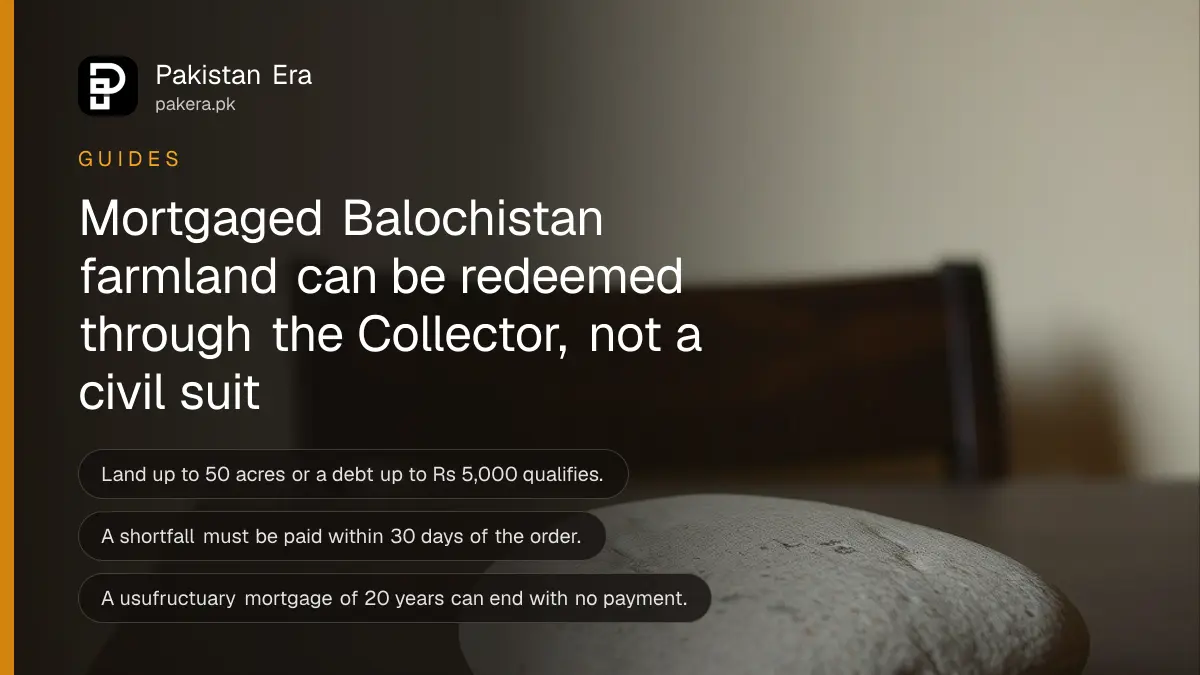
If your farmland in Balochistan is mortgaged (rehan) and the loan is now due, you can ask the district Collector to redeem it: file a petition, deposit the sum you believe is owed, and the Collector can order the lender out. The Balochistan Redemption and Restitution of Mortgaged Lands Act, 1964 allows this for land up to 50 acres, or where the mortgage money is not more than Rs 5,000.
We read the full text of the Act on the Balochistan Code, the provincial government's own law portal, on 21 October 2026. Everything below about sections, deadlines and amounts comes from that text. A rural family often hands over a field for a loan and then finds the lender will not return it. This Act gives a faster route than a civil suit.
The Collector can order redemption of mortgaged farmland without a civil suit
Under section 3, a mortgagor (the owner who gave the land as security) may apply to the Collector, who is the district revenue officer. The Collector hears the mortgagee (the lender holding the land), checks the sum due, and if satisfied orders the mortgage redeemed under section 5.
The route opens only after the principal money has become due and before a civil suit for redemption is time barred. It covers agricultural land, pasture, the sites of buildings on that land, trees, water rights and a share in profits. It does not cover house plots inside towns. To see how your land is entered, first read the steps to check land records in Balochistan.
You qualify if the land is up to 50 acres or the debt is up to Rs 5,000
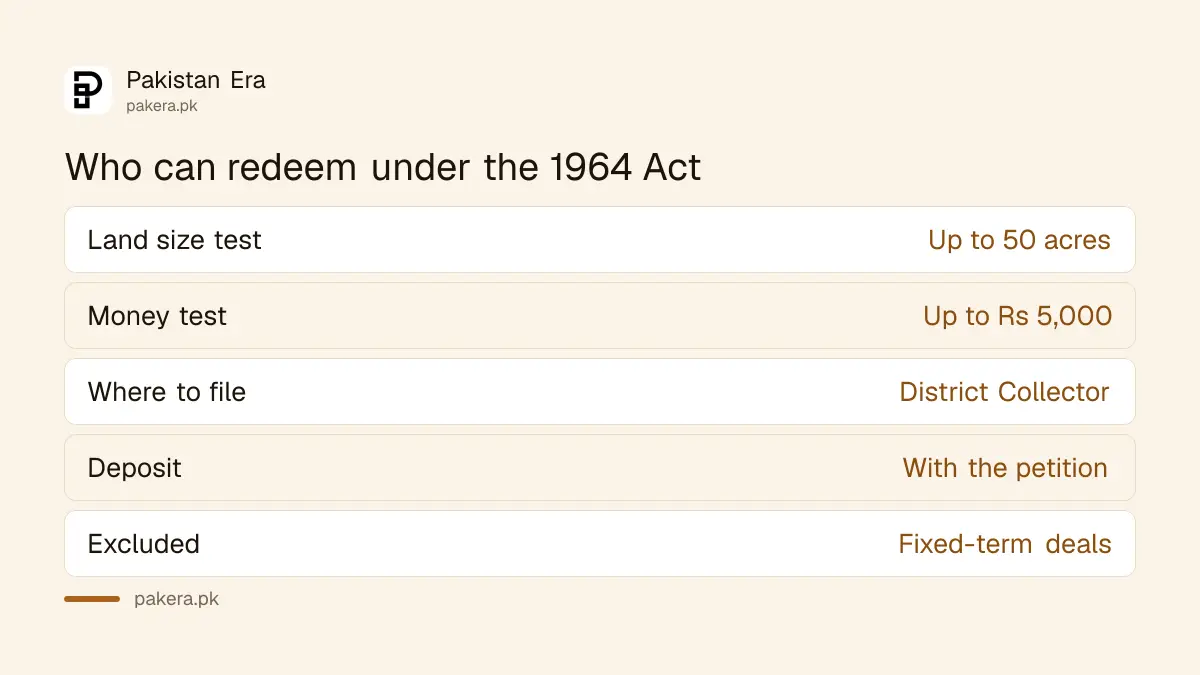
Section 3 sets two tests. Either the mortgaged land does not exceed fifty acres, or the principal money secured does not exceed five thousand rupees. Meeting one test is enough. The share of village common land that came with the plot is not counted in the acreage.
| Question | What the Act says |
|---|---|
| Who files | The mortgagor, including an assignee or heir |
| Where | The Collector of the district where the land lies |
| Land size test | Up to 50 acres |
| Money test | Principal not more than Rs 5,000 |
| Not covered | A fixed-term usufructuary mortgage meant to end without repayment |
| Area | Whole province except the Tribal Areas |
One exclusion matters. If the deal was a usufructuary mortgage for a set number of years, designed to end by itself without any repayment, section 3 does not apply. The lender simply returns the land when the term ends.
Deposit the sum you think is due when you file
Section 4 requires the petitioner to state, to the best of their knowledge, the sum due under the mortgage and to deposit it with the Collector at the time of the application. A petition without the deposit is not complete.
If you are short, the Collector can still order redemption but sets a top-up within 30 days, or a longer period the Collector allows (section 6). Miss it and the petition is dismissed with costs. Interest stops from the date you deposit the sum, once the lender accepts it or the Collector finds it correct (section 9).
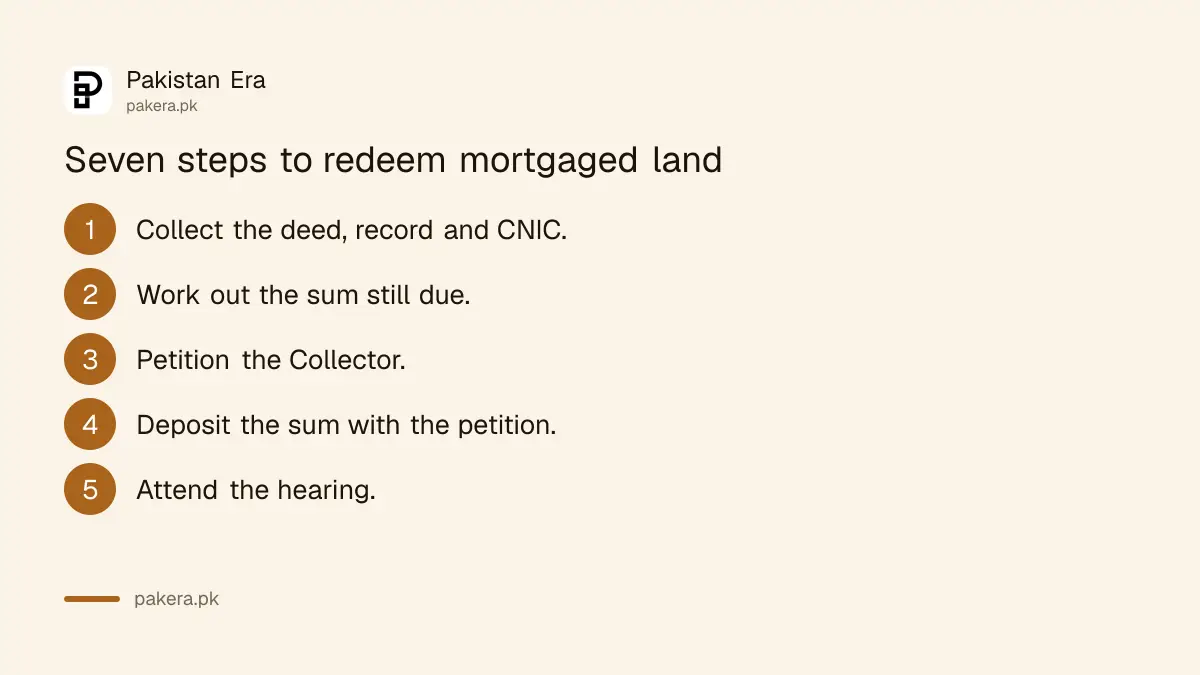
- Collect the mortgage deed, the revenue record of the land and your CNIC.
- Work out the amount you believe is still due, using the lender's receipts.
- Write a petition to the Collector of the district and state that amount.
- Deposit that sum with the Collector when you file.
- Attend the hearing. The lender is heard before any order.
- Pay any extra sum within 30 days if the Collector orders it.
- Take possession, which the Collector delivers under section 18.
The Act names no fee and no form. The Board of Revenue can make rules on petitions and procedure, and we could not find any such rules on the portal. Ask the Deputy Commissioner's office or a revenue lawyer what the district practice is. If an heir files, the entry in the record matters too, as in the guide to reading a land fard.
Old usufructuary mortgages can end with no payment at all
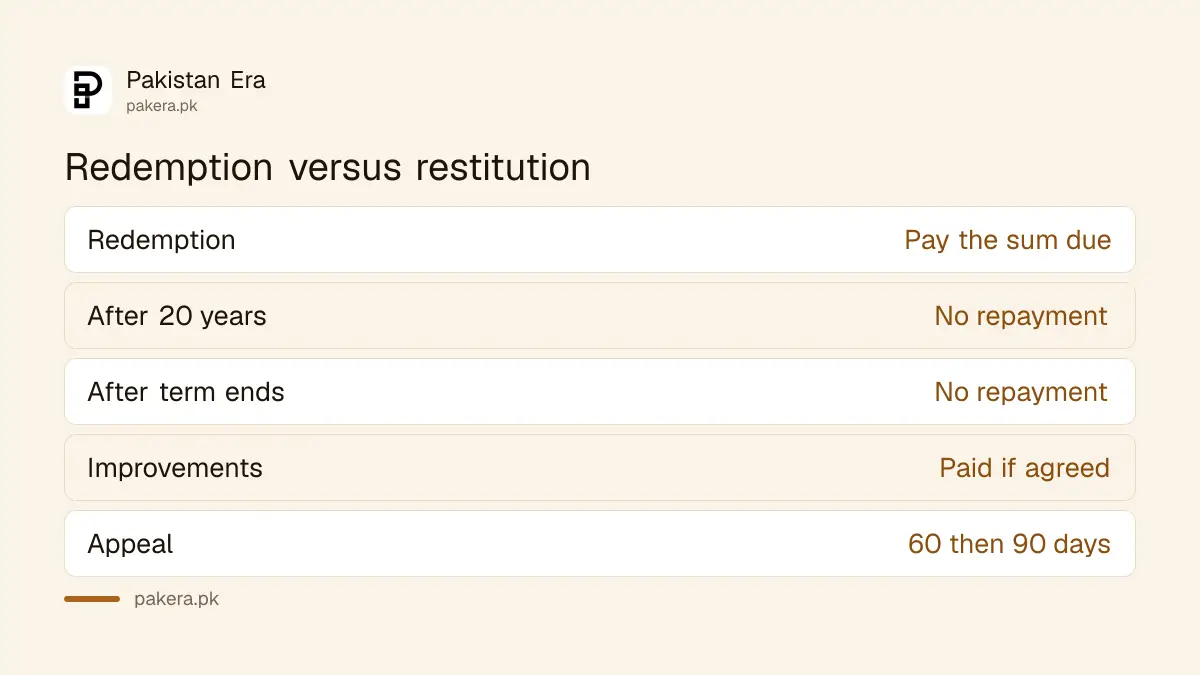
Chapter III is the strongest part for families. If a usufructuary mortgage (one where the lender farms the land in place of interest) has run for 20 years or more, or its period has expired, the Collector can extinguish it without any repayment of the mortgage money (sections 10 to 12).
The Collector can also return the title deeds held by the lender and put the owner back in possession. There is one cost. If the contract expressly says the lender is paid for improvements, such as a tube well or levelling, the Collector decides that amount and you must deposit it within six months, or the petition may be dismissed (section 13).
| Route | Basis | Do you repay? |
|---|---|---|
| Redemption | Sections 3 to 9 | Yes, the sum found due |
| Restitution after 20 years | Sections 10 to 12 | No, only agreed improvements |
| Restitution after term ends | Sections 10 to 12 | No, only agreed improvements |
If the Collector rules against you, appeal within 60 days
An appeal from the Collector goes to the Commissioner within 60 days. A further appeal goes to the Board of Revenue within 90 days (sections 14 and 16). The time needed to get copies of the order is not counted.
Two traps follow. If a petition is dismissed, the same person cannot file another for the same mortgage (section 8). And civil courts cannot hear claims on a mortgage that was extinguished under Chapter III (section 17). Either side can still file a civil suit to establish rights against a redemption order, but the order stands until that suit succeeds (section 7).
If the lender is trying to sell the land meanwhile, the civil route to freeze it is explained in the guide to stopping a property sale with an Order 39 injunction. Time limits for civil suits are in the limitation schedule.
Common questions
Does this Act apply to a house or shop mortgage?
No. It covers agricultural, pasture and similar land only. Building sites inside towns and villages are outside the definition of land in section 2.
Who hears the petition?
The Collector of the district where the land is. Appeals go to the Commissioner and then the Board of Revenue.
How long do I have to pay a shortfall?
The Collector gives you 30 days, or longer if the Collector allows it. If you miss that period, the petition is dismissed with costs.
Can the lender attach the money I deposit?
No. Section 22 says no court or revenue officer can attach a sum deposited under the Act. If the petition is dismissed, the deposit is returned to you under section 21.
Do heirs of the mortgagor have the same right?
Yes. The Act says mortgagor includes an assignee and a representative in interest, so heirs can file in the original owner's place.
Does the Act work in the Tribal Areas?
No. Section 1 extends it to the whole province except the Tribal Areas, and only where the government has notified it to come into force.
How we verified this
What we checked, where we read it, and what we could not confirm.
We read the full text of the Balochistan Redemption and Restitution of Mortgaged Lands Act, 1964 on the Balochistan Code on 21 October 2026. We could not confirm the district notification dates under section 1(3), any Board of Revenue rules on fees and forms, or whether every district applies the Act in practice. This is general information, not legal advice.
About the author

Tax, Bills and Technology Writer
Ali Akhtar is a young and curious voice here at Pakistan Era. He is currently pursuing his A-Levels and has a growing interest in Pakistan’s changing industrial landscape and educational trends. Ali likes to write in a way that helps him explain and explore the world around him. His writing reflects the perspective of the new generation navigating the evolving trends of Pakistan where technology, youth innovation, and shifting opportunities are reshaping the country’s future.