How to Ask a Civil Court to Stop a Property Sale in Pakistan: Order 39 Injunction
Fear a disputed property will be sold in Pakistan? Order 39 lets a civil court grant a temporary injunction. See the grounds, the 15 day and 6 month limits.
Short answer: If you have filed a civil suit about a property and fear the other side will sell or damage it, Order 39 rule 1 of the Code of Civil Procedure lets the court grant a temporary injunction. It can stop the sale or removal until the suit is decided or the court orders otherwise.
A property dispute can be won on paper and lost on the ground, if the house is sold to an innocent buyer while the case drags on. A temporary injunction is the tool made to prevent that. It is also called a stay order.
We read the Code of Civil Procedure on the Pakistan Code website on 14 October 2026. We did not read the court fee schedule or case law, so ask a lawyer about those parts.
Rule 1 covers property in danger of being sold, wasted or damaged
Order 39 rule 1 says that when it is proved by affidavit or otherwise that disputed property is in danger of being wasted, damaged or alienated by a party, or wrongly sold in execution, the court may grant a temporary injunction until the suit ends.
Alienated means transferred to someone else. An affidavit is a written statement you swear to be true. The rule also covers a defendant who threatens to remove or sell property to cheat his creditors.
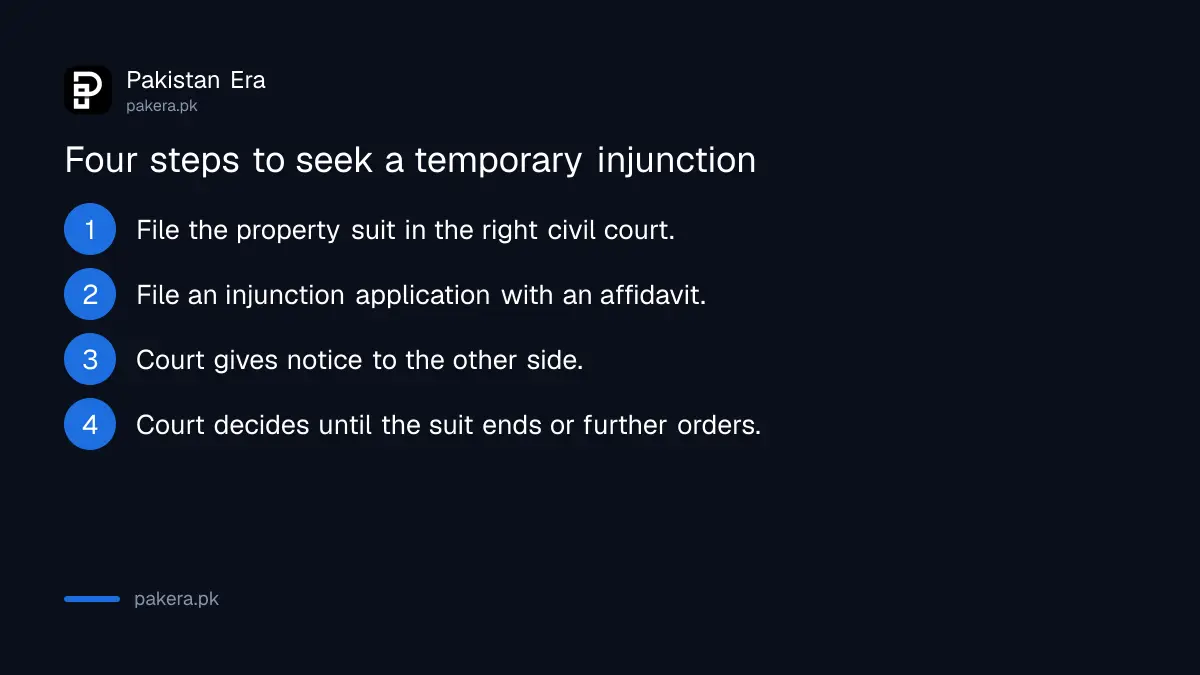
- File a civil suit about the property in the court with jurisdiction.
- File an application for an injunction with an affidavit saying what you fear and why.
- Attach proof such as the agreement to sell, the land record or a message that shows the plan to sell.
- Ask for a date soon, and ask the court to restrain the sale until it decides.
- Serve notice on the other side as the court directs.
Before you file, check the paper trail of the property. Read how to verify a property's title before you buy and how to register an agreement to sell in Punjab.
The court must give notice before it grants an injunction
Rule 3 says the court must give notice of the application to the other side first. It can skip notice only where delay would defeat the injunction's purpose. For Government bodies, notice runs from two to seven days.
The rule has exceptions. Some pledge-sale cases and cases against Government or statutory bodies are treated differently, and the Government notice period cannot be less than two days or more than seven. Ask your lawyer which applies to your case.
| Stage | Rule | Time limit |
|---|---|---|
| Injunction without the defendant being heard | 2A | Not ordinarily more than 15 days |
| Injunction after notice and hearing | 2B | Ends after 6 months unless extended |
| Extension of the order | 2B | Court records reasons and reports to High Court |
| Notice to Government or statutory body | 3 | Not less than 2 days, not more than 7 |
| Attachment for disobedience | 2(4) | Remains in force up to one year |
An injunction has strict time limits
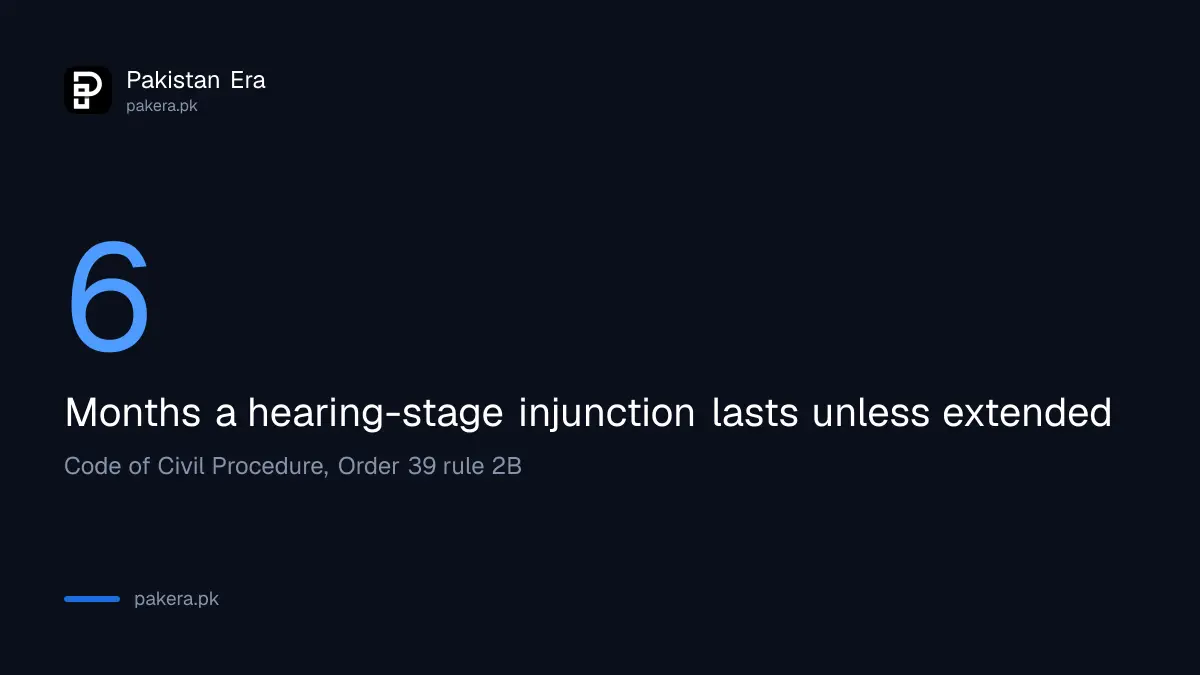
Rule 2A says an interim injunction passed without the defendant being heard should not ordinarily go beyond fifteen days. Rule 2B says an order made after hearing the parties ends after six months unless the court extends it, giving reasons.
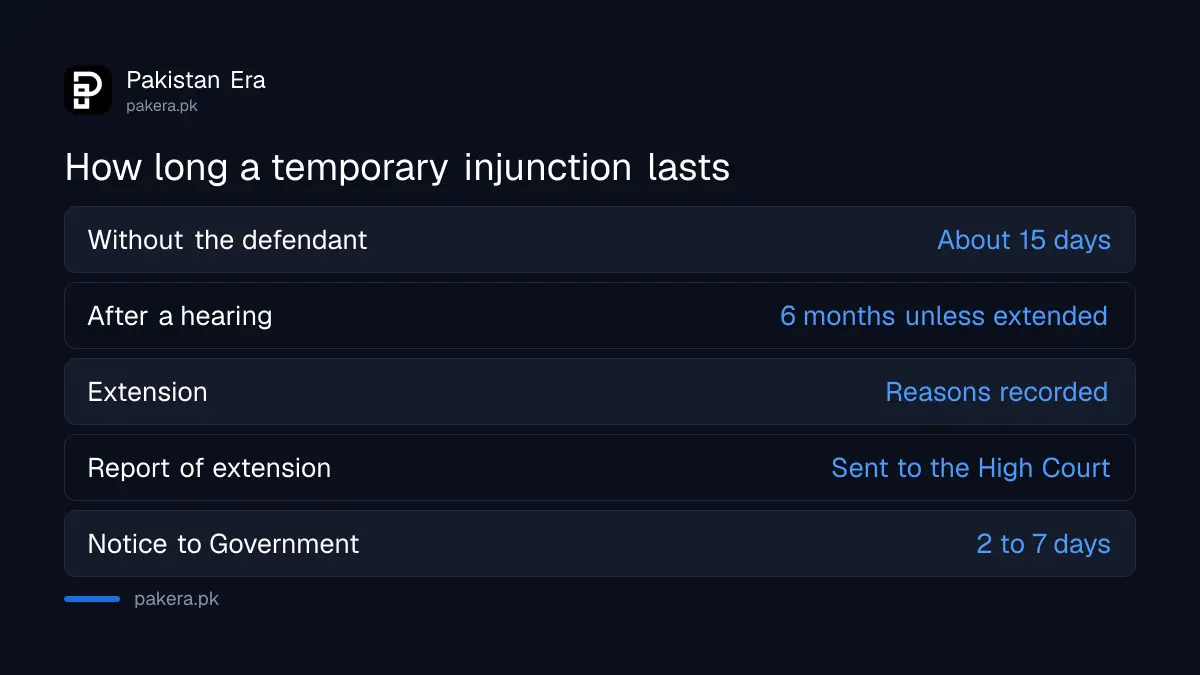
A report of any extension must be sent to the High Court. So watch the dates. If the six months are about to end, ask your lawyer to apply for an extension before the order lapses, not after.
The defendant may also apply to the court to cancel or change the order under rule 4. Be ready for that hearing with your documents.
Breaking the order has consequences
Under rule 2(3), if a party disobeys an injunction, the court may attach his property and order him detained in prison for up to six months, unless it releases him sooner. Attachment under that rule cannot last beyond one year.
If the property is sold in spite of the order, tell the court at once and with proof. Note the date, the buyer and the registry details. A sale made after a court order is a serious matter for the seller.
When the case ends, a decree or stay order may need to be entered in the land record. See how to record a court order or stay order in your land record in Punjab. To track hearings, see how to check a court case status online.
Common questions
What is a temporary injunction?
It is a court order that stops a party from doing something, such as selling disputed property, until the suit is decided or the court orders otherwise.
Can a court stop a sale before the case is decided?
Yes, under Order 39 rule 1, if it is shown that the property is in danger of being wasted, damaged or sold.
How long does the injunction last?
An interim order without hearing the other side should not ordinarily exceed fifteen days. After a hearing, it ends in six months unless extended.
Does the other side get notice?
Yes. Rule 3 requires notice, though it can be skipped where delay would defeat the purpose, apart from the Government cases the rule names.
What if someone ignores the order?
The court may attach property and order detention for up to six months under rule 2(3).
How we verified this
What we checked, where we read it, and what we could not confirm.
Last checked on 14 October 2026, Pakistan time. We read the Code of Civil Procedure, 1908 on the Pakistan Code, Order XXXIX. We did not read the court fee schedule, how courts decide such applications, or any provincial change. Speak to a lawyer before you file. This page explains the law and is not legal advice.
About the author

Senior Writer, Public Services and Technology
Shahid joined us in 2024 as an author. He is a senior contributor to Pakistan's leading technology websites. He writes detailed articles, mostly covering his expertise in the latest tech, mobiles, apps, gadgets, and step-by-step guides. His ideology is to help people understand the latest trends and explain complex methods through very easy-to-understand guides.