How to Report Unlawful Online Content to PTA, and Why Sites Get Blocked
Report a harmful website, post or profile to PTA under Unlawful Request, see what the form asks for, and learn why sites get blocked under PECA section 37.
To report a website, post or account as unlawful in Pakistan, file on PTA's complaint portal, complaint.pta.gov.pk/CMS/, under "Unlawful Request". You need a profile made with a mobile number registered on your CNIC, the exact link to the content, and an answer on whether you already reported it to the platform. The legal power to block comes from section 37 of the Prevention of Electronic Crimes Act, 2016.
Update, 9 October 2026: reported PTA figures put blocked URLs at 1,577,936 out of 1,789,022 processed. Read the latest blocking figures.
Two kinds of people land on this question. One has found something harmful online, such as a fake profile, a leaked photo or a page spreading threats, and wants it taken down. The other has opened a site and seen a notice that it is blocked, and wants to know why. This guide covers both.
We read the current text of the Act on the Pakistan Code, the Ministry of Law and Justice's statute site, and the code of PTA's complaint portal on 29 September 2026.
How to report unlawful online content to PTA
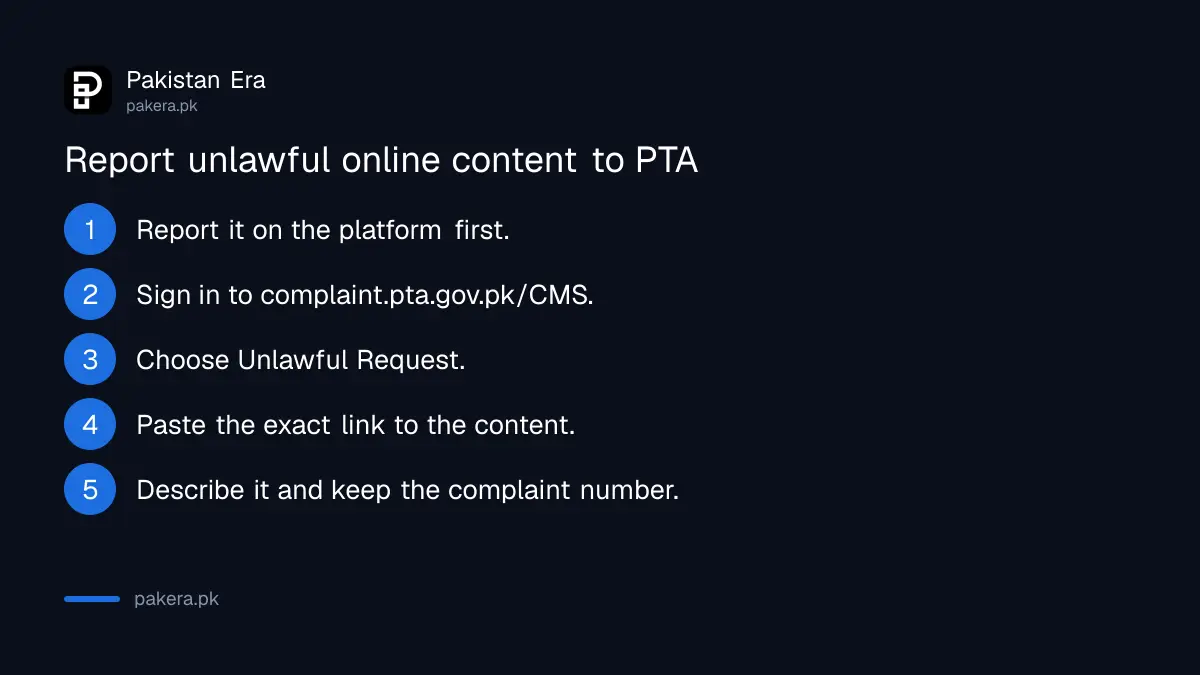
Sign in to PTA's complaint portal, choose "Unlawful Request", pick the platform, paste the link to the content, say whether you reported it to the platform first, and describe it. PTA's form says the complaint is made under the 2021 Rules on removing and blocking unlawful online content.
- Report the post to the platform first, using its own report button. Take a screenshot of that report.
- Open complaint.pta.gov.pk/CMS/ and create a profile with a mobile number registered against your name and CNIC, then verify it by OTP.
- Choose the complaint type "Unlawful Request", which the portal describes as "Unlawful Online Content Related Complaint".
- Select the platform, for example Facebook, YouTube, TikTok, or "Website / URL" for an ordinary site.
- Answer "Have you already lodged Complaint with Platform / Application?"
- Paste the full link in "Online Link to the Objectionable Content".
- Describe the content, with links, timestamps and any other details, then submit and keep the complaint number.
PTA's portal has a separate FAQs link for unlawful online content, and the helpline is 0800-55055 if the form will not work for you. The PTA CMS phone app offers the same categories.
What PTA's unlawful content form asks for
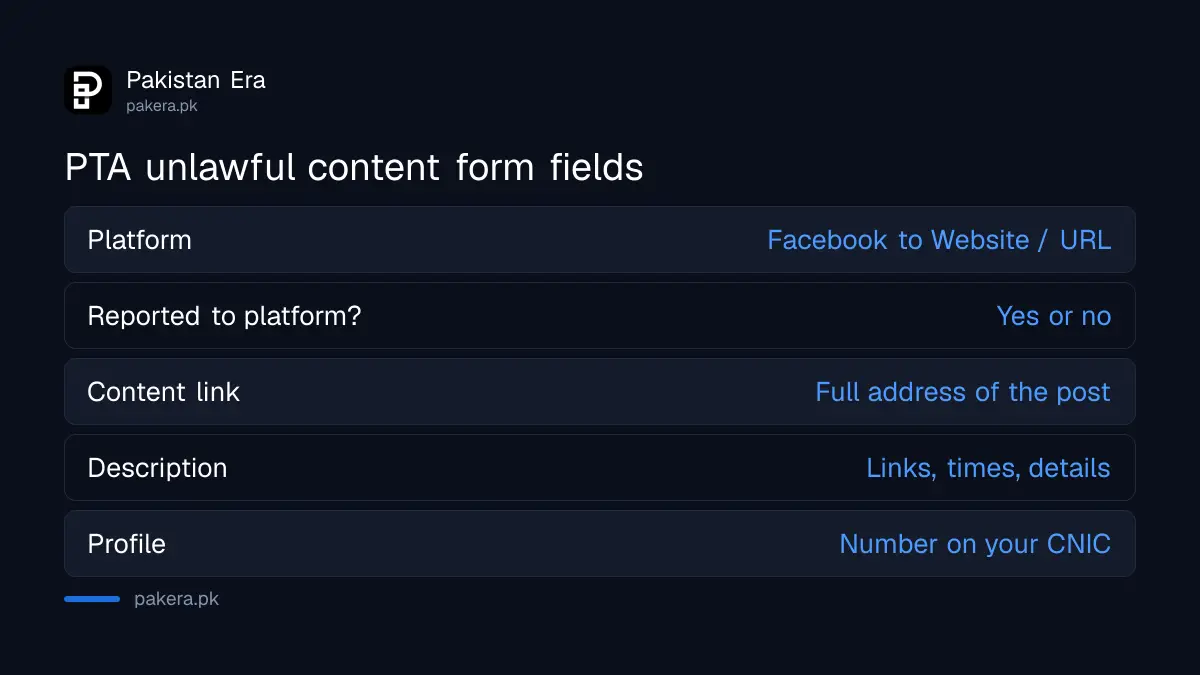
The form asks who you are, which platform the content is on, the exact link, whether you reported it to the platform, and a description. A vague complaint without a working link gives PTA nothing to act on.
| Field in PTA's form | What to put |
|---|---|
| Complainant name | Your name as on your CNIC |
| Guardian of complainant | The guardian name the form asks for, usually your father's or guardian's name |
| Platform | Facebook, Instagram, X, YouTube, TikTok, WhatsApp, Telegram, LinkedIn, Snapchat, Website / URL or Mobile App |
| Lodged with platform? | Yes or no, and when |
| Online link to the content | The full address of the post, profile or page |
| Description | What the content is, when you saw it, and why it is unlawful |
Copy the link from the browser's address bar, not a shortened share link. Posts get deleted and reposted, so screenshots with the date visible help too. If the content is a crime against you, such as blackmail or a fake profile used for fraud, report it to the police or the cybercrime authority as well. PTA can block content. It does not prosecute anyone.
Section 37 of PECA: the legal basis for blocking
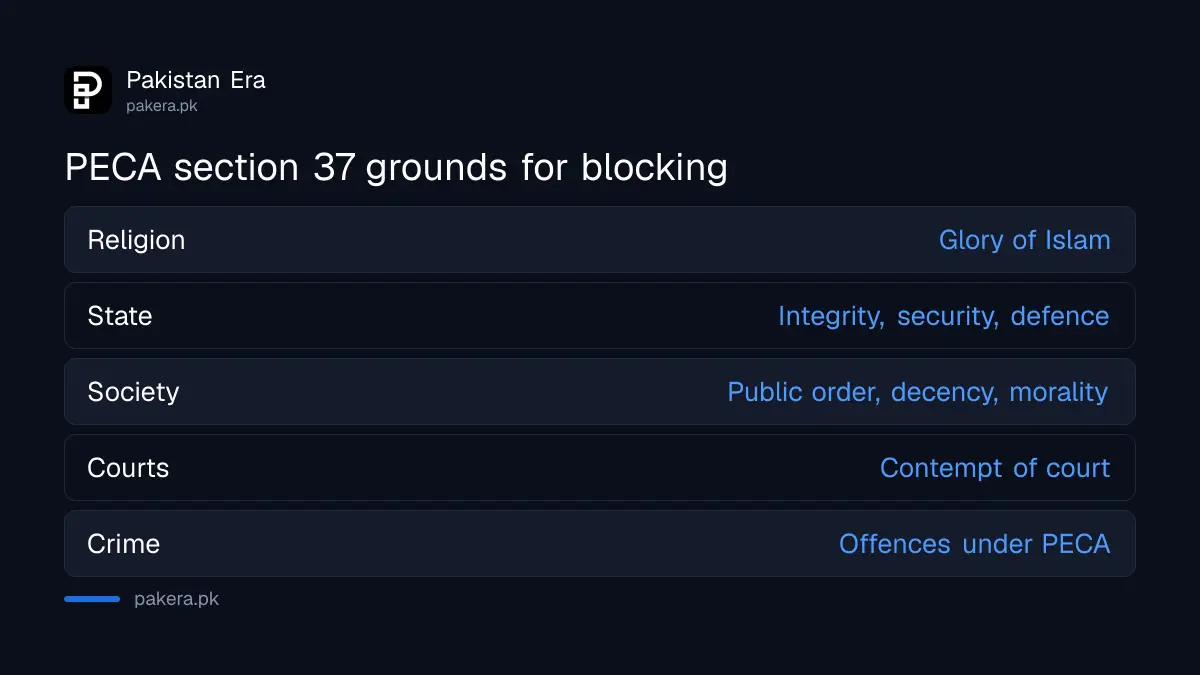
Section 37 of the Prevention of Electronic Crimes Act, 2016 lets "the Authority" remove or block access to information online on set grounds. They include Islam, Pakistan's security and defence, public order, decency or morality, contempt of court, and offences under the Act.
The section, as it reads on the Pakistan Code, lists these grounds:
- the interest of the glory of Islam;
- the integrity, security or defence of Pakistan or any part of it;
- public order;
- decency or morality;
- contempt of court;
- commission of, or incitement to, an offence under the Act.
Section 37 also says the power must be used under rules with "safeguards, transparent process and effective oversight". The rules PTA's form cites are the Removal and Blocking of Unlawful Online Content (Procedure, Oversight and Safeguards) Rules 2021.
One legal change matters. The Prevention of Electronic Crimes (Amendment) Act, 2025 changed what "the Authority" means in the Act. It now means the new Social Media Protection and Regulatory Authority, not PTA. Its chair and members were reported appointed in March 2026. Yet on 29 September 2026 PTA's complaint portal was still taking unlawful content complaints. So PTA's portal remains the working route for now.
Why a website shows "blocked by PTA"
A block notice usually means access to that site has been blocked in Pakistan, and your internet provider is showing the notice instead of the site. The notice comes from your provider's network, not from the website itself.
Not every site that fails to open is blocked, though. Check these before you assume a block:
- The site is down for everyone. Try it again later, or on another network.
- Your internet is down. Other sites fail too. That is a provider fault, and complaining to PTA about your network is a different route.
- Parental or safe browsing filters. Some home packages add them, and they show their own block page.
- A real block. The same site fails on every Pakistani network but works for someone abroad.
Some platforms are blocked in part rather than in full. A game or app can be reachable but restricted, as happened with Roblox in Pakistan. We do not quote the exact wording of block pages, because we could not read an official template for it.
How to challenge a block on your own site
Section 37(4) lets anyone affected by a blocking order apply to the Authority for a review within 30 days. If the review goes against you, section 37(5) allows an appeal to the Tribunal within another 30 days.
| Step | Time limit in section 37 | Where |
|---|---|---|
| Review of the blocking order | Within 30 days of the order | The Authority that made it |
| Appeal against the review decision | Within 30 days of the review order | The Tribunal |
The 30 days run from the date of the order, so a site owner who finds out late loses time. Keep a record of when the block started and any notice you received. The Tribunal named in the section was changed by the Establishment of Telecommunication Appellate Tribunal Act, 2024, so get legal advice before you file an appeal.
Platforms have a duty too. Under section 2S, added in 2025, social media platforms must keep an easy, always available way for users to complain about unlawful or offensive content. That is why step one is always the platform's own report button.
Common questions
How do I report a fake Facebook profile to PTA?
Report it on Facebook first. Then file on complaint.pta.gov.pk/CMS/ under "Unlawful Request", choose Facebook, paste the profile link and say you already reported it.
Which law allows PTA to block websites?
Section 37 of the Prevention of Electronic Crimes Act, 2016. It allows blocking on grounds such as security, public order, decency or morality and contempt of court.
Can I complain to PTA without a CNIC?
No. PTA's portal needs a profile made with a mobile number registered against your name and CNIC. The helpline, 0800-55055, can advise if you cannot register.
Can a blocked website owner appeal?
Yes. Section 37 allows a review application within 30 days of the order, then an appeal to the Tribunal within 30 days of the review decision.
Is PTA still in charge of blocking content?
PTA's portal still takes unlawful content complaints. But the 2025 amendment moved the section 37 powers in the Act's text to the new Social Media Protection and Regulatory Authority.
Does PTA arrest people for posts?
No. PTA handles blocking and removal. Crimes such as blackmail or harassment go to the police or the cybercrime authority.
How we verified this
What we checked, where we read it, and what we could not confirm.
Last checked on 29 September 2026. The text of sections 37, 2R, 2S and 2T and the 2025 definition of "Authority" were read in the Prevention of Electronic Crimes Act, 2016 on the Pakistan Code, which notes that its copy is under review and the Gazette is the original. The complaint type, form fields, the 2021 Rules citation and the profile rule were read in the code of PTA's complaint portal. The appointment of the new Authority's members in March 2026 is reported and not read in a Gazette notice. We did not file a complaint.
About the author

Tax, Bills and Technology Writer
Ali Akhtar is a young and curious voice here at Pakistan Era. He is currently pursuing his A-Levels and has a growing interest in Pakistan’s changing industrial landscape and educational trends. Ali likes to write in a way that helps him explain and explore the world around him. His writing reflects the perspective of the new generation navigating the evolving trends of Pakistan where technology, youth innovation, and shifting opportunities are reshaping the country’s future.