State Bank of Pakistan Earned Rs 1,990 Billion in FY26 and Remitted Rs 1,932 Billion to the Government
The State Bank of Pakistan earned Rs 1,990 billion in FY26, down 20%, and says Rs 1,932 billion went to the government. See what the accounts show in full.
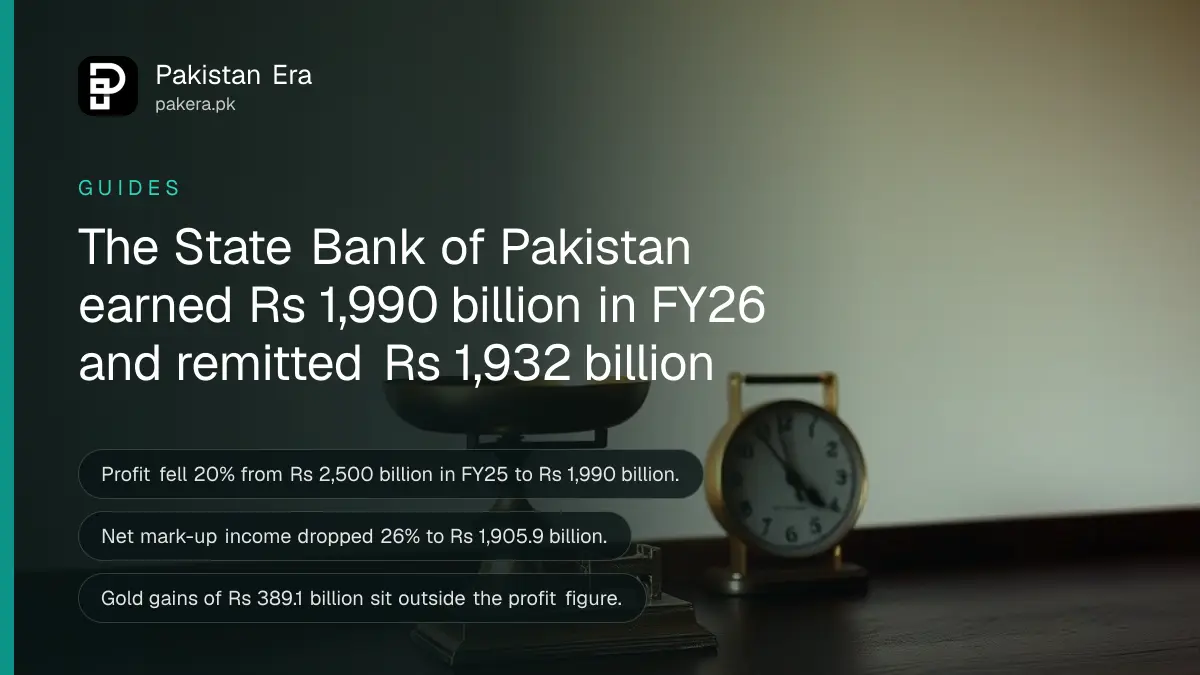
Short answer: The State Bank of Pakistan (SBP) earned a net profit of Rs 1,990 billion in FY26, the year ended 30 June 2026. That is 20 per cent less than the Rs 2,500 billion of FY25. The SBP says Rs 1,932 billion of surplus profit has been remitted to the federal government.
The SBP published its annual financial statements on 27 August 2026. We read the profit and loss account, the equity statement and the notes. The press release gives the headline. The accounts show where the money came from, and why it was lower.
The SBP earned Rs 1,990 billion in FY26, down from Rs 2,500 billion
The SBP's profit for the year was Rs 1,990.4 billion, against Rs 2,499.8 billion in FY25. The fall is Rs 509.4 billion, or 20.4 per cent. The central bank earns most of its income as mark-up on the government securities and other assets it holds, so a fall in interest income moves the profit directly.
| Line in the profit and loss account | FY25 (Rs billion) | FY26 (Rs billion) |
|---|---|---|
| Mark-up earned on assets at amortised cost | 2,801.3 | 2,037.4 |
| Mark-up earned on assets at fair value through other comprehensive income | 25.9 | 63.1 |
| Mark-up expense | -245.2 | -194.5 |
| Net mark-up income | 2,581.9 | 1,905.9 |
| Fair valuation adjustment on COVID-19 loans | 22.9 | 19.6 |
| Other income, net | -24.1 | 153.1 |
| Operating expenses | 80.9 | 88.3 |
| Profit for the year | 2,499.8 | 1,990.4 |
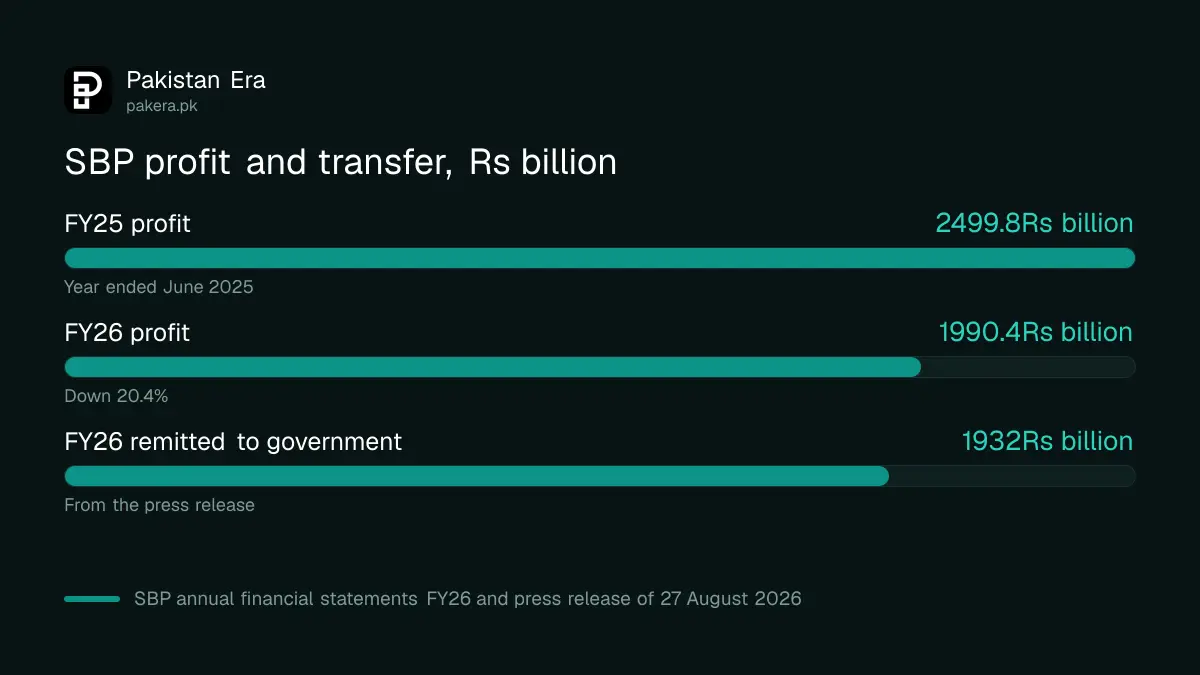
Amounts in the statements are printed in thousands of rupees. We converted them to billions and rounded to one decimal place.
Lower mark-up income explains the fall
Net mark-up income fell from Rs 2,581.9 billion to Rs 1,905.9 billion, a drop of 26 per cent. Other income swung from a net loss of Rs 24.1 billion to a net gain of Rs 153.1 billion, which softened the blow. Operating expenses rose 9 per cent, with banknote printing at Rs 29.6 billion.
The accounts do not name one cause for the lower mark-up. Interest rates were far lower on average than in FY25, when the policy rate began the year near 20 per cent and had come down to 11 per cent by May 2025, according to the SBP's own rate table. Our explainer on the policy rate decision sets out where the rate stands now.
Gold gains sit outside the profit figure
The Rs 1,990 billion does not include the rise in the value of the SBP's gold. That gain, Rs 389.1 billion in FY26 against Rs 591.2 billion in FY25, goes to other comprehensive income and to a revaluation reserve, not to profit. The reserve stood at Rs 2,324.3 billion on 30 June 2026.
This matters when you compare headlines. Some readers add the gold gain and some do not. The SBP's own profit line leaves it out, and so does the Rs 1,932 billion transfer. Total comprehensive income, which does add it, was Rs 2,516.9 billion.
How much reached the government is a separate figure
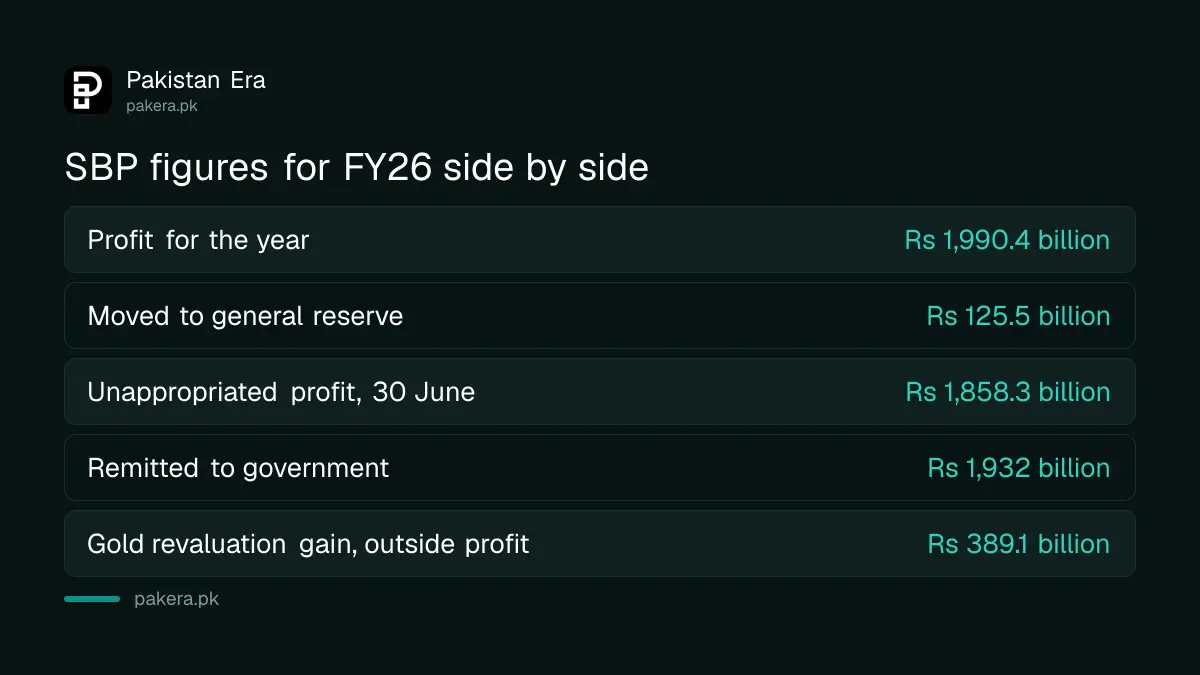
The SBP says that after appropriations, a surplus profit of Rs 1,932 billion has been remitted to the federal government. The accounts show Rs 125.5 billion moved to the general reserve in FY26, against Rs 58.7 billion the year before, and Rs 1,858.3 billion of unappropriated profit at year end.
We could not rebuild Rs 1,932 billion from the statements alone. The press release counts the transfer after appropriations "as required under the accounting framework and statutory requirements". So we quote each figure as its own source gives it. The list below sets the four numbers side by side.
- Profit for the year: Rs 1,990.4 billion, from the profit and loss account.
- Moved to general reserve: Rs 125.5 billion, from note 30 of the accounts.
- Unappropriated profit at 30 June 2026: Rs 1,858.3 billion, from the balance sheet.
- Remitted to the government: Rs 1,932 billion, from the 27 August press release.
What the transfer means for the budget
The transfer is non-tax revenue to the federal government. The Finance Ministry's Annual Debt Review gives net federal revenue of Rs 10,520 billion for FY26, and Rs 1,932 billion is about 18 per cent of that, by our arithmetic. The two figures are not measured the same way, so treat the share as a guide only.
The size of the transfer also helps the debt picture. Our review of the Annual Debt Review shows interest still takes two thirds of net federal revenue. A smaller SBP profit in FY27 would mean less help from this source if rates stay lower.
Common questions
How much profit did the State Bank make in FY26?
It made Rs 1,990 billion, or Rs 1,990.4 billion exactly, for the year ended 30 June 2026.
Why was the profit lower than in FY25?
Net mark-up income fell 26 per cent, from Rs 2,581.9 billion to Rs 1,905.9 billion, and the accounts do not state a single reason.
Where does the SBP's profit go?
Most of it goes to the federal government, after a part is kept in reserves. The SBP says Rs 1,932 billion was remitted for FY26.
Does the profit include gold gains?
No. Gold revaluation gains of Rs 389.1 billion are shown in other comprehensive income and in a reserve, not in profit.
Does the SBP profit come from taxpayers?
No. It comes from the SBP's own income, mainly mark-up on the assets it holds. It is not a tax.
Where can I read the accounts?
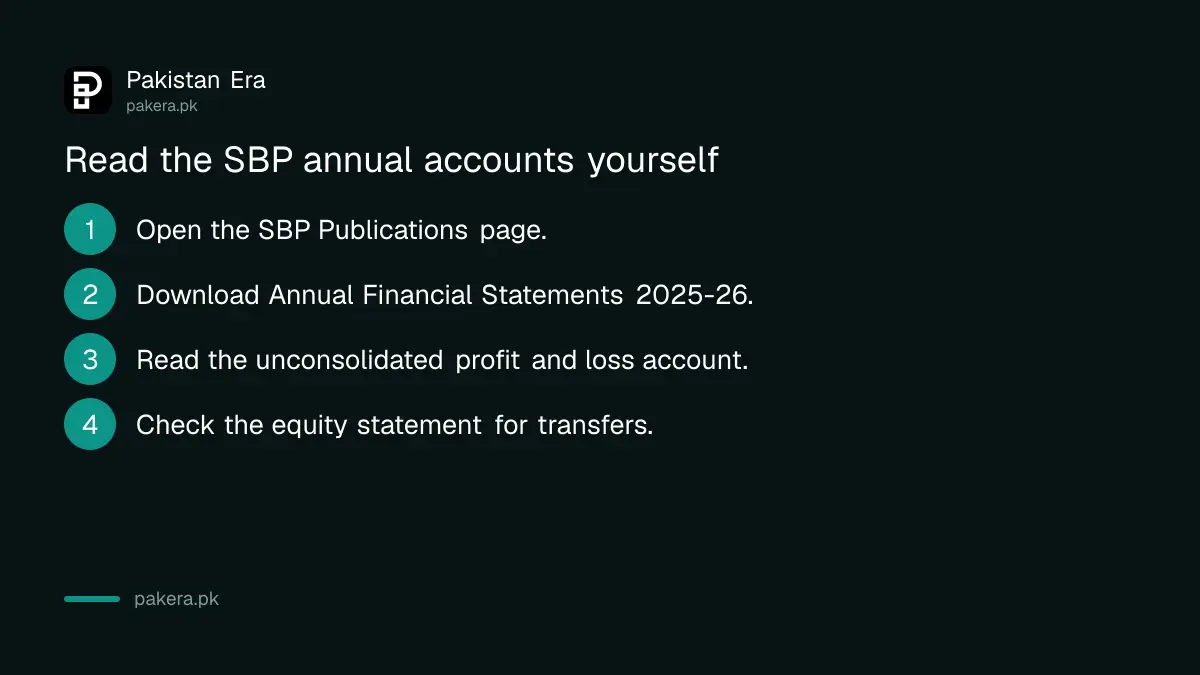
On the SBP website, under Publications, as the Annual Financial Statements for 2025-26.
How we verified this
What we checked, where we read it, and what we could not confirm.
Last checked on 11 October 2026. We read the State Bank of Pakistan's press release of 27 August 2026 and its Annual Financial Statements for FY 2025-26, including the unconsolidated profit and loss account, the statement of changes in equity and notes 30 and 32. We also read the Finance Division's Annual Debt Review for FY2026 for the revenue figure. Billion-rupee conversions, percentage changes and the share of revenue are our arithmetic.
About the author

Global Affairs & Political Economy Writer
Muhammad Hatim is a book lover who started writing because he enjoys it. At Pakistan Era he writes about international relations, geopolitics and the global economy, with a particular interest in South Asia and the forces behind current events.