SBP Names UBL, HBL and NBP Pakistan's Systemically Important Banks for 2026, With Extra Capital From March 2027
SBP named UBL, HBL and NBP Pakistan's systemically important banks for 2026. Extra capital of 2.5%, 1.5% and 1.0% starts 31 March 2027. What it means for savers
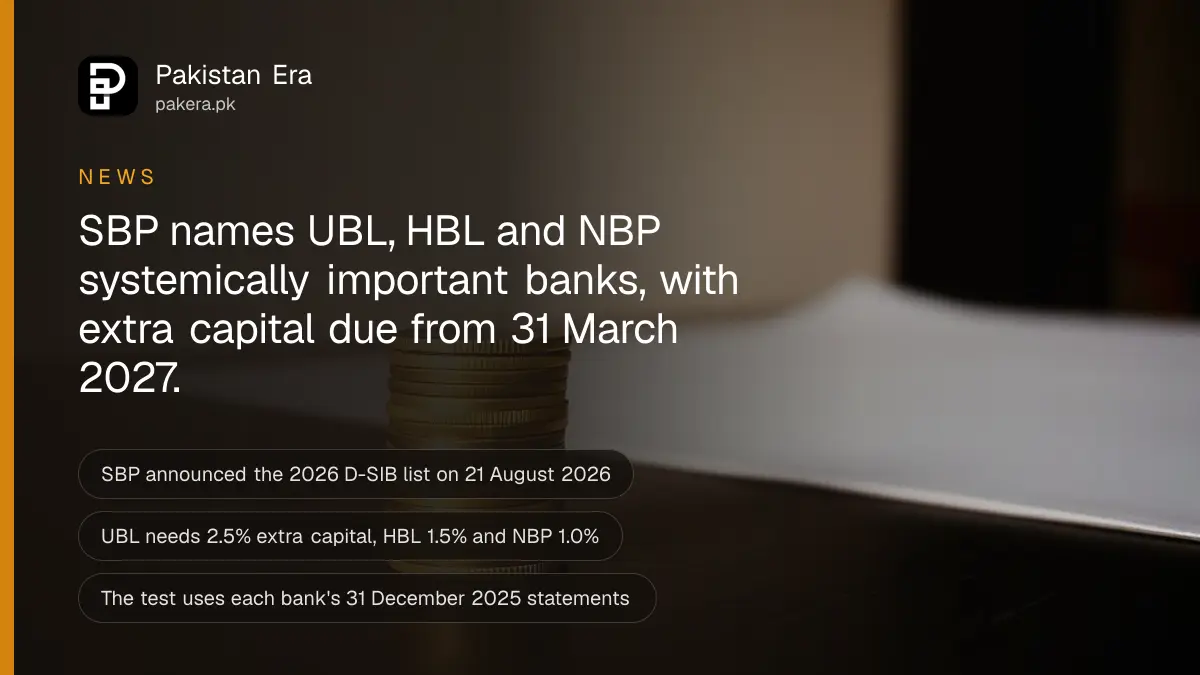
The State Bank of Pakistan (SBP) has named three banks as Domestic Systemically Important Banks for 2026: United Bank Limited (UBL), Habib Bank Limited (HBL) and National Bank of Pakistan (NBP). From 31 March 2027 they must hold extra capital of 2.5 per cent, 1.5 per cent and 1.0 per cent respectively, in addition to tighter supervision.
The SBP announced the list on 21 August 2026. It is not a warning about the health of these banks. It is a label for banks so large and so connected that a failure would hurt the whole system, so the regulator asks them to carry a thicker safety cushion. This explainer sets out what the list says, how the SBP picks the banks and what, if anything, changes for a customer.
Read the three names and their extra capital
The SBP press release of 21 August 2026 lists each bank under a "bucket" and gives each bucket an extra capital requirement. The measure used is Common Equity Tier-1 (CET-1) capital, which is a bank's shareholder equity and retained profit, the purest layer of its loss-absorbing cushion.
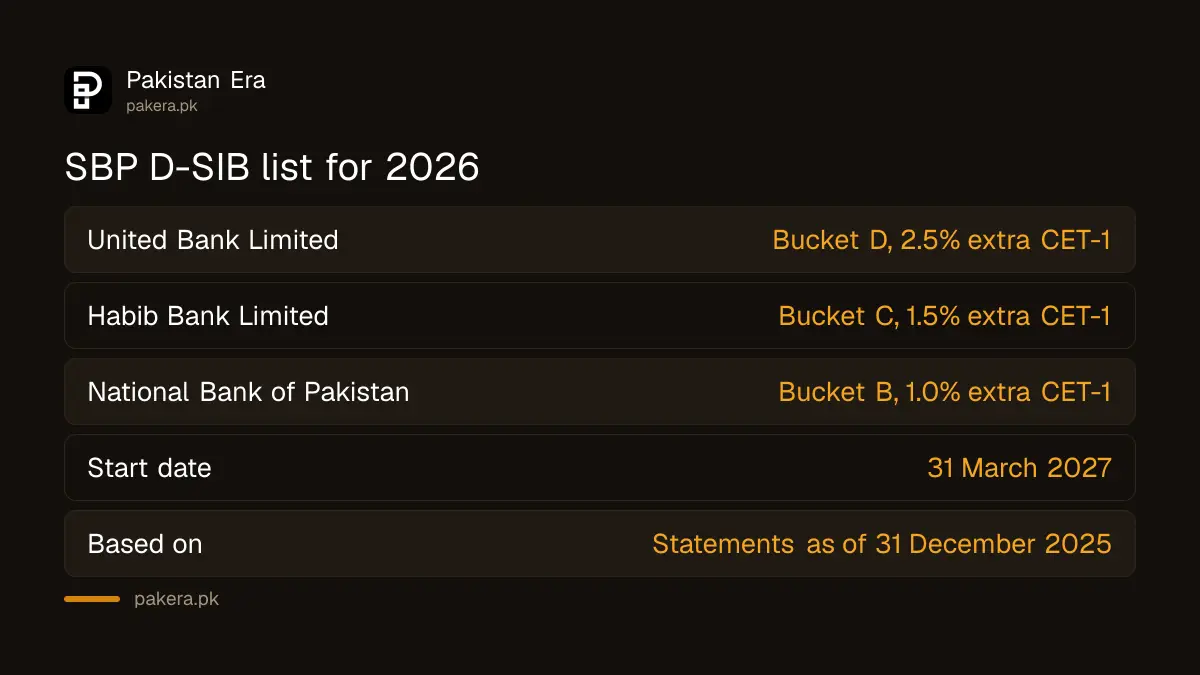
| Bank | Bucket | Extra CET-1 required |
|---|---|---|
| United Bank Limited | D | 2.5% |
| Habib Bank Limited | C | 1.5% |
| National Bank of Pakistan | B | 1.0% |
The extra requirement takes effect from 31 March 2027. It is on top of the normal minimum capital, and the three banks also face enhanced supervisory requirements under the SBP framework.
See how the SBP picks these banks
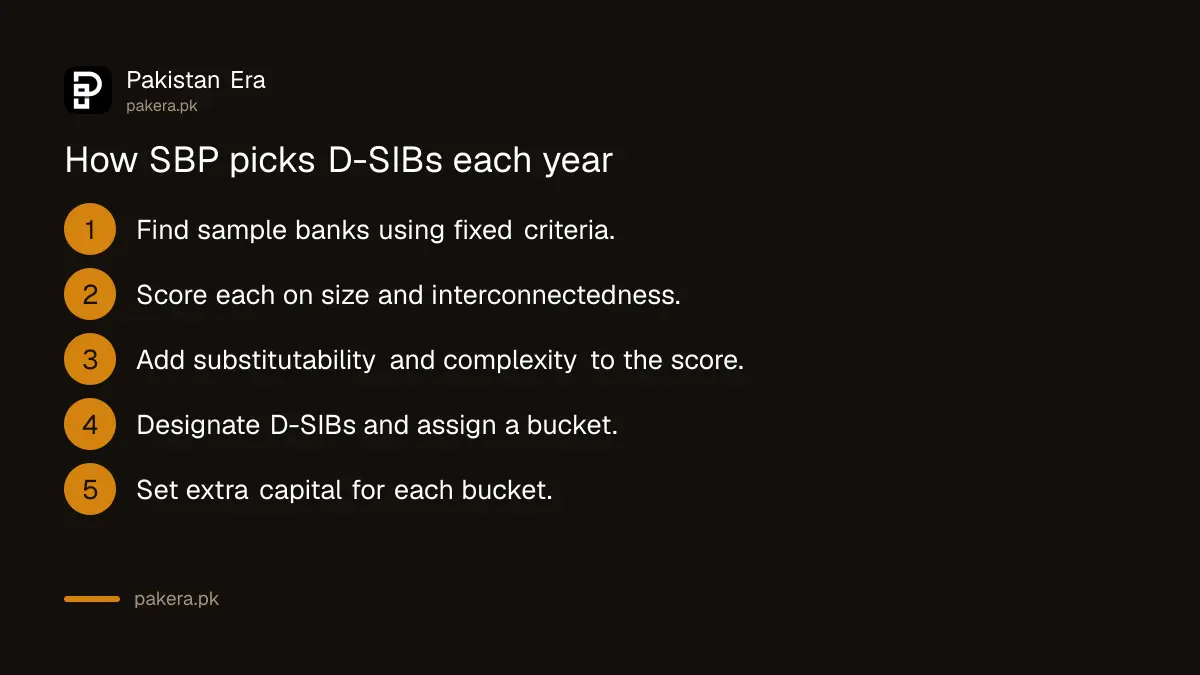
The SBP uses its Framework for Domestic Systemically Important Banks, published in April 2018 and amended in December 2022. It runs the test once a year in two steps.
- The SBP first identifies "sample" D-SIBs, using fixed quantitative and qualitative criteria.
- It then designates D-SIBs from that sample, based on each bank's composite systemic score.
The score looks at four things: size, interconnectedness, substitutability and complexity. Interconnectedness means how tightly a bank is tied to other banks. Substitutability means how hard it would be for others to replace the services it provides. For the 2026 list the SBP used the banks' financial statements as of 31 December 2025.
Check what happens to foreign bank branches
The same press release covers branches of global systemically important banks (G-SIBs) in Pakistan. These must hold extra CET-1 capital against their risk-weighted assets in Pakistan, at the rate the Financial Stability Board has set for their parent bank. The release does not name any such branch, so we name none.
Understand what it means for your account
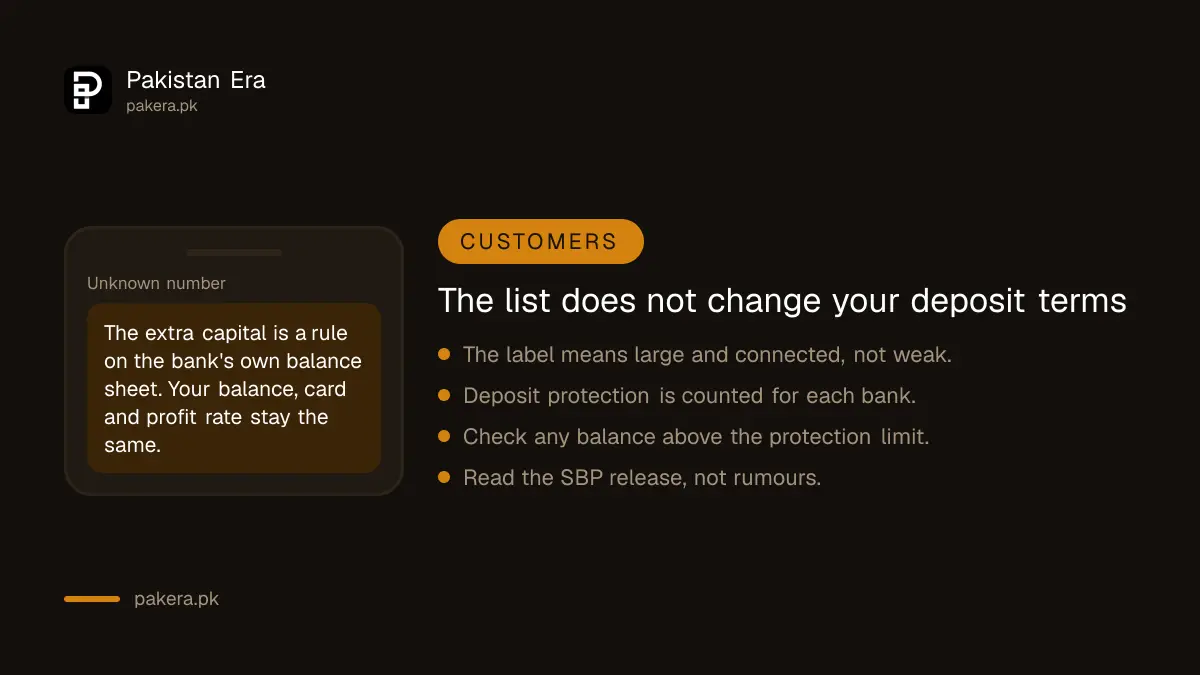
For a customer, nothing changes on the day the list is published. Your balance, your card and your profit rate stay as they were. The extra capital is a rule for the bank's balance sheet, not a charge on you.
The SBP says the aim is to strengthen the banks' resilience against shocks and improve their risk management. It does not say how the banks will meet the extra requirement, so we do not predict any effect on lending or profit.
The wider picture is positive, according to the SBP's own data. Its mid-year review said Pakistan's banking sector stayed resilient in the first half of 2026, as we set out in our report on the SBP mid-year banking review. In that review, the SBP's stress tests say the large systemically important banks are expected to remain solvent under severe shocks over two years.
Keep your own deposits protected
The D-SIB list does not change the deposit protection limit. Cover is for each bank, so it matters whether your money sits at one bank or several. Our guide on checking whether your deposit is protected gives the current limit and the steps.
If you hold large savings in a single bank, whether or not it is on this list, compare it against that limit. And if you want to see what your balance earns, our table of savings account profit rates for October 2026 shows what banks pay now.
- Check each account against the protection limit.
- Do not move money because of a rumour. Read the SBP release.
- Use the banking Ombudsman if a bank delays your money.
Common questions
Which banks are D-SIBs in Pakistan for 2026?
United Bank Limited, Habib Bank Limited and National Bank of Pakistan, according to the SBP release of 21 August 2026.
When does the extra capital requirement start?
On 31 March 2027, says the SBP. Until then the banks continue under the earlier rules.
Does a D-SIB label mean the bank is weak?
No. It means the bank is large, connected and hard to replace, so the SBP asks it to hold extra capital. The release does not criticise any of the three.
Does my money change from this list?
No. The rule is about the bank's own capital. Your deposit terms are unchanged.
How often does the SBP update the D-SIB list?
Every year. The SBP says the identification is carried out annually, using the previous 31 December statements.
How we verified this
What we checked, where we read it, and what we could not confirm.
Last checked 11 October 2026. We read the SBP press release of 21 August 2026, "State Bank of Pakistan Designates Domestic Systemically Important Banks (D-SIBs) for the year 2026", on sbp.org.pk. The three names, the bucket and percentage table, the 31 March 2027 date, the two step process and the G-SIB branch rule come from that release. We did not read the full D-SIB framework document, and we do not predict any effect on lending. This is information, not financial advice.
About the author

Technology Journalist & Multimedia Producer
Ahmad Ali is a technology journalist and multimedia producer at Pakistan Era, joining the team in October 2026. He covers consumer technology and digital life for Pakistani readers, combining research with hands-on product testing.