Senate Election 2027 in Pakistan: 48 Seats, Who Votes, Rs 20,000 Deposit and Every Step of the Timetable
Pakistan's Senate election 2027 fills 48 seats ending in March. Who votes, who can stand, the Rs 20,000 deposit and each legal deadline, from the Elections Act.
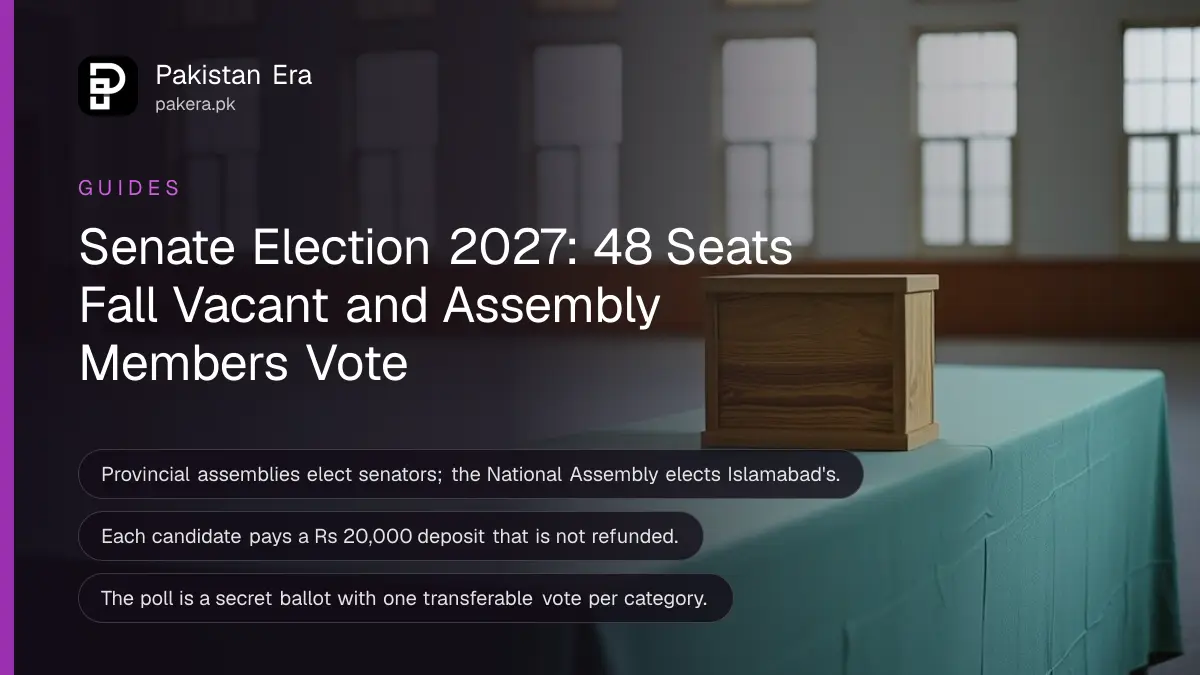
Short answer: Pakistan's next Senate election will fill the 48 seats whose terms end in March 2027. Senators are not elected by the public. Members of each provincial assembly vote for their province's senators, and the National Assembly votes for Islamabad's. The vote is a secret ballot, and each member gets one transferable vote per category of seat. Candidates pay a Rs 20,000 deposit that is not refunded.
We counted the 48 seats from the Senate's own members list on 11 November 2026, and we read the Senate election chapter of the Elections Act 2017 on the Election Commission of Pakistan (ECP) website, sections 105 to 126. The ECP has not announced a schedule yet, and by law it cannot hold the poll until close to the date the seats fall vacant. Below is who votes, who can stand, every step from notification to result, and what to watch for.
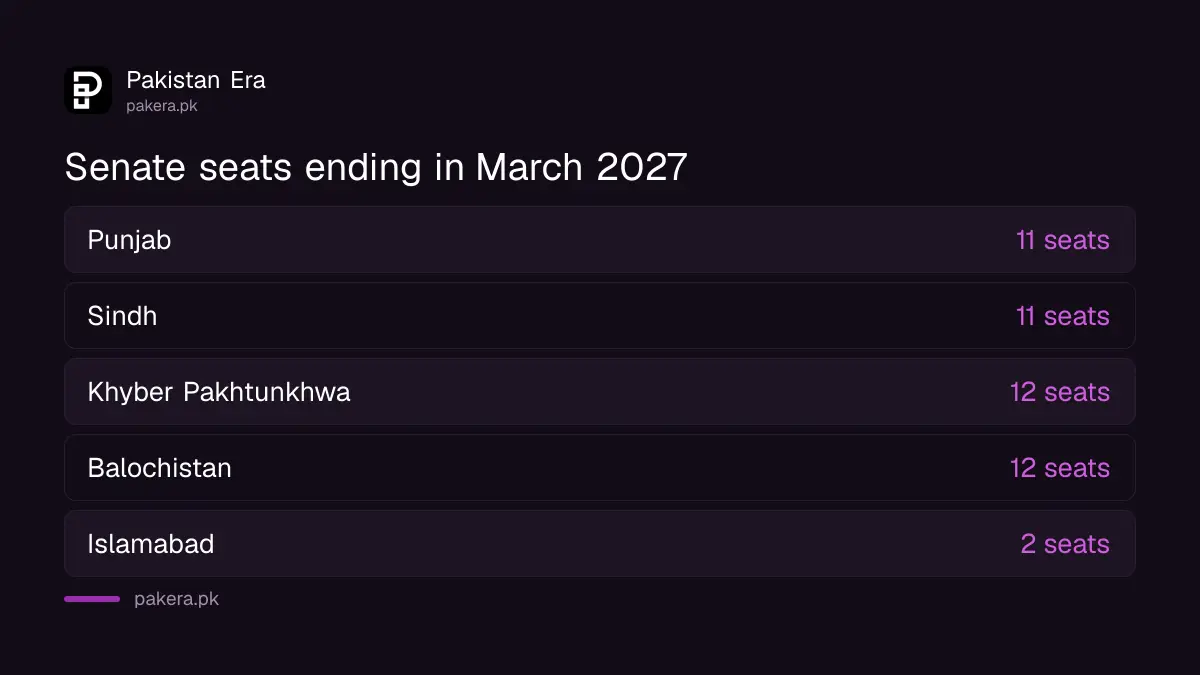
48 Senate seats fall vacant in March 2027
Exactly 48 senators, half the House, have terms listed as "March 2021 to March 2027" on senate.gov.pk. They are the seats filled in the 2021 election. The other 47 listed senators serve to March 2030.
| Area | Seats ending March 2027 | Who votes for them |
|---|---|---|
| Punjab | 11 | Members of the Provincial Assembly of Punjab |
| Sindh | 11 | Members of the Provincial Assembly of Sindh |
| Khyber Pakhtunkhwa | 12 | Members of the Khyber Pakhtunkhwa Assembly |
| Balochistan | 12 | Members of the Provincial Assembly of Balochistan |
| Islamabad | 2 | Members of the National Assembly |
Why do Khyber Pakhtunkhwa and Balochistan have 12 and the others 11? Each province has one non-Muslim seat, and those are elected in alternate rounds. In 2021 the two non-Muslim seats were in Khyber Pakhtunkhwa and Balochistan, so they come up again in 2027. The split by seat type below is our own count from the 2021 group, not an ECP figure: each province has 7 general seats, 2 women's seats and 2 technocrat or aalim seats, plus the non-Muslim seat in those two provinces. Islamabad has 1 general and 1 women's seat.
The public does not vote in a Senate election
A Senate election is an indirect election. Under section 107 of the Elections Act, the ECP calls on the members of each provincial assembly, or of the National Assembly for Islamabad, to elect the senators. So if you want a say, your route is the MPA or MNA you already elected.
That is also why the party balance in each assembly decides most of the result in advance. A party with a large majority in a provincial assembly can expect most of that province's seats. Your MPA's contact details, and your MNA's through find your MNA, are the way to raise a view before the vote.
Each member has one transferable vote per category
Section 122 says every member of the voting assembly may vote, no vote can be given by proxy, and the poll is by secret ballot. Each voter has "only one transferable vote for each category of seats", however many seats that category has. In practice, the member ranks candidates in order of choice on the ballot for general seats, and does the same on separate ballots for women's, technocrat and non-Muslim seats.
The counting method itself is set in the Election Rules 2017, not the Act, and we have not set it out here.
Who can stand for the Senate
A candidate must meet the qualifications in Article 62 of the Constitution and must not be disqualified under Article 63. He or she must be on the electoral roll, since the nomination paper needs a certified extract from it. The technocrat and aalim seats have their own tests in section 2 of the Elections Act:
- Technocrat: a degree of at least 16 years of education recognised by the Higher Education Commission, and at least 20 years of post-qualification experience with a record of achievement at national or international level.
- Aalim: a degree or sanad of at least 16 years of education recognised by HEC, and at least 20 years' experience as a teacher or researcher in Islamic principles, philosophy and law.
The nomination paper is Form A, signed by a proposer and a seconder who are themselves voters in that election, meaning members of the voting assembly. A candidate can be nominated on up to 5 nomination papers, but pays one deposit.
What goes with a nomination paper
- A declaration that the candidate consents and meets Articles 62 and 63.
- A declaration of being a technocrat or aalim, for those seats.
- A declaration that a separate bank account has been opened, or an existing one set aside, for election expenses.
- An attested copy of the CNIC.
- A statement of assets and liabilities of the candidate, spouse and dependent children as on the last 30 June, on Form B.
- A certified extract of the electoral roll showing the candidate's name.
- A deposit of Rs 20,000, in cash or with a National Bank of Pakistan or treasury receipt. It is not refundable.
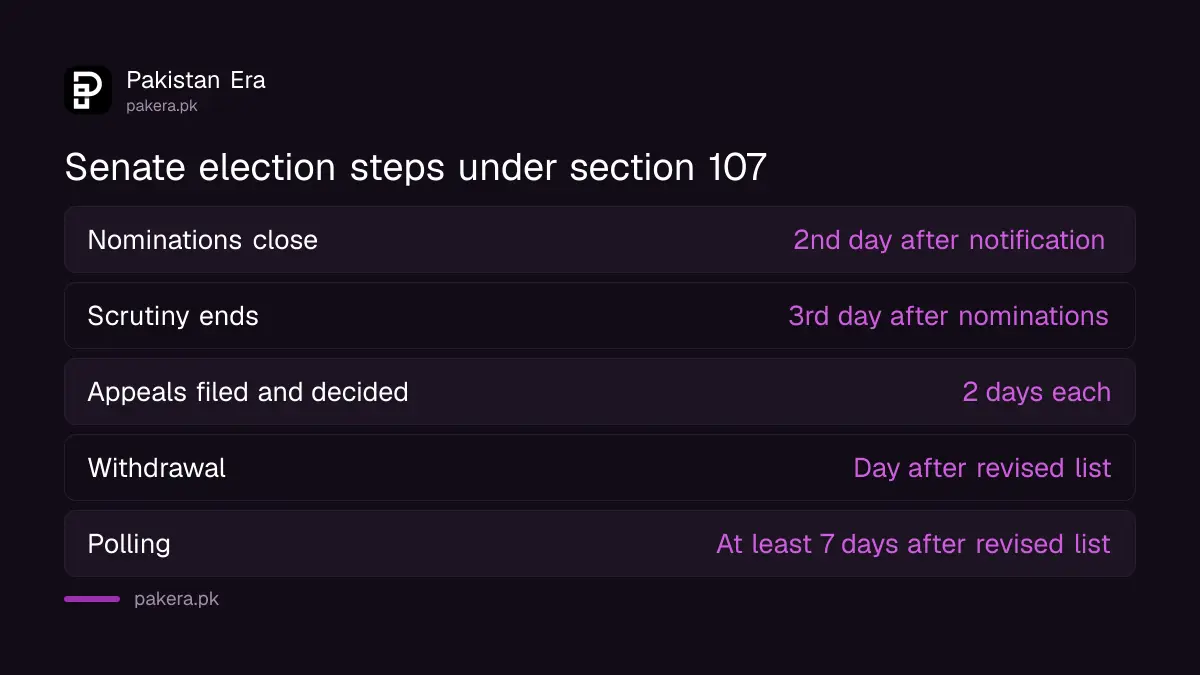
The Senate election timetable is short and fixed by law
Section 107 sets the gaps between each step, counted from the day the ECP publishes its notification in the Gazette. The whole process, from notification to polling, takes about two to three weeks. Here are the limits in the Act:
| Step | Last date under section 107 |
|---|---|
| Nominations close | Second day after the notification |
| Names of nominated candidates published | Day after nominations close |
| Scrutiny ends | Third day after nominations close |
| Appeals filed | Second day after scrutiny ends |
| Appeals decided | Second day after the appeal deadline |
| Revised list published | Day after appeals are decided |
| Withdrawal | Day after the revised list |
| Polling | Not earlier than the seventh day after the revised list |
Where a date falls on a public holiday, it moves to the next working day. Appeals against a Returning Officer's scrutiny decision go to a tribunal of a High Court judge, and its order is final.
When the 2027 poll can be held
Article 224(3) of the Constitution says a Senate election to fill seats whose term is ending cannot be held earlier than 30 days before the seats fall vacant. With terms ending in March 2027, that puts the poll in February or March 2027. This is our reading of the law; the ECP has not announced a date.
Uncontested seats, results and appeals
If, after scrutiny or withdrawals, the number of candidates in a province is equal to or below the seats on offer, the Returning Officer declares them elected unopposed under section 118. He must wait until the appeal period ends first. If there are more candidates than seats, a poll is held.
After the count, the ECP publishes the winners in the Gazette and on its website. A winner must file a return of election expenses within 5 days, and the ECP will not publish the name of a winner who fails to. A losing candidate who disputes the count can appeal to the ECP within 3 days of the count, under section 125.
The new senators join those serving to 2030, and the House then elects its Chairman and Deputy Chairman. The current Chairman, Syed Yousaf Raza Gilani, holds an Islamabad seat whose term ends in March 2027, according to the Senate's members page. Every bill still needs this House too, as set out in how a bill becomes law in Pakistan. A seat that falls vacant later in a term is filled by a by-election instead, under the rules in by-election rules in Pakistan.
Common questions
When is the next Senate election in Pakistan?
For the 48 seats ending in March 2027. Under Article 224(3) the poll cannot be earlier than 30 days before the seats fall vacant. The ECP has not announced a date yet.
Can ordinary citizens vote in the Senate election?
No. Provincial assembly members elect their province's senators, and National Assembly members elect Islamabad's.
Is the Senate vote secret?
Yes. Section 122(6) of the Elections Act 2017 says the poll for the Senate is held by secret ballot.
What is the nomination fee for a Senate candidate?
A Rs 20,000 deposit, paid in cash or at a National Bank branch or treasury, under section 111. It is not refunded.
How many Senate seats does each province have?
23 each, and Islamabad has 4, for 96 in all. About half come up for election every three years.
Who can stand on a technocrat seat?
Someone with at least 16 years of HEC-recognised education and at least 20 years of post-qualification experience with a record of achievement at national or international level.
Sources: Elections Act 2017 (as modified up to 5 August 2023, as published by the ECP), sections 2, 105 to 126; Senate of Pakistan members list on senate.gov.pk; Constitution of Pakistan, Articles 59, 62, 63 and 224. Last checked 11 November 2026.
About the author

Global Affairs & Political Economy Writer
Muhammad Hatim is a book lover who started writing because he enjoys it. At Pakistan Era he writes about international relations, geopolitics and the global economy, with a particular interest in South Asia and the forces behind current events.