How to Pay Sindh Vehicle Tax Online, and Check Your Arrears First
Check Sindh token tax by registration number, generate a 12 digit PSID on the Excise portal and pay through 28 banks, Easypaisa, JazzCash or card
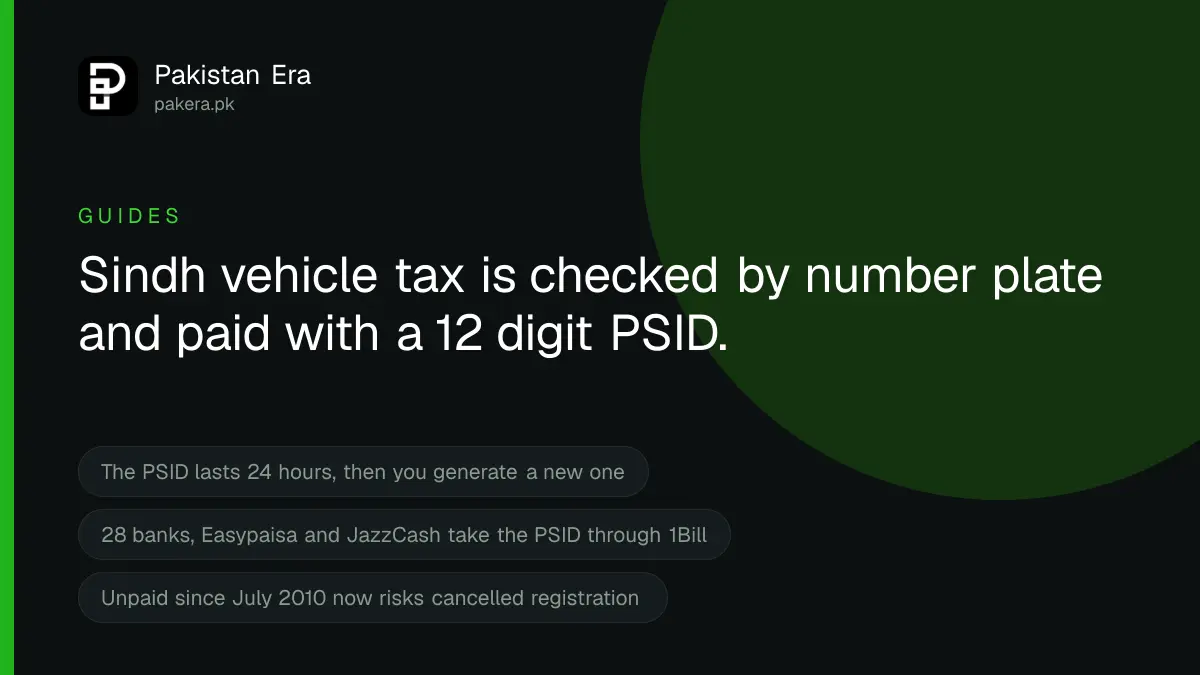
Online vehicle tax payment in Sindh runs through the Excise department's tax portal at taxportal.excise.gos.pk. Choose Quick Pay, type your mobile number and registration number, and the portal shows your arrears and current tax. It then gives you a 12 digit PSID, which you pay within 24 hours at an ATM, through a banking app, in Easypaisa or JazzCash, or by card. No office visit, no bank queue.
A Karachi number plate has a way of collecting years. The car changes hands, the file goes in a drawer, and nobody asks about the token tax until a traffic stop or a sale. Since the Sindh Cabinet decided on 5 August 2026 to start cancelling registrations of long term defaulters, that drawer is worth opening now.
We read the Excise, Taxation and Narcotics Control Department's own pages and its tax portal on 17 September 2026. The portal lists 28 banks that accept the PSID through 1Bill, though its heading says 29, and that count is where most of the convenience comes from. Everything below is from those pages unless we say it is reported.
Where do you check Sindh vehicle tax by registration number?
On the Quick Pay page of the tax portal, which calculates what is owed before you commit to anything. The department's older verification page at excise.gos.pk/vehicle/vehicle_search shows the vehicle record, and a separate page searches by CNIC, but the tax amount itself comes from Quick Pay.
The form asks for four things: whether the vehicle is a 4 wheeler or a 2 wheeler, a mobile number in the form 03XXXXXXXXX, the registration number written like ABC-123 with the hyphen, and a captcha. Then it lists the tax under three headings: Head, Arrears and Current Tax.
Read the Arrears line before anything else. That is the number a buyer will find, and the number the new enforcement is aimed at. Registration records for every province, including who owns the car and whether it is reported stolen, are in the vehicle verification portals we tested, and Sindh's is one of the ones that works.
How do you pay Sindh vehicle tax online?
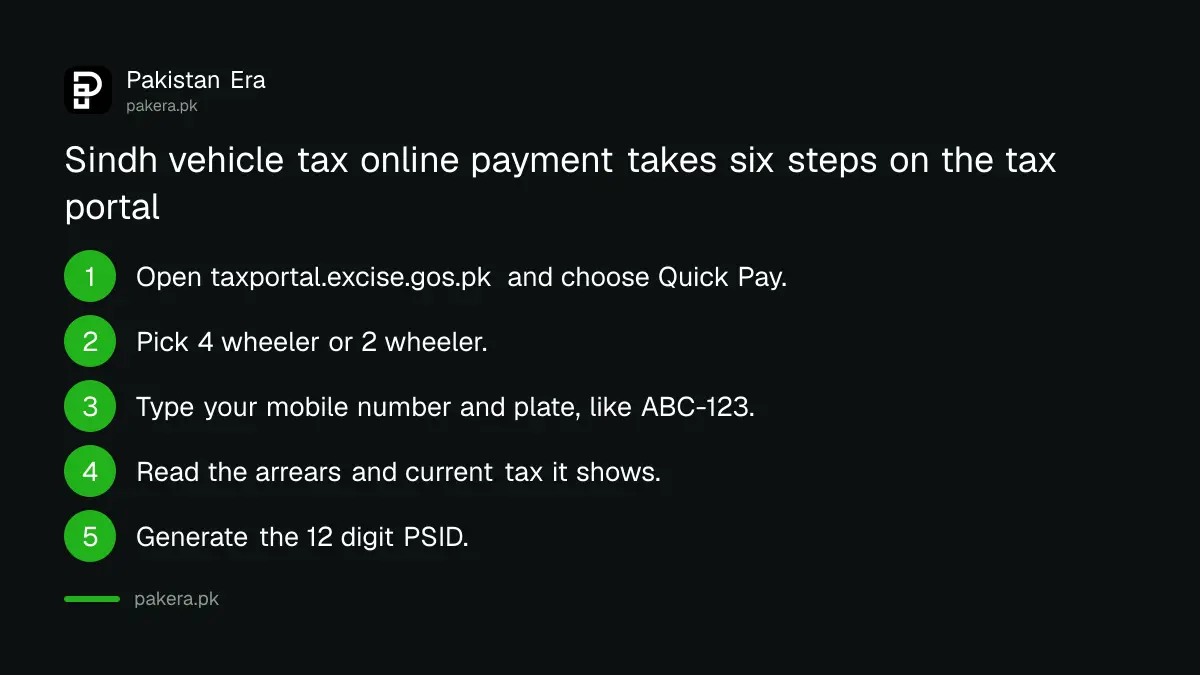
- Open taxportal.excise.gos.pk and choose Quick Pay. You do not need an account for this route.
- Select 4 Wheeler or 2 Wheeler.
- Enter your mobile number and the registration number, then the captcha, and press Calculate Amount.
- Check the Arrears and Current Tax lines against what you expected.
- Press Generate PSID. The 12 digit Payment Slip ID appears on screen and is sent by SMS to the number you typed.
- Pay the PSID through any channel in the next section. The department sends a confirmation SMS once the payment lands.
The PSID is valid for 24 hours. The portal's FAQ says so, and adds that if you generate more than one for the same vehicle, only the most recent one is valid. So do not create a PSID on Thursday and plan to pay on Saturday. Make it when you are ready to pay.
The Quick Pay page carries a line saying service charges apply, but the rupee amount is blank on the page. Expect a small fee on top of the tax, and treat any figure a third party site gives you as a guess.
The portal also offers to courier the challan to a Sindh, Punjab, Balochistan or Khyber Pakhtunkhwa address. That is for people who want paper, not for payment. You can also register an account on the portal, add several vehicles, and pay them all from one login, which is the route the department's FAQ describes for families with more than one car.
Which banks and apps accept the Sindh Excise PSID?
Any bank on the 1Link network through its 1Bill invoice option, plus Easypaisa, JazzCash, and card or account transfer through the BlinQ option on the portal. The channel you pick decides how many taps it takes, not whether it works.
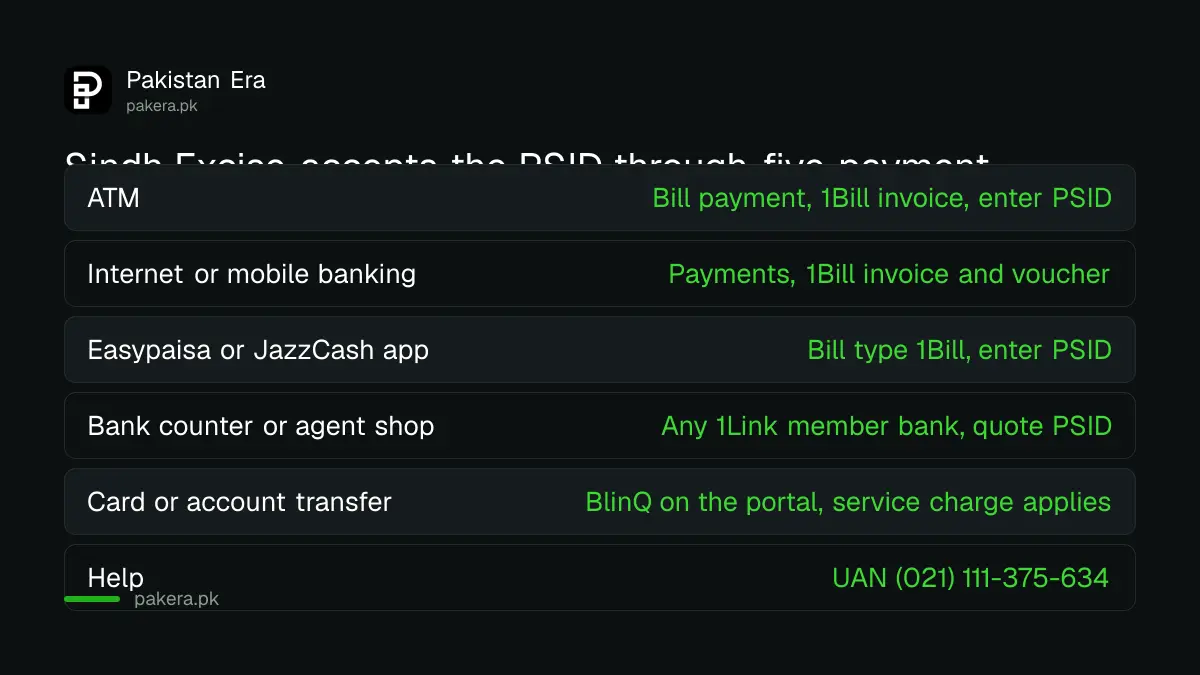
| Channel | Where to find it | Banks the portal names |
|---|---|---|
| ATM | Bill Payments, then 1Bill Invoice or Voucher, enter the 12 digit PSID | Habib Metro, Meezan, Askari, Summit, Bank Al Habib, Allied, UBL, JS, Bank of Punjab, Bank of Khyber and others |
| Internet or mobile banking | Payments, then 1Bill Invoice and Voucher | Dubai Islamic, Habib Metro, Meezan, Standard Chartered, Allied, Bank Al Habib, Askari, Summit and others |
| Easypaisa or JazzCash app | Bill type 1Bill Invoice or Voucher, enter the PSID | Both wallets |
| Over the counter | Any 1Link member bank branch or branchless agent shop, quote the PSID | NBP, Sindh Bank, Faysal, Silk, Al Baraka, First Women, Khushhali and others |
| BlinQ on the portal | Debit or credit card, Easypaisa and JazzCash, or account transfer | Any card |
Two details from the list are worth knowing. UBL appears for ATM only, and National Bank of Pakistan appears for mobile banking and counter payment but not ATM. If your usual channel is not listed for your bank, use the wallet route rather than guessing.
The department's page on motor vehicle tax still says tax is collected through 12 designated National Bank branches linked with Civic Centre Karachi. That is the counter route, and it still exists. The portal is the same tax paid without the branch.
Is there a Sindh Excise app?
Two, and they do different jobs. The tax portal's own FAQ names the payment app as epayment gos, on Android and iPhone, and says registration and payment work the same way in the app as on the portal.
The department's second app, listed on Google Play as an official app from Excise and Taxation Department Sindh, does vehicle verification and a tax calculator for new registrations, not payment. It was updated on 10 June 2026 and carries a 2.3 star rating from 2,110 reviews, which is a fair warning about reliability. The web portal did everything we needed, so start there and treat the apps as optional.
How much is the token tax in Sindh?
The department publishes some figures and leaves gaps, and the portal fills the gaps by calculating your own vehicle. The table below is what the motor vehicle tax page at excise.gos.pk actually states, read on 17 September 2026.
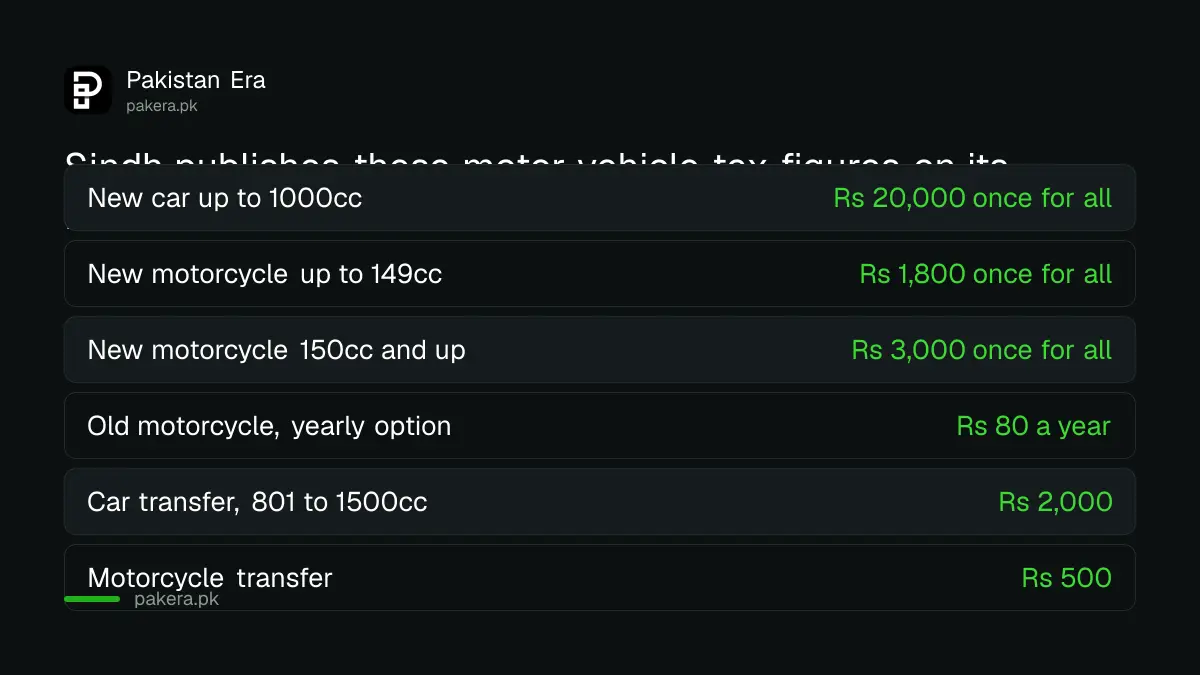
| Vehicle | Motor vehicle tax on the department's page |
|---|---|
| New car or jeep up to 1000cc, private | Rs 20,000 once for all |
| Registered car up to 1000cc, 3 to 5 years old, tax up to date | Rs 15,000 |
| New motorcycle or scooter up to 149cc | Rs 1,800 once for all |
| New motorcycle or scooter 150cc and above | Rs 3,000 once for all |
| Registered motorcycle under 5 years old | Rs 600 once for all, or Rs 80 a year |
| Registered motorcycle 5 to 10 years old | Rs 300 once for all, or Rs 80 a year |
| Registered motorcycle 10 to 15 years old | Rs 100 once for all, or Rs 80 a year |
The page stops there. It does not print an annual rate for cars above 1000cc, which is the question most owners have, so we are not printing one either. Several calculator sites quote a yearly scale by engine size. We could not find that scale on any department page, and a figure we did not read at source is not going in a table.
What the department does give away is the shape of the tax. Its four wheeler calculator asks you to pay tax up to one of three dates: 31 December 2026, 30 June 2027 or 31 December 2099. The first two are half year periods. The third is the once for all option, which the page calls Life Time Tax for cars up to 1000cc. So for a small car the choice is a single payment or nothing, and for a motorcycle it is a small once for all sum or Rs 80 a year.
The calculator also asks for your FBR taxpayer status. Sindh's fee schedule does not spell out the difference on its tax page, but the field exists for a reason, and checking your filer status with one SMS before you generate a PSID costs nothing.
Registration and transfer fees are separate from token tax and are fully published: 1 per cent of the vehicle's value to register a car up to 1000cc, rising to 5 per cent above 2500cc, and transfer fees from Rs 500 for a motorcycle to Rs 7,000 for a car above 3000cc. A late transfer has its own penalty schedule in Sindh, and late registration of a new vehicle now costs Rs 10,000 after 30 days and Rs 200,000 after 180, on rates the page dates from 13 February 2025.
When is Sindh vehicle tax due, and what is the penalty?
The department's page does not state a due date or a late surcharge for token tax, and we looked for both. The calculator's half year periods end on 30 June and 31 December, and news coverage each year treats 30 June as the last date to pay without penalty. That is reported, not read on the department's page.
Punjab is different and clearer. It publishes a standing 10 per cent rebate for paying the whole year by 31 August, which is set out in the Punjab token tax rate schedule. Sindh publishes no rebate.
The penalty Sindh has chosen instead is administrative. Rather than a surcharge, the department is moving on the registration itself.
What happens to vehicles with unpaid token tax in Sindh?
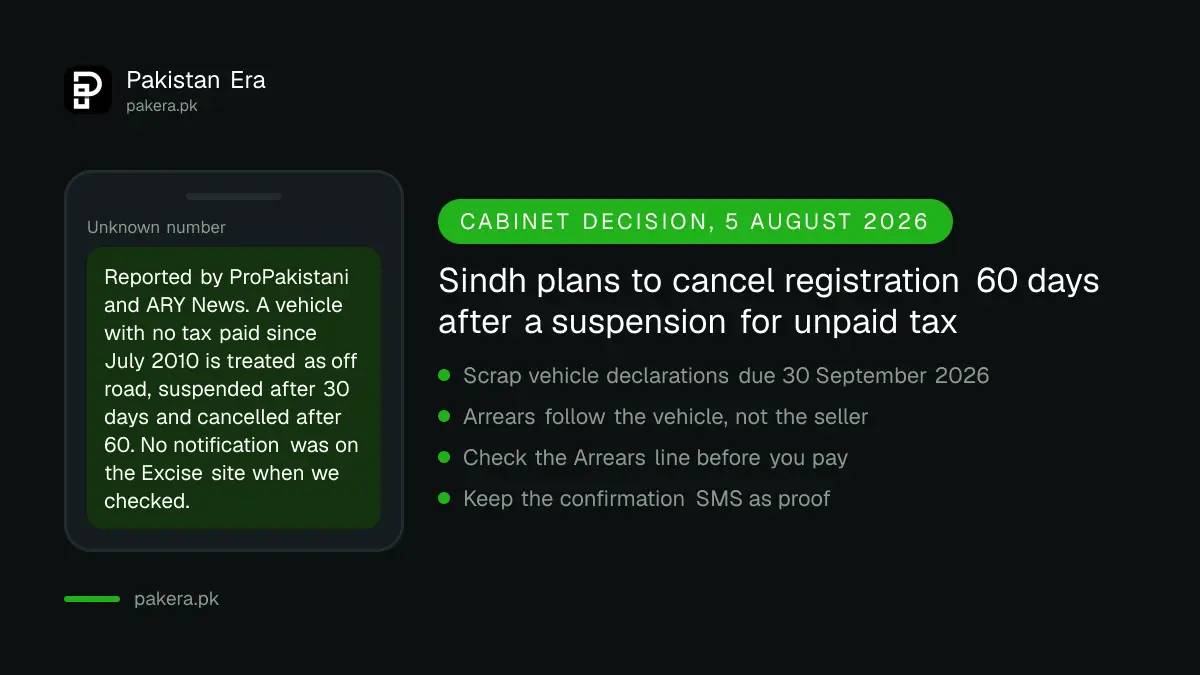
On 5 August 2026 the Sindh Cabinet, chaired by Chief Minister Murad Ali Shah, approved a set of vehicle registration reforms. ProPakistani and ARY News reported the same terms:
- A vehicle with no tax paid and no declaration filed since July 2010 is treated as off road.
- Its registration is suspended after 30 days, and cancelled after 60 days if the dues are still unpaid.
- Owners of destroyed, scrapped or permanently unusable vehicles must file a declaration by 30 September 2026.
- Licensed dealers may hold unregistered stock for six months, with two three month extensions, at a Rs 100 reporting fee per vehicle.
- Third party insurance, made mandatory in Sindh in March 2026, stays valid until expiry after a transfer.
All of that is a cabinet decision as reported. When we checked the department's notifications page on 17 September 2026, its latest entry was dated 9 April 2026 and nothing about suspension or cancellation had been published. A cabinet approval and a notified rule are different stages, and the second has not appeared yet. We covered the decision the day it was made in the Sindh cancellation report, and the advice has not changed: clear the arrears before the rule catches up with the announcement.
A cancelled registration is a different problem from a fine. The car cannot be transferred, a buyer's verification check will show it, and restoring the record means dealing with the department in person. Paying a PSID is an evening's work by comparison.
Token tax is also not the only thing attached to a plate in Karachi. An unpaid Karachi e-challan sits on the same record and surfaces at the same moments, so check both before a sale.
Common questions about online vehicle tax payment in Sindh
Can I pay Sindh token tax online without visiting the Excise office?
Yes. Quick Pay on taxportal.excise.gos.pk generates a 12 digit PSID that you pay at an ATM, through a bank app, in Easypaisa or JazzCash, or by card through BlinQ.
How do I check my vehicle tax in Sindh by registration number?
Enter the registration number, vehicle type and your mobile number on Quick Pay and press Calculate Amount. The page shows Arrears and Current Tax before you generate anything.
How long is the Sindh Excise PSID valid?
24 hours, according to the portal's FAQ. If you make more than one for the same vehicle, only the latest one works.
Which banks accept the Sindh vehicle tax PSID?
The portal lists 28 banks on the 1Link network through 1Bill, including Habib Metro, Meezan, Allied, UBL, Askari, Bank Al Habib, Standard Chartered, JS, NBP and Sindh Bank, plus Easypaisa and JazzCash.
What is the last date to pay token tax in Sindh?
The department's page does not state one. Its calculator runs in half year periods ending 30 June and 31 December, and 30 June is widely reported as the last date, so treat that as the safe deadline.
Will Sindh really cancel my registration for unpaid tax?
The cabinet approved it on 5 August 2026, with suspension after 30 days and cancellation after 60 for vehicles unpaid since July 2010, as reported by ProPakistani and ARY News. No notification was on the department's site when we checked on 17 September 2026.
Is there a Sindh Excise helpline?
The tax portal gives UAN (021) 111-375-634, and the department's website header gives a 24 hour call centre on (021) 111 374 634. Both are the department's own numbers, printed on different pages.
How we verified this
What we checked, where we read it, and what we could not confirm.
Last checked 17 September 2026. We read the Sindh Excise, Taxation and Narcotics Control Department's motor vehicle tax page at excise.gos.pk, which gave the governing law, the registration and transfer fee schedules, the motor vehicle tax figures for motorcycles and for cars up to 1000cc, the luxury tax, the late registration penalties dated 13 February 2025 and the 12 National Bank branches; the tax portal's Quick Pay page at taxportal.excise.gos.pk, which gave the form fields, the Arrears and Current Tax display, the Generate PSID step, the service charge line with no amount, the courier option, the 1Bill bank list headed 29 and listing 28, the BlinQ options and the UAN (021) 111-375-634; the portal's FAQ, which gave the app name epayment gos, the 12 digit PSID and its 24 hour validity; the department's vehicle search pages and its four wheeler calculator with its pay up to dates of 31 December 2026, 30 June 2027 and 31 December 2099; the Google Play listing of the department's verification and calculator app, updated 10 June 2026 and rated 2.3 from 2,110 reviews; and the department's notifications page, whose latest entry was dated 9 April 2026. The cabinet decision of 5 August 2026 on suspension and cancellation of registration, the July 2010 cut off, the 30 September 2026 declaration deadline, the dealer holding rules and the insurance change are reported by ProPakistani and ARY News on 5 August 2026 and had not been notified on the department's site when we checked. The 30 June last date is reported by PakWheels and APP and is not stated on the department's page. We did not print an annual token tax scale for cars above 1000cc, because the department's page does not publish one and the figures on calculator sites carry no source. We did not submit a live registration number, so the arrears display is described from the form rather than from a result. Fees, deadlines and portals change, and the department's pages are the final word.
About the author

Tax, Bills and Technology Writer
Ali Akhtar is a young and curious voice here at Pakistan Era. He is currently pursuing his A-Levels and has a growing interest in Pakistan’s changing industrial landscape and educational trends. Ali likes to write in a way that helps him explain and explore the world around him. His writing reflects the perspective of the new generation navigating the evolving trends of Pakistan where technology, youth innovation, and shifting opportunities are reshaping the country’s future.