Solar Output in Winter in Pakistan: Units per kW in December by City
Solar panels in Pakistan make about half their summer units in December: 82 per kW in Lahore, 86 Islamabad, 107 Karachi. Check yours and get more in winter.

In December, 1 kW of solar panels in Pakistan makes about 75 to 113 units in the month: about 82 in Lahore, 86 in Islamabad, 95 in Peshawar, 107 in Karachi and 113 in Quetta. That is roughly half of the best summer month in Punjab and two-thirds in Karachi. A 5 kW system in Lahore makes about 410 units in December.
So if your solar system made 750 units in May and about 400 now, it is probably working normally. The drop is the season, not a fault. These are our estimates from NASA's 25-year solar records for each city, for south-facing panels at a normal roof tilt, after 25% for losses.
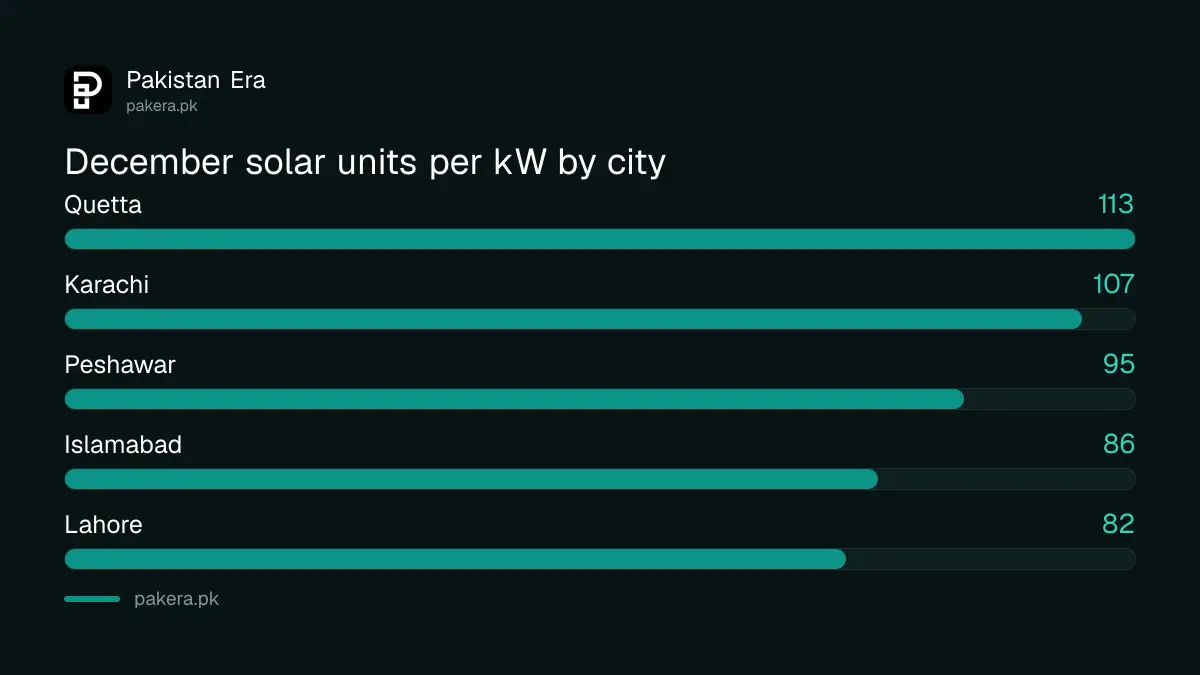
Expect about half your summer solar units in December in Punjab
In Lahore, Faisalabad, Multan and Islamabad, December output is about 48% to 55% of the best month. Karachi and Hyderabad hold up better, at about two-thirds, because they sit further south and get clearer winter skies.
| City | December units per kW | January units per kW | Best month units per kW | December as share of best |
|---|---|---|---|---|
| Quetta | 113 | 110 | 183 (June) | 60% |
| Karachi | 107 | 112 | 156 (May) | 68% |
| Hyderabad | 102 | 106 | 152 (May) | 67% |
| Peshawar | 95 | 94 | 169 (May) | 55% |
| Islamabad | 86 | 86 | 158 (May) | 54% |
| Multan | 84 | 84 | 153 (May) | 55% |
| Lahore | 82 | 80 | 158 (May) | 52% |
| Faisalabad | 75 | 73 | 156 (May) | 48% |
To get your own expected figure, multiply your system size in kW by your city's number. A 3 kW system in Islamabad: 3 x 86 = about 258 units in December. A 10 kW system in Karachi: about 1,070 units.
Shorter days, a low sun and fog cut winter output
Winter days are shorter, the sun stays lower in the sky, and fog and smog block light across Punjab and parts of Khyber Pakhtunkhwa. Each of these cuts output. Cold weather helps a little, because panels work better when they are cool.
- Short days. The panels get fewer hours of useful sun.
- Low sun. Sunlight hits a flat or gently tilted panel at a slant, so less of it lands on each square metre.
- Fog and smog. The averages above already include normal fog years. A day of thick fog can make far less than the average, and a clear day more.
- Long shadows. A water tank or a wall that never shaded the panels in June can shade them for hours in December.
- Cool panels. NASA's records put Lahore's average December air temperature at about 15 degrees C, against about 37 in June. Cool panels lose less to heat.

Check whether your winter output is normal in four steps
Read your December units from the inverter app or display, divide by your system size in kW, and compare with your city's figure. If you get at least 80% of it on a month with normal weather, the system is working.
- Open your inverter's app or screen and note the units (kWh) made in the last 30 days.
- Divide by your system size in kW. For a 5 kW system that made 380 units, the answer is 76.
- Compare with the December figure for your city in the table. Lahore is 82, so 76 is 93% of it.
- If you are below 80% after a mostly clear month, look for shade, dirt or a fault, using the fixes below.
Do not judge by one foggy week. Compare a full month, and compare December with last December if your app keeps history.
Clean the panels and steepen the tilt to get more winter units
The two cheapest ways to raise winter output are clean panels and a steeper angle. Smog leaves a film of dust, and a panel tilted at about 50 degrees catches the low winter sun far better than a flat one.
On our NASA figures, moving a south-facing panel from a normal roof tilt to the best December angle adds about 15% in Faisalabad, 18% in Lahore, 20% in Islamabad, 22% in Karachi, 25% in Peshawar and 29% in Quetta for that month. The best December angle is about 48 to 52 degrees in Karachi, Lahore and Multan and about 55 to 59 degrees in Islamabad, Peshawar and Quetta. Only adjust a frame that is designed to move, and fix it firmly afterwards; loose panels are dangerous in winter storms, as the NDMA windstorm advice for rooftop panels explains.
Clean with plain water and a soft cloth or sponge, early in the morning or in the evening when the glass is cool. Never stand on the panels, and switch the system off at the isolator first if the maker's manual asks for it.
| Winter fix | What to do |
|---|---|
| Smog dust | Rinse with plain water whenever a film builds up, more often in heavy smog |
| Low angle | Steepen an adjustable frame to the winter angle from October to February |
| New shadows | Look at the roof at 10 am and 2 pm; move or trim what shades the panels |
| Inverter errors | Note the error code and call the installer under warranty |
Plan your winter bill around the lower solar units
Winter is when solar covers the smallest share of a bill. If you added electric heaters or a geyser, your use rises just as output falls, so the grid will supply more of your units until March.
A 1,000 watt heater run for 4 hours a day uses about 120 units a month, more than 1 kW of panels makes in any Punjab city in December. The running cost by slab is worked out in the electric heater cost per hour figures. On a net billing contract, your summer surplus is credited at the export rate, not the import rate, under the 2026 net billing rules, so it does not fully pay for winter imports.
If your net meter shows exported units that never appear as credit on the bill, that is a separate problem with its own complaint route, covered in the steps for a defective solar net meter and missing export credit.
Common questions
Why is my solar producing less in winter in Pakistan?
Shorter days, a low sun angle, fog and smog. In Punjab, December output is about half of May even when the system works perfectly.
How many units does a 5 kW solar system make in winter?
About 410 units in December in Lahore, 430 in Islamabad, 475 in Peshawar, 535 in Karachi and 565 in Quetta.
How many units does 1 kW of solar make a day in December?
About 2.4 to 3.7 units a day across the main cities: about 2.6 in Lahore, 2.8 in Islamabad, 3.5 in Karachi and 3.7 in Quetta.
Does fog stop solar panels working?
Thick fog cuts output sharply for as long as it lasts, but panels still make some power from scattered light. Output recovers as soon as the fog lifts.
Should I change my solar panel angle in winter?
If your frame is adjustable, yes. A steeper winter angle of about 48 to 59 degrees, depending on the city, adds about 15% to 29% in December.
Is low winter output covered by the warranty?
No. A seasonal drop is normal. Warranties cover faults, such as a dead panel, broken glass or a failed inverter, under the maker's own terms.
How we verified this
What we checked and where we read it.
On 24 November 2026 we downloaded monthly solar irradiance and air temperature climatology (January 2001 to December 2025) from the NASA POWER project for eight cities. December and monthly figures use irradiance on a south-facing panel tilted at latitude minus 15 degrees, a common roof tilt, multiplied by 0.75 for losses and by the days in the month; that loss factor is our assumption. The best-angle gains compare NASA's monthly optimal-angle figure with that same tilt. The net billing rules are NEPRA's Prosumer Regulations 2026, listed on the NEPRA legal page.
About the author

Tax, Bills and Technology Writer
Ali Akhtar is a young and curious voice here at Pakistan Era. He is currently pursuing his A-Levels and has a growing interest in Pakistan’s changing industrial landscape and educational trends. Ali likes to write in a way that helps him explain and explore the world around him. His writing reflects the perspective of the new generation navigating the evolving trends of Pakistan where technology, youth innovation, and shifting opportunities are reshaping the country’s future.