Sales Tax on Solar Panels in Pakistan: 10% in 2026-27, and What It Adds to Your System
Solar panels in Pakistan carry 10% sales tax under the Eighth Schedule, not 18%. What it adds to a home system, what inverters pay and how to check an invoice.
Solar panels in Pakistan carry 10% sales tax, not the standard 18%. The reduced rate sits at serial 90 of the Eighth Schedule to the Sales Tax Act 1990, added by the Finance Act 2025, and the Finance Act 2026 left it unchanged. It covers photovoltaic cells and the modules or panels made from them, whether imported or supplied locally.
So when a dealer quotes you a price for panels, 10% of the taxable value is sales tax. Inverters, batteries and mounting frames are not in that line. We read the Act as FBR has published it, updated up to 30 June 2026 with the Finance Act 2026 changes, to set out what the 10% covers and what it does not.
The 10% rate covers cells, modules and panels
Serial 90 of the Eighth Schedule lists photovoltaic cells, whether or not assembled in modules or made up into panels, under tariff headings 8541.4200 and 8541.4300, at 10%. That is the solar panel itself, mono or bifacial, from any brand.
Section 3(2)(aa) of the Act says goods in the Eighth Schedule are charged at the rates set there. Section 3(1) sets 18% for everything else. The 10% applies to the value of the supply, and on imports to the value at the import stage.
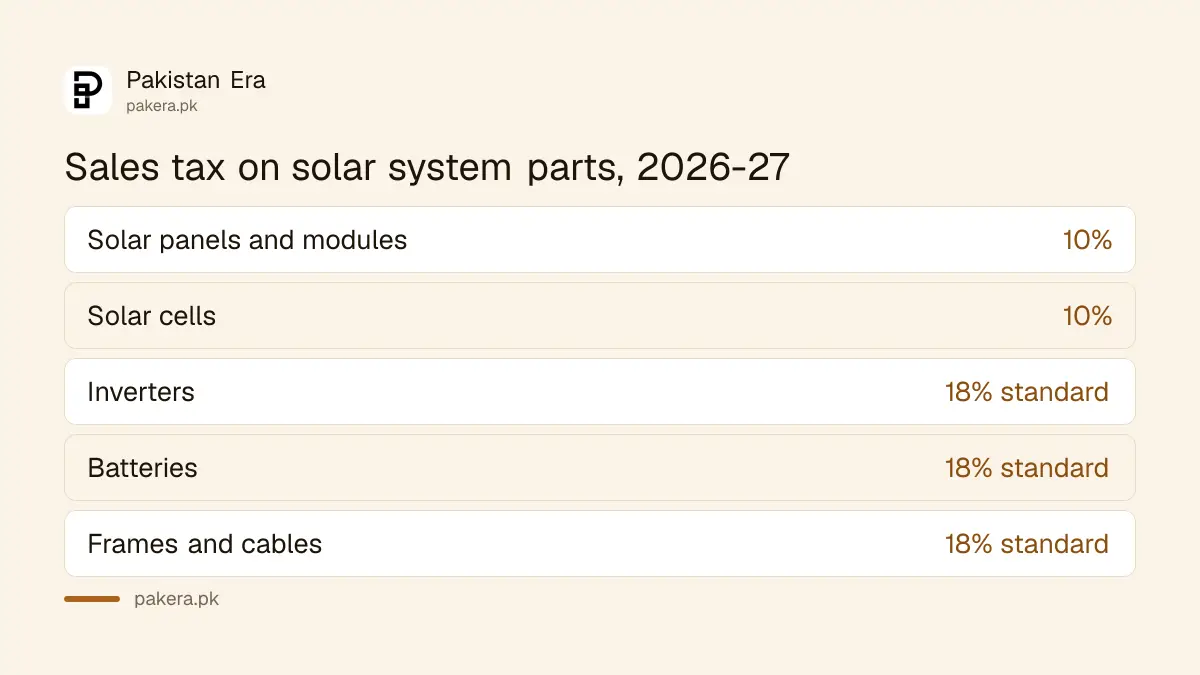
| Item in a solar system | Sales tax line | Rate |
|---|---|---|
| Solar panels and modules (8541.4300) | Eighth Schedule, serial 90 | 10% |
| Solar cells not yet in modules (8541.4200) | Eighth Schedule, serial 90 | 10% |
| Inverters | No reduced line in the Act | 18% standard, unless an SRO says otherwise |
| Batteries | No reduced line in the Act | 18% standard, unless an SRO says otherwise |
| Frames, cables, breakers | No reduced line in the Act | 18% standard, unless an SRO says otherwise |
What 10% adds to a home solar system
On panels worth Rs 500,000 before tax, 10% sales tax adds Rs 50,000. At the standard 18% it would have been Rs 90,000. The saving is on the panels only, so the other parts of the system still decide much of the final tax bill.
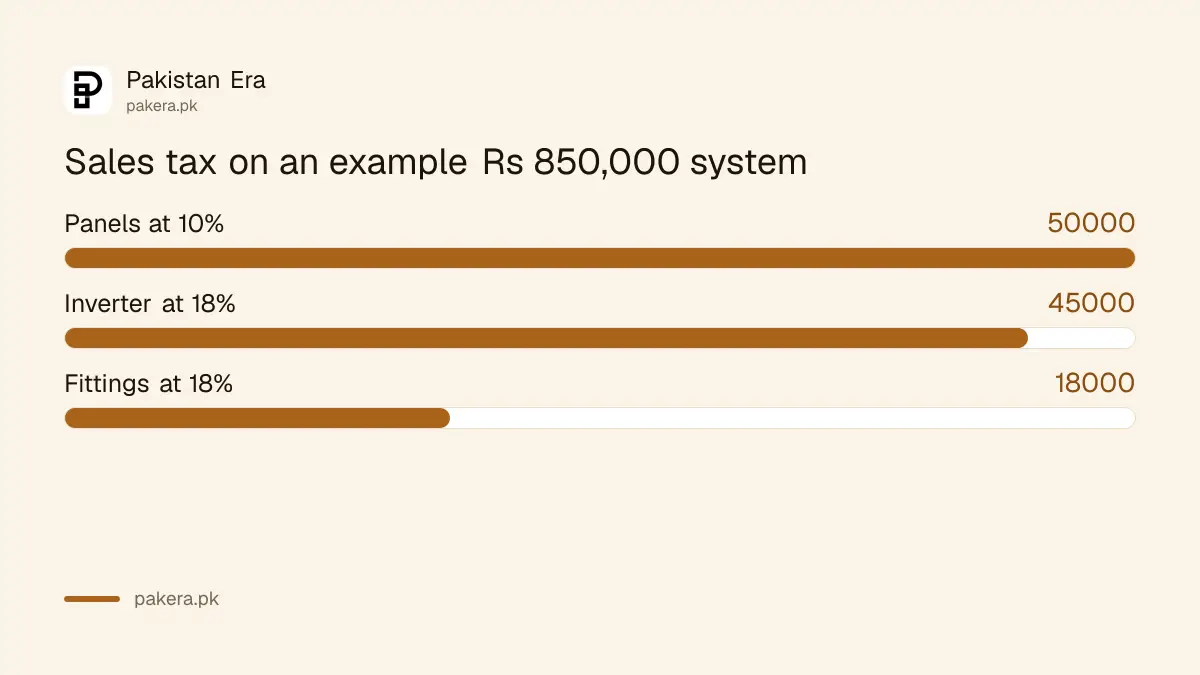
Here is how the tax splits on an example system. The prices are our round figures for illustration, not market quotes.
- Panels, Rs 500,000 before tax: 10% sales tax is Rs 50,000.
- Inverter, Rs 250,000 before tax: 18% sales tax is Rs 45,000.
- Frames, cables and fittings, Rs 100,000 before tax: 18% sales tax is Rs 18,000.
- Total sales tax on the example: Rs 113,000 on Rs 850,000 of equipment.
Installation labour is a service. It falls under provincial sales tax on services, at the rate your province sets for that kind of work, not under the federal Sales Tax Act.
When the 10% rate came in
The footnote to serial 90 says the entry was added through the Finance Act 2025, which took effect on 1 July 2025. The consolidated Act updated up to 30 June 2026 carries the Finance Act 2026 changes elsewhere, and serial 90 still reads 10%.
So for the 2026-27 tax year, the 10% rate on panels continues. Any later change would need an amendment to the Eighth Schedule, either by a Finance Act or by a notification that FBR publishes.
Check your solar invoice before you pay
A registered dealer must give a sales tax invoice that shows the tax charged. Check that the panels are taxed at 10% and the other items at their own rate. A dealer who charges 18% on panels, or adds tax without an invoice, is not following the schedule.
- Ask for a quotation that lists panels, inverter, batteries and fittings on separate lines.
- Check that the panel line shows 10% sales tax.
- Ask for the dealer's NTN or STRN and run an ATL sales tax check on it.
- Check the panels are genuine before you pay, using the steps to check if a Longi or Jinko panel is original.
- Keep the invoice. You need it for warranty claims and for the net metering file.
If you plan to sell units back to the grid, the distribution company asks for equipment details. The net metering documents checklist shows what goes in the file, and a stuck application can go to NEPRA through a net metering complaint.
Common questions
What is the sales tax on solar panels in Pakistan?
10%, under serial 90 of the Eighth Schedule to the Sales Tax Act 1990, for photovoltaic cells, modules and panels.
Is the solar panel sales tax still 10% in 2026-27?
Yes. The Act as updated up to 30 June 2026, with the Finance Act 2026 changes, still shows 10% at serial 90.
Is there sales tax on solar inverters?
Inverters are not in the 10% line. Without another reduced entry or an SRO, they are taxed at the standard 18%.
When did sales tax on solar panels start?
The 10% entry was added through the Finance Act 2025, which took effect on 1 July 2025.
Does the 10% apply to imported panels?
Yes. Section 3 charges sales tax on goods imported into Pakistan as well as on local supplies, and serial 90 has no condition limiting it to one of them.
Is solar installation taxed at 10%?
No. Installation is a service, taxed under provincial sales tax on services, not under the federal Eighth Schedule.
How we verified this
What we checked and where we read it.
Last checked 15 November 2026. The 10% rate comes from serial 90 of the Eighth Schedule, and the 18% standard rate from section 3(1), of the Sales Tax Act 1990 as updated up to 30 June 2026, published by FBR. Footnote 1029 records that serials 89 and 90 were added through the Finance Act 2025. Example system prices are our own round figures, used only to show the arithmetic.
About the author

Tax, Bills and Technology Writer
Ali Akhtar is a young and curious voice here at Pakistan Era. He is currently pursuing his A-Levels and has a growing interest in Pakistan’s changing industrial landscape and educational trends. Ali likes to write in a way that helps him explain and explore the world around him. His writing reflects the perspective of the new generation navigating the evolving trends of Pakistan where technology, youth innovation, and shifting opportunities are reshaping the country’s future.